
I’ve spent a lot of space on this blog over the last year complaining about movies that are just too long. This is mostly because the guilty filmmakers don’t use the extra time properly. I don’t hate long movies in general. I believe a creator should take all the time that is necessary to tell their story. The problem that has cropped up far too often this year is that directors and producers more often than not don’t seem to know when to end them, opting to pile on with imagery and symbolism rather than getting to the bloody point. This flaw has persisted so much in 2023 that I’ve gotten a bit gun shy going to see certain films, because I need to formulate an entire strategy around how I’m going to get past any kind of drawn-out nonsense, to say nothing of the fact that at one of my local AMCs, we only get three free hours of parking (with validation), so that any show that’s two and a half hours long basically means I have to shell out an additional five-to-ten dollars because heaven forbid AMC only show 20 minutes of trailers, commercials, and Nicole Kidman bullshit before starting the fucking flick.
There are a couple of projects that have bucked this trend in surprising ways. For example, part of the reason I love Oppenheimer so much is because Christopher Nolan detonated the atomic bomb at the two-hour mark, but still found a way to keep the audience’s attention for a whole other hour afterward. He knew he had compelling content, and that the story of J. Robert Oppenheimer didn’t end with those infamous blasts, so he made sure to tell it in a way that was satisfying. Similarly, with Killers of the Flower Moon, Martin Scorsese did so much research and had so much consultation and collaboration with the Osage people that he complete rewrote the script to make sure everything got told the right way, no matter how long it took. It can be done.
Contrast that with Napoleon, which was a confused and often boring two and a half hours, and for some reason Ridley Scott has a four-hour cut he’s planning to release on Apple. We also have Rebel Moon from Zack Snyder, which has already bombed with critics to an insane degree, and yet he’s hamstringing Netflix with another “Snyder Cut,” topping out at over three hours despite the 135 minutes of the current cut being nigh-unwatchable.
It is this unfortunate trend that dominates tonight’s grouping of International Feature submissions. All three of the films I’m going to discuss below could have been great, but they all fell into the same trap (with one falling into several more which ultimately doom it). For whatever other qualities and faults they have, each is held back by the fact that their directors seemingly forgot those age-old truisms that brevity is the soul of wit and that you should always quite while you’re ahead. Any could still hear their name called on Thursday when the Academy announces the shortlist, but it’s unlikely they’d have gotten my vote had I been in on the full process. As ever, I’ll review them in order of viewing, with any release info I have at my disposal.
Pictures of Ghosts – Brazil – No Release Information Available

Of the three entries this evening, this is the one I’m most forgiving towards. This was the third foreign entry I saw of four on Day 2 of this year’s AFI Fest. Between the lack of sleep and the fact that my eyes were already tired from reading subtitles for several hours, I’m willing to concede that part of my eventual boredom could have been related to fatigue (I recorded a vlog of my experience, available here). But even if it wasn’t, there’s still more to like about this movie to outweigh the monotony than the others.
Directed by celebrated Brazilian filmmaker Kleber Mendonça Filho (director of the acclaimed Neighboring Sounds and Aquarius), this documentary is sort of a true-life version of Cinema Paradiso, chronicling Filho’s love of film and his hometown, which laid the foundation for his art.
The story is divided into multiple chapters, but the core is in two main sections. The first regards his family home in the coastal city of Recife. Growing up into a cinephile, Filho made dozens of homemade movies using all sorts of cameras and formats, from VHS and Betamax to MiniDV, likely shooting every inch of his house from multiple angles. For the purposes of this documentary, Filho spent seven years digitizing and up-resing hours of footage to show his formative experiences, learning different cinematic techniques and filming shorts with his friends and neighbors. There’s a particularly darling aside about a neighbor’s dog who loudly intruded on many a scene, to the point that its eventual death left an artistic hole in Filho’s heart.
The second major part deals with the larger industrial issues of the city, which at one point had several ornate movie palaces in a bustling local economy. Filho notes the mystique that each one had, including one where he developed a rapport with a projectionist who showed him the ropes of working in a theatre, similar to Alfredo’s mentorship of Salvatore in Paradiso. The wistful narration and images sadly give way to the present day, where this once vibrant section of Recife is now little more than shuttered businesses and slums.
If that was the entire film, I’d say it was a winner, mostly because it would be a short documentary. It would likely be clocking in at around the 40-minute limit, but it would be an enthralling 40 minutes worthy of the Oscar. Instead, Filho takes his reminiscence just a bit too far, dwelling for too long on these once great shrines to cinema, often going back and forth between several locations to the point where the audience can get dizzy and lost. He also ends the proceedings with a fictional sequence that just screams pretentiousness. I admire the painstaking lengths Filho went to in order to give us as complete a profile as possible, but it feels artificially inflated to stretch it to feature length. The movie itself is only 90 minutes, but it still came off as twice as long as it needed to be. Like I said, though, part of that might have been my own fading consciousness (I distinctly remember chowing down two hot dogs and guzzling a soda for a late caffeine boost afterwards before going into Tiger Stripes to end that day’s quadruple feature), and I really did enjoy the vast majority of what I saw. And when you’re basically telling you’re own life story, anyone can be given a bit of grace for going just a touch overboard.
Grade: B
About Dry Grasses – Turkey – In Theatres February 23
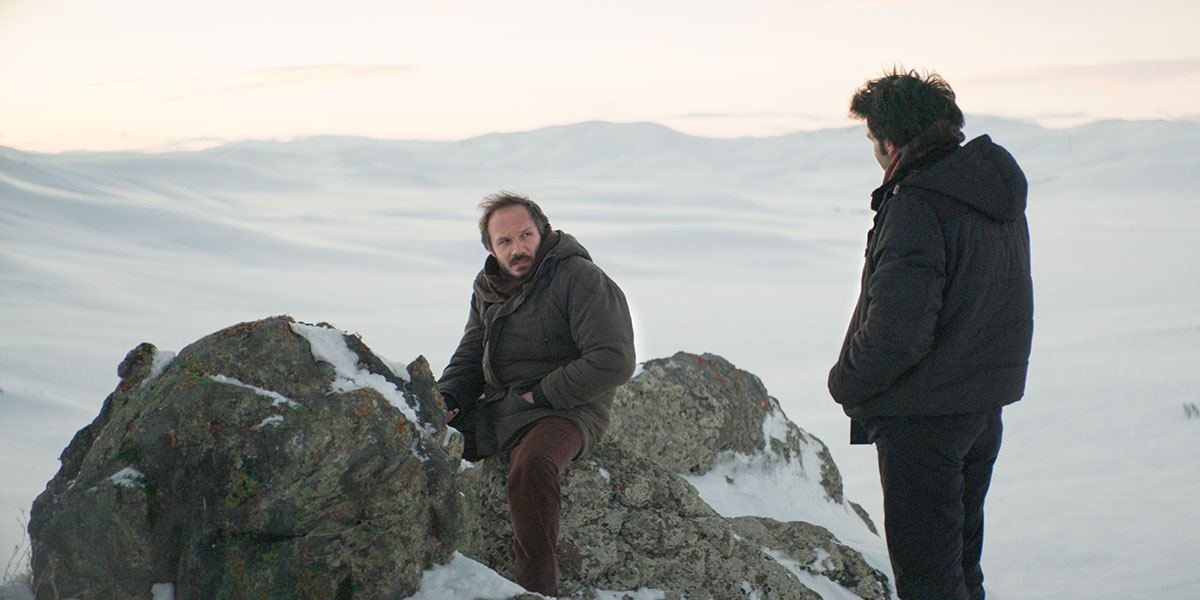
This was the penultimate screening of my time at AFI Fest, and I was certainly running on fumes by this point. But even without the drowsiness, there is just no saving this film. There were a couple of entries at the festival that I actively despised. This was the worst of the bunch, and of the 32 International Feature contenders I’ve seen so far, it ranks dead last.
At first the story had some promise. Deniz Celiloğlu stars as Samet, a middle school art teacher in a remote village. It’s explained that he’s on assignment there but would rather be working in his hometown of Istanbul, but educators are sent where they’re needed due to staffing shortages for several years before they can transfer out. The film begins with Samet returning to the village after the holidays for the start of the winter term, his last semester before he can request reassignment. He lives in what is basically a two-room shack with another teacher, Kenan (Musab Ekici), who specializes in history. They have no real friendship, but are more than cordial with one another, and Samet is something of a popular figure in town, even with those who have diametrically-opposed viewpoints (a military commander and a rabblerousing anti-establishment protestor, for example). He’s even well liked among the students of his school, particularly Sevim (Ece Bağcı), who’s a bit of a know-it-all, but Samet admires her initiative and ability to think beyond the limitations of her small town existence. He dotes on her constantly, hoping to encourage her to get out and see the world as soon as she gets the chance.
So far, so good, honestly. The performances are well-done, the cinematography of the windswept snowscapes of eastern Turkey are gorgeous to behold, and Samet’s situation is one that resonates with a lot of viewers, myself included. I got so many flashbacks to my high school days in upstate NY, particularly the harsh winters, as well as my young adult years where I yearned for the time that I could move out west to a warmer climate and pursue my true ambitions. This has the makings of a relatable story about what someone has versus what they want, and learning to see the value in what they contribute, even if it isn’t the situation they idealized.
But then things go very south very fast. Similar to The Teachers’ Lounge, there’s a surprise inspection of Samet’s classroom, one he did not authorize or condone. As backpacks are turned out and contents dumped all over the place (one of the conservative administrators decided that THIS was the day they’d enforce their “no makeup” rule for the girls), it is discovered that Sevim has written a love letter to someone. The note is confiscated, along with a makeup compact that Samet himself gave her, and Sevim is left quite embarrassed. Feeling sorry for her, Samet gets the compact back, as well as the letter, but only after several other staff members have read it and mocked her in private for it. It’s never explicitly stated who the letter was written to, but based on the reactions and body language of the faculty, there’s an implication that maybe it was meant for Samet. He calls Sevim to his office and returns the compact, telling her not to worry and that she’s not in trouble. When Sevim asks to have the letter back as well, he lies and says he destroyed it without reading it, which also lends credence to the idea that he was the subject of it, to say nothing of the fact that Samet then reassures Sevim that it’s natural to have crushes, and that he once pined for one of his teachers. Sevim doesn’t quite buy the story, and when she asks again, Samet insists that it’s gone.
A few days later, the hammer drops on Samet and Kenan hard. They’re summoned to district headquarters, as the principal has sent a complaint about them up the chain. Two girls at the school have accused them of inappropriate touching. The higher-ups have determined that the principal overreacted by not even investigating the claims himself before advancing them, especially because after a very brief examination, they’ve figured out that the allegations are unfounded. Despite being warned not to attempt to suss out who filed the complaints, that’s exactly what Samet and Kenan do, finding out that Sevim was one of the pair.
At this point, my interest has waned, mostly because we’ve already seen this story in a much better foreign entry from a decade ago, Denmark’s The Hunt. In that film, Mads Mikkelsen played a kindergarten teacher who gently rebuffed the love messages of one of his students, so she lied and said he molested her, turning him into an instant pariah and threatening both his career and his life. The hysteria that arose from the lies of a child who didn’t have any better way to express her frustration made for one of the best thrillers I saw that year, and it rightfully turned Mikkelsen into a global sensation.
But even worse than the thematic repetition is the direction this film goes. Rather than keep his head down and let things blow over, especially knowing that Sevim can be a little vindictive (in an early scene, she openly wishes for Kenan to get sacked simply because she finds him boring), he decides to retaliate in utterly cruel fashion, signaling her out in class, berating her, throwing chalk at her, and even tossing her out of the classroom. He then turns his ire on the rest of the class, venting all of his provincial frustrations at them and turning his class into a dictatorship. He was once considered the “cool” teacher because he let the kids express themselves and draw whatever they wanted. Now he yells at them, orders them to draw what they’re assigned, and flat out tells them that they’ll never amount to anything anyway, so why bother?
If this was all there was to this film, I could tolerate it even if I didn’t agree with it. There’s something to be said for a story about a man self-destructing right as he’s about to achieve his goals. It happened to the Hare, why not Samet? But no, not only does this tale spiral into some borderline abusive behavior in completely ill-advised ways, director Nuri Bilge Ceylan (this is incredibly his sixth film to be submitted by Turkey, with 2008’s Three Monkeys making the shortlist) opts to bloat things out even further with a completely separate, feature-length B-story about a love triangle between Samet, Kenan, and a woman named Nuray (Merve Dizdar, who amazingly won Best Actress at Cannes for this performance), an English teacher and disabled veteran working in a neighboring village.
Oh yeah, as if jeopardizing his exit via overt bullying wasn’t enough, now we have to introduce the temptation of romance into Samet’s life to make him consider staying after all, if it means he can be with Nuray. Again, there’s something there, but the opportunity is squandered with go-nowhere plot beats and stilted dialogue filled to the brim with circular rhetorical questions. There’s a scene where Samet goes to dinner at Nuray’s house. He was supposed to invite Kenan as well, but he intentionally withheld the information to get some alone time with her. Okay, dick move, but not unheard of. So, do we get sexy time? Kind of, but only after a solid 20 minutes of mind-numbing philosophical “debate” between the two, with all of the lines being a self-perpetuating back-and-forth of nothing. “Do you think I’m stupid?” “Define stupid.” “What do you think it means?” “What does anything mean?” SHUT UP AND FUCK ALREADY! God, I’ve seen nuns engage in more believable foreplay.
It’s one thing to feel like you’re stuck in a rut, with little prospects of change while you’re in a dead-end job. Millions of us have experienced it. But it’s rare when a filmmaker apparently thinks it’s a good idea to trap his audience in that same doldrum for three goddamn hours! By the time the snows melt and the term finally ends, I felt like I deserved some sort of graduation present for enduring it all, especially because the whole film is sound and fury signifying nothing. No lessons are learned, no real resolutions are had, no status quo has been interrupted. Everything just proceeds as it normally would, as if nothing had transpired in the preceding 200 minutes. I’ve been in a few lectures that seemed to go on forever, but I at least came out of them with some additional knowledge and information. This felt like existing intelligence was being actively siphoned out of my brain.
Grade: D
Rojek – Canada – No Release Information Available

Finally tonight, we end on an important documentary from Canada that I saw in a private screening thanks to my Film Independent membership. This was the first time I’d ever experienced something like this, and it was intriguing. Also, I had to prevent myself from fanboying just a bit, because the movie was introduced by Denis Villeneuve, who then came to the back row and sat next to me. It was everything I could do not to ask him all the questions.
As for the film itself, Rojek (Kurdish for “one day”) is the fourth film from Turkish-Canadian director Zaynê Akyol. A quasi follow-up to her successful work, Gulîstan, Land of Roses, which focused on all-female regiments of Kurdish fighters against ISIS, this project combines those soldiers’ ongoing efforts to deter terrorism and rebuild the Rojava region with testimonials from captured ISIS fighters, hoping to get an insight into the mindset of someone who has been radicalized.
The premise is absolutely brilliant, as the caliphate believes in an extreme fundamentalist interpretation of Islam, including curtailing almost all civil rights for women, so to see these contrasting shots of imprisoned men and assertive work by groups of women is profound and inspiring to say the least. It also can’t be understated just how eye-popping the cinematography is, as drone cameras capture large swaths of literal scorched earth alongside makeshift military camps, hospitals, and humanitarian infrastructure.
We also get some truly devastating sound bites from the prisoners, all of whom agreed to be interviewed by a woman as a condition for appearing in the film and getting their message out. You can see the hostility in a lot of their faces, some giving very curt responses, others trying to appeal to some sense of compassion to understand why they’re right in what they believe, even if it would mean someone like Akyol could never do the work she does. The most memorable statement comes from one fighter who appears to admit his guilt before quickly turning his remorse into a violent threat. He says that he broke the law and should be punished. He’s okay with that. However, by imprisoning him, he believes that those who locked him up are punishing his wife and children, who have done nothing wrong. In that sense, he tells the camera, it makes him even more radical, and inspires him to do even more damage should he ever get out. That’s fucking scary, y’all, and by far the most damning moment of the entire movie.
The problem is the length of time and the repetition of scenes to get to that point. The entire picture goes in a continuous cycle. We’re shown a scene of the women Kurdish fighters engaging in some sort of training activity or humanitarian effort, often visually contrasted with the sheer amount of devastation that has been caused in the region as a result of ISIS and the Syrian Civil War. After a few minutes, we go to a jail and listen to one of the captured ISIS members talk about their feelings and their situation. Rinse and repeat.
This goes on for almost two and a half hours. We got the point after 30 minutes. I feel like this has a little more justification as a feature than Pictures of Ghosts, but even then it should have topped out at about 85 minutes. Because the outdoor sequences are often shot on drones with little natural sound, opting in many cases to rely on the orchestral soundtrack, the viewer is lulled into something of a fugue state, finding it increasingly harder to register or retain the information being presented, highly important though it is. The reason I remember that one fighter’s threat so vividly is because it snapped me out of a stupor that I had been in for the previous half hour. After so many laps of the same track, suddenly here’s a guy saying that it’s okay to punish him, but imprisoning him means he’ll kill again. Wait, what now? Did I hear that right? Holy shit, I did!
There’s a lot of this film that just didn’t stick, but I will remember that for quite a long time to come. The fact that such crucial content comes in the form of a jarring escalation of the rhetoric rather than the crescendo of a much tighter and efficient examination of a modern atrocity is ultimately why Rojek falls short for me.
Grade: B-
***
Believe it or not, folks, we’re almost done! I have a full review coming tomorrow for one film in particular, and then one last group post to round out the pre-shortlist proceedings. And even once we get the news, I still won’t be done, as I have normal coverage to resume, as well as several festival entries that are finally getting released theatrically in these last three weeks of 2023. And of course, despite seeing more than a third of the submissions, I’m all but certain there will be a couple on the shortlist that I haven’t tracked down yet, so I’ll be mad dashing to see them as well!
Join the conversation in the comments below! Have you been able to see any of these films? Which ones sound the most intriguing to you? What do your home movies say about your life now? Let me know! And remember, you can follow me on Twitter (fuck “X”) and YouTube for even more content!

 I Actually Paid To See This
3 thoughts on “Back Row Thoughts – The Long Shots”