
Over 150 films were deemed eligible by the Academy to compete for the Oscar for Documentary Feature. Last week, more than 90% of the field was eliminated, whittling the contest down to 15 semifinalists. I had already seen a few of the candidates, and since the announcement, I’ve ticked a few more off in my annual quest to view the entire shortlist. As of this writing, I’m about halfway through the set, having viewed seven so far, and I have definitive access points for five the remaining eight, with three still in the process of tracking down.
That said, I was curious about a few films I saw during the course of the year that didn’t make the first cut. One of which, The Mission, I’ve already critiqued in this space. Still, there are two others that I haven’t had the chance to talk about yet, so I might as well share them with you now that both are in theatres, because if you’re of a mind to see them, they are worth the time despite them being out of the competition. This also finally clears my backlog of potentially embargoed festival material, so that for the rest of Awards Season, I can go forward with stuff that I’m seeing in the moment.
Occupied City
I remember the first time I ever got to see screenings of the Oscar-nominated short film categories. It was back in the winter of 2014, a few months before I moved to Los Angeles. I was living in Connecticut at the time (working for ESPN), and so options were slim in trying to do what became the Oscar Blitz. Hell, three years before that, when my goal was just to see all the Best Picture nominees, I had to drive to Massachusetts just to see 127 Hours, because no theatre in CT was showing it. For the shorts in 2014, I saw the Animation category in a small indie house in New Haven (about a 45-minute drive), missed out on the Documentaries (they were at the same theatre, but closed the day before I went down), and the Live Action field was literally in an art gallery’s warehouse in a tucked away section of Hartford. I don’t even remember the name of the place, though they were also the only location in the state that I know screened The Great Beauty, which won for International Feature that same year.
Anyway, back then, the screeners were accompanied by interstitial content in between each nominee. For Animation, it was a cartoon giraffe and another animal I can’t recall wearing tuxedos and giving silly Hollywood shop talk as if they were actors on their break during a shooting day. It was cute enough. For Live Action Short, there were interviews with several prominent figures in the industry, including Steve McQueen, who would soon see 12 Years a Slave win Best Picture. He got his start in short films, and talked about how essential they are to developing filmmaking talent, so that professionals can move on to bigger and better projects, so long as they remember their roots.
His philosophy becomes somewhat self-fulfilling with Occupied City. This is the last of my festival fare, having seen this two months ago at AFI Fest. I just said that both films I’m discussing are worth the time commitment, but if you are so inclined, be forewarned that for this one, it is very much a long commitment. Standing at over four hours long, this is an epic journey, but one that amazingly keeps your attention for the bulk of the duration.
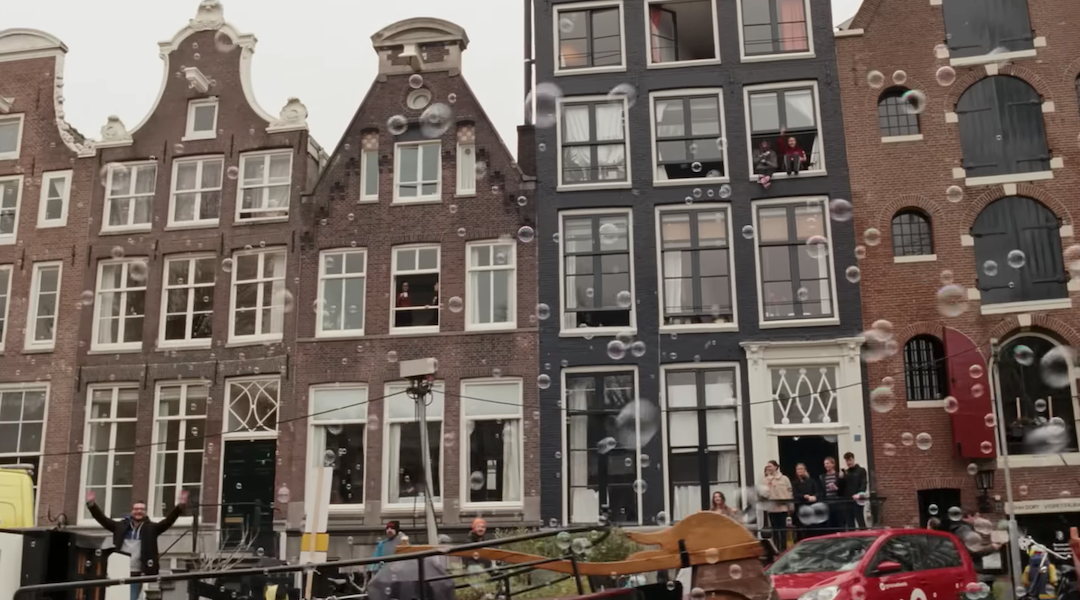
The film is an adaptation of the historical opus, Atlas of an Occupied City, Amsterdam 1940-1945, written by McQueen’s wife, Bianca Stigter. During the Second World War, the Nazis seized much of the Netherlands, including its capital, where it remained until the Third Reich was defeated and driven out by resistance forces in cooperation with Allied troops. Stigter’s book is a street-by-street, sometimes building-by-building chronicle of every address in Amsterdam that held any significance during the war operations during that five-year period. Narrated by Melanie Hyams (spare a thought for all the time she had to spend in a recording booth for this project), the basic idea is to show a location in present-day Amsterdam, discuss what its role was during the occupation, and then add a footnote as to whether it has been demolished or remains standing in its original form.
Contrasting this somewhat sterile presentation is a vérité-style observation of life in Amsterdam during the COVID pandemic. Over the course of the four hours, filmed over more than a year, we see how the initial outbreak of the virus affected the public, with weddings taking place over Zoom, people practicing social distancing and subsisting on food deliveries, and the shuttering of the city’s famed Red Light District. We’re also shown several protests from those who cared more about their convenience than the lives of others, refusing to wear masks and stay indoors while we were all trying to sort this out. One could even detect similarities to the former regime in scenes where these demonstrations had to be broken up by riot police with firehoses. The world was in chaos, and Amsterdam saw the good and bad just like we all did.
The order of addresses follows this to a point, with the first half of the film discussing how low things got for the Dutch during the occupation, supplemented with the panic of the largest global crisis since then. At about the halfway mark, when the first vaccines are distributed, things begin to turn around. Life starts returning to normal. We see a wedding outdoors on a lovely bridge, people dining in restaurants and buying groceries again, and the warmest reception possible for the reopening of the Red Light District. I never realized how much that area was a point of civic pride. Makes me love the Dutch even more than I already do. All of this is accompanied by stories of rebellion, secret meetings, and small victories against the SS, showing how resilient the people were back then – and still are today – when they come together in common cause for the greater good. Even the protests turn more positive, with much larger gatherings to combat corporate greed and climate change that require no government repression.
This is pretty inspirational, but I won’t pretend that it isn’t a slog at times. For example, there’s a sequence near the halfway point where the camera just rides along on a tram at night, with no natural sound, just an ambient piano score, and very slowly the shot turns upside down. We just observe this for at least five solid minutes, without any narration or context. The easy visual metaphor of a world gone topsy-turvy gets across after 15 seconds, so everything after that just seems tacked on. In a film so thorough (and even then, it’s only about 1/9 of the content available, as McQueen has stated there’s a 36-hour master cut that adapts every single entry from Stigter’s book), to have such a lengthy tangent that just further pads the runtime is exhausting.
The film took a lot out of me, but I’m still glad I saw it, because as we tiptoe ever closer to the return of fascism, it’s worth acknowledging that the vast majority of people today didn’t live through the last round, and thus don’t have a frame of reference or memory for just how many atrocities were committed and how it can feel like forever until you’re on the other side of it. It was released on Christmas Day, and it’s worth seeking out if you’re interested. Just pray there’s an intermission.
Grade: B+
Anselm

I’ve already discussed one of Wim Wenders’ efforts this year with Perfect Days, which did make the shortlist for International Feature, and frankly I think it’s one of the best films of the year full stop. However, Wenders also put out a documentary, of a type I’ve never seen before. Shot in 6K resolution and in 3D, Anselm isn’t so much a documentary as it is an interactive art exhibit.
Wenders has used 3D before, in his 2011 documentary, Pina, but I’ve never seen that one, so this was an entirely new experience for me. The idea of a 3D doc is something completely novel from where I sit, and it was enthralling to watch, especially because it was filmed for the format rather than optimized in post. Focusing on the life and work of German painter and sculptor Anselm Kiefer, the film is engrossing because of its near-perfect use of scale to supplement the visual profile.
I’ll give you an early example. The film begins with several shots of one of Kiefer’s displays, consisting of a bunch of wedding dresses on mannequins set inside a forest and a collapsed building. Each one has some sort of accoutrement that fits one of any number of themes about human suffering, oppression, and hope. Seeing all these dresses, your mind establishes the sense of scale of what you’re watching. Once this sequence is done, we cut to a warehouse where Kiefer works on and stores his projects. We see a painted canvas wheeled into the frame, followed by Kiefer pushing it. You expect to see Kiefer at the same regular height you did the dresses, because that’s the bar that’s been registered in your brain based on what you’ve seen. Instead, it turns out that this canvas is huge, at least 20 feet tall and probably 40 feet wide, dwarfing Kiefer as he pushes it onto a vertical stack of other similarly-sized paintings. That’s the grand scope that this man goes for, and it’s eye-popping to see just how far he goes for his craft.
This continues as we actually see him work. He has a team that dresses a wall in vines, and in quick succession has people douse them with lighter fluid, then he sets it on fire with a flamethrower torch, and just behind him, moving down the line from right to left, is another who sprays it with water to put it out, giving us a scorched drapery that sears its silhouette into the final piece. In another, he’s painting as normal, except that the size of the canvas would take up the same space as about 15 Renaissance frescoes, and his paint palette is a huge platter of blacks, whites, and greys that he slathers on the surface with a giant putty knife in lieu of a brush. He rides a bike around his own warehouse, as we see towering sculptures that would look like a child’s blocks if they were sized down. This is the type of massive work that is Kiefer’s stock in trade. I honestly started to wonder if this man ever goes home for how often he goes big.
The only drawback is the recreated scenes of his childhood and early career. Performed by Kiefer’s son Daniel and Wenders’ great-nephew Anton, the asides are endearing at times, but they feel artificial next to the immersive majesty of Kiefer’s output. And it’s not like Kiefer himself never takes the time to speak to the camera or take an interview, so the flashbacks are kind of superfluous. They’re not bad, per se, but they are a distraction from all the wonder we get to behold when we’re just watching Kiefer do his thing.
I’m genuinely sad that this didn’t make the shortlist, if nothing else than for the novelty and gorgeous nature of the 3D production. Part of the joy of art is surrounding yourself with it and truly taking in the weight of the work, either by going to a museum or gallery, or basking in a public display that makes the world just a bit more colorful and magical. Anselm gives you that sense of being part of something larger that shows the beauty of pain and the rush of challenging a paradigm, far better than at least one of the shortlisted docs I’ve already pored over since last week’s announcement, and whether the highly snooty and unpredictable Documentary Branch realizes this or not, you owe it to yourself to experience it.
Grade: A-
Join the conversation in the comments below! Have you seen any of the shortlisted documentaries? Which one is your favorite so far? Are there other entries that you feel should have made the cut? Let me know! And remember, you can follow me on Twitter (fuck “X”) and YouTube for even more content!

 I Actually Paid To See This
One thought on “Back Row Thoughts – The Doc is Out”