
With less than a week until Oscar nominations are announced, it’s time to continue the look back at the deluge of films that Netflix is promoting in hopes of Academy honors. Part One of this series dealt with two films that made it to the Documentary Feature shortlist. Tonight, we deal with Animated Feature.
As I mentioned when the semifinalists were announced, there are six movies released by the streamer that were submitted to the Academy and deemed eligible for the category. Don’t worry, I’m not going over all of them. For one thing, that’s way too long of a read. For another, it’s clear that not all of these entries are created equal, even in Netflix’s eyes. The platform publishes a “For Your Consideration” page every year, detailing the content that it’s putting its weight behind for the Awards Season campaign. I don’t watch everything they put forward (several documentaries and foreign films didn’t make the Academy’s first cut and/or weren’t submitted), but it’s a useful guide to see what they think has a chance. Of the six animated movies that can receive votes, fully half of them (The Monkey King, The Magician’s Elephant, and Miraculous: Ladybug and Cat Noir) are not included.
I think it’s safe to say that they’re out of the running. If they somehow get nominated on Tuesday, I’ll gladly pop them on my TV. For now, though, they’re irrelevant, and we can instead focus on the three that have the better odds.
Leo
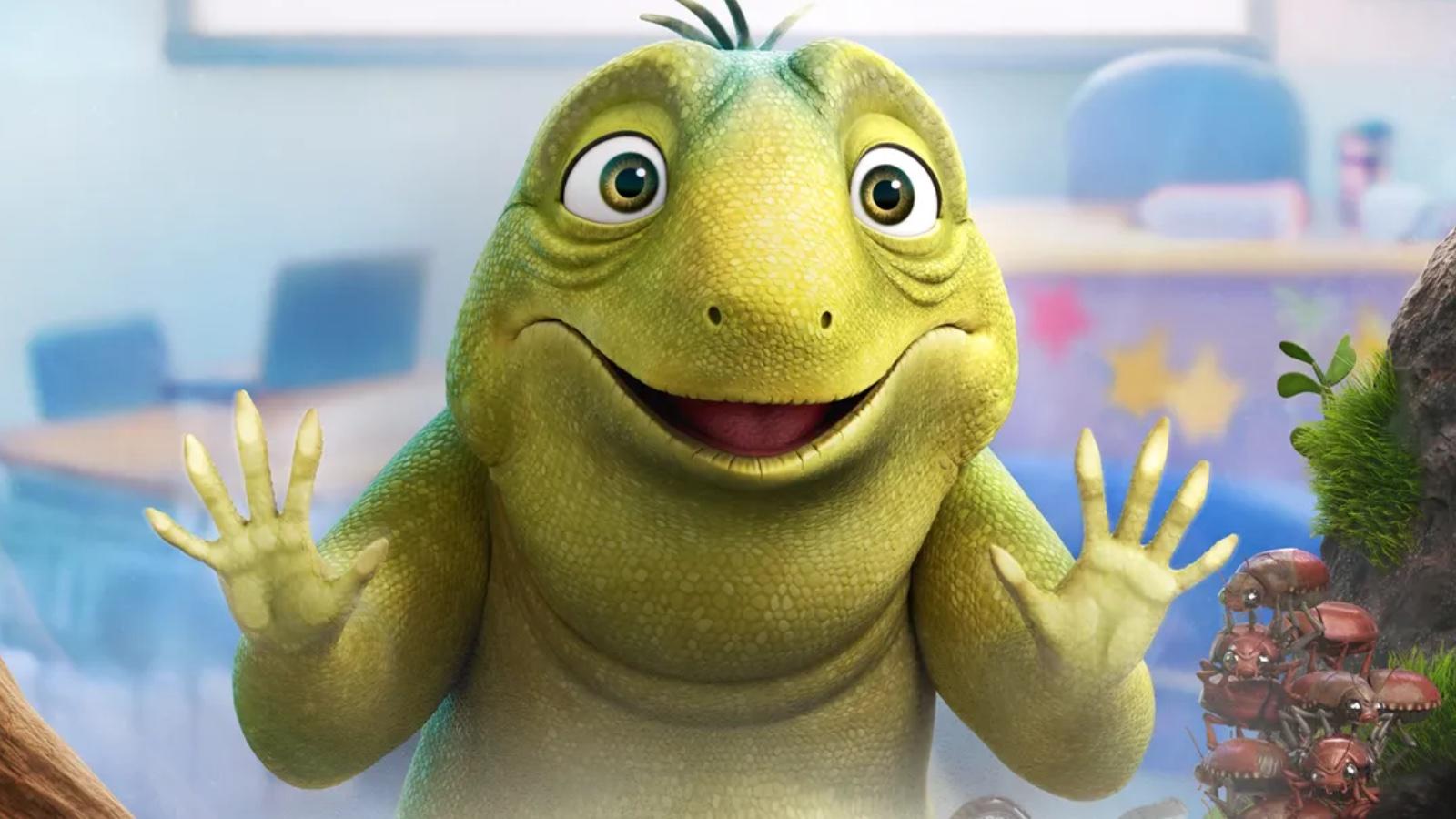
You know, it’s kind of amazing that for an actor as physically and comedically animated as Adam Sandler, he’s really not done all that much work in cartoons. His first attempt, Eight Crazy Nights, famously flopped, and he’s had mild success with the first three Hotel Transylvania films, but that’s it. Given his penchant for silliness, both in adult and family-friendly contexts, you’d figure he’d be churning out colorful projects on the regular. It’s something of a shame, too, because Leo is fantastic. Combining his over-the-top style with surprisingly insightful lessons for both kids and adults, the movie is endlessly entertaining, creatively designed, and just the right amount of goofy to be consistently fun throughout.
Sandler voices the title character, an aging lizard living in a terrarium in a 5th grade classroom along with a turtle named Squirtle (they both resent their names), voiced by Bill Burr. Ever the observer as year after year of children wend their way through the place – including some pretty funny people watching-style commentary about the foibles of the children – Leo finds himself in a rut, yearning to see the outside world. This hope turns to fear when he learns that most lizards like him live about 75 years, and he’s 74. What was once an ambition is now an existential crisis. With the arrival of a stern substitute teacher named Ms. Malkin (Cecily Strong), Leo sees his chance for escape. As a means of learning responsibility, a student is assigned to take him home and look after him for the weekend. As he relates to Squirtle, the plan will be to break out of his carrying case when the kid isn’t looking, get outside, and make for the Everglades.
The first one tasked with watching him is Summer, a talkative girl with not that many friends. Voiced by Sandler’s daughter Sunny, she has a habit of gabbing endlessly and going off on multiple tangents, never pausing for a breath so someone else can get in a word. When Leo takes his chance to leave, he gets caught in the act, and in his attempts to prevent Summer from getting him in trouble, he inadvertently reveals to her that he can speak. Calming her down and allaying her fears, Leo reassures Summer that she’s a good kid. She just needs to keep conversations two-sided. Ask people questions rather than telling them all the answers in one go. This advice leads to Summer becoming more popular in school, and Leo is satisfied that some good came of his delayed exodus.
Before long though, Leo is on a rotation of lodging with the other students, offering similar wisdom to them along the way in exchange for not having his cover blown. He tells rich girl Jayda (Sandler’s other daughter Sadie) that despite coming from wealth, she’s not that special, and neither is her family. Thus, she shouldn’t feel pressure to be “better” than everyone else and just be herself. To the sheltered and overprotected Eli (Roey Smigel; father Robert co-wrote and co-directed, as well as providing some side character voices), he teaches him how to live independently, including a hysterical “break-up” with the semi-sentient drone that shadows and coddles him. To the bully Anthony (another of Smigel’s offspring, Ethan), he helps him process the insecurity of being held back a grade and not advancing with his own friends.
There’s a lot to love about all of this. The kids have distinct personalities rather than just being archetypes, and their actions have weight and consequences. I’d be curious to see what a child psychologist would think watching this, given Leo and Squirtle’s underlying thesis that times may change – along with the associated trends and slang – but the experiences of children in social situations remains fairly constant, to the point that decades of watching allow them to predict outcomes and offer perspective (though admittedly Burr’s turtle does so with a much heavier dose of cynicism). This intriguing pathos helps inform a lot of the jokes, which feel oddly mature given the juvenile subjects. Honestly the most childish bit is a running gag about hyperactive kindergarteners that I absolutely adore because it is 100% true. My nephew’s in that stage right now, and I’m kind of thankful I can just watch from a distance rather than having to experience it all firsthand.
The only downsides are some predictable turns that only serve to pad the runtime. From the first weekend with Summer, Leo tells each child that he’s only speaking to them specifically, setting up a “Liar Revealed” twist, which is one of the more tired tropes in comedy films. This one handles it better than a lot of others, mostly because that established emotional intelligence in the kids allows for brief anger and quick forgiveness because they understand his reasons, but it’s still kind of annoying. Similarly, there are obvious heel turns from a couple of characters – I won’t say who for spoiler purposes, but you can see them coming from space – that only serve to set up road blocks in the plot, and there’s never any fallout beyond the initial distraction and delay.
That said, it should be noted that I wouldn’t even bring these flaws up if the rest of the movie weren’t so impeccably written (save for a few plot holes). A fun, balanced, and appropriately batshit kids movie is a rare thing these days, and again, given Sandler’s particular set of skills, I’m surprised he doesn’t try it more often. Warts and all, I fell for this film, from Sandler’s performance, to the art style (those kindergarteners!), to the morals, to the oddly short songs that seem tailored to each kid, there’s an undeniable charm here, one I hope Sandler and Smigel can replicate in future.
Grade: A-
Chicken Run: Dawn of the Nugget

The original Chicken Run is an all-timer for the artform as far as I’m concerned. As much as I love Wallace and Gromit, Shaun the Sheep, and so man others, it was always at or near the pinnacle of Aardman Animation. It’s one of the most fun capers ever made, and its distinctly British humo(u)r makes it stand out from the crowd to this day.
It’s hard to believe that it’s taken over two decades to get a sequel, but Dawn of the Nugget has arrived. Now, arguably a follow-up wasn’t needed, which is true for a lot of great films. But given its success, as well as the more crass influences in the industry, it is legitimately surprising that it held out for as long as it did. Think of it as the English, claymation version of The Incredibles. You could have left it alone forever, but a lengthy hiatus allowed for a worthy story to be crafted, and thus the end result was worth the wait.
Now settled in their island oasis, the former denizens of the Tweedy’s Farm live in idyllic seclusion, with all their needs met. The community grows with the birth of Molly (Bella Ramsey), the daughter of heroes Ginger (Thandiwe Newton) and Rocky (Zachary Levi), who raise her to be brave and curious, but also to steer clear of the roadways outside the pond where their islet is nestled. Justifiably afraid of being discovered and sent back to their death camp farm, the pair go overboard to shield Molly from this one particular threat, especially once they see a truck passing by for Fun-Land Farms (“Where Chickens Find Their Happy Ending”).
However, being her parents’ daughter, Molly is unsatisfied with mere words of discouragement, so she sneaks out one night to get a closer look. While on the road, she meets another chicken named Frizzle (Josie Sedgwick-Davies), who’s jealous that she was considered too small on her own farm to go to Fun-Land, thinking she’s missing out on some grand adventure due to her size. The pair make it inside, where they find a lovely playground full of the happiest chickens they’ve ever met. Of course, things are never what they seem, as the operation is being run by the villainous Mrs. Tweedy (Miranda Richardson), hatching (hehe) yet another scheme to commit bird genocide for profit, this time with the help of her new subservient husband, the aptly named Dr. Fry (Nick Mohammed). Fearing the worst, it’s up to Ginger, Rocky, and all the others to break in, free the unsuspecting poultry, save Molly and Frizzle, and get the flock out of there in one piece.
As the story goes, it’s simple, but satisfying, creating new but plausible reasons for all the classic characters to return to action. The responsibilities of parenthood and the potential of the next generation are all the motivation needed for another bit of daft derring-do, and in one of the better character moments, it’s Ginger who initially suggests hiding rather than fighting back in hopes of protecting her child, unwilling to take unnecessary risks. It’s also just a ton of fun to have the old gang back. Babs (Jane Horrocks), for example, is still the same dimwitted tit that you can’t help but love, while Imelda Staunton’s Bunty continues to be a goddamn queen.
The problems for me are two-fold. One is that this movie doesn’t feel as bold as last time. It doesn’t pull too many punches (there’s a scene that makes the deadly nature of Fun-Land very apparent that’s quite effective), but the original literally posited a children’s version of The Great Escape, with every bit of subtext that implies. This just plays more like a boisterous kiddie adventure, which is perfectly fine, but a little misplaced here given the stakes of the original.
The second is the voice cast. Nearly half of the previous players have been replaced, including the two leads. I understand casting David Bradley as Fowler, because Benjamin Whitrow is dead. I can also see sidestepping Mel Gibson given his problematic status, but Zachary Levi sounds far too different to be anything but jarring. Apart from that, however, none of the acting changes are justified. Julia Sawalha came forward and basically said she was disinvited because she sounded “too old,” and I’m guessing that’s why Timothy Spall and Phil Daniels are also gone. That’s just stupid. Time passes. The characters themselves age. Rocky and Ginger have a child who grows to adolescence before the meat of the story (sorry) truly begins, so is it really that hard to believe that the characters might sound a little older? I’m not saying that Romesh Ranganathan and Daniel Mays do a bad job as Nick and Fetcher, but they didn’t need to be brought in. The people we had were perfectly fine, and to the trained ear it does sound odd for some of the characters to have the same voice and for others not to. The littlest kids won’t notice or care, so it doesn’t ruing things, but it’s still noticeable, and does detract for the more hardcore fans.
This is still well worth your time, though. The jokes mostly land, Bella Ramsey is a great addition to the group, and the animation itself is as strong as ever. Like most sequels to landmark films, this doesn’t live up to the original, but it doesn’t have to. It’s serviceable, paying due respect to the world that’s been built up and not betraying the first movie’s legacy. That and a bucketload of laughs are more than enough.
Grade: B+
Nimona
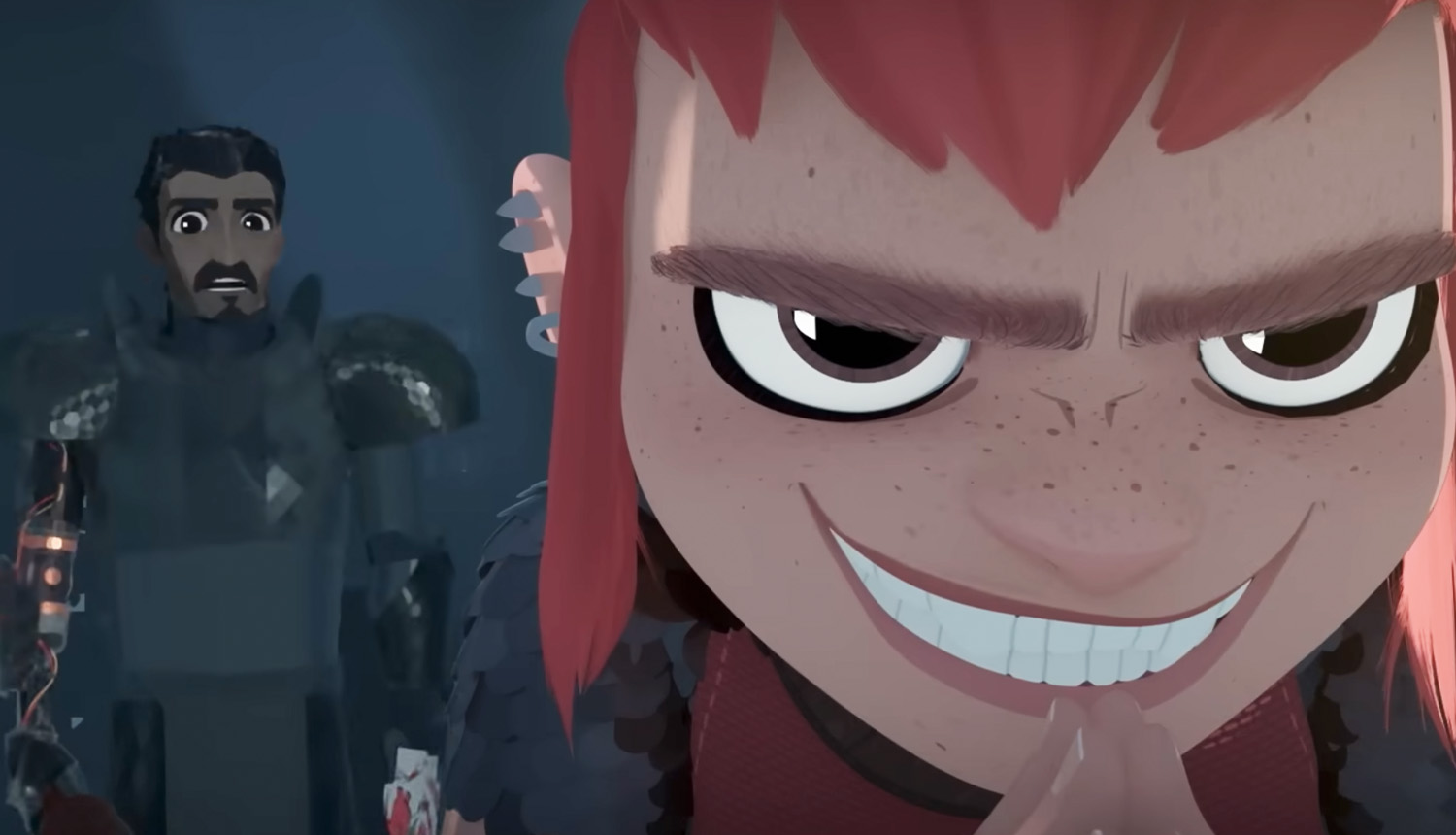
When I first saw the art style for Nimona, my immediate thought went to two short films: the Oscar-winning Feast, and the first virtual reality project to be nominated for an Academy Award, Pearl, both directed by Patrick Osborne. Turns out, I wasn’t far off, as he was the first director attached to this picture. He didn’t see it through, as he left the project during the pandemic, and it was eventually passed on to Nick Bruno and Troy Quane coming off of Spies in Disguise, who finished the movie despite it being cancelled by Disney (after they acquired and shut down Blue Sky Animation Studios) in 2021 and revived by Annapurna and Netflix a year later. Osborne’s fingerprints are still all over this thing, however, and that’s a major plus, because this is one of the best looking animated works of the year.
There’s a beautiful contrast between the main characters in their core designs. The titular lead (voiced by Chloë Grace Moretz), has rounded features and more fluid outlines, to coincide with her shapeshifting abilities. Meanwhile, Sir Ballister Boldheart (Riz Ahmed), along with the other knights of this steampunk realm, is drawn with much more rigid, angular lines. It’s a simple touch, one that’s used quite often in animation, but it’s done to great effect here, all against a color palette that is absolutely gorgeous with its minimalist backgrounds and bright but muted hues. I’m partially colorblind, and even I was bugging out over how beautiful this turned out.
As for the story, it’s an excellent parable about self-identity and prejudice. A thousand years after a woman named Gloreth (Karen Ryan) was believed to have slain an evil monster, a hybrid medieval/futuristic society has flourished under her deified legacy. The walled-off country is protected by an elite group of knights, all descended from her bloodline, per tradition and law. When the film begins, Ballister is set to become the first commoner to attain knighthood, the rules having been changed by the new queen (Lorraine Toussaint), who believes that everyone should be given a chance to prove their worth, regardless of background.
However, at the ceremony where Ballister is given his title – along with his boyfriend, the hilariously named Ambrosius Goldenloin (Eugene Lee Yang) – a weapon rigged into the hilt of his sword emerges and kills the queen, leaving Ballister as the prime suspect and the entire kingdom regressing back to the previous generations’ belief in birthright privilege.
While on the run, Ballister is accosted by Nimona, a pink punk teenager with fanged teeth who looks to become Ballister’s villainous sidekick. Initially wanting to join him in a self-initiated campaign of chaos and destruction, she decides to help him clear his name, as he’s being hunted by the entire knighthood, led by Ambrosius himself.
Let me just say this straight out the gate. I love Nimona. She is just the absolute freaking best. I know there are deeper meanings to her character, particularly when it comes to gender and sexual identity (as maintained by creator ND Stevenson, who made the graphic novel on which this movie is based, though the plot is only loosely connected to the source material), but I don’t care. It doesn’t matter how old I get, when you grow up crushing on emo girls, that infatuation never goes away, and Nimona fits the bill perfectly. Whenever she hyperactively declares that she wants to go break stuff, or when her eyes light up and she grins the word, “METAL!” through her gritted teeth, I swoon. However you come to interpret her – and her malleable design is intended for a spectrum of takes – she is just so damn cool.
Amidst the hijinks that ensue, there is an important message about how society treats those who are different, and how easily confirmation bias can turn anything on its ear, even the perception of basic facts. I like that the film doesn’t waste time pretending there’s a mystery about who really killed the queen. The answer is fairly obvious, and we all know it pretty early on. However, the fact that the culprit is caught dead to rights and can still manipulate the situation so that the people of the kingdom dismiss the evidence of their eyes and ears is all too timely. Three years ago we Americans watched an insurrection unfold on live television, and the people responsible have spent nearly every day since then trying to convince us that it somehow didn’t happen. And sadly, there are millions in this country who are militantly receptive to that line, because it reinforces their preconceived notions – fomented by these same perpetrators – about their political adversaries.
Then there’s the emotional toll of identity and acceptance. It is one of the most crippling feelings in the world to know that people hate you because of who you are, because of things you cannot change. For Ballister, it’s the fact that he was born common. For Nimona, it’s the perception that she’s dangerous because she looks different. This resonates with so many in this country and the world at large, even if it doesn’t align necessarily with a genetic or biological demographic. I took a lot on the chin as a kid because I grew up poor. It’s not as severe as those who are persecuted for being gay, trans, Jewish, or just not white, but I still know what it feels like. You are who you are, and to be told that who you are is somehow wrong, through no fault of your own, can be devastating, and lead a person to some very dark places. I’m glad this film doesn’t shy away from them, because only by confronting these issues can we hope to improve things. There’s a lot of stuff that I won’t even pretend to understand about the topic, but I do understand the feeling of being irrationally hated, because I’ve lived it, and I’ve been to that brink.
is the movie perfect? No. As awesome as Nimona is, sometimes she can be a bit obnoxious. There’s a dude-bro knight named Todd (Beck Bennett) who I just can’t stand whenever he’s on screen. There are a few too many points where the messaging gets in the way of the plot rather than servicing it. But on the whole, this has the potential to be a modern masterpiece, one that makes you laugh and cry in equal measure, and one that will hopefully go a long way towards teaching youngsters the value of empathy. If any of the Netflix submissions is going to get a nomination, I hope it’s this one.
Grade: A-
Join the conversation in the comments below! Have you seen this films? Which is your favorite? How can Leo know about pop culture references like the Ninja Turtles but not understand basic math while living in a 5th grade classroom? Let me know! And remember, you can follow me on Twitter (fuck “X”) and YouTube for even more content!

 I Actually Paid To See This
3 thoughts on “DownStream – The Big Red N-velope, Part Two: Animation”