
As we come ever so much nearer to closing the book on 2023 cinema, it is time to return to the realm of documentaries. I’ve already covered the Documentary Feature category on the Oscar Blitz, including my admission of defeat in my annual quest to clear the shortlist, having come up one short. I did my best, but in the end I goofed and it cost me my streak. Oh well.
That said, we do still have five films to discuss that I haven’t had the chance to cover here yet. If you read the Blitz column, you know where I rank everything, but that’s it. All the normal things like synopses, analyses, and grades have not yet been divulged, and I’m nothing if not thorough (and snarky, verbose, fat, etc.). So while I’m speed-running the remaining Independent Spirit nominees, there’s still some work to do here on the blog.
As I mentioned in the Blitz breakdown, this was a particularly dour year for documentaries, evidenced by the five nominees, all born from tragedy. Of those that didn’t get picked, the prospects aren’t much cheerier, but they are on the whole slightly more positive, mostly because three of the five fall into the “Artistic” subcategory I mentioned in Part One of this series. They won’t fill you to the brim with happiness, but they at least offer something intriguing that isn’t entirely depressing.
Five films to look at, so let’s get to it. On the off chance there’s a release of In the Rearview before the Oscars, I’ll include it in my recap of Blitz films I didn’t get to see before nominations, currently scheduled for the week before the ceremony.
Desperate Souls, Dark City, and the Legend of Midnight Cowboy

The last clause of this title is the only information you really need. Despite its lengthy name, Desperate Souls is just a “making of” documentary about the seminal film, Midnight Cowboy, the first and only X-rated movie to win the Oscar for Best Picture. It came out in 1969, at the height of the countercultural movement, introducing ideas and imagery that would scarcely warrant an R-rating now, but for its time were downright scandalous.
To be clear, I love Midnight Cowboy. As far as I’m concerned, it’s one of the greatest films ever made. John Schlesinger crafted something truly timeless, filled with memorable lines (“I’m walking here!”), fantastic music (“Everybody’s Talkin'”), delirious editing and cinematography, and perhaps the best performances of Dustin Hoffman and Jon Voight’s careers, definitely so in the latter case.
Watching the documentary, you learn some intriguing tidbits. There’s a deep dive into Schlesinger’s homosexuality, and how the film was sort of used as a means of expressing the humanity of the gay community in an age where their identity was still treated as a mental illness. There’s some very interesting analysis of just how bold it was to show New York’s seedy underbelly before the New Hollywood era fully began. This movie was dangerous in a lot of respects, something I always admire. And if nothing else, Bob Balaban has some good interview sound bites.
But really, that’s all there is on offer. This is a DVD extra disguised as a new project. It’s hard to listen to Voight wax nostalgic about the subversive nature of the movie when he’s spending most waking moments talking out of the other side of his mouth about how all us “Hollywood Liberals” are devil-worshippers who steal elections from God’s chosen leader, Donald Trump. And as thorough as the narrative is, Hoffman’s absence is extremely noticeable. You might as well talk about Groundhog Day but only interview Andie MacDowell and NOT Bill Murray.
The most likely reason this was shortlisted was because its director, Nancy Buirski, died last August, about nine weeks after the film was released. Buirski was an Academy member, and she made some important documentaries in her time, including The Loving Story (which was adapted into the dramatic film Loving, for which she won a Producers Guild Award), The Rape of Recy Taylor, and A Crime on the Bayou. Her work was shortlisted by the Academy before, but she was never nominated for an Oscar. My guess is that the Documentary Branch wanted to honor her legacy and see if a posthumous nomination was possible.
Grade: B
A Still Small Voice

We’ve gotten a good amount of documentaries dealing with the hell that was the COVID pandemic, with singular focus on the frontline workers and healthcare professionals who bore the brunt of the emotional and physical trauma. A Still Small Voice is another in this series, a powerful and raw look at one of the more ancillary pockets of this battle: hospital chaplains.
Directed by Luke Lorentzen, the film primarily follows a woman named Margaret, who goes by “Mati.” She’s finishing up a one-year residency as a chaplain at Mount Sinai Hospital in New York, under the watchful eye of her supervisor, a pastor named David. Mati is part of a five-person team that regularly meets to process their emotions, figure out how to handle difficult cases, and just ease the burden of their job, which is to provide spiritual and religious services to patients who desire it.
There are a few moments of levity here and there, in particular one rather ironic scene where Mati, who was raised Jewish, is the only chaplain on duty, so she must perform a baptism on a newborn baby. Obviously the ritual is more important to the parents than any interfaith implications, but it’s still kind of funny that they couldn’t wait until they could just go to church.
But really, this is a film about how even the helpers need help sometimes, and you see the toll that the work takes on Mati, David, and the whole group. When patients are dying, it’s their job to comfort them and their families, even though there’s nothing that can truly be said to ease the pain. When the doctors, nurses, and orderlies are overwhelmed by the influx of COVID cases, it’s the chaplaincy team that wheels carts around the floor just so they can carbo load and hydrate. This puts an incredible strain on them, and often there’s no one to support them as support staff. David has a very angry conversation with Mati at one point because she doesn’t show up to work. She needed a mental health day and didn’t call in before her shift was scheduled to begin. This leads both of them to doubt whether they should even be doing this job, with David reporting up his own chain, trying to figure out his next steps.
There are a lot of painful images in this film, but they’re handled in an empathetic and tender way. Rather than wanting to turn away, you just want to jump into the screen and hug them. They’re doing the job that so many of us could never imagine doing, showing a strength that transcends faith and culture. We all just need a shoulder sometimes. People like Mati do their best to provide it, even if it means a Jewish girl stands in for the priest at a baptism. Whether you’re religious or not (I’m certainly not), you can say a quick prayer of thanks that they exist.
Grade: A-
To Kill a Tiger

I covered this one pretty thoroughly in the Documentary Feature breakdown, but it bears repeating just how crucial and dangerous a film like this is to make. A lot of well-meaning people in this country work tirelessly to make life better for women and young girls, prodding the government and the citizenry to keep striving for true equity in our laws. It takes a film like To Kill a Tiger to remind us all how far the rest of the world still needs to come.
I find myself replaying Kiran’s story in my head from time to time, weeks after I saw the movie, because it just boggles my mind that this stuff happens as a matter of regular course in other parts of the world. I understand different cultures and traditions, but just like with Children of the Mist last time around, at some point there needs to be an intervention of sanity where we all just collectively shout, “No! This is wrong! I don’t give a fuck what your gods say, don’t you fucking touch her!” I know not all instances of sexual assault can be prevented, but to throw up your arms, blame the victim, and even propose that she be sold off into marriage AS A CHILD to her attackers to protect them? Burn in Hell, assholes!
The horrors that Ranjit and his family had to endure are extreme, but they’re a firm reminder of just how easily we can backslide if we don’t keep pressing the issue. I wholeheartedly believe in due process, and not painting with a broad brush. Every case should be handled on an individual basis with care and a focus on the facts, but when a system is truly broken, you have to call it out. Nearly every single person involved with this case failed Kiran in some key way. An officer didn’t properly make a report of the incident. The local councilmember tried to sweep it under the rug. The villagers threaten Kiran and her family – as well as Nisha Pahuja’s film crew – for drawing negative attention. The defense attorney tells the camera, with no hint of irony, that Kiran bears responsibility for her attack for being out as late as she was, and that boys simply can’t control themselves; she wouldn’t even trust her own son alone with a girl. Do you understand how fucked up that is? This is a woman, defending alleged rapists, by saying that men are naturally predisposed to rape… and that’s somehow the rape victim’s fault? I was gobsmacked hearing that. Literally, someone smacked my gob.
Ranjit has some issues of his own, between the pressure of the townspeople and a general degree of laziness. But you can see the anguish on his face as he recounts his own shame that he didn’t protect Kiran. It was no more his fault than his daughter’s, and at times he looks to be more traumatized than the young girl herself (though notably Kiran basically doesn’t talk for the first half hour or so), but when it matters most, he dedicates himself to ensuring justice and fighting for his blood, which makes him more honorable than anyone else in that entire accursed village. They don’t want outside attention because they don’t want the judgmental eyes of the West on them. Well, sorry, fuckfaces, if your solution to child rape is having the child marry her rapist, get ready for some judgy-ass stares, and be grateful if that’s the worst that happens to you.
Grade: A
Apolonia, Apolonia
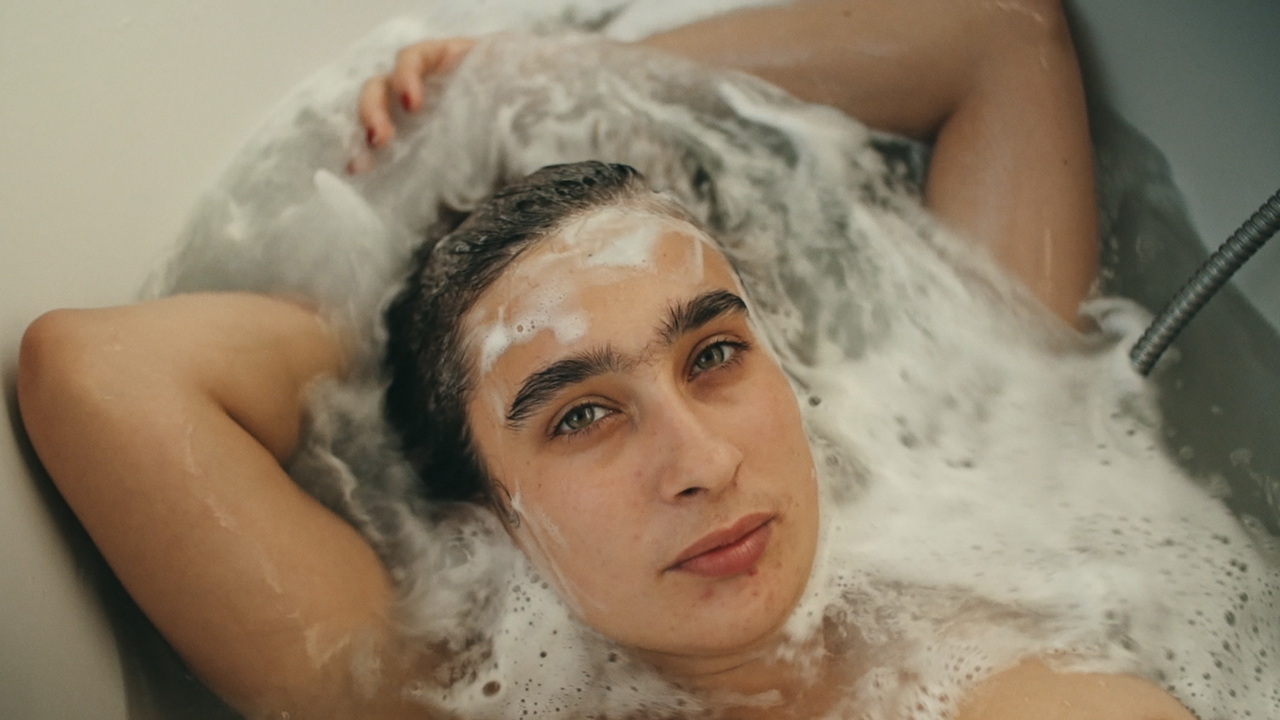
There’s a moment in Apolonia, Apolonia that sums up the basic problem with the entire project. After having her work judged at the Beaux-Arts de Paris for an exhibition of the top graduates (for which she was not selected, though she did graduate), Apolonia Sokol recounts a critique she got that her paintings are less interesting than her personality. And sadly, that’s the ultimate disappointment of the film. Sokol’s artwork is intriguing to a point, but she herself is intriguing to a much larger degree. Director Lea Glob, who followed Sokol with her camera for 13 years, is borderline obsessed and probably as platonically in love with her as any person can be, which comes across to us in the audience. But as we observe Sokol’s developing career, Glob’s movie in essence proves the judge’s point. This artist is much more engaging than her actual art.
That’s not to say she’s bad, not by any means. I mean, she still did actually graduate from Beaux-Arts, one of the most prestigious art schools in the world. That’s not nothing. She clearly has talent. But as we see, her oeuvre is fairly one-dimensional. She paints nudes, particularly women, sometimes even herself, with an eye towards challenging the patriarchy. She’s like a 21st Century Frida Kahlo, right down to the unibrow. Okay, cool. We can understand that in a 20-minute short. Why do we need two hours?
Sokol’s life is fascinating. She grew up in an actual theatre, living with artists, hippies, and various other bohemians. She develops a quasi-romantic relationship with a refugee and model named Oksana that ends quite sadly. She gets sponsored by a taste-making patron who gets her oh so close to the clutches of Harvey Weinstein, which is creepy in the extreme. You can see the charisma and mystique about her that drew Glob to film her for over a decade, even at the risk of her own life.
If the goal is to let us get to know this amazing person, mission accomplished. She’s freaking awesome. If the goal was to help her gain more fans and lovers of her paintings, then I’m sorry, it didn’t work for me. The degree of intimacy Glob shows us has some fine points, but it also feels just a tad too insular, like a private photo album that’s best kept in the family. Every so often, it feels like we’re intruding on their story rather than watching something that’s open to the world, which hurts its accessibility, but at least we learn about a few cool people along the way.
Grade: B-
32 Sounds

This final entry is definitely the most unique and interactive of the entire shortlist, but that doesn’t mean it’s all that great. Directed by Sam Green, and featuring himself and JD Samson in a lot of the segments, 32 Sounds is an exploration of exactly what it advertises, 32 distinct sounds, and the science surrounding the very phenomenon. After premiering at Sundance in 2022, the film has toured the festival circuit and gotten a public release, but depending on where you see it, you might have a different experience than someone who watches it elsewhere.
This is because, as part of this experimental film, there are different presentation setups for whatever sound system your theatre might have, and Green delights in playing around with the different speaker and acoustic layouts in different venues. This makes for an occasionally fun bit of meta viewing (or hearing), but the overall film does suffer in places.
On the plus side, we get some real insight into how sound travels and how our brains interpret it. This is done through poignant interviews with musicians and scientists, including a deaf composer and professional foley artist Joanna Fang. Seeing how people from all walks of life and different experiences process and work around sound is quite fascinating. The experience is mildly enhanced in moments where Green asks the audience to close their eyes (he tells you when to open) to heighten their audial perception.
Where the film comes up short for me is in two areas. One, so many people wax far too poetic about sound for my tastes. I don’t take the sense for granted, especially as someone who actually feels pain from ASMR rather than pleasure, but I don’t need soliloquys about the harmonics of water. The second is that the editing of the film is kind of all over the place, which is distracting in a visual medium, even if audio is the focus. The clearest example of this is the fact that I can’t tell you what the 32 sounds are. Green introduces the first one with a number slate, as well as the second and third. Then nothing until we jump to number eight several minutes down the road. This happens at multiple points, which ultimately defeats the purpose. Why call your movie 32 Sounds if we can’t take notes on the actual list of 32?
It’s a minor gripe, but it did detract because every time I saw a number skip, my semi-OCD brain was trying to piece together the missing digits. Were they on the screen when Green told me to close my eyes? Did he skip numbers entirely? If so, why would he do that? These momentary exercises in re-centering myself add up to time I’m not engaging with the film, and thus lessens the overall engagement. Still, it’s an intriguing concept, one I’d like to see explored further or applied to other media.
Grade: B
***
And with that, the Documentary Feature shortlist is as complete as it’s going to get! Like I said, if somehow the final entry does pop up for me to see, I’ll slot it in with El Conde and Robot Dreams towards the end of the Blitz, but I am officially not holding my breath. Thanks as always for taking the trip with me, and I hope you got to see and enjoy some of these films! The Blitz resumes tomorrow with a category that you’d think 32 Sounds would have been perfect for, but it weirdly wasn’t shortlisted. I wonder if they even submitted it.
Join the conversation in the comments below! Did you see any of these documentaries? Which one was your favorite? Can we shift to something a little less foreboding and depressing next year? Let me know! And remember, you can follow me on Twitter (fuck “X”) and YouTube for even more content!

 I Actually Paid To See This