As previously mentioned, in two years’ time the Oscars will be back up to 24 categories, as the Academy will introduce an award for Best Casting. I very much look forward to this new aspect of my annual obsession. But I have to admit, it’s felt odd for the last few years to only have 23, thanks to the combination of Sound Editing and Sound Mixing into one field.
To be clear, I’m in favor of this change. It’s the one sort of “user-friendly” alteration that the Academy has made for the casual fan that’s made sense, because most viewers don’t listen for the subtle differences in these areas of sound design. Having worked as a professional editor, my ears are sort of trained to it, and I can tell when we’re dealing with natural sound on set and sound effects that are added in post. But I am very much the exception.
To give an example, one of the most frequent tools I and other editors at ESPN would use would be what we called “fake nats.” Sometimes, when cutting a highlight, the broadcast feed we take in has proprietary music that we can’t use. This happened a lot with golf tournaments on the Golf Channel, as they would begin their coverage in progress and cut to their own packages for earlier holes with a music bed underneath. Why they wouldn’t start the telecast from the opening tee off is beyond me. I mean, it’s not like the GOLF CHANNEL had any other programming priorities than GOLF, but I don’t get paid to figure this shit out.
Anyway, when we got those feeds, we’d have to get rid of that music. So on our servers, we had several reels of “fake nats,” previously recorded clean natural sound for various situations within a particular sport. So when Golf Channel shows you how Tiger Woods did on the first hole even though they didn’t go live until the 13th, it would be my job to substitute in some fake nats to match what you see on screen. Say Tiger had a tremendous drive that got the audience fired up. I’d go to the nats reel, find a shot of a similar action with a loud tee shot and audience applause after the ball landed. I’d then sync that up with the new footage, and voila! We’ve covered up their mixing with some of our own. Then, if I use a video transition to the next play, or did any kind of telestration effect on the visual, I’d add a sound effect from an entirely separate reel.
That’s the main difference between the two disciplines, but other than the people who pay attention to this stuff for a living, no one really cares. So the proper decision was made to redux the element entirely and award both editors and mixers with the joint prize. It was the right move, but I have to admit that my somewhat OCD ass never really got comfortable with the idea of having only 23 categories. A prime number? Really? Just feels off to me. But soon, balance will be restored. Hooray!
Anyway, on to the actual stuff I’m supposed to talk about tonight.
This year’s nominees for Sound are…
The Creator – Ian Vogt, Erik Aadahl, Ethan Van der Ryn, Tom Ozanich, and Dean Zupancic

There are a lot of problems with The Creator, not the least of which is the fact that it bafflingly tried to posit machines as the good guys in a war against humanity – in the midst of industry strikes centered on AI-generated content, no less – and that most of the story, technical, and artistic elements are just an amalgamation of much better science fiction properties. The film is an absolute mess, and an insult to our collective intelligence.
That said, there are some positive aspects here and there, but the sound design is not one of them. In fact, it spotlights some of the core issues. Most of the effects are recycled from several other films, particularly the Star Wars franchise (which director Gareth Edwards worked on when he made the excellent Rogue One). This includes laser blasters, ominous space beams, and general futuristic static. You get the impression at multiple points that the U.S. military and the robots are just different versions of the Rebels and the Stormtroopers (somehow humans are the latter), and the sound effects do nothing to dissuade you from that association.
Then there’s the mixing, which leaves a lot to be desired. In several crucial scenes, you can’t properly hear what the characters are saying, as SFX from the outside environment clashes with John David Washington’s relatively low voice. Ken Watanabe and Allison Janney’s characters face similar obstacles. This carries over into the major action sequences, which just come across as noise, particularly in space, even though there’s no air to carry sound waves out there.
But the worst bit of all is the selective amplification of Alphie’s head gears. Because there’s so much focus on the robotics involved, to the point that we constantly have to look through the holes at the base of the simulants’ heads, pretty much every movement of our leading android is accompanied by various whirs and whizzes of the machinery turning inside her, and we always hear it… until the team (and Edwards) decide it’s more dramatic not to. This is most noticeable during the last big ground battle, where the humans send living bombs to detonate and destroy villages. As one runs down a bridge, Alphie emerges to stop it. It’s already bullshit enough that nobody saw the film’s actual MacGuffin come out of hiding and stroll into the center of the battlefield, but to maintain the “surprise,” we didn’t hear her either. No mechanical or electronic noises, no footfalls, nothing. This is the same shit that they pulled in M3GAN, and it’s not satisfying. At least that flick had the excuse of being tongue-in-cheek and not trying to be anything all that ambitious. For this however, it’s cheating, and you don’t get Oscars for cheating.
Maestro – Steven A. Morrow, Richard King, Jason Ruder, Tom Ozanich, and Dean Zupancic

Hey, two bites at the apple for Ozanich and Zupancic. Good for you guys! You probably won’t win for either one, but congrats all the same. Anyway, Maestro is a natural selection for this category because it’s a movie about a composer. Clearly, music plays a heavy part, whether it’s the score, catalog tracks, or just adjacency to instruments. When music is integrated into certain scenes, it works quite well. This is best demonstrated by Bernstein’s triumphant, passionate concert, also known as Bradley Cooper’s full-on “GIMME OSCAR!” moment where he pours his blood, sweat, and tears into the performance.
On the other side of things, and you know exactly where I’m going with this, the sound of Cooper’s voice as Bernstein is just awful. I’ve harped on it before, but it bears repeating until this Awards Season is over, and hopefully no one attempts this again. Leonard Bernstein had a very distinct voice, and Cooper’s imitation comes nowhere close, to the point that it feels like parody. He sounds congested the entire way through, and there’s really no excuse for it. This is much more Cooper’s fault than anyone else’s, but at some point the sound team needed to intervene. One of the on-set mixers needed to speak up and tell him he sounded off, and adjust the mix to compensate. Failing that, one of the editors needed to go to Cooper and say it just wasn’t working, and either make some severe changes, or get Cooper into the booth for an ADR session to correct the original tracks. Any real chance of enjoyment of this film evaporates the moment you hear this impression, and while the sound design team isn’t exactly to blame (unless that voice DID come from ADR, in which case this film should be disqualified entirely), you also can’t reward them for such a snafu.
Mission: Impossible – Dead Reckoning Part One – Chris Munro, James H. Mather, Chris Burdon, and Mark Taylor
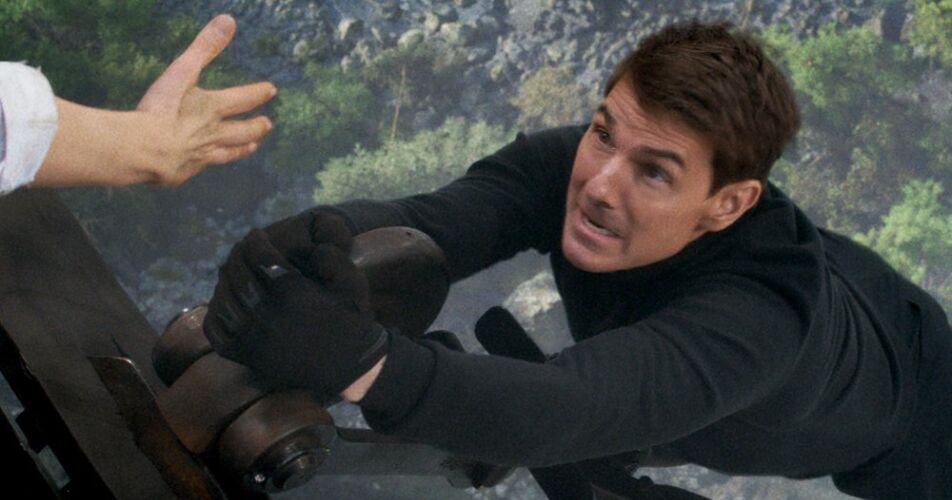
This entry ranks near the top of my list almost by default, merely because it’s among the more complete and competent of the contenders. As the most popular action film of the year, Mission: Impossible 7 lives and dies by the effectiveness of its set pieces, and the sound profile is a huge part of that. There are so many moving parts in each scene that it’s honestly kind of impressive how well the editors keep up. Between shootouts, car chases, train derailments, explosions, and anything else you can throw at Ethan Hunt in these flicks, the sound effects all click properly. Nothing ever feels out of place, gunshot noises match the impact points on various surfaces, even the cruciform key that serves as the MacGuffin has a subtle little shiny sound cue attached to it.
But more important in a film like this is the mixing. Dialogue and exposition come fast and furious (unlike in the actual Fast and Furious movies) in this story, with several scenes taking place in very large and loud environments. We in the audience have to be able to understand what Tom Cruise, Vanessa Kirby, or Simon Pegg are saying at all times, even when Cruise is parachuting off a cliff towards a speeding train. The appeal of this franchise is how almost interactive it feels when we see these high-octane scenes unfold in basically real time. Without a proper mix, key information (or information about the key) could be lost or frustratingly confused. The team does its due diligence to make sure that doesn’t happen, and that is worthy of praise.
Oppenheimer – Willie Burton, Richard King, Gary A. Rizzo, and Kevin O’Connell

Richard King makes his second appearance on this list, which is awesome, but come on guys, can we spread the wealth on the jobs, please? There are a lot of prime examples of how great the sound portfolio is in this movie, from the mixing of the more hushed conversations, to the pointed accusations from Jason Clarke in the hearing, to the way that Oppenheimer’s focus fades in and out in the more dramatic moments, as his mind wanders to the consequences of his actions. There’s even a really cool moment where the Los Alamos workers hold a rally and stomp their feet while standing in the bleachers in a manner that mimics the sound of an oncoming train.
But really, I only need one moment to show you why this almost certainly should win: the bomb itself. Christopher Nolan likes to fuck around with time a lot in his movies, but this is an area where he’s properly, and compellingly, disciplined on the science. Light travels faster than sound, we all know that (or at least we should, who knows what knowledge will get banned in public schools next). So as the team starts testing their equipment and smaller explosives, we see it play out like a fireworks display. The ordinance is triggered, we see the blast, and because Oppenheimer and his associates are at a safe distance, we hear it a couple of beats later.
It’s an excellent primer for the main event at the Trinity Test. When the atomic bomb is finally detonated, we see the blinding flash of light and the gorgeously ominous mushroom cloud. And then we wait, because the blast happened several miles from the nearest human. Then, slowly but surely, the shock wave approaches, bombarding both the cast and the audience with almost overpowering force, giving you the full brunt of the visual and auditory experience of watching such a destructive weapon in action. It reminded me of when my friends and I would drive up the coast to see SpaceX launches. Seeing the rocket take off over the hills some miles away, then hearing and feeling the awesomeness of it right in our chests is an experience I’ll never forget. This is the pinnacle of scientific exploration, for better and worse, and Nolan’s film conveys that perfectly. It’s a simple demonstration of physics, but the sound team makes it feel as real and as impactful as humanly possible.
The Zone of Interest – Tarn Willers and Johnnie Burn
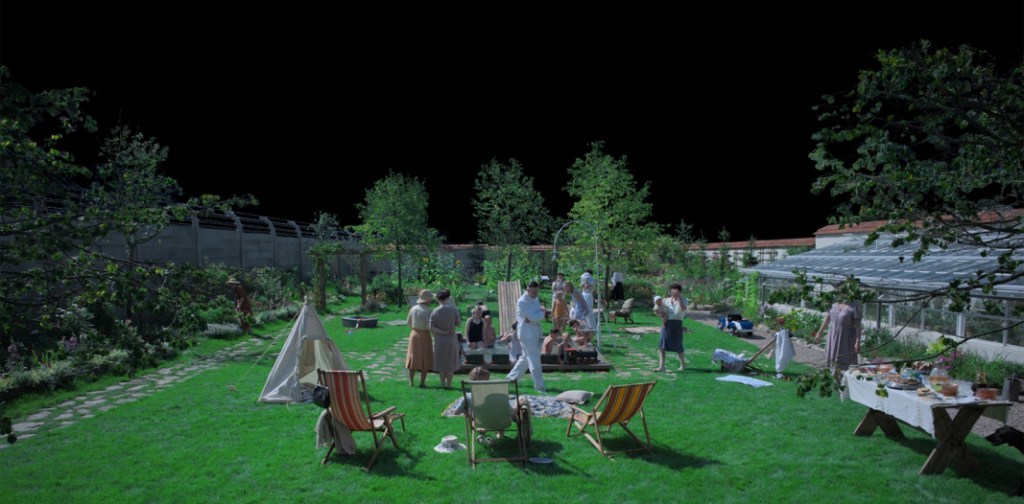
Nope. Sorry, just nope. There are good things about The Zone of Interest, but this ain’t one of them. I absolutely abhorred the sound design in this picture. The only time it works is when you hear subtle wails, screams, and gunshots over the back fence of the family home, which apart from some smokestacks is the only real indication we get of the atrocities going on at Auschwitz in the background of this ironically idyllic home life.
I’ll give credit for that, but everything else is excruciating. The sound of Rudolf Höss dry-heaving at the end, the far too quiet dialogue, the dog that’s not allowed to be nearly as cute and playful as it should be? It’s all rubbish. But worst of all are the night vision scenes. Not only is the visual wholly unpleasant to look at (for technical reasons, not for thematic; we can’t really know the thematic because the film refuses to explain what’s going on), but the noise is atrocious. Throughout both sequences, the young girl makes her way through the woods, accompanied by this low, gurgling rattle that sounds like someone farting through a didgeridoo. It feels like the film itself is vomiting, and that’s only ever off-putting, and not in the good way that draws the viewer in. Without any context, such ghastly rumblings just make us want to turn away, and since we’re getting no plot or story details for anything, we’re not missing a single thing if we do. This is by a considerable margin the worst aspect of the film. How it even got shortlisted, much less nominated, is beyond me.
***
This is definitely not the strongest set for this category, mostly because Dune: Part Two got pushed to this year thanks to the strikes. I have a feeling that had it come out as originally planned, this category, along with Visual Effects, would be complete locks, as well as some other ones potentially. One would hope that with this being in practical terms an open contest the contenders would be much stronger, but sadly they are not. This is a two-horse race for me, when it really should have been four or five.
My Rankings:
1) Oppenheimer
2) Mission: Impossible – Dead Reckoning Part One
3) Maestro
4) The Creator
5) The Zone of Interest
Who do you think should win? Vote now in the poll below!
Now, as I’ve been doing up until this point whenever I clear an Academy shortlist (or come one shy, in the case of Documentary Feature), I will provide my personal rankings of all 10 films that made the semifinals. My top two match the same spots for the five nominees, but what about the other three spots? Well, here you go.
1) Oppenheimer
2) Mission: Impossible – Dead Reckoning Part One
3) Killers of the Flower Moon
4) The Killer
5) Ferrari
6) Barbie
7) Maestro
8) Napoleon
9) The Creator
10) The Zone of Interest
Next up, we go from the technical to the artistic, as dedicated professionals do their best to transform the actors into their characters in ways that amaze and astound… and maybe even gross out. It’s Makeup & Hairstyling!
Join the conversation in the comments below! How much do you pay attention to the sound design in a movie? Which sound effects do you like the best? Should using the “Wilhelm Scream” be grounds for instant firing? Let me know! And remember, you can follow me on Twitter (fuck “X”) and YouTube for even more content!

 I Actually Paid To See This
One thought on “Oscar Blitz 2024 – Sound”