More than any other category in the Academy Awards, this is the one I always feel least qualified to analyze. This is because I know fuck all about the practicalities of the craft. I have had makeup put on me before, including by professional HMU artists. But I am so basic my pH level is pretty much a solid 14.
I’ll give you two examples, one from each side of this field’s particular equation. I have worn pretty much the same haircut for my entire life. I keep it relatively short, pad it flat and forward, so that if there’s fringe it just barely hangs, and I square it off in the back. Then I leave it from anywhere between two and four months, until I look like I’m growing a mullet, at which time I go to Supercuts and hit reset. It’s a little more difficult these days, as I’m starting to thin on the top (because clearly a guy like me needs a bald patch to solidify his sex appeal), but that’s pretty much it. I used to comb it with a right-side part, but I eventually got too lazy to bother, so again, flat and forward.
I have deviated from this pattern on exactly five separate occasions. When I was seven, I got a buzz cut for the summer. I was told that doing so feels great in the pool, and I would swim faster. I wasn’t competing or anything, I just wanted to be as dolphin-ish as possible at that age. When I was 10, I went with a spike do once in the spring, to mimic Bart Simpson. When I fell asleep on the school bus, kids would literally tear the padding out of the seats and see how much they could balance on top without me noticing. My freshman year of college, this time to be Homer, I shaved completely bald for Halloween. I looked like a cancer patient, but on the plus side, a black outfit and some dark circles around my eyes later, I pulled off Uncle Fester instead. When my hair grew back over the winter, my friends actually had me go to a stylist so I could look dapper for a party we were going to. It was the first and only time in my life that I put gel in it.
In between these incidents, from fifth grade until graduation, I had a rat tail. Coming off a particularly bad year, my mom decided to give me a win of sorts, and acquiesced to my request to get one, because it was trendy at the time. As a condition of having it done, however, she made me promise to keep it through high school. I thought nothing of it at the time, so I agreed. As I learned fairly quickly, however, this was meant to be a lesson to not follow fads, as rat tails fell completely out of fashion the next year, and over the course of its tenure, several people tried to cut or burn it off. My junior year, on the opening night of the fall play (my only lead role), two members of the cast actually held a poll among the others as to whether or not I should be pinned down and have the thing forcibly removed. Yes, two teenagers felt emboldened enough to hold a vote on whether to commit felony assault and battery against one of their peers, WHILE A TEACHER WAS DOING MY MAKEUP AND PINNING THE TAIL OUT OF SIGHT!
Now, I knew deep down that I was in no way obligated to keep it, and my mom confirmed that years later. But after a while, it became a point of pride. It was something that made me stand out, that forced people to react to me, and it became an easy barometer for how I interacted with other kids. If they mocked me or shunned me because of it, I knew they weren’t worth my time. If they asked me how or why I got it, I would answer honestly. If they had any follow-ups about why I kept it, I told the truth there as well. I gave my word, and I stick to it. It certainly wasn’t the wisest decision I’ve ever made, but I said I’d abide by it, and I did. I gave my choir teacher the “honor” of cutting it a day before Commencement (I braided it for the occasion, as it had reached the small of my back over the course of seven years, and my mom kept it in a jewelry case for the rest of her days; presumably she didn’t engage in any voodoo rituals with it), and when word spread overnight, I was BMOC the next morning for the festivities. Graduates turn their tassel on their cap. I removed one from mine.
As far as makeup is concerned, it was common practice for either parents or teachers to do the kids’ makeup for the school shows. My senior year was an exception because we just didn’t have enough volunteers. So most of the girls in the cast did it for each other and anyone else who needed it. On the night of our dress rehearsal, I got impatient, and decided to apply it myself. I had been a theatre nerd for years by that point. How hard could it be? I just needed some foundation, a bit of rouge to bring out my cheeks, a tiny bit of eyeliner to make my baby blues pop, and the minimal amount of lip color. I took the foundation that looked closest to my skin tone (don’t worry, this is very much NOT a blackface story), grabbed whatever else I thought was necessary, and set to work.
About 15 minutes later, I declared that I was ready. It was at that moment that I was quite thankful that my first entrance wasn’t until Act IV of this particular bit of Shakespeare (The Comedy of Errors, to be specific). Two of the girls who also had small roles and were waiting in the hallway fell over with laughter, then dragged me into their dressing room (sadly without sexy results), as it was empty at the time. I applied my makeup using only a compact mirror in very poor light. When they took me in the classroom they were using, I saw with a full-size mirror and bright lights that I had WAY overdone it. As one of them said to me, “Your character may be Spanish (I was a nameless merchant, but my director asked me to do an Inigo Montoya voice for the sake of shtick), but your makeup job is somewhere between Italian clown and French whore.” We all had a hearty chuckle at my ineptitude, and the pair then sat me down and spent the next half hour fixing me. For our actual three nights of performances, they made a point to get my face out of the way first once they were done with themselves, to prevent further tragedy.
I have never again attempted to do my own makeup. I know when I’m out of my depth, and on whatever rare occasion might warrant it, I will leave it to the professionals. So yeah, this is far from my area of expertise. I just know what I think looks cool, so I default to that whenever I judge this category.
This year’s nominees for Makeup & Hairstyling are…
Golda – Karen Hartley Thomas, Suzi Battersby, and Ashra Kelly-Blue
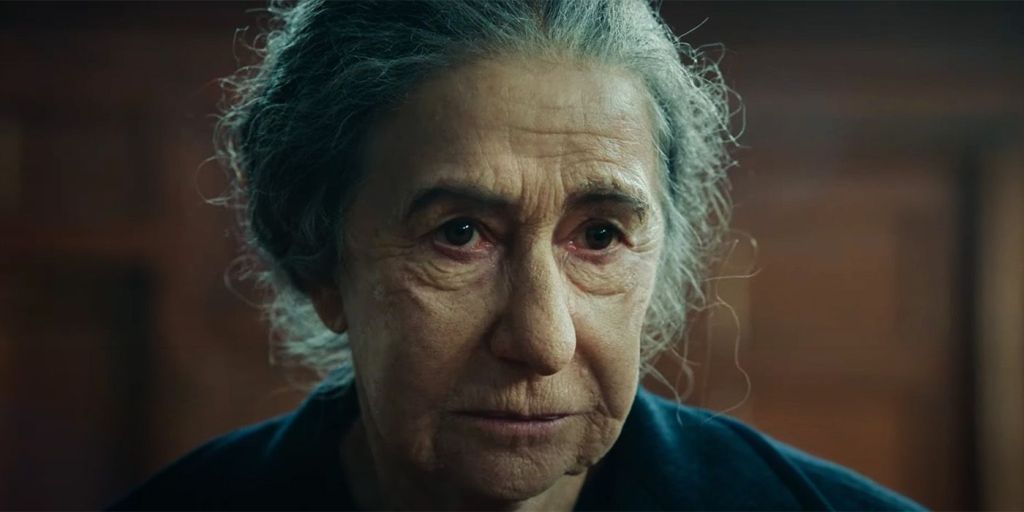
Golda is not a good movie. In fact, of all the feature films nominated at this year’s Oscars, it holds the lowest Rotten Tomatoes score, at 52% (the next lowest is Napoleon at 58%). It’s a complete slog filled with confused characterization, awful dialogue, off-screen action, and Helen Mirren smoking. They even found a way to waste Liev Schreiber by making him into Henry Kissinger. It’s almost a complete waste of film.
That said, this is one of the few categories where the overall quality of the work doesn’t seem to matter, and the makeup on Mirren is pretty superb. She really does look like Golda Meir. You can still see the basic features in her face to remind you that it’s Helen Mirren playing a part, but otherwise she’s a dead ringer. What little credibility the film has comes from just how well the team did its job here.
There’s not much to recommend beyond this, though. Schreiber just looks like a constipated accountant as Kissinger, and the rest of the characters are so interchangeable that you can’t focus on who’s supposed to look like whom. It’s perfectly competent, but nothing special. This is very much a one-person focus for the HMU team, which can work when it’s an absolute knockout (like The Whale last year), but it doesn’t quite rise to that level. This isn’t Darkest Hour or any truly transformative work. It’s well done, to be clear. I don’t want to discount what the team achieved. It’s just not at the “Holy shit this needs an Oscar NOW!” tier.
Maestro – Kazu Hiro, Kay Georgiou, and Lori McCoy-Bell
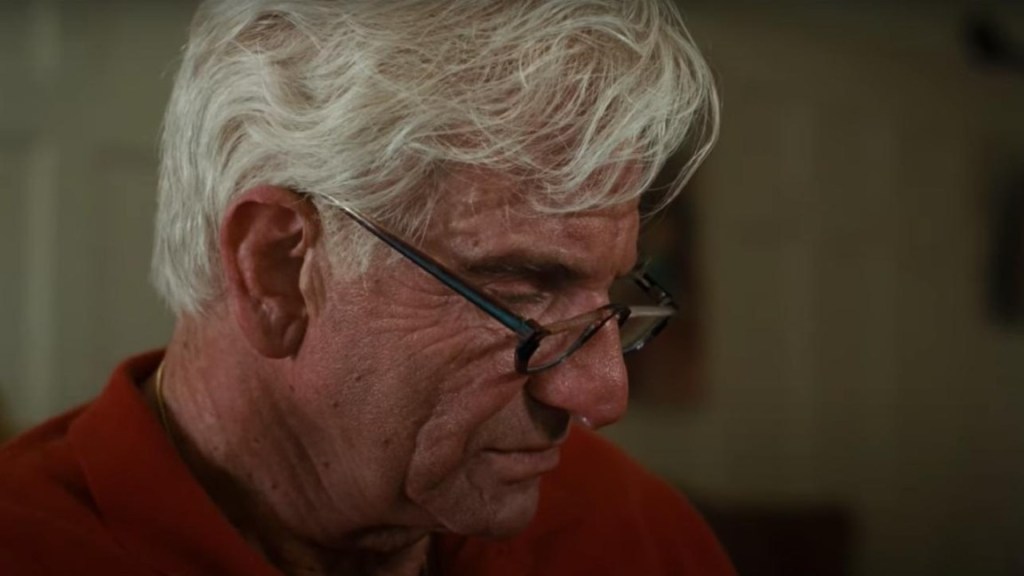
A lot has been made about the schnoz. Is it “Jew-face?” Is it insensitive? Is it even an issue? The answers are no, no, and it really shouldn’t be but we need something to complain about, right? Anyway, I didn’t give a crap about Bradley Cooper’s nose. It looks fine enough, you can’t see any lines that indicate an obvious prosthesis, it’s applied and blended properly, and Kazu Hiro creates an overall facial profile for his lead actor/director that makes him look enough like Leonard Bernstein (though there are some scenes where he looks more like Steve Martin for some reason). I’d much rather have that than what we got for Napoleon, where they didn’t even try to make Joaquin Phoenix look like anything other than Joaquin Phoenix in cosplay.
The real achievement here, however, isn’t with Cooper, it’s with Carey Mulligan. I absolutely love how they aged her over the course of the film. Comparatively, Cooper as Bernstein was the easier task. You just tan the skin and gray the hair once the base design is in place. With Mulligan’s Felicia, they had to create several unique and distinct looks for her to show the passage of time. The lines on her face start out very subtle before they become quite pronounced on her deathbed. Her hair changes multiple times, each matching the era for that section of the story. And not once does it ever look cheap or artificial. A lot is made of a makeup job that helps an actor embody their role, but an expert gradual aging is its own challenge. Look at Sally Field in Forrest Gump for a prime example. Kazu Hiro and his team did some impressive work in this regard.
Oppenheimer – Luisa Abel
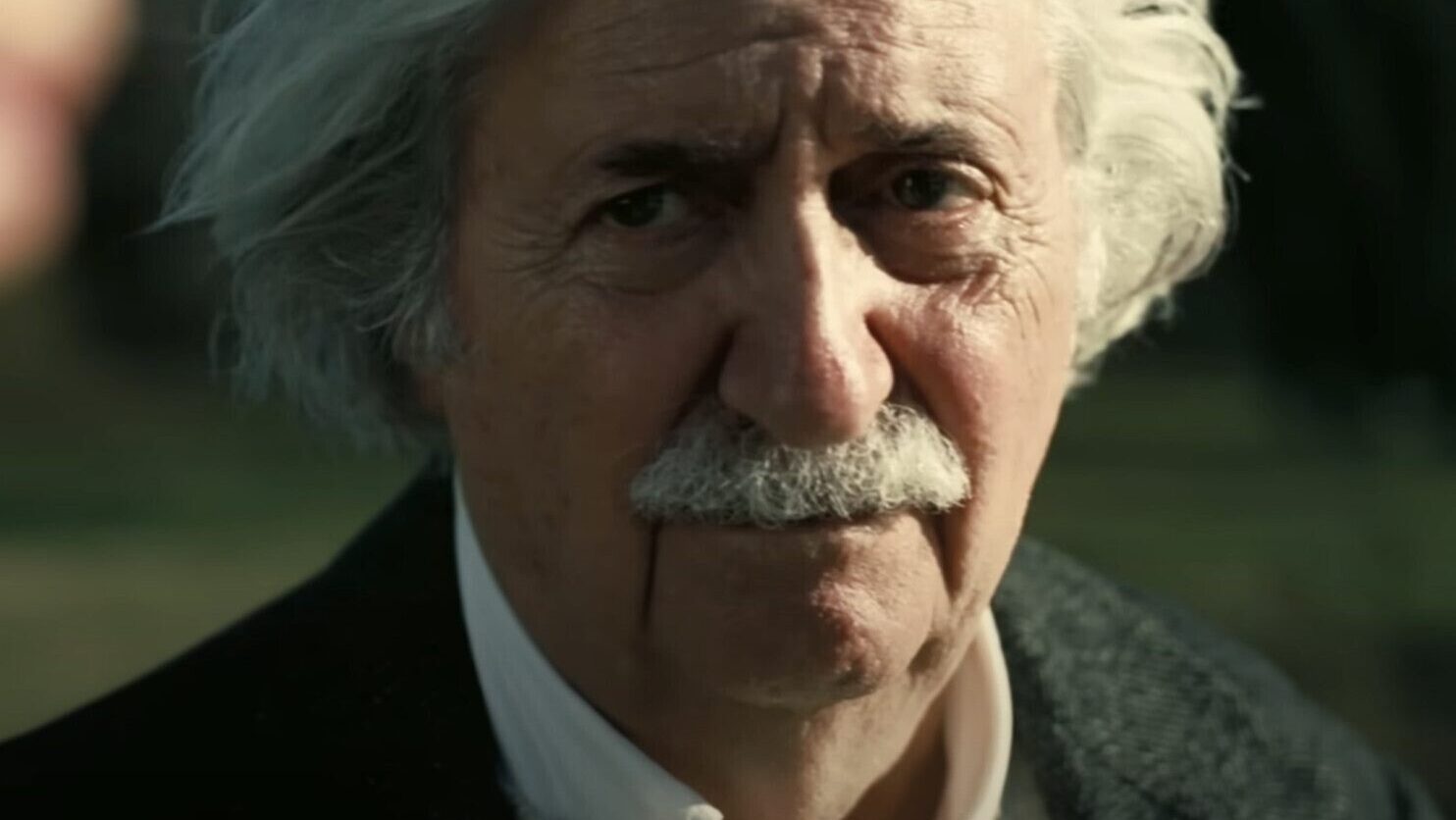
Speaking of that very subtlety, the body of work on Oppenheimer is truly superb, particularly as it relates to Cillian Murphy and Robert Downey Jr. Over the course of the film, we can track the different points in the alternating plot lines by how these two look. Early in the film, Murphy looks quite youthful, though that’s partially done by de-aging CGI, at least in the face. The somewhat disheveled, almost curly hair seems like the genuine article. As time goes on, however, his face becomes thinner, more sallow, aided by the line work on his cheeks and jaw, his hair becoming ever shorter as things wear on. The ending scene where he’s an old man isn’t all that convincing, but it gets the job done.
The same goes for Downey. When Lewis Strauss and J. Robert Oppenheimer first meet, he’s got a vibrant face and a full head of hair, though in this case it doesn’t look like he was de-aged. When we jump to his confirmation hearings, the hairline has thinned and receded significantly, but there’s still the steel in his gaze, hinting at his ulterior motives.
As for the rest of the cast, there are a lot of highlights to be had. Matt Damon is given a convincing mustache, David Krumholtz ages nicely, and the quintet of Dane DeHaan, Josh Hartnett, David Dastmalchian, Scott Grimes, and Alden Ehrenreich are basically unrecognizable. Most prominent of all are Tom Conti and Gary Oldman, who are made into practical clones of Albert Einstein and Harry Truman. You could make an easy case for Abel to win (she frequently works with Christopher Nolan, but this is her first nomination) because she does superlative work on both small touches for the leads and transformative work for the supporting cast.
Poor Things – Nadia Stacey, Mark Coulier, and Josh Weston
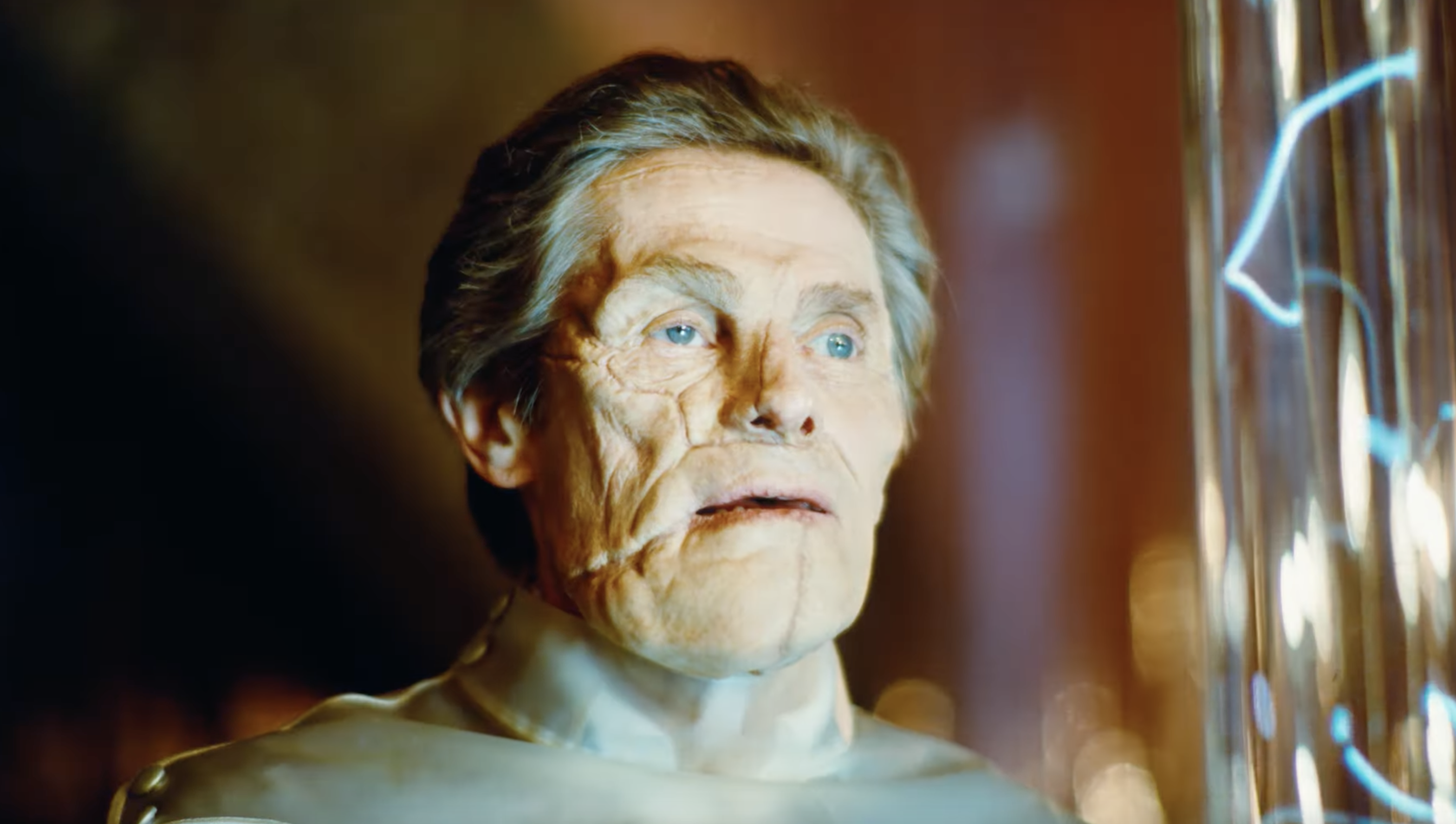
The big focus of the makeup design in Poor Things is obviously on Willem Dafoe as Godwin Baxter. A Dr. Frankenstein type who is much more of a surgical amalgam than even his own creation, his face and body are hideously scarred due to the cruel experimentation of his father. It’s a wonderful look that necessitated having Dafoe in the makeup chair for six hours a day to apply and remove all the prosthetics during shooting.
But not to be outdone is the general look for the bulk of the characters. Creating a colorful blend of Victorian dress and a Gothic aesthetic, each of the major characters sports a hairstyle that’s just a bit off from the prim and proper, particularly Duncan, Max, Harry, and Felicity. Further, when Bella goes to work in a brothel, we get a bevy of interesting looks, from Kathryn Hunter sporting a massive array of tattoos, to varying hair and makeup techniques for each of the working girls, to one of the johns having a literal hook hand. Pretty much every character that we spend any decent amount of time with has some conspicuous feature that sets them apart, giving the viewer a thematic example of how we’re all constructed beings to some extent or another. It’s just not always as obvious as the duck-dog.
It winds up being so much of the presentation that Bella herself becomes a contrast due to how, for lack of a better term, “normal” she looks. Her wardrobe is much more bombastic, but as far as her physical appearance, she sticks out only because she doesn’t have any pronounced features, again a visual representation of just how non-monstrous this creature is. The only differentiating marks on her are the surgical scars on her abdomen and the back of her head, a necessary side effect of her resurrection. But those are only seen when those areas are properly exposed and given direct camera focus. Otherwise she’d blend into the background. Or rather, she would in a world much more mundane than the one in this film, which is the point.
Society of the Snow – Ana López-Puigcerver, David Martí, and Montse Ribé
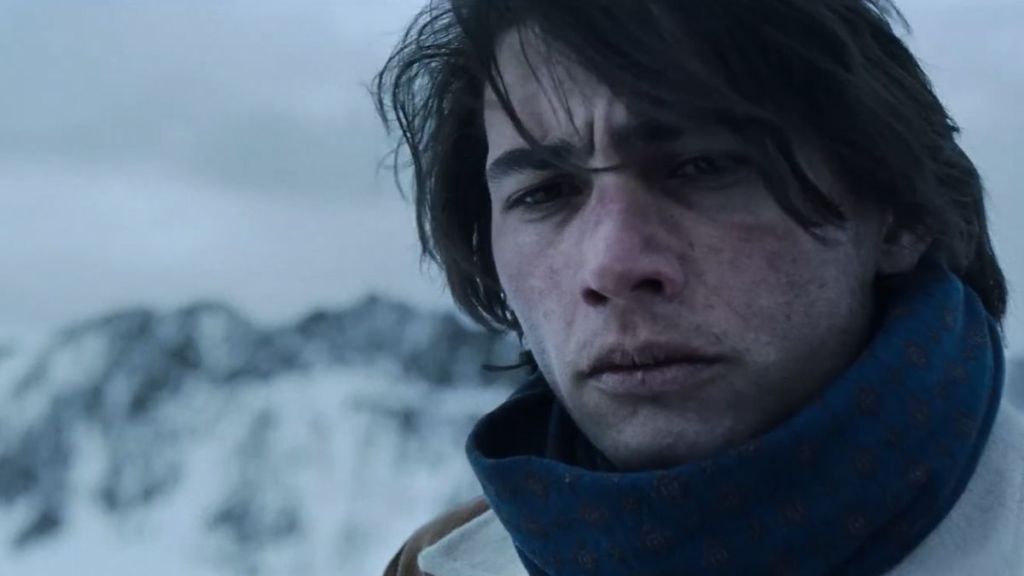
The task for the makeup team on Spain’s entry was an arduous one, both literally and figuratively. Shot almost entirely in sequential order, Society of the Snow depicts the 72-day survival effort after the Andes flight disaster, where a plane carrying 45 passengers from Montevideo to Santiago crashed in the mountains, leaving those still alive to fend for themselves in the harsh winter conditions before they could venture out and seek their salvation, as search and rescue missions were called off shortly after the accident.
Every passenger and crew member on the flight is accounted for in the cast, and for those whose counterparts didn’t die instantly, the shoot was a lengthy process, lasting over 100 days (a full month longer than the actual survivors spent on the mountain). More and more drop off as the story goes on, but they still had to be convincing as a unit for as long as they were a part of the events.
This requires a makeup process that evolves over several stages, and the only aspect that was within the control of the actors was keeping to their diets so that they could lose the appropriate amount of weight as filming went on. Meanwhile, each performer had to be given facial hair, frostbite, sunburns, dead skin, scars, chapped lips, and other various sores on their faces, feet, hands, and torsos. Their naturally-growing hair had to be teased out over and over again to convey the passage of time. Fingernails had to look grimy, brittle, and infected. Their eyes had to be highlighted to the point where it looks like they’re practically bulging out of their skulls. In essence, the HMU team had to make it look like the actors were suffering just as much as the real people did.
Much of the filming took place on an actual mountainside, and weather was a factor. So while they weren’t in any of the shots, the artists had to endure the elements just like the performers, getting their own uncomfortable taste of the real-life ordeal. And then, when the main story was over, they had to regroup, wait a few weeks for the cast to gain their weight back, and then reconvene to shoot the opening scenes, complete with 1970s hairstyles. You know, just in case they didn’t have enough to do.
This is a tremendous undertaking, requiring a lifetime’s worth of dedication and skill. I don’t know if it’ll win, but you have to admit that if it does, it will have been well and truly earned.
***
This is one of the few categories where Best Picture nominees are often included, but that doesn’t necessarily mean they’ll default to the win. For me the top three all have viable claims to the prize, and on the right day you could possibly convince me for the other two. I’ve gone back and forth on my pick a few times, but as of right now, I’m going with the most comprehensive, superlative effort. And just like my rat tail, for better or worse, I’ll stick with it.
My Rankings:
1) Society of the Snow
2) Oppenheimer
3) Poor Things
4) Golda
5) Maestro
Who do you think should win? Vote now in the poll below!
Up next, one of the more shocking decisions of the Acting Branch was to leave off Margot Robbie while nominating Ryan Gosling, but there’s another side to this potential triangle of snubbery to explore. It’s Best Supporting Actress!
Join the conversation in the comments below! Which category do you feel least knowledgeable about? What about the most? Have you ever had HMU faux-pas worse than mine? Let me know! And remember, you can follow me on Twitter (fuck “X”) and YouTube for even more content!

 I Actually Paid To See This
2 thoughts on “Oscar Blitz 2024 – Makeup & Hairstyling”