I accomplished a lot this weekend. I was able to make my screening of Robot Dreams, so all features for this year’s Oscars are in the books. I took in Madame Web, what is almost certain to be the worst movie of the year. I got my taxes done. I kept my blogging streak going. I got the footage I need for my next video breakdown at the end of the week. And somehow, some way, I also slept for a couple of hours.
But most importantly, I got to partake in my favorite part of this entire Blitz process, the Shorts categories. Between the Landmark NuArt Theatre and the Laemmle Royal in Santa Monica, I marathoned a triple feature of 15 nominated short films, all in one day. It is by far the best part of Oscar Season, because you truly never know what to expect.
We begin tonight with the first of these three categories, Animated Short. The nominees this year run the gamut from the playful to the profound, the iconic to the ironic, and each was an absolute joy to behold. In fact, in an odd sort of unintentional symmetry, all three Shorts fields pretty much played out the same way. On a thematic level, it’s a complete apples and oranges comparison from one entry to the next, but from a stylistic and narrative perspective, each of these contests follow a similar pattern. I’ll explain further in a bit, but I’m just too excited to get to the actual contenders. Let’s do it!
This year’s nominees for Animated Feature are…
Letter to a Pig – Tal Kantor and Amit R. Gicelter

A heavily stylized look at trauma and remembrance, Letter to a Pig emphasizes the importance of shared history in an age of apathy and misinformation. Drawn mostly in charcoal and pencil sketches with some fantastic rotoscoping effects peppered in (as characters become more emotionally intense, their minimalist designs are filled in with live action body parts like fingers and eyes), the story revolves around a young girl learning the story of an ironic survival during the Holocaust.
A boy runs through a wooded area, chased by Nazi soldiers. Coming upon a barn, he runs in and hides. He’s able to see the soldiers enter and search the facility, and is sure to be caught, until a pig makes eye contact and casually strolls in front of his hiding place, blocking him from view until his pursuers leave. In the modern day, the boy, now an old man, recounts the experience to a disinterested classroom of teenagers, including a letter of thanks he wrote to the animal. As the admittedly corny moment is playfully mocked by the class, he becomes angry, implying that it’s not worth sharing the truth to those who don’t want to hear it. This leads the girl to imagine a surreal and dark scenario where she and her peers kill the pig, before regretting the cruelty.
Visually, this film is stunning, but I will admit to getting a bit lost in the weeds with the story. I think part of the art of the narrative is the idea that pigs are not kosher, and yet ironically one ends up saving the boy’s life. However, I can’t be entirely sure. This is because the dialogue, which is entirely in Hebrew, isn’t properly translated for the audience, at least not in this release. Whoever was in charge of the subtitling, be it within the film’s team or at ShortsTV as distributor, made a crucial error. Most of the classroom scenes are done with minimal outlining and character models in black against a white background. The subtitles are also in white, distinguishable only through a slight drop shadow effect on the text. As such, I couldn’t read the translation well enough to absorb what was being said, and I lost the literal message of about half the cartoon.
Because of this, I’m left to infer the meaning from the visuals alone, and it’s a touch muddy. I have an interpretation, but I have no way of knowing if it’s accurate, which is very frustrating. The short itself is gorgeous, but I feel like I got an incomplete experience because of the poor captioning.
Ninety-Five Senses – Jared and Jerusha Hess

Similar to my favorite nominee from last year’s class, My Year of Dicks, Ninety-Five Senses is presented in multiple artistic styles and animation techniques, one for each of the five main senses that humans have. An old bumpkin with a heavily affected hillbilly accent, voiced by Tim Blake Nelson, waxes philosophical about how each of his senses impacted his life, accompanied by innovative animation to illustrate.
Based on actual persons and events (the film was made in partnership with the non-fiction streaming service, Documentary+), the story is filled with amazing art and good humor. For example, the man muses about something he read about smartphones physically flattening our eyes as a form of evolutionary adaptation, to the point where some people literally might not be able to look away, and it’s accompanied by a wonderfully goofy image of a conveyer belt where phones smash eyeballs from circles into ovals.
It’s all very enjoyable, until the big twist, which recontextualizes everything we’ve heard and seen so far, setting a dark, heavy tone for all that follows. I won’t give it away here, because you need to see it for yourself in order to truly grasp the collective thud in the room when this moment occurs, because the entire audience gasped in surprise. We were all laughing at the silliness and odd poignance of what this character was talking about, only for the levity to be instantly smashed. That’s some really effective storytelling, because it forces the viewer to evaluate their own perceptions and wonder if they’re somehow complicit in what’s going on. The ultimate moral won’t change anyone’s minds, but it will grab your attention in ways you don’t expect.
Our Uniform – Yegane Moghaddam

A big part of the fun of this category is the wide array of artistic styles that show off massive creativity and the ability to think outside the normal parameters of how films are made. Our Uniform is a perfect example. A very simple narrative – literally, it’s basically just a wistful narrated monologue – the film leaves a lasting impact based on the non-traditional presentation, to the point that the filmmaker felt the need to put a disclaimer at the beginning to make clear that she’s not making a political statement, just musing nostalgically.
The short is animated through clothing. Pieces of fabric and various items are laid out in stop-motion on the surface, with 2D pencil sketches and pastel colors superimposed in, on, behind, and around them. The film opens with a couple pairs of pants and a skirt rolled out on the screen, with animated legs protruding from the cuffs to simulate walking. It’s really well done.
The narrator then talks about growing up in Tehran, where she had to wear a hijab in school as part of her class uniform, even though her school was single-sex. Despite there being no boys or men, she still had to cover her hair, which she felt was odd. Thus, she talks about a few minor acts of rebellion where she and her classmates would intentionally let slip a few strands, or braid longer hair in a ponytail so that no matter which way the teacher tugged the hijab, something was left exposed.
There’s a lot of creativity with the art style. In particular is a moment where five girls are drawn over the chest of a shirt. Illustrating how younger girls wore white hijabs and older girls wore black ones, the animation of the hijabs morphs back and forth on the colors in sync with a crease that courses through the shirt at chest level with the models, raising up to give them breasts. It’s a great cheeky laugh. There are no political statements made, and the closest thing to anything controversial is a depiction of a nude woman in Hell for a few seconds, a visual representation of a warning given to her by one of her teachers for her mischief. But I guess given Iran’s recent crackdowns, you can’t be too safe. This is just a delightful bit of fun, executed in highly imaginative fashion.
Pachyderme – Stéphanie Clément and Marc Rius
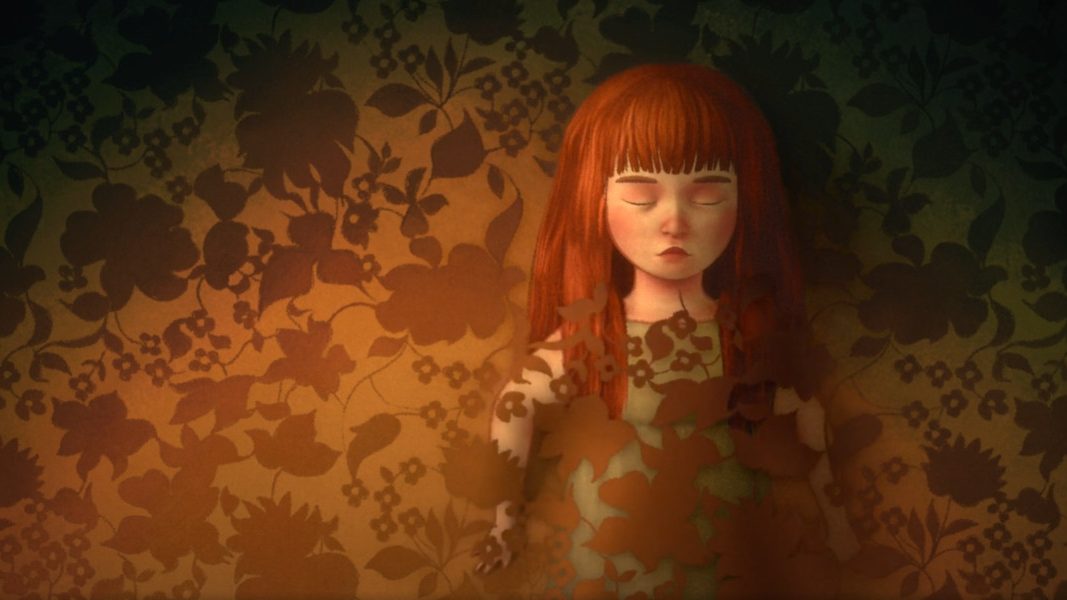
This one is a bit of a doozy. Blending 2D and 3D techniques, this absolutely gorgeous tale of fear and trauma is colorful and safe on a surface level, but when you stop to consider the subtext, things get real dark real fast.
A woman narrates a story about spending time with her grandparents as a child. Whenever her parents had to be out of town for any extended period of time, she was left in their care for a few days. The woman recounts that she never liked staying there, mostly because she found the old house scary, making it hard for her to sleep. She imagined the eyes of monsters in the knots on the wooding planks in the ceiling, for example, the type of thing that could easily give a kid nightmares. The centerpiece of fear for her was a trophy of a large elephant tusk prominently displayed in the hallway.
She relates vignettes that seem fairly innocuous, like going fishing with grandpa, swimming in the river, and grandma cooking nice meals, reassuring her that nothing bad could happen to her when she was with them. However, as the visuals relay, things are not as they seem. The desire of the girl to literally fade into the wallpaper whenever grandpa is nearby is your first major clue. Then comes the “smell” of his “healing kiss” when she gets a fishing hook caught in her finger. Then it’s the suggestion that she swim in her underwear when she forgets to bring a bathing suit. When you take it all in, especially with the first-rate visuals, you realize what’s really going on, with the tusk being a literal symbol of no one being willing to address the figurative elephant in the room, and your heart breaks.
If you’re not paying attention, you can easily gloss over this all-important deeper meaning, and just see an animated slice of life that seems downright quaint and pleasant, which is what makes it all the more devastating and skillful. The fact that the visuals are necessary to fully understand the breadth of what’s being conveyed here is why the artform is so essential. This could be a bedtime story you read to your own kids in a lighthearted way without the animation. That’s how subtle the overt text of the plot is, and that’s kind of scary. Some of the worst things imaginable occur in plain sight, and Pachyderme gets that across in surprisingly expert ways.
War is Over! Inspired by the Music of John and Yoko – Dave Mullins and Brad Booker
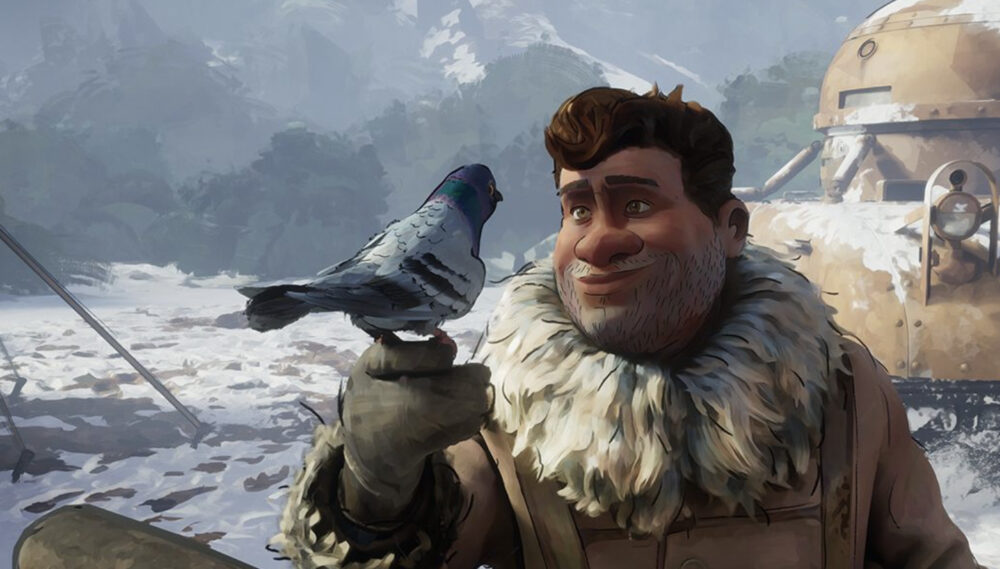
Two forces come together in what may be the most high-budget, emotionally-manipulative entry in the bunch, which you could argue flies in the face of this entire process. But goddammit if it isn’t beautiful as all get out, kicking me right in the emotional gonads.
See, those two influences are among my favorite, items (for lack of a better word), about Christmas. The first is John Lennon and Yoko Ono’s “Happy Xmas (War is Over).” I know it’s saccharine, but I love it. I have so many memories tied to that song. It was one of the first my mom tried to teach me on guitar, and one of the few regrets I have now that she’s gone is that I never perfected it so I could play it with her. It’s honest, aspirational, hopeful, and most importantly, secular. To some that may be blasphemous, to which I reply that the entire holiday was coopted from pagans anyway, so get over yourselves. The message is about healing, unity, and setting aside differences, no matter where you come from or what your beliefs are. Sure Yoko can’t sing for crap, but that doesn’t matter. I sing it every year at the top of my lungs.
The second is the Christmas Truce of 1914. During World War I, in an event that has become something of a legend in the century since, British and German troops along the Western Front declared an informal ceasefire during the holiday. Songs were sung, games of soccer were played, the dead were buried, and for just one day, the “War to End All Wars” actually ended, with the men treating each other as brothers rather than enemies. When it really comes down to it, wars are between governments, not peoples. The soldiers who do the fighting and dying are but sacrificial pawns, which renders the whole thing pointless, and for one day, that truth came out, and humanity prevailed.
So now we have War is Over!, a very stylish 2.5D animation done in a quasi-comic book style in the Unreal Engine, mixed with an Expressionist aesthetic that is just eye-popping. In an imagined alternate version of this event, a carrier pigeon flies between trenches on either side of the conflict, delivering messages of moves in a remote game of chess, neither player knowing he is facing his own mortal enemy. The brief respite gives the two leads a bit of sanity, and as the game progresses, morale is boosted for both sides, until the time comes for another all-out assault on No Man’s Land, where innocence goes to die. The plot is exceedingly predictable, but that doesn’t stop it from being vibrant, beautiful, and tragic in equal measure, with John and Yoko’s ballad only coming in at the end to punctuate the proceedings. I totally understand if someone finds this mawkish in the extreme, but for me, it hit me right in my feels with surgical precision.
***
So, about that pattern. For all three Short Film categories (Animation, Live Action, and Documentary), as I watched I noticed a weird similarity. There’s a clear #5 in each group. None of these films is bad, let me be 100% clear on that. All of these are fantastic in their own way. But for each list, one is decidedly a tier below the other four, for one reason or another. Above them, there are clear #3 and #4 entries that dazzle the senses, and could easily win the category in another year against another field. Finally, at a whole different level, are the top two, and I have a hell of a time picking a winner for each one. For the first time I’ve ever seen, when the Oscars honor their chosen victors, it is impossible for me to say that they got it wrong on any of these. That’s how good all the nominees are.
My Rankings:
1) War is Over! Inspired by the Music of John and Yoko
2) Pachyderme
3) Ninety-Five Senses
4) Our Uniform
5) Letter to a Pig
Who do you think should win? Vote now in the poll below!
Up next, close your eyes, open your ears, and scramble to click out of the ads on Spotify. It’s Original Score!
Join the conversation in the comments below! Do you get to see screenings of the Shorts nominees? Which of the three categories is your favorite? What styles speak to you? Let me know! And remember, you can follow me on Twitter (fuck “X”) and YouTube for even more content!

 I Actually Paid To See This
One thought on “Oscar Blitz 2024 – Animated Short”