For the last several years, there’s been an odd association when it comes to the screenwriting categories at the Academy Awards. The perception has been that Original Screenplay is more prestigious than Adapted, because turning previously created work (oftentimes done by someone else) into your own is somehow considered an easier task. This is one of the reasons why people think Barbie‘s advocates wanted the script nominated here (as it was for both the BAFTAs and the WGA). As I’ve mentioned before, the Academy’s rules are clear, and given the naked campaigning that happens this time of year, I’m much more cynical and believe they were just trying to play the odds for a better chance at a win.
Because in reality, comparing the process for Original and Adapted is apples and oranges. You could just as easily argue that Original is the path of least resistance, because you can just come up with your own idea and run with it relatively unfettered, whereas with Adapted you may have to endure relentless consulting and notes from the creator who licensed the property. Don’t believe me, watch Saving Mr. Banks. It’s almost insultingly one-sided and treats P. L. Travers like an intransigent bitch, but there is truth in some of the steps they had to go through. If you’ve got a hot property, you won’t just let someone else do what they want without your approval. I’m sure the same was true for Barbie, and that Mattel was definitely a constant presence during both the writing and production, making sure Greta Gerwig and Noah Baumbach didn’t do anything that might hurt the brand.
It’s important to keep this in mind, because for the first time in a while, the Original category is the weaker field of the two. On the Adapted side, we have five nominees for Best Picture, all of which will likely come away with something on Oscar Night. On the Original side, only four of the films are up for the top prize (Killers of the Flower Moon is the one Best Picture nominee not up for a writing award), and none of them has a realistic path to victory. I’d even argue that at least three (if not more) of the nominees feel like pity nods, because the one sad tradition that’s held true for a while is that one or both of the writing contests are seen as consolation prizes for films that won’t win anything more prestigious.
But does that mean these are bad choices? Far from it. Most of them have something truly special to offer, while those that don’t at least have an ounce of intrigue, for better or worse. There’s a clear separation between the two sides this year, one larger than we’ve seen in a while, but that doesn’t mean that the eventual winner should feel like they’ve gotten an asterisk.
This year’s nominees for Original Screenplay are…
Anatomy of a Fall – Justine Triet and Arthur Harari
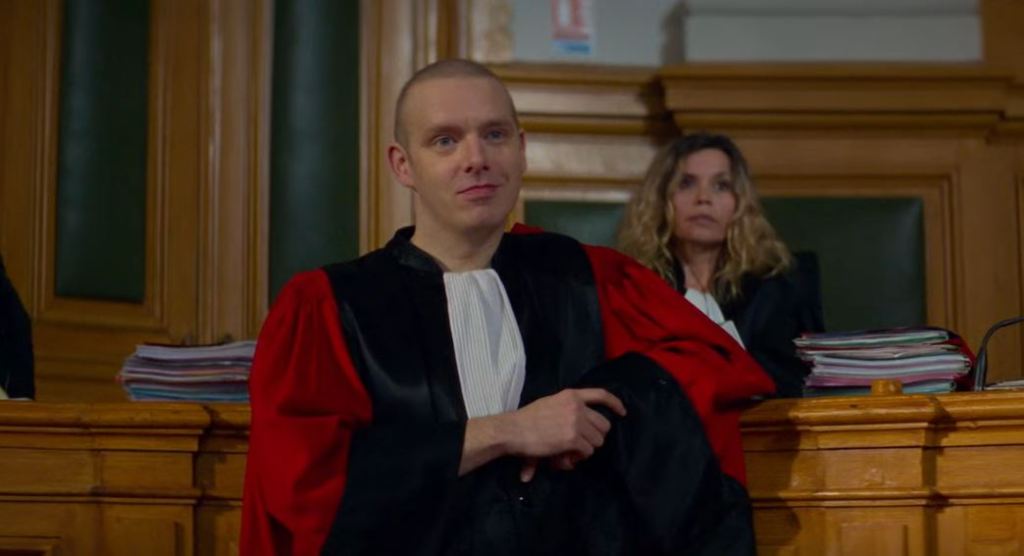
The two key elements of any script, regardless of its origins, are story and dialogue. Unless you’re making a silent film (which still puts lines on a slate while the actor delivers them), you need to be solid in both respects. For Anatomy of a Fall, the screenplay succeeds on one front but falters on the other.
As far as dialogue goes, it’s great. Triet and Harari expertly mesh English, French, and German, emphasizing both the language barriers and the nuances within them, to help convey the tone of the film, particularly during the trial scenes. It’s most telling in the moments where Sandra has trouble understanding the subtleties and allusions of the questions posed to her, because French is not her first language. Part of what makes the case against her interesting is this inability to answer in ways that the court and prosecutors find satisfying, which increasingly leads to a detached characterization for Sandra as things wear on. When she explains her theory that Samuel committed suicide, her lack of fluency translates into hesitation and doubt, non-verbal cues that could prejudice the jury against her.
On the story front, however, oof. I’ve railed enough about the film’s steadfast refusal to resolve the plot – including its opening slate website that telegraphs the forced ambiguity – but even setting that aside, the actual narrative leaves a lot to be desired. When Sandra calls her lawyer, she lies right to him about bruises on her wrist. She lies to investigators. She shutters herself away from those who could help her, committing one suspicious action after another for no other reason but to create false tension. Similarly, the trial itself is something of a sham. I’m no expert on French law and jurisprudence, but I’m guessing a case that’s as flimsy as this one would never be brought. Sandra has no alibi because she and her family live in isolation, and there were no witnesses to the event. The entire case is based on one forensic analysis of how Samuel could have fallen, which is easily countered by an equally valid theory from the defense. Everything else is innuendo and character indictments, which would never hold up in this country (presumably), so unless the standard of evidence and burden of proof is much lower in France, there’d be no trial at all. This gives us a false pretense for most of the story, and then it ends with Triet flat-out telling us (through the social worker character) to just decide for ourselves whether Sandra killed her husband.
Based on Awards Season results to date, this probably has the best chance of winning next Sunday, but from where I sit, it’s incomplete, pretentious, and intellectually lazy. The dialogue is strong, but that’s only half of the proposition.
The Holdovers – David Hemingson

This has all the earmarks of a script that would be celebrated in most years. It’s sharp, clever, and filled with tremendously biting comebacks. The surrogate mentorship that Paul Hunham has with Angus Tully is music to a writer’s ears, given its insight, poignancy, and mournful cynicism. The character of Mary serves as a perfect foil to both sides of the conflict. The story is tight and flows at a proper pace. Lessons are learned, empathy is felt, and we leave with the impression that some good has been done as a result. I know I certainly felt that way watching it.
However, it can be argued that all those strengths also double as weaknesses, because it almost feels too familiar. The instant I saw the trailer for this film, I immediately penciled “Screenplay Nominee” into my mental notepad. If you asked an AI to generate a script guaranteed to get the attention of award voters, this is likely what would pop out (obviously minus the human element and any hint of nuance). The dynamics and humor are things we’ve all seen before, so you have to elevate things to get beyond the initial pass and have this be more than a token nomination.
In my opinion, Hemingson accomplishes the goal. All of the characters – even the other “holdovers” who only stick around for a few minutes – feel fully fleshed out. The turns in the story, while reasonably predictable, do serve the plot and the players based on what is established early on. Nothing feels tacked on or superfluous, not even the scene with the frozen hooker in Boston. Every piece falls neatly into place, and while that may be a baseline expectation at this point, it’s still impressive to me when it’s pulled off.
If nothing else, this should be lauded for giving us the single best line of 2023: “Hardy, I have known you since you were a boy, so I think I have the requisite experience and insight to aver that you are, and always have been, penis cancer in human form.”
Maestro – Bradley Cooper and Josh Singer

This nomination is nothing more than an apology to Bradley Cooper. He’s up for Best Actor (and Best Picture), but not Best Director, so this is his true “behind the camera” nod. There’s no other reasonable explanation, because honestly, this script just isn’t that good.
Leonard Bernstein was a fascinating person and a truly gifted musician, and yet we spend almost no time on any of that. Instead it’s “party like a rock star” drugs and promiscuous sex, only framed around someone who, as an orchestral composer and conductor, one might expect to be more buttoned up. There’s some good dialogue here and there, mostly for Carey Mulligan and Sarah Silverman, but everyone else is simply there to praise Bernstein – and Cooper by extension – while Cooper himself just waxes philosophical and smokes another cigarette.
I mean, what is the actual story of this movie? Bernstein gets his big break, meets his eventual wife, woos and marries her, has some kids, screws around behind her back, she keeps up appearances because she’s not an idiot, they eventually divorce, she forgives him, and then she gets cancer and dies. Is that the plot of an Oscar-worthy film, or a Lifetime Movie of the Week?
My good friend Jason Godbey over at No Rest for the Weekend referred to this as “Weaponized Oscar Bait,” and the script is a perfect example of this idea. It’s competently written, but it’s all in service to Cooper patting himself on the back, and expecting us all to go along with it. Sorry, but I just don’t. The screenplay is functional at best, and hardly worthy of the highest honor in film.
May December – Samy Burch and Alex Mechanik

If there was any justice, this film would be up for more than just the screenplay, as Julianne Moore deserved a Supporting Actress nod, as did the Editing. Instead, this is the token acknowledgement of one of the more clever films of last year, and this is coming from a guy who wasn’t all that enthusiastic for it when I saw the trailers. I thought this was gonna be some Single White Female shit or a knockoff of Basic Instinct. Instead that latter angle was used in Anatomy of a Fall, so what the hell do I know?
The story twist has been done to death over the last 30 years or so. Whereas once M. Night Shyamalan could blow us out of the water by revealing that Bruce Willis was dead all along, nowadays we’re so desensitized to them that the savvy viewer actually goes into any psychological or suspenseful movie with a desire to figure it out long in advance. And in some other genres, heist movies chief among them, the twist has become a very tired trope, as betrayals and double-crosses are just part of the formula and not the least bit fun anymore.
With May December, Samy Burch and Alex Machanik actually give us a solid plot turn that puts everything into perspective. This is because, while both Moore and Natalie Portman are outwardly kind but privately suspicious with their own ulterior motives, you’re never quite sure who’s in control, who’s playing who. That’s a very difficult balance to maintain, and the writers pull it off excellently. There’s a fascinating enticement to how hungry Portman’s character is for drama, contrasted with Moore’s quest for order and peace of mind while living a rebuilt life. Both have legitimate, character-based reasons for what they do, and both are devious in their execution. As such, it’s hard to root for either one, yet all the more satisfying when you see who comes out on top.
Past Lives – Celine Song

Like Women Talking last year, somehow this wonderful film is up for Best Picture despite only being nominated elsewhere for the script. This is an absolute travesty, as Celine Song should be up for Best Director, Greta Lee should arguably be in the Best Actress field, and I could even argue for the Cinematography. Sadly, this is its only chance to pick up any hardware (despite winning the top two prizes at the Independent Spirit Awards last weekend), and unlike Women Talking, this is unlikely to win because the Academy clearly has another hill to die on.
It’s a shame, because this script is marvelous. Not only does it tell a warm, compelling, and realistic human story, but it does so in an incredibly intimate and empathetic manner. It’s the first “love triangle” film I’ve seen where there really is no triangle, just three people with equally valid motivations reconciling their past with their present, and committing to live in reality rather than fantasy.
It is heartbreaking to see how much Hae-sung holds a candle for Nora (or Na-young when she went by her Korean name), but it’s just as gut-wrenching to see Nora put in a position where she has to figure out, over the course of decades, how to parse her feelings while also retaining her own agency and going forward with her own wants and needs.
And of course, spare a thought for John Magaro’s Arthur, who is eternally gracious, understanding, and patient. He feels much more awkward about the language barrier than anything else, and has enough confidence and trust in Nora that he’s in no way threatened by Hae-sung’s presence. He sees the emotional stakes as well as the humor in the situation, giving Nora the space she needs to work through stuff, as well as the support that a loving partner should. In a lesser film with a lesser script, he’d become possessive and engage in histrionics with Hae-sung, but that’s both cliché and unrealistic. That shit happens in action movies or cheap rom-coms, not actual examinations of real experiences. Song treats her characters with love, dignity, and respect, mostly because they’re based on herself and the people in her life. There’s no pettiness and no need to air dirty laundry, just grant perspective, and that’s unbelievably disciplined and refreshing.
***
I can’t be entirely sure how this category will shake out, mostly because the WGA Awards are delayed until April due to last year’s strike, and the presumed front-runner isn’t even eligible because it wasn’t written by a member of the guild. I have a pretty good guess based on what results we do have so far, and if I’m right, this will be one that I think the Academy gets decidedly wrong.
My Rankings:
1) Past Lives
2) The Holdovers
3) May December
4) Anatomy of a Fall
5) Maestro
Who do you think should win? Vote now in the poll below!
Up next, it’s the category that almost cost me my completion streak at the Oscars, and if you aren’t extremely lucky next week, it will cost you yours. It’s Animated Feature!
Join the conversation in the comments below! What qualities do you look for in a great script? Have you ever tried writing one of your own? Do you think Original or Adapted is easier? Let me know! And remember, you can follow me on Twitter (fuck “X”) and YouTube for even more content!

 I Actually Paid To See This
One thought on “Oscar Blitz 2024 – Original Screenplay”