
The Oscar Blitz is always an adventure. No matter how much I watch in a given year, there’s always some category that throws me a curve and makes the prospect of completion that much more uncertain. I anticipate every year that there will be some movies I’ll miss, but I can make them up via streaming or rentals. The variables I can never account for, however, are the films that defy even that baseline expectation.
Such was the case this year with Animated Feature and Robot Dreams. Last year it was Tell it Like a Woman and A House Made of Splinters, the year before it was Writing with Fire. Every year there’s at least one that threatens to fuck this process sideways, and this time, it was a cartoon.
For those who don’t know the rules, Animated Feature is voted on by the Short Films and Feature Animation Branch of the Academy on a separate ballot from the general one. This is because animation as an artform and technology is very time-consuming, and various bumps in the production can delay or alter release schedules. As such, the submission deadline is earlier in the year, to give eligible films more time to have their qualifying theatrical run.
However, as Robot Dreams has demonstrated, the current requirement for that run is woefully insufficient. Every film in the category, as well as the general ballot, must be publicly released in a theatre for one week, with a minimum of three shows a day, during the calendar year for which it’s submitted. Robot Dreams presumably met that benchmark, but it wasn’t advertised, and it certainly wasn’t in Los Angeles, which is the preferred (and until 2020 only) qualifying city. Because the Academy didn’t rescind the nomination, we have to assume it played in one of the other five eligible places with absolutely no fanfare, for the bare minimum seven days. After that, it was pulled, either by the creators, or by Neon, the film’s domestic distributor. It did have a full release in France and Spain, but not in the U.S.
And here’s the thing. It won’t have that full release until well after the Oscars are in the rearview mirror. Numerous sources have reported that Americans won’t see a commercial release until May 31. The only hope you have of seeing this film before Oscar Night is this coming Wednesday, March 6, where there will be a “One Night Only” nationwide rollout in several major cities. I got extremely lucky and searched all the indie theatres and art house companies in L.A., finding a free screening two weeks ago hosted by American Cinematheque, and I claimed my spot immediately after it was announced, the only time I ever leapt into action after getting a promotional email. I still had to show up at the theatre an hour in advance to make sure I could get in, as only members of AC were guaranteed entry. For everyone else it was first come, first served if you responded to the invite in time to get a ticket. This was a perk from signing up for a mailing list, but for everyone reading this, you get one shot and one shot only, otherwise you’ll have to go into next Sunday’s ceremony knowing that there’s a film nominated for an Academy Award that basically no one was allowed to see.
That’s just wrong. I don’t know why Neon is employing this strategy, because pretty much nobody is going to care about seeing this in three months. The entire reason so many films campaign as hard as they do during this time of year is to boost their box office returns by advertising their nominations. Neon, for whatever reason, decided that they didn’t want to make money off of this surprise nod. And it’s not like they just got the distribution and had to wait a while until they could put it out. They acquired the U.S. distribution rights back at the Cannes Film Festival nearly a year ago. There’s no excuse.
But corporate idiocy aside, between this and Tell it Like a Woman last year, it’s become clear that the Academy needs to change its eligibility rules. It is antithetical to everything the organization – and the Oscars by extension – stands for, to basically say that any movie can be regarded as the “best” in a certain field, while at the same time ensuring that no one gets to see it for themselves. This kind of chicanery is no longer sustainable in the digital age. Movie lovers across the nation and around the world have the right to view what you’re putting on a pedestal as a superlative, and at this point it’s up to the Academy to facilitate that.
So here’s what I propose, a sort of amendment to an idea I had a couple years back. There are now six cities where a film can have its qualifying run – Los Angeles, New York, Chicago, Miami, Atlanta, and the San Francisco Bay area. Step one is to extend that list even further. At minimum we should add Philadelphia, Washington, Seattle, Dallas, Houston, Charlotte, Las Vegas, Denver, and Phoenix, if not more. Step two, the qualifying run needs to be two weeks and must be publicly announced. If you’re submitting a film, you should have enough confidence to put on a poster that you’re doing so. No more secrecy.
Third, and most important, the Academy needs to mandate full releases. Just like they implemented diversity rules for the general ballot and Best Picture, so too can they add in a simple rider on the submission form that says, “By entering this film, you and your distributors agree that if nominated, there will be a public release – either theatrically or digitally – within 30 days. This tells all filmmakers that they need to actually submit quality projects, and it tells potential distributors upfront that by acquiring the rights, they’re obligated to do more than just make money off it. Maybe that will make some distributors think twice about buying films, but it’s a risk worth taking. And if it becomes a problem, the Academy itself can always stipulate that if a qualified movie doesn’t have domestic distribution, the Academy will provide a limited release to satisfy their own requirement, even if it’s through an online hub like the actual Academy Screening Room that members use to watch and vote.
The fact that a movie is up for the highest honor in the industry, but people can’t see it, runs counter to the entire proposition. Even more disappointing is the fact that Robot Dreams is a pretty great movie. It deserves to be seen just as much as we the paying audience deserve to see it. Why can’t we fix this?
This year’s nominees for Animated Feature are…
The Boy and the Heron – Hayao Miyazaki and Toshio Suzuki

Since the inception of this category, every film that Hayao Miyazaki has directed has been nominated, save for Ponyo. The man is truly the greatest artist to have ever worked in this medium, and while Disney dominates on brand recognition and longevity, his works are as a whole better across the board.
His latest, and most likely final film, The Boy and the Heron, is the capstone to one of the most storied careers in cinema history. It’s true that The Wind Rises was supposed to be his swan song, and his retirement only lasted 10 years, so it’s possible that he may make another film at some point. But at the age of 83, the odds are not great.
The movie is a pure masterpiece, blending his signature hand-drawn style that evokes wild imagination and examinations of darker, more mature themes, with a “Greatest Hits” style acknowledgement of his body of work and a figurative passing of the torch, presumably to his son Goro. Steeped in Japanese cultural history but still instantly accessible to those who don’t share his heritage, Miyazaki molds The Boy and the Heron into a sweet, wholesome, funny, and profound story of a mother’s undying love as only he can.
Miyazaki’s entire career has been about using the fantastical to ask relevant, real-world questions, and to get his audience to see the world through a different lens. The Academy honored him for this when Spirited Away won this prize over 20 years ago. He’s long overdue for a return to glory with what will be debated as among his greatest achievements, and we probably won’t get another chance to give him that moment as thanks for all he’s given us.
Elemental – Peter Sohn and Denise Ream

This nomination almost feels like pity. Disney and Pixar have been on a sustained downturn for the past few years, with only a few bright spots. After some good but not game-changing entries – and some real duds – there’s a sort of tangible desperation at the preeminent animation houses, scrambling to put out sequels to beloved and/or commercially successful older films rather than coming up with innovative new concepts. Somehow, after the major disappointment that was Lightyear, Pixar has loaded up Inside Out 2 for this year (pushing original film Elio to 2025), and there are more planned sequels to Toy Story and Cars in the works.
The nomination of Elemental feels like a plea from the Short Films and Feature Animation Branch for the studio to rethink its priorities. This isn’t all that good of a film. In fact it premiered at Cannes to mixed-to-negative reviews before recovering after release and eventually getting a Certified Fresh rating on Rotten Tomatoes. But at least it’s a creative idea, rather than going back to the well.
Because while the story, characters, and lame jokes leave A LOT to be desired, there are things worth celebrating in this flick. The animation is as gorgeous as ever, especially the constant movement of Ember and Wade’s fire and water effects. The idea of a Pixar rom-com has potential, as does that of depicting the immigrant experience. The voice work, for the most part, is on point. This is a deeply flawed entry, but you can see where it could have blown us away. It by no means deserves this award, but given the trends at the company, I can certainly see the membership giving this a vote of confidence if it means preventing The Gooder Dinosaur.
Nimona – Nick Bruno, Troy Quane, Karen Ryan, and Julie Zackary
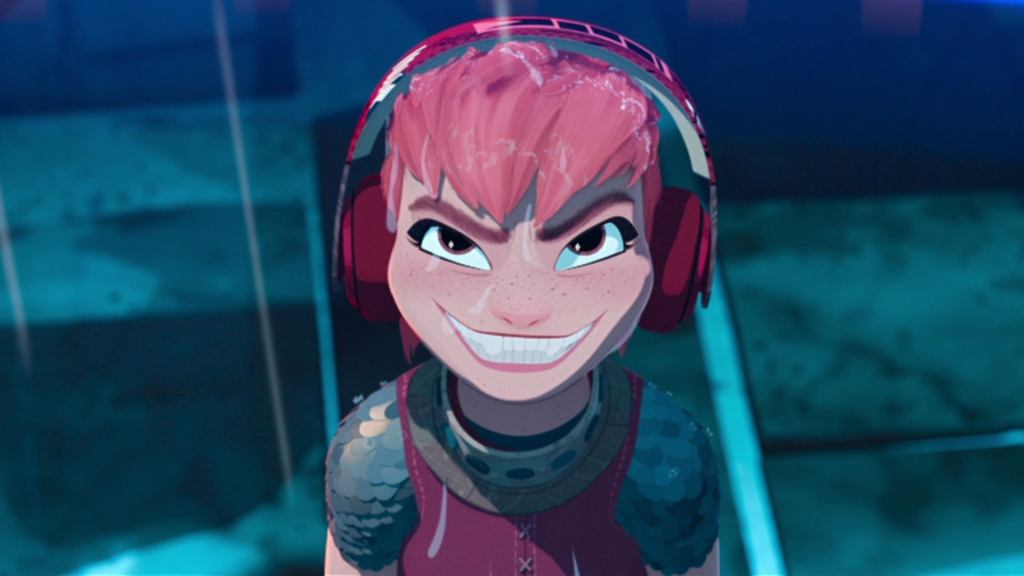
God I love Nimona! She is one of the best pure characters in animation I’ve ever seen. Her desire to be a villain, her impulsive nature to create playful chaos, her sense of humor, her shapeshifting ability, all of it works to perfection. The somewhat steampunk world she inhabits isn’t always amazing, but she most certainly is.
What makes the film Nimona work so well is its relatability and its sense of empathy, which seems odd given the otherworldly elements at play. A lot is made of the fact that Ballister and Ambrosius are an openly gay couple, and that Nimona herself can be seen as a symbol for issues with gender identity, and all of that is great. But the trick is that it’s not overtly thrown in your face as a “message” movie. No one makes a thing out of Ballister’s relationship. There’s no heavy-handed posturing about how Nimona “feels” like a girl one day, a boy the next, or something else entirely the day after. She just changes when she wants to, living in the way that feels most natural and logical to her needs in the moment. There is deeper meaning to all of that, but kids who aren’t necessarily ready to handle that subtext can still see her as just an awesome mischief maker.
And even setting aside the potential demographic implications, the core story about acceptance and love will resonate for just about any viewer. In the film’s climax, where Nimona in her “demon” form is ready to sacrifice herself just to end her pain, you feel that deep in your soul. It’s not a case of treating suicide as a “noble” option, like so many films do, it’s about a being that has endured unceasing torment and grief, to the point where she sees herself as the monster that others make her out to be, and decides it would be better to slay that monster than continue living as a pariah through no fault of her own. That cuts deep, man. Really deep. I’ve rarely seen the self-loathing at the heart of suicidal tendencies depicted so honestly, and beautifully. We live in a world where it’s all too easy to dismiss someone’s entire existence for purely superficial reasons (just look at Twitter), but to bring it out into the open and show the genuine harm it can cause is a bold choice for what is ostensibly a movie for kids. The fact that it happens to a character that is just so objectively bad-ass and cute (the love for emo girls never dies) only makes it sink in more.
Robot Dreams – Pablo Berger, Ibon Cormenzana, Ignasi Estapé, and Sandra Tapia Díaz

As mentioned above, it is an absolute crime that general audiences won’t get to see this movie until months after Oscar Night, because it is a genuine delight. The art design is bright, colorful, and vibrant. The time capsule love letter to 1980s New York is superb. The characterization is amazing. And it all happens with basically no dialogue, which is INSANE for an animated film.
No one wants to be truly alone forever, even us introverts. Just because someone’s not a social butterfly doesn’t mean they don’t need companionship. That’s what motivates Dog (one of the few flaws the film has is that every anthropomorphic animal is named after what it is, even though there are many, many dogs in this version of NYC) to order Robot off an infomercial, to create a friend of his very own. And contrary to how many of these stories run, this is not a transactional relationship for Dog. He truly wants to show Robot the world, take care of him, and form a genuine rapport. Even when circumstances force them apart, he still worries for his friend, rather than bemoaning the loss of an appliance. The turns of the plot are numerous and surprising, and ultimately result in an unexpectedly poignant statement on what it means to be happy and sacrifice for someone else.
But even before we get to that, there’s just so much fun to be had. I’ve never seen a film get more mileage out of Earth, Wind & Fire’s “September,” for example. The amount of slapstick and sight gags could rival The Simpsons in its heyday. Every character feels totally fleshed out without ever saying a word. It’s truly impressive.
I just wish you all could see it.
Spider-Man: Across the Spider-Verse – Kemp Powers, Justin K. Thompson, Phil Lord, Christopher Miller, and Amy Pascal
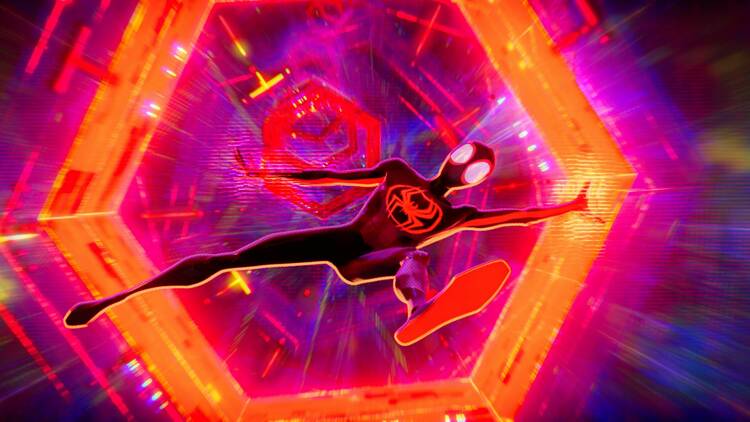
It’s hard to find something to quibble with in a film that managed to one-up its own predecessor as one of the most ingenious, mind-blowing, and ambitious animated films of all time, and jet Lord, Miller, et al managed it in a lot of aspects. From the next-level animation (the mood coloring in Gwen’s scenes is off the charts amazing), to the meta implications of the plot, to the fully committed vocal performances, to the sheer number of different and distinct versions of Spidey, it’s very easy to see why this is the front-runner once again.
The only real quibbles I have are in the story and the runtime. Some actions are based far more in plot utility than character motivation. Some sequences stretch on just a bit too long, creating an unnecessary cliffhanger ending that would have been avoided if things were just a bit more tight. The entire concept of “Canon Events” is a great incitement… except that Miles Morales arguably already had that moment when he lost his Prowler uncle in the last movie. The quasi-villain turn for Spider-Man 2099 was far too obvious and telegraphed. In most other films, none of these would be worth mentioning, but the Spider-Verse series is clearly on another level in most respects, so when they do slip up, those errors are all the more noticeable. I would still watch this – and the original, AND the next one when it comes out in 2025 – a hundred times without hesitation. But this year in the category, it’s a game of inches from a sheer quality standpoint, and it’s a disservice to not acknowledge the few imperfections while we’re having so much fun.
***
This is one of my favorite categories every year, because as my life has gone on, I’ve been able to witness in real time the transition of animation from being mostly just a medium for children to an artform that defies genre and classification, pushing every storytelling boundary there is, and oftentimes blowing right past them. Every year should be as solid as this one is as far as how good the nominees are, because this is the one type of film that is truly only limited by your imagination. The more this fact gets recognized, the better off the entire industry will be.
My Rankings:
1) The Boy and the Heron
2) Nimona
3) Spider-Man: Across the Spider-Verse
4) Robot Dreams
5) Elemental
Who do you think should win? Vote now in the poll below!
Up next, only one category remains until Best Picture, and it’s the one that has the largest amount of controversy surrounding who got in, and who didn’t. It’s Best Actress!
Join the conversation in the comments below! How much animation do you watch in a given year? Should all nominated films be required to be accessible to the general public? Would you buy yourself a robot friend if given the chance? Let me know! And remember, you can follow me on Twitter (fuck “X”) and YouTube for even more content!

 I Actually Paid To See This
One thought on “Oscar Blitz 2024 – Animated Feature”