
The early rounds of Awards Season are well underway, with the ultimate prize being the Oscars. If you’ve read this blog with any regularity, you know that the competition for International Feature is almost always intense and difficult to track, as there’s no formal requirement that the submitted films ever screen in the United States. The deadline for entries was back on October 2, and as noted here, Ireland was first out of the gate with the wonderful Kneecap. Since then, 88 other countries joined the fray, with a total of 85 films accepted by the Academy and presented to members for viewing and voting. China’s submission, The Sinking of the Lisbon Maru, was disqualified because the documentary had more than half of its dialogue in English. Subsequently, Jordan withdrew its entry, My Sweet Land, due to a diplomatic dispute with Azerbaijan. Finally, Haiti’s film, Kidnapping, Inc. and Uruguay’s The Door is There were left off the final lists for undisclosed reasons, making this the smallest field for International Feature since 2016.
Some of the hopefuls already have strong, assertive marketing campaigns behind them, with none bigger than France with Emilia Pérez working in tandem with Netflix. It’s probably the front-runner for now, but there are over a dozen that are also available to watch on various streaming and VOD platforms, so that the discerning viewer need not default to it.
Thus far, I’ve made my way through 16 movies vying for this prestigious honor, with the bulk of them coming from festivals and online access, and I still have several more at my fingertips. With a month to go before the Academy releases the shortlists, now’s as good a time as any to go over a few of them here. All three of these pictures are accessible right now, either as part of a subscription or for a VOD rental, so if you want to clear a few off the list, this is a good place to start.
The Devil’s Bath – Austria
Availability – AMC+, Philo, YouTube, Sling, Roku Channel, and VOD Rentals

Austria’s entry is a bit of good old fashioned 18th Century superstitious horror, centered on the melancholy associated with traditional gender roles with a nice dose of cultish gore thrown in for good measure. Written and directed by Veronika Franz and Severin Fiala (the team behind 2019’s The Lodge), the film takes a long, hard look at the dark side of rural married life while also incorporating elements from classics like The Wicker Man.
Experimental musician Anja Plaschg stars as Agnes, a young woman who begins as the happy new wife to fisherman Wolf (David Scheid). Essentially sold into wedlock by her poor family, Agnes is nonetheless thrilled to experience wedded bliss, hoping to quickly become a mother and be of service to the woodland community that adopts her. She knows it is her duty to God to be a good, submissive wife, support her husband in all things, and raise proper children. This has been drilled into her head since birth, and is completely natural to her.
However, things start to quickly go awry, and Agnes discovers the truth behind the idyllic face of her new normal. At her wedding, her brother (Lukas Walcher) gives her a severed finger as a wedding present. The finger comes from a woman who was brutally executed at the beginning of the film for killing a baby. Oh yeah, did I mention that the opening scene shows this lady carrying an infant up a waterfall and chucking it over like the end of Last of the Mohicans? Cause that’s a tone-setter if ever I saw one! However, given the insular superstitions of the community, Agnes happily accepts the finger, thinking it will be a good luck fertility charm if she stores it under her mattress.
Things only get more fucked up from there. Wolf refuses to have sex with her, as he’s pretty clearly shown to be secretly gay, Wolf’s mother (Maria Hofstätter) completely takes over Agnes’ domestic life and criticizes everything about her, and acts of basic courtesy are seen as weakness, particularly when Agnes gives a very pregnant woman an extra piece of bread at a work site. Instead of taking an empathetic stance that the woman needs extra nourishment for the baby and shouldn’t even be performing manual labor this close to giving birth, she’s berated for rewarding laziness, and then gets shunned by that same woman later on for denying her the extra. Agnes can’t win for losing, with everyone blaming her for things that are well beyond her control, robbing her of any individualism.
This eventually leads to a depressive spiral where Agnes attempts suicide, which is seen as a worse sin than murder in this close-knit group. Yes, the woman who threw a baby off a cliff and was publicly executed, with her headless mutilated corpse left to rot in the forest, is still considered better off than someone who takes their own life. It’s sick beyond measure, compounded by the gaslighting efforts of the townsfolk to convince Agnes that it’s she herself who is unwell.
The portrayal and depictions of this hypocrisy are handled really well, as are the few moments of shock gore that go along with the slow burn tension of the plot. My only real complaints are that the pacing is a bit off (Agnes’ growing madness comes in fits and spurts rather than a steady progression) and that the initial escalation happens far too quickly to be wholly believable. Maybe something is lost in the translation, but watching the film, it occurred to me that so much suffering could have been avoided if the characters were upfront about their wants and needs and not so passive. Only Wolf’s mother has any real agency, and she uses it solely for controlling purposes, be it towards Agnes or Wolf. At times, this otherwise brilliant story devolves into what I call “Sitcom Territory,” where a simple adult conversation would resolve 99% of the issues at hand, but they just don’t because reasons. In a 22-minute comedy, this works fine, because things wrap up neatly by the end of the episode. In a two-hour feature, it can become tiresome.
Still, the good stuff far outweighs the bad, and the giddy joy on display during the grizzly finale is worth the time it takes to get there. I don’t think this will ultimately be nominated, but it could sneak onto the shortlist, and is definitely deserving of your eyeballs.
Grade: B+
Old Fox – Taiwan
Availability – VOD Rental
Last week I did a “Back Row Thoughts” column on films that should have been seen before the election in hopes that it might sway a voter or two away from making the worst decision in modern American history. Sadly, that did not come to pass, and we as a society may be jolly well fucked for the next four years and beyond, with Donald Trump’s prospective cabinet being an almost literal murderer’s row of horribleness, from a Homeland Security secretary who shoots puppies in the face, to a potential known pedophile and child sex trafficker as Attorney General. The warning signs were all there, and somehow a majority of American voters chose to either ignore them or endorse them against all logic and basic human decency.
In that respect, Taiwan’s entry, Old Fox, might have been added to the list of films in that post. A morality tale set against the backdrop of rapid social and economic changes in the country (yes, I call it a country without apology, and therefore am braver than John Cena), the movie asks a very simple question that only a child should struggle with: if given the choice, do you take a humble life and help people, or a wealthy life without care for anyone else?
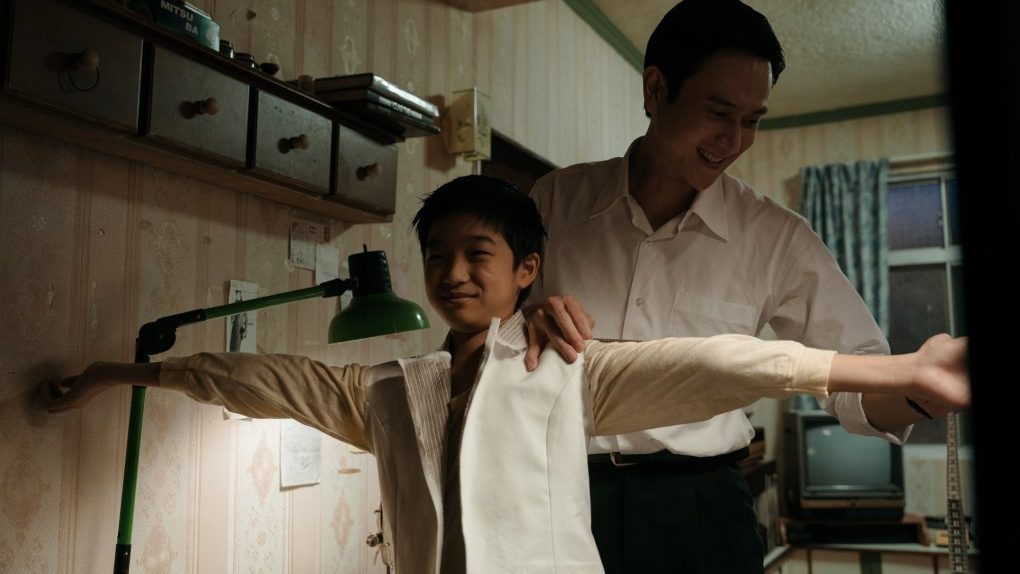
Well, in this case, a child does struggle with it. Liao Jie (Bai Run-yin) is an 11-year-old son of a widower (Liu Kuan-ting) who makes an honest working class living in a posh restaurant. Jie’s father scrimps and saves so that one day they can buy a house (they currently rent in a poor neighborhood) and convert it into a shop as a means to honor his late wife. Jie himself is bullied at school for his father’s lack of riches and for being scrawny, and wishes against everything for his dad to raise the money as quickly as possible. When one of his landlord’s agents (Mugi Kadowaki) reveals that a unit will soon open up for sale, Jie is insistent that his dad spend all their savings to snatch it up immediately before there are any other bidders.
One day, Jie meets the landlord, Boss Xie (Akio Chen), a local mogul and the titular “Old Fox,” a nickname given to him for his sly and opportunistic business sense. Seeing himself in the boy, Xie befriends Jie and tries to teach him how to be a “winner” in life, including abandoning all sentimentality and leveraging every weakness you can find in others. Xie thinks of Jie as a second chance after losing his own child, who rejected his miserly ways. In that sense, Xie is something of an Ebenezer Scrooge-like character, but it’s the young Jie who must face the crisis of conscience and choose between his father’s grace and his mentor’s greed.
I really like the performances here, as well as the script by Chan I-wen and writer/director Hsaio Ya-chuan. There’s just one aspect that really, really bugged me, and that’s Jie himself. I’m all for precocious youngsters in films, and it’s understandable to a point that the boy doesn’t fully grasp the situation. That said, every time he starts an argument with his dad about why they’re not buying the house and making the shop NOW (NOW NOW NOW NOW NOW!), I wanted to throttle him. I get that he’s only 11, but for fuck’s sake kid, learn some goddamn patience. The offer of the open unit was an unexpected jump in his father’s plan, a shortcut to the end. By turning it down, he’s only keeping things on schedule, attaining the goal when he said he was going to had the new opportunity never presented itself. This isn’t an actual dilemma. Turning down the offer doesn’t mean they’re homeless tomorrow or that mom will haunt them for eternity. It’s just sticking to a plan, and the fact that Jie utterly refuses to see that infuriated me at points. Even his burgeoning rapport with Boss Xie is based on trying to butter him up so that Xie will sell to his dad for cheap. I’ve seen literal train conductors with less of a one-track mind.
Once you set that aside though, things do proceed well enough. The ethical quandaries are realistic and all too familiar at this point, and the moments where Jie finds a bit of redemption are touching in the extreme, particularly as it relates to one of his bullies. When the film focuses on these moments, it’s fantastic. When it allows Jie to temporarily become Veruca Salt, I struggle. Still, really good overall.
Grade: B+
Laapataa Ladies – India
Availability – Netflix

It’s odd how much heft Netflix is putting behind Emilia Pérez when there are other candidates on its own platform that aren’t getting nearly the same level of attention. One such hopeful is India’s entry, Laapataa Ladies (or Lost Ladies as the translation goes), a delightful comedy of errors sadly shunted off to the side in this competition, I’m guessing because India chose it over this year’s bigger critical/festival darling, All We Imagine as Light.
Set in 2001, mostly so we can have scant mobile and internet resources for this caper, a newly married couple, Deepak and Phool (Sparsh Shrivastav and Nitanshi Goel, respectively), board a crowded train after their wedding to go home to Deepak’s family farm. They aren’t the only couple there, with several others making their compartment rather cramped, and all of the brides wearing the same veil to cover their faces. After dozing off, Deepak wakes up in time to disembark on his stop, taking who he thinks is Phool with him. Upon arriving at his homestead, however, he lifts the veil to discover that he has taken the wrong wife, Phool’s place filled by Jaya (Pratibha Ranta), who introduces herself as Pushpa. Meanwhile, Phool arrives at the end of the train’s route, scared and confused, and sees Jaya’s intended groom, Pradeep (Bhaskar Jha) quite angry and accompanied by various goons, implying that he’s a gangster. Phool asks the station master (Vivek Sawrikar) for help, but as she’s illiterate and doesn’t even know the name of Deepak’s village, she’s stuck.
What follows is a light farce as Phool makes a small living at the train station, selling food and tea with the shit-talking-but-still-matronly Manju Mai (Chhaya Kadam) while waiting in case Deepak comes looking. Meanwhile, as Jaya tries to hide her identity for her own safety (her marriage to Pradeep was very much NOT wanted), she ingratiates herself into Deepak’s family and introduces progressive ideas to the women. Deepak himself enlists the help of a corrupt police officer (Ravi Kishan), who believes that Jaya is a thief and has her comically tailed.
The entire affair is rather silly, but it’s the fun kind, and believable to a certain extent. As I said, the setting of 2001 is mostly to put up roadblocks in what would be an easy investigation today, and the practice of arranged marriages in rural parts of India can certainly lead to circumstances as weird as this one due to the simple lack of educational opportunities for poor women. The more trite moments are forgivable because the film definitely has its heart in the right place, and if nothing else, our two leading ladies give fantastic performances that radiate charm and good humor in every scene.
That said, I do have to wonder about the state of policing in India. I’ve seen a fair few films out of the country (or set in it) over the last few years, and this theme of incompetent cops who are easily swayed by bribery pops up so often that it’s become a downright trope. I sincerely hope this isn’t a reflection of reality, because while Kishan’s antics (and those of his deputies played by Daood Hussain and Durgesh Kumar) are very funny, between this and another International Feature entry dealing with similar subject matter in a much more serious way (Santosh out of the United Kingdom), I’m genuinely concerned about India’s justice system, or lack thereof.
Grade: B
***
This should be enough to get you started if you’re looking to polish off a few entries and you don’t have access to indie and arthouse theatres. There are at least seven other submissions that are available to stream as of this publish, and I’ll get through them all in due time. My goal is to see at least 30 candidates this year, so fingers crossed!
Join the conversation in the comments below! Have you seen any of these films? Which is your favorite? Would any get your vote for the International Feature prize? Let me know! And remember, you can follow me on Twitter (fuck “X”) and subscribe to my YouTube channel for even more content, and check out the entire BTRP Media Network at btrpmedia.com!

 I Actually Paid To See This
2 thoughts on “DownStream – First Foreign Forays”