
Last week, Oscar completists like myself got the first major announcement about the films vying for next year’s prizes, a triad press release from the Academy listing the submissions deemed eligible for Documentary Feature, International Feature, and Animated Feature. As I do every year, I make it my goal to track down and view all of the entries for animation, as there’s no shortlist of 10-15 movies to lump in with the others. You can read the full slate here, but the long and short of it is that there are 31 films officially in the competition (I watched The Greatest Surf Movie in the Universe and Dragonkeeper for NOTHING!), and so far, I’ve seen 15. Of the remaining 16, 14 of them are either readily available to me or will be coming out over the next month. There are two that I can’t track down yet (I try every year but I’ve never finished the full set), so if you have information on Captain Avispa or Rocket Club: Across the Cosmos, I’d appreciate the tip.
I’ve covered most of the ones I’ve seen already, but there are a few that I’ve kept in my back pocket waiting for this announcement, mostly because they’re all foreign affairs. So now’s a good time to go over them. Each of these five films has something to offer, be it in terms of story or artistic merit. In two cases, they’ve been put forward by their respective nations as their pick for International Feature as well, so you know there’s at minimum a great deal of pride in these works. I don’t expect them all to be nominated come January, but I wouldn’t be surprised if one or two do hear their names called.
Sultana’s Dream

A Spanish production directed by Isabel Herguera, Sultana’s Dream made waves over the last year due to its art style and local messaging, winning the prize for Best Basque Film at the San Sebastián Film Festival. I agree that the animation itself is quite creative, but the story is far too niche to attract a wide audience, and there was one major technical issue that prevented me from fully engaging.
Miren Arrieta stars as Inés, who goes on a sort of Eat, Pray, Love bit of globetrotting in search of the fictitious “Ladyland,” conceived by writer Rokeya Hossein in her 1905 short story that gives the film its title. It’s a feminist utopia where gender roles are completely reversed, with women leading the society through art, science, and diplomacy, while the men remain indoors as househusbands, willingly giving up their power after wars had rendered them cowards. Through her travels, Inés seeks to learn more about the idea of matriarchal societies as well as Hossein as a person.
This is wonderfully illustrated through three distinct art styles. In the main journey, where Inés talks to other academics, studies works, and has a romantic affair, the animation is traditional hand-drawn ink and paint with a mixture of angular and curved forms that evoke a touch of Picasso’s cubism. I particularly loved the design of Inés herself, with a pointed nose, curious eyes, and an ethnically ambiguous skin tone. She feels like a real person despite the somewhat abstract nature of her look. For the life story of Hossein, we switch to intricately detailed shadow puppets. As for Ladyland, it is illustrated through mendhi, or henna art as we know it more commonly in the West. All three techniques go a long way towards getting the story across in pure visual terms.
This is crucial because the dialogue does not offer much. I don’t know if this was a problem with the theatre where I saw the film (the Laemmle chain is usually REALLY good about this, as foreign and indie films are their bread and butter), or if it was an intentional choice on Herguera’s part, but there was no subtitling. I lean toward it being intentional, because this isn’t a case where the film is in Spanish and my lack of knowledge in the second-most common tongue in Los Angeles once again becomes my downfall. This story is presented in six different languages: English, Basque, Bengali, Hindi, Italian, AND Spanish. But we get no translation for anything. So basically I’m left only understanding, at best, a third of the dialogue. Given that variety, you have to think that if Herguera wanted the voices and words to be understood, there would be a drastic need for subtitling, but it’s just not there. As such, the visuals have to get the story across as unambiguously as possible.
To a degree, it works, but there were large swaths where I was just trying to keep up, especially in the Bengali and Hindi sections, as I know absolutely nothing of either language apart from loan words. With the Spanish and Italian, I know some Latin roots, so I did my best to suss out keywords that would help contextualize the individual scenes. But in the end, it wasn’t enough, leaving me just getting the gist of what I was seeing, rather than fully experiencing it. Again, this could have just been a glitch in the theatre (I was the only one in the auditorium and it was the last day they were showing it), but my gut says it was a choice, and if you’re trying to engage people on an artistic and intellectual level, you have to make absolutely sure the message gets across. Sadly, it just didn’t. My curiosity was piqued certainly, but I very much struggled to understand all of what I was watching.
Grade: C
Ghost Cat Anzu
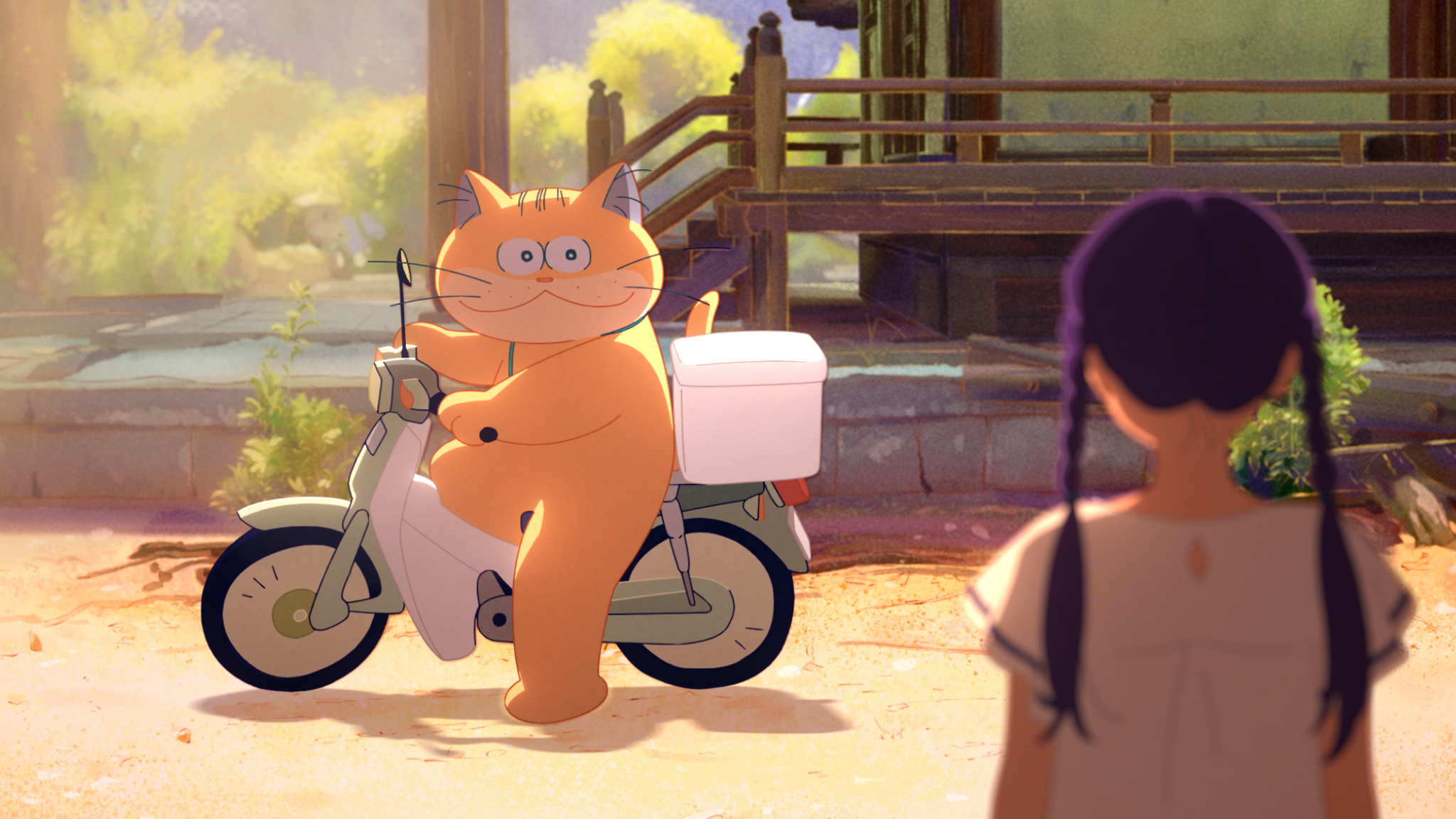
Screening at the Directors’ Fortnight at this year’s Cannes Film Festival, and nominated for Best Feature at the Annecy Festival, Ghost Cat Anzu is a sweet, simple coming-of-age story about loss and coping, brought to life with the delightful anime touch that we all know and love, thanks in large part to the anthropomorphic yōkai leading the antics. It’s nothing we haven’t seen before, but it will definitely put a smile on your face.
An 11-year-old girl named Karin (voiced by Noa Gotō in Japanese and Evie Hsu in the English dub) leaves Tokyo with her father, Tetsuya (Munetaka Aoki/Andrew Kishino) several years after the death of her mother Yuzuki (Miwako Ichikawa/Erica Schroeder). Arriving in a small village, Tetsuya takes her to the local temple, where his father lives, in order to ask for money because he’s massively in debt to loan sharks. When he’s refused, Tetsuya leaves Karin in her grandfather’s care, along with Anzu (Mirai Moriyama/Jason Simon), a bakeneko, which is a large cat-like spirit similar to a nekomata. Anzu was adopted as a sickly stray kitten, but after decades, he never died, eventually growing to human proportions, learning to talk, and even taking up part-time work as a massage therapist. As a yōkai, Anzu can see and hear influences both in the human world and the spirit world, so he’s tasked with protecting Karin.
Karin herself is headstrong and resentful. Tetsuya is an unreliable parent at best, and she never got to properly mourn her mother’s passing. Bored out of her mind, she passes the time by playing pranks and manipulating two local boys who are just old enough to notice when a pretty girl notices them. When Tetsuya breaks his promise to return on the anniversary of her mom’s death so they can visit her grave together, Karin becomes determined to make the trip herself. After meeting several other yōkai, she even gains a bit of sympathy and cash after playing up her angst. When Anzu calls her on her bull, she accepts him accompanying her to Tokyo, and eventually to the Land of the Dead, in hopes of getting the closure she needs.
There’s a lot of wackiness on display here, from the various monsters and spirits, to the oni who pursue them in the real world, including in a zany car chase. Yet somehow, it all stays just grounded enough to be believable within context. Karin is no Veruca Salt by any means, but in a weird way it’s refreshing to see a grieving child be something of a mischievous brat who tries various underhanded tactics to get her way when she’s had the worst happen to her in her short life. It’s also kind of fun that Anzu and Karin basically have their adventures separate from one another until the story needs them to team up. That gives us ample time to get to know each character beyond just the superficial and the silly.
This is aided by the animation, which in a rare turn for anime, was filmed in live action and rotoscoped. It adds the illusion of three dimensions and provides just a touch more visual depth to what we’re seeing. I’ve never seen rotoscoping done in this way before, especially since Eastern animation typically moves the characters at a different pace than Western animation. The slight lag in the movement somehow becomes more fluid, and this giant paunchy feline somehow feels tangible. It’s really well done.
The story beats aren’t revolutionary by any means. We’ve had plenty of films, including great anime works like Suzume, The Boy and the Heron, and The Imaginary just in the last two years, that tackle the loss of a parent in fantastical ways. And if I’m being honest, those films did it better. But that doesn’t mean that Ghost Cat Anzu is subpar by any means. It’s charming, funny, and heartfelt, tugging on your strings at precisely the right moments. I was left wanting in a few aspects, like hoping for a fuller exploration of the Land of the Dead, or some sort of postmortem reconciliation between Tetsuya and Yuzuki, or any exploration for why the God of Poverty (Shingo Mizusawa/David Goldstein) needed to be involved at all. But the movie definitely gets it right where it counts, and the clever use of rotoscoping was a visual treat I didn’t expect.
Grade: B
Flow

The official Oscar entry for Latvia, Flow is a very straightforward and simple tale of survival, told on a massive scale with some of the most gorgeous animation I’ve seen in a while. The second feature from Gints Zilbalodis (after 2019’s Away), this film sees the full realization of Zilbalodis’ talent and potential in a sweeping odyssey that fixes the storytelling shortcomings of his last outing and gives audiences of all ages something new and wonderful to behold.
Like Away before it, Flow has no dialogue, and is designed like a beautiful indie video game, with Zilbalodis using the open-source Blender software for this effort. However, this time around, there are no human characters, only animals. There’s also no grand metaphor for the proverbial circle of life, and apart from one character and one key moment of the plot, there really aren’t any supernatural elements. Everything here is conducted with a sense of realism, at least as far as the presentation is concerned. The most reductive way I could describe this is if someone put The Adventures of Milo & Otis through the Unreal engine, which would be spectacular if that’s what this actually was. But it’s so much more.
In some remote forested area, a singular black cat makes its living roaming around and being just generally adorable. It resides in an abandoned house filled with wood carvings of cats and other various animals, overlooking a massive wooden cat statue the size of a giant Buddha. One day, after dodging a group of dogs that alternately fight over fish and rabbits, a massive herd of deer are seen running in the opposite direction, right before a tidal wave floods the land. Terrified and at a loss for instinct, the cat and the friendliest of the dogs scramble for higher ground as the waters quickly rise. The dog finds its pack in a small raft and barks what we assume is an invitation for the cat to join them, but it refuses. Eventually, when the water rises up even beyond that of the humongous statue, another boat passes by, and having no other option the cat swims for it, climbing on board and meeting a capybara. They’re eventually joined by a lemur that likes collecting floating trinkets, the dogs, and a secretary bird that has its wing broken by its flock after it defends the cat when the others try to kill and eat it. Now with no one but themselves, they must navigate these uncertain tides in search of any dry land, all the while dealing with the elements, each other, and on occasion, a passing leviathan whale (the aforementioned sole character that looks otherworldly compared to the main crew).
The animation here is dazzling to say the least, particularly reflections in the water. When the characters are looked at straight on, their outlines are soft, and similar to the style of Away, some of their features intentionally look washed out and unrendered. But when you see them reflected, their images become much sharper, to the point that they almost feel lifelike. This is only enhanced in the moments where the animals act in the most cutesy versions of their respective natures, particularly the dogs roughhousing with one another, or the cat spotting a ray of light focused off the lemur’s favorite mirror. It pounces on the lemur playfully like your own kitten chasing a laser pointer, and if you don’t want to just jump into the screen and give it all the cuddles, I don’t know what’s wrong with you. I’m allergic to cats and I was falling over myself wanting to pet it, especially when Zilbalodis makes its eyes widen. These bits not only add personality to the characters, but they also make up for the occasional odd beats where the animals work in decidedly human ways, like figuring out how to steer the boat.
But what’s even more impressive is the world that Zilbalodis builds, making this a large scale adventure almost beyond belief. Even before the flood, we see remnants of human civilization, implying that this might take place in a time after us, when the Earth reclaims itself after we’re long extinct. At the same time, there are signs of recent habitation, like the cat’s house, which has in-progress sculptures and paper sketches that can’t be all that old, so maybe all the people simply evacuated the area in anticipation of the wave. Similarly, our motley menagerie contains species from all over the world. The cat’s residence implies East or Southeast Asia, but like the dogs, it could come from anywhere. The deer look like they’re from Europe or North America. Capybaras are from South America. Secretary birds and lemurs are native to Africa, with the former residing all over the continent and lemurs being more localized in Madagascar. They represent a world that is forced together by an event that drowns any sense of environment or geography, with relics and ruins potentially representing any number of cultures.
What Zilbalodis is doing here is showing us that this is a universal story. It could happen everywhere and nowhere at the same time. Does humanity still exist? What part did they play in this disaster? Where are all these creatures from? There are an infinite number of answers to these questions, and an infinite number of possibilities as to what can happen next. Because of that, we in the audience are left to focus on these small animals and their place in this gargantuan expanse, leaving all other concerns floating away. This is about coming together for common survival, allowing us to project the feelings of friendship and camaraderie onto them without having to anthropomorphize them, and it’s not done with any sense of altruism or purity. Communicating only through their various noises and movements, their personalities are largely left to our imagination, even in the more explicit moments like the group overruling the secretary bird to let the rest of the stranded dogs onto the boat to rejoin their packmate. Zilbalodis draws these animals with just enough exaggeration to hint at a soul, but without it being overly cartoonish. It’s like if the Lion King remake actually tried to be good. There’s a realism underneath the animated sheen, rather than just photorealistic images that don’t match the dialogue, especially since there is no dialogue here. We’re the ones who get to interpret their feelings and motivations based solely on what we see, which is not only ambitious, but far more efficient than what Disney crapped out five years ago (and will be crapping out again in three weeks, once more not branding itself as animation despite there being no live action cinematography).
This film is the best example I’ve seen of the old cinema trope that “the real journey was the friends we made along the way.” The actual plot points are extremely basic, with one dot connecting to the other without anything getting in the way. What matters is how we get there, and Zilbalodis has created a true masterpiece to demonstrate this idea in its simplest and most bewitchingly endearing form.
Grade: A
The Glassworker

Pakistan’s Oscar entry represents new ground for the country’s film history. It’s the nation’s first ever feature-length hand-drawn animated film. That’s a tremendous achievement in and of itself. The fact that it’s really good makes it all the more special. Directed and co-written by Usman Riaz in his feature debut, the picture is a really well-made anti-war allegory that almost reaches something akin to perfection if not for one major issue.
Drawn in a style evoking anime, the movie is something of a steampunk wonder set in a war-torn country. It has no name, but given that the residents of this land fight their neighbors over one piece of territory that both lay claim to, it’s clear we’re talking about Pakistan and India, as well as their longstanding conflict over the region of Kashmir. In this area’s Waterfront Town lives Tomas Oliver (Khaled Anam in the original Urdu version and Art Malik in the English dub; I opted for the Urdu since this is an International Feature submission), a professional glassblower and artist, along with his son Vincent (YouTuber Mooroo in Urdu and Sacha Dhawan, famous for playing The Master against Jodie Whitaker’s 13th Doctor in English), who is training as his apprentice. Told mostly through flashbacks, the story unfolds in a letter read by Vincent from his childhood friend Alliz (Miriam Riaz Paracha/Anjli Mohindra), with whom he fell in love, after she was suddenly forced to leave.
Alliz is the daughter of the wealthy military leader, Colonel Amano (Ameed Riaz/Tony Jayawardena), who moved to Waterfront Town to use it as his base of operations as the nation prepares for war. Alliz, brilliant and beautiful, catches the attention of the entire town, but she doesn’t believe in simply becoming a military wife, instead focused on her passion for the violin. She meets Vincent while wandering into his father’s shop and seeing his artwork, and Vincent is instantly smitten, though Tomas, as a pacifist, is initially resistant to them becoming friends.
As Alliz and Vincent grow, they learn more about the harshness of the world, and try to stay close despite the norms of their society seeking to drive them apart. Vincent is seen as a coward because of his father’s opposition to the war, while Alliz is being groomed to eventually date and marry a young man at her school named Malik (Dino Ali/Sham Ali), who joins the military as a teenager and who meets with the approval of Alliz’s elitist mother (Faiza Kazi/Mina Anwar). There’s an innocence to Alliz and Vincent’s rapport, and you’re constantly rooting for it to turn into a romance, but as we’re all too aware, we don’t always get the happily ever after, especially when it seems like the entire world – or in this case the whim of the writers – is conspiring against them.
The animation is lovely, and there are some really deep themes worth exploring. For instance, Vincent challenges Alliz to become a “real” artist by creating something of her own rather than just playing pieces by other composers. It’s honestly an argument I’ve made many a time, especially when it comes to pop music, as the so-called “artist” often doesn’t write the music or lyrics, they don’t play instruments, and their voice is regularly distorted through autotune. They’re just the face of the track, making everyone else BUT them the true “artist.” It’s an argument that’s often been dismissed as me being a “hater,” but I’ve always stood by it. If you don’t create the art, you’re not the artist, and you don’t deserve that title. In this film, there’s a more nuanced approach to it, as instrumentalists are granted artistry through their interpretation of the music and their performance, so it’s not a true 1:1 comparison, but I do appreciate the sentiment behind it. Glass is all Vincent has, as he’s home schooled and has no other formal trade skills or education. His entire life is creation, set against a world that’s pushing itself towards mutually-assured destruction. The irony is potent, especially when Tomas is blackmailed into making glass for the military in secret, forcing him to carry the stigma of being a pacifist when a) there should never be one for NOT wanting people to die, and b) his work is actively saving the lives of the people who ostracize him, and Vincent by extension.
I really only have one problem with this film, and that’s the ending. I won’t spoil anything, but it was deeply unsatisfying given all the buildup. The character development and mirrored moments of sadness pointed in a singular direction, as did the multiple instances of foreshadowing and meditations on fate via the possible existence of djinns affecting certain outcomes (as well as creating the perfect sand that Tomas and Vincent use to make their glassworks). It was all leading to one outcome, but the film didn’t commit to it, and it was beyond frustrating. When the credits rolled, I literally screamed, “WHAT?!” from my chair (I was the only one in the auditorium) because I was incredulous about ending on the note it did. I decided to reserve judgment until I did some research to see if this was an original story or an adaptation. If it was the latter, I could let it pass and fault the source material, assuming the film was faithful to it. Instead, it’s the former, with three writers coming up with the story and script. That means they chose this ending that flies in the face of everything they established.
As such, take this grade the same way I intended for The Last Duel a couple years ago. The Glassworker is a really, really, REALLY good movie, with a sweet, heartwarming story and innovative animation. It just made one crucial stumble that prevented it from true greatness.
Grade: B
Living Large

We end with a joint production of the Czech Republic and Slovakia (Czechoslovakia reunited at last!), Living Large, a clever and creative bit of stop motion with a universally relatable story. This is one where I’m curious if I saw the wrong version of the film, but it’s the one that’s currently out in theatres now, so if you want to clear it off your list, now’s your chance.
In an ordinary city lives Ben Pipetka (voiced by Hugo Kovács in the original Czech and Tyler Joseph Gay in English), an overweight teenager about to start high school. He spends the summer beforehand hanging out and practicing music with his best friend Erik (Sebastian Pöthe/Fionn Kinsella), planning on performing at the school’s Christmas concert in December. This gives Ben plenty of time to write his song, which begins as a punk anthem about being hungry for life. However, we see that he’s hungry for basically everything else, as he eats tons of sweets and pastries, giant burgers, and lots of pasta. He loves cooking, but he clearly eats way too much.
When school begins, he seems well-adjusted enough, able to crack jokes and act cool even when he’s bullied by a local asshole named Max (Prokop Zach/Preston Bowman), his cronies, and even his own teachers. He also catches the eye of Klara (Agáta Tandlerová/Alexandra Hermans), who has, ahem, “developed” over the summer. He wants to impress her with his sense of style and humor – and also his ability to bake, as she loves cakes – but her brothers are Max’s goons, and they take every opportunity to make Ben’s life miserable. Things get worse for Ben when the school nurse gives him a physical and informs him that he’s dangerously obese, and an embarrassing incident at the local pool leaves him severely self-conscious. With the help of his veterinarian mom (Tatiana Dyková/Alyson Leigh Rosenfeld), his own zaftig divorced father (David Novotný/Wayne Grayson), and his dad’s new girlfriend Sofie (Eliska Krenková/Laurie Hymes), Ben resolves to go on a diet, both for his own health, and to impress Klara.
A movie like this has a lot to offer. The stop motion is superb, with the odd character and set models providing a fun and abstract absurdity to the proceedings. This is supplemented with fantasy sequences done in traditional 2D hand-drawn style, with a sort of pencil sketch filter, like they’re notes in a journal that Ben might doodle when he’s daydreaming. I buy most of the character dynamics, for good and bad, and there’s a strong sense of empathy for those who struggle with their weight. At first Ben has a very cavalier attitude about everything, eating whatever and whenever he pleases, but when the reality of his situation hits, you do get a real indication of just how hard it is to undo that damage. Trust me, as a 42-year-old diabetic who’s dealt with this his entire life and has had to learn to live with the man in the mirror rather than hate him, this stuff hits home.
The biggest problem with the story is that it’s a bit too predictable and a bit too mean-spirited at times. For example, this is set in the modern day, yet Ben is openly bullied by other kids with no intervention from adults, and sometimes the adults themselves partake. That’s some 1980s Stephen King shit, right there, not 2020s. Similarly, they make Ben’s situation out to be far worse than the objective numbers would indicate. At his physical, he’s listed as 5’5″ and 180 pounds (at least in the English dub, I assume the metric equivalent is used in the original). When I was in 8th grade, I weighed the same but was only 5’2″, and in some pictures I looked as wide as I was tall. When I started my senior year (before I began working at Burger King and fucked my body up further), I still weight 180, but I was now 5’10” and regularly wore a men’s medium shirt and 34-waist pants. Based on Ben’s model, he should easily be 50-80 pounds heavier than they say. I know I praised the odd shapes of the characters, but this feels like piling on for false pathos.
This extends to the plot itself, where Ben’s hurdles are easily foreseen. His motivations for getting in shape are grossly misplaced, so it’s no surprise that he goes into a depressive spiral when they don’t work out. You can chalk some of that up to teen angst and hormones, but the real problem is that he’s never given good advice, except from Sofie, who’s a wonderful character through and through. This is because she’s meant to deliver that last emotional whammy and recontextualize our sense of sympathy towards Ben, and I can respect that, even if it’s telegraphed from very early on.
Those are the only real flaws in the presentation, but as I mentioned earlier, I get the feeling that I might have watched the incorrect version of this film. The English dubbing is not great. Gay’s voice sounds like a bastardized blend of Michael Cera and Jonah Hill, and it only works in small doses. A lot of the dialogue feels like it was clumsily written to match the lip flaps rather than flowing naturally. This extends to the music that Ben and Erik make, as the singing feels way out of place and the lyrics simply don’t flow. I won’t fault the overall product too much on this, but this is a fully packaged English version (including English credits that only mention the English cast) that’s available for American audiences to see. I get the feeling there’s some vocal nuance in the Czech that would have felt less awkward.
Still, like I said, I won’t hold that against the film itself. That’s international sales and localization more than anything else. The actual movie is intriguing, at times quite funny, and has its heart in the right place, getting the sentimentality through when it’s needed. It has some story and character flaws, but depending on who sees it, I think the right lessons will get across.
Grade: B+
***
That’s all for this edition. Now to start speeding through the other 16 entries in hopes of finally completing the submission list before nominations in January! God help me.
Join the conversation in the comments below! Have you seen any of these films? Which was your favorite? How can a kitten mewing convey more emotion than two full hours of bland CGI crud? Let me know! And remember, you can follow me on Twitter (fuck “X”) and subscribe to my YouTube channel for even more content, and check out the entire BTRP Media Network at btrpmedia.com!

 I Actually Paid To See This
6 thoughts on “Back Row Thoughts – Animation Destination”