
One of the challenges of Awards Season is simply keeping up. Between the International, Documentary, and Animation submissions being released, and the eventual shortlists from the Academy (coming next week), just trying to stay organized and on task is its own daunting odyssey at times. It’s especially difficult this year, as the vast majority of contenders have been backloaded into the film calendar, coming out between mid-October and now. As I do my best to track down everything possible, it’s all I can do to not let the basic duty of review fall by the wayside. So naturally, I have a huge backlog to get through. We’re halfway through December, and this entry debuted in theatres on November 1. It’s already available to stream on Apple, as that was the main studio/distributor behind it. Needless to say, I am way behind schedule, but in an odd way, this film sort of illustrates the core issue with cramming everything into the end of the year.
Last year, director Steve McQueen came out with his first ever documentary, Occupied City. It was a massive, exquisitely detailed, and thorough tour through modern Amsterdam, comparing each location to its version and utility during the Nazi occupation of World War II. It also clocked in at four and a half hours, making it almost impossible to absorb all the information and properly contextualize it. His newest entry, Blitz, sort of suffers from the same problem, only in reverse. At an efficient and well-paced two hours, the movie doesn’t really waste time with side tangents, instead getting to the point and delivering a satisfying story. However, given the glut of everything else, the biggest dilemma is figuring out how any entry can distinguish itself and remain memorable as each week brings multiple new combatants into the fray, like the cinematic equivalent of a battle royale. Blitz is charming, poignant, heartfelt, extremely well acted, and has a great musical profile. All that said, I struggle to keep it fresh in my mind because at times it was too ordinary to really register.
McQueen has said in interviews that he made a point of not studying war movies for inspiration, as he didn’t want to succumb to the tropes of the historical genre. Instead, for this tale he relies on literary influences, particularly the works of Charles Dickens, putting a 20th Century spin on those classic themes. Social differences, the value of family, the uncommon resilience of children, and the struggle to survive in trying times all come to the fore in this relatively compact adventure that unfolds over the course of but a few days.
During the WWII German bombing campaign that gives the film its name, English citizens, particularly in London, had to adapt to a new normal where nighttime raids were common, local police and military enforced curfews, and the Underground became a network of subterranean shelters. It’s in this dangerous environment that we find Rita (Saoirse Ronan), a factory worker taking care of her aging father (Paul Weller) and her young mixed race son George (Elliott Heffernan), the boy’s Jamaican dad Marcus (CJ Beckford) having been deported before George was born.
As the destruction and devastation creeps ever closer to Rita’s neighborhood, she’s forced to make a difficult decision. For his safety, she arranges for George to be sent away to the countryside, where he’ll live in something of a commune with other local children so that he can continue to grow and learn in peace. George, who’s never felt like he truly belonged anywhere but with his family, doesn’t want to leave, and upon boarding the train, tells Rita that he hates her for abandoning him, as distraught kids are wont to do.
Rebellious, homesick, and already fed up with other boys bullying him on the train, George makes the utterly mad choice to jump off and make his way back home. Over the course of about two days, he stows away on a different train and befriends a trio of brothers who’ve also scarpered, gets back to London and tags along with an immigrant air raid warden named Ife (Benjamin Clementine), and is even abducted by a woman called Anita (singer Celeste) and forced to work for a group of thieves who use him to loot bombed-out shops because of his small size. By the time he’s able to extricate himself from these numerous quick trials, he’s become strong enough to do something truly heroic for the entire community, a gauntlet of experience before he can have the catharsis of reunion with his mother.
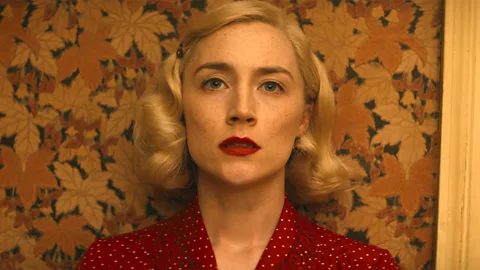
As for Rita, she’s fighting her own parallel battles. An experienced musician, she’s chosen to sing for BBC Radio as a means to cheer up the troops (an excellent, period appropriate original song called “Winter Coat”), and her coworkers use the occasion of a live broadcast to air grievances about the government’s response to the ongoing shelter crisis. Restless and wishing to do more to help without her own child to look after, she volunteers at a makeshift bunker to comfort kids who have either lost or can’t find their families, under the direction of a kind man named Mickey (Leigh Gill). And of course, once she learns that George has gone missing, she’s forced to set out looking for him, aided by a local soldier called Jack (Harris Dickinson) who has a crush on her.
So yeah, if a lot of these plot points seem familiar, you’re not alone. Pretty much all of them can be thematically or narratively tied back to Dickens, particularly the likes of Oliver Twist, Great Expectations, Bleak House, Hard Times, and Nicholas Nickleby. Part of it is because Dickens’ style provides a nice contextual backdrop to George and Rita’s respective journeys, but it also helps to create the film’s more individualized throughline about how history tends to repeat itself.
You can not only draw a bridge between these 19th Century works and the 20th Century story of life during the war, but also easily extend it to events occurring now in the 21st Century. Fascists and authoritarians continue to wage wars for their own power and gain. Good, common, working class people are often the collateral damage in much bigger affairs that they have nothing to do with. All of us are forced to look to whatever better angels we have in order to persevere. This is all territory that’s pretty universal.
But most importantly, McQueen gives focus to the idea of how we scapegoat “others.” George is mocked because he’s black. His father was deported after getting into a fight with racists who harassed him for being with a white woman. Ife gets side eyes from the locals when he’s just trying to help. Mickey, being a little person, is derided for his size. Rita, as a woman, is expected by her employer and her government to hold her tongue and do her work lest she lose what little income she has. As important as it is to come together in common cause during troubling times, McQueen also makes it clear that we can’t succumb to the very prejudices and infighting that allow the war machine to keep chugging along.
These are the elements – along with strong cinematography, Ronan and Heffernan’s performances, and a solid score by Hans Zimmer – that make this film really good, and well worth your time to watch. Where it falls short is in two areas. One is that the plot is all too predictable. As soon as you see George’s face, you know that there’s going to be a lot of time devoted to race. As soon as he jumps off the train, you know he’s going to get home. As soon as you meet multiple characters, you can tell that they’re clearly marked for death. As such, a lot of the emotional weight of the proceedings is sapped, making it harder to invest in what you’re seeing. There was literally only one event in the story that surprised me, but it was only for the execution of the moment, rather than the moment itself.
The second is the Dickensian plotting and characterization. None of it is particularly bad, but it’s so familiar that once you recognize one instance of it, you’ve kind of already gotten the point, and yet we go over it several more times. It’s entertaining enough in the moment, but because of its derivative nature, it becomes more difficult for the picture to establish its own identity, and by extension, it has to do more to stand out amongst the ever-growing heap of what will likely be Oscar also-rans.
This is a really well-made film, one that connects with the events of its setting as well as those of the audience watching it today. It’s just that, for this year, one which decidedly did not spread the wealth with the quality throughout the last 12 months, a film like Blitz isn’t unique enough to separate itself from the rest of the field. It came out six weeks ago, I saw it four weeks ago, and as I’ve been writing this review, I’ve had to rack my brain to remember the crucial plot details and emotions I felt when I saw it. It gets in and out quickly, it doesn’t waste your time, and it has some very important things to say. But just like the rubble and devastation left in the actual Blitz’s wake, when the dust settles, it’s hard to remember what was even there.
Grade: B+
Join the conversation in the comments below! What film should I review next? Are you feeling overwhelmed by all the prestige fare coming out at the same time? Would you ever jump from a moving train? Let me know! And remember, you can follow me on Twitter (fuck “X”) and subscribe to my YouTube channel for even more content, and check out the entire BTRP Media Network at btrpmedia.com!

 I Actually Paid To See This
One thought on “A Quick Rush – Blitz”