
We’re less than two weeks from Oscar nominations, and I’m doing my level best to clear out as many possible contenders as I can. I’m more than halfway through the Documentary Feature shortlist, and I only have one more International Feature semifinalist that I can watch before the nods are announced (Norway’s Armand is gambling on a release after the finalists are known). I have a bunch of Independent Spirit nominees that could cross over to get through as well, and I’m clawing my way through Netflix’s FYC lineup.
It’s a lot, to be certain, but who needs sleep, right? Anyway, the other field to tackle is Animated Feature. With 31 submissions and no shortlist, getting through them all is a very tall order, especially since two titles are currently unavailable in any form that I can find. Still, I’ve cleared 19 so far, and will almost certainly get to 22 or more before the deadline.
This column will focus on three of those hopefuls, each of which had fairly limited theatrical runs here in the U.S. Two basically just got the minimum one-week qualifier, while the other was a critical and box office flop, and thus only lasted about a month in mainstream cinemas. I’d wager that four of the five spots in the final category are already spoken for, but there is an outside chance that one of these three could snatch the last one, so it’s worth taking a look.
The Day the Earth Blew Up: A Looney Tunes Movie

This will blow your mind. The Warner Bros. animation department has been around, in some form, for about 90 years now, and yet somehow, this is the first ever fully animated feature-length theatrical Looney Tunes film put out by the studio. Yeah, to the amazement of all, any movie featuring the Looney Tunes characters either incorporated live action elements or was TV or streaming only until just now. That is wilder than Taz, my friends.
Anyway, the overarching moral of The Day the Earth Blew Up is that you have to take risks, that simply rebooting something popular may sell, but that doesn’t make it good. This line of thinking may seem rich coming from an entity like Warner Bros., who constantly reboot their franchises and destroy original content for tax write-offs, and on the surface, it certainly is. But part of the fun of this flick is in the ways that it actually does test the waters and push (safe) envelopes within its framework. Hell, the mere existence of the film as a cinematic first sort of illustrates the point.
But let’s go further. Given that this is the first Looney Tunes movie, who do you think is the star of it? Naturally you’d figure Bugs Bunny would take the lead. He wasn’t the first character created, but he’s been the face of the property for over 80 years. And yet, he’s nowhere to be found, not even in a passing reference or visual gag. Instead, this is a Daffy Duck and Porky Pig story (Eric Bauza voices both of them), with Petunia (Candi Milo) serving as the major side character/love interest. And really, that’s it as far as the core cast of cartoons. Not only is there no Bugs, there’s no Sylvester, Tweety, Elmer Fudd, Yosemite Sam, Foghorn Leghorn, Granny, or any of our other favorites. I mean, given the title, you’d think at least Marvin the Martian would show up, given his goal to remove his obstruction to viewing Venus, but nope. It’s just Daffy and Porky, and despite the madcap world they inhabit, the plot is honestly fairly grounded as a conflict between best friends/adoptive brothers where one tries to improve their lives (Porky) while the other is stunted by emotional arrested development (Daffy), manifested in his trademark zaniness.
Another genuine gamble is in the film’s presentation. Hand-drawn animation is something of a dying art form, but the creative team goes all in with gusto on the visual profile, with alternating scenes evoking the styles of the old Warner Bros. animation legends. One moment everything looks like it was drawn by Chuck Jones, the next by Tex Avery, and then another jump to Friz Freleng. You’d expect an animated film aimed at younger audiences to be filled to the brim with already-dated pop culture references, but this picture instead tugs at the nostalgia strings in a completely novel manner. Even the fourth wall breaks are limited to solid jokes, like Daffy openly hoping that “there’s no twist in the plot” before the word “FORESHADOWING” flashes across the screen in giant letters.
These are all surprisingly brilliant and heartfelt touches that lend the proceedings an astonishing degree of credibility, and weirdly makes the audience that much more invested in the inherently silly plot. Daffy and Porky get a job at a local bubble gum factory in hopes of repairing their dilapidated house (Petunia works there in R&D, trying to come up with the perfect new flavor), unaware that an alien (voiced by Peter MacNicol) has found a way to alter the recipe for a new rebrand of an older gum so that when chewed it turns people into zombies. You wouldn’t expect a premise like that to be sustainable beyond the seven minutes of a classic Looney Tunes short, but because of the care taken in developing Porky and Daffy as characters (at least within this batshit context) as well as the artwork, it is. Sure, things drag a bit towards the end, what with the standard third act conflict cliché (Warner can’t go bucking the ENTIRE formula, after all), but things held up quite well.
The film only came out for a week in late December for its qualifying run, and won’t get a wide release until February 28. That’s kind of shady, and falls under the Robot Dreams umbrella of “why should you be eligible if you intentionally wait until the Oscars themselves – or later – to let the public see it?” But that said, it is worth seeing, and not just for the novelty. This is something borderline spectacular.
Grade: A-
The Colors Within
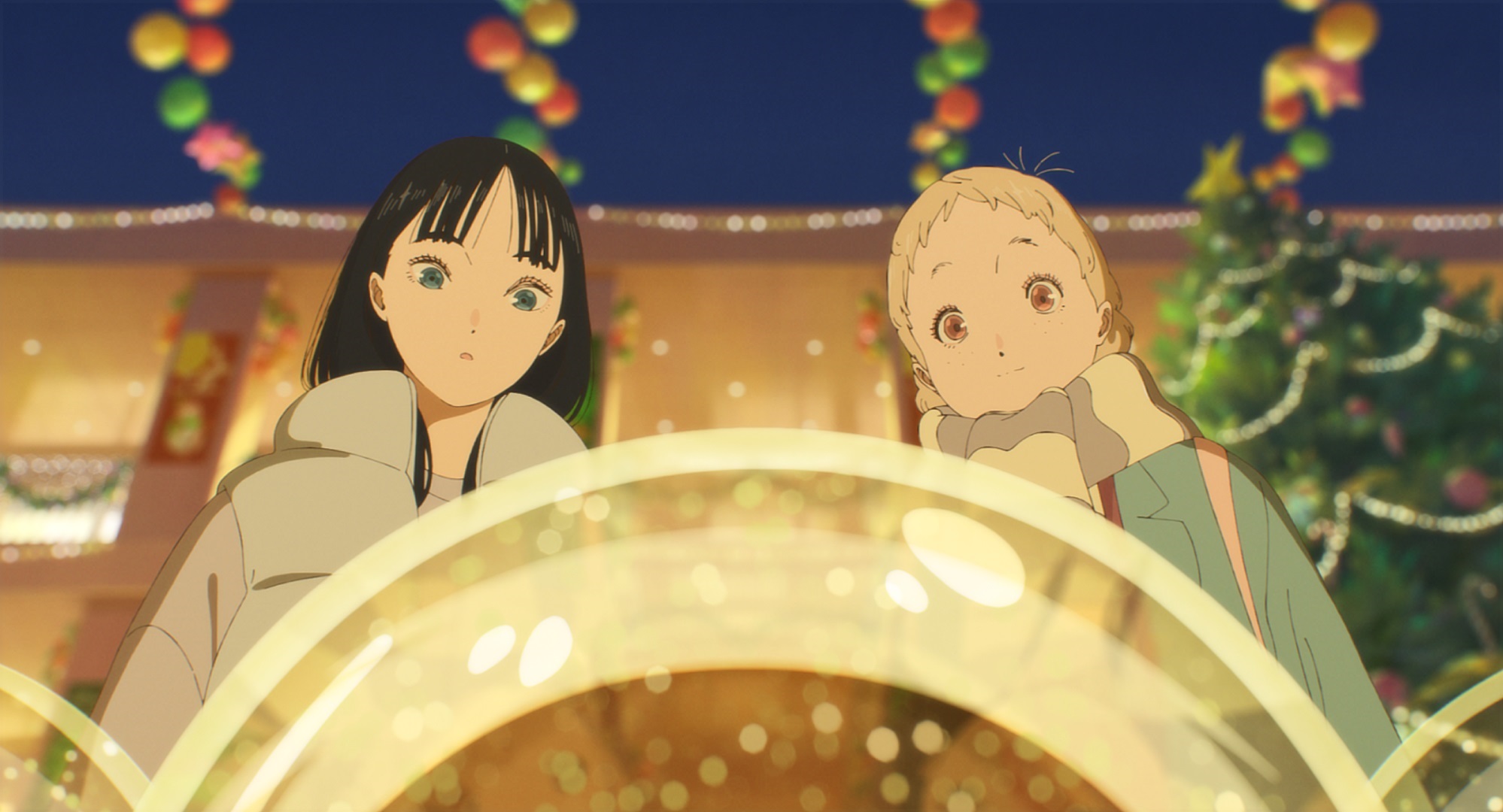
This is the third pure anime film I’ve seen for this year’s set, and so far I’d say this is the least of them. Don’t get me wrong, this is still good, but it does feel like a missed opportunity for some dazzling artistic and visual storytelling. Whereas the likes of The Imaginary and Ghost Cat Anzu did wonders with their creative premises, The Colors Within sort of rests on its own laurels for the sake of a standard teenage tale.
The story focuses on Totsuko (voiced by Sayu Suzukawa in Japanese and Libby Rue in English), who goes to an all-girls Catholic school. Forced to adhere to strict rules, she nonetheless leads a happy academic life, sharing a dorm room with three other students, enjoying dance, and never really questioning her religious education. The big, curious thing about her is that she has this ability to see people as colors, essentially able to discern personalities and behaviors from an aura-like hue that only she can see. Of particular wonder to her is upperclassman Kimi (Akari Takaishi/Kylie McNeill, i.e. Suzu from Belle), who is one of the most popular girls in school and who leads the choir. One day, while daydreaming about Kimi’s color, Totsuko accidentally takes a dodgeball straight to the face from the idol, and when Kimi drops out days later, she feels responsible.
Totsuko tracks Kimi down to a secondhand bookstore, where she notices Kimi working and practicing guitar. Through a series of awkward errors, Totsuko somehow forms a band with Kimi, as well as a nerdy boy called Rui (Taisei Kido/Eddy Lee), a computer DJ and theremin player who happened to eavesdrop. Over the next several months, the three spend all their free time together writing songs (eventually performing for the school) and dealing with their various adolescent issues.
None of these plot threads is necessarily bad, but we’ve been over all of them before. Totsuko’s discovering her more rebellious side, Rui is under pressure from his parents to go to med school and follow in the family line of doctors, and Kimi hasn’t been able to bring herself to tell her grandmother (Keiko Toda/Lani Minella) that she’s left the academy, feeling too guilty because Gran’s the one who raised her (no official word on her parents, but since it’s an animated movie for young people I think we can assume they’re dead), and she has such fond memories of her own time there. That last subplot is the only one that carries any weight, mostly because it allows us to explore why Kimi left when she wasn’t in any trouble, but that’s about it.
I wouldn’t care so much if these diversions didn’t take time away from the fantastic visual gimmick. Much of the film uses what appear to be washed out watercolors (or something similar), which allows Totsuko’s Color Vision to be especially vibrant by contrast. The possibilities for what director Naoko Yamada could do with this idea are endless, but sadly she just uses it as the setup for the standard but satisfying teen drama. It arguably should have been the focal point of the entire story. How does someone’s color define them? Can it shift depending on a mood or situation? Hell, if you want to go really crazy, what if Totsuko was blind except for this gift, which she wouldn’t be able to put into words because she doesn’t know what red or blue is? So much could have been done with this concept, but it’s mostly just for show in a few scenes.
That said, the film itself is perfectly cromulent. The character designs are fun, and the leads all have great personalities. The climactic concert is appropriately triumphant, with songs so catchy you might just find yourself grooving in your chair. The overall lessons learned about honesty, friendship, and loyalty are solid. Everything works in this movie, but when you see Totsuko’s ability, you do somewhat lament what might have been.
Grade: B
The Lord of the Rings: The War of the Rohirrim
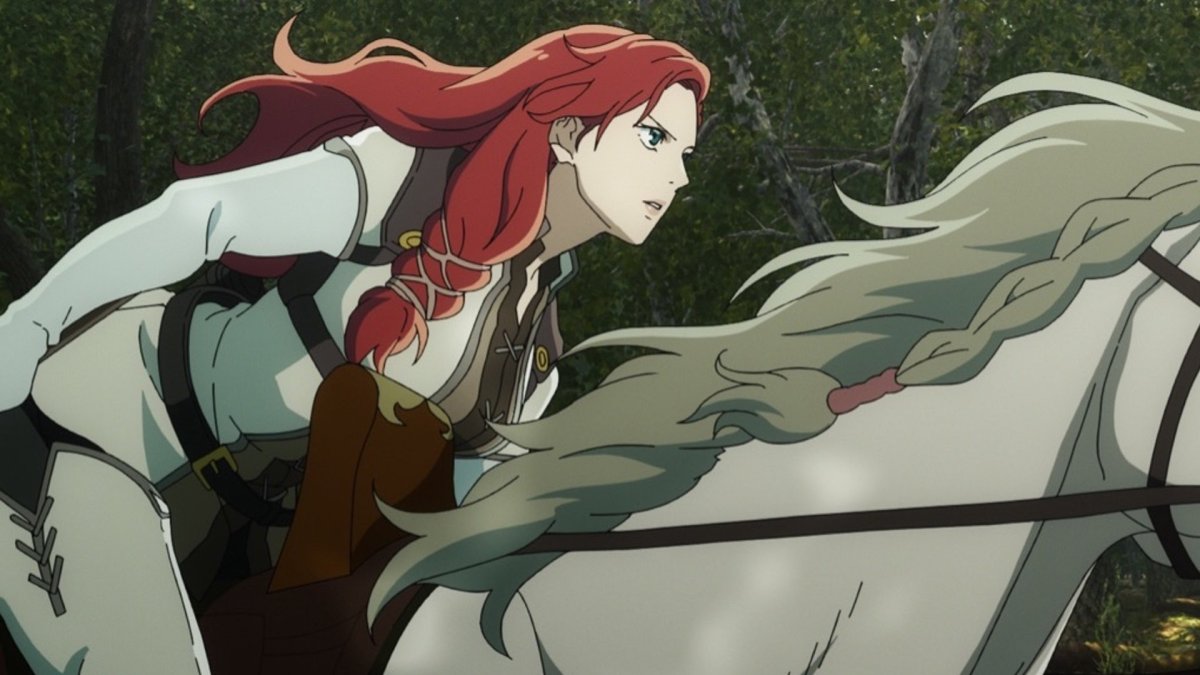
As I said, I’ve seen three animes so far, but this is one of two others (along with The Glassworker) that use the anime style. Directed by Kenji Kamiyama and produced by WingNut Films (the company that worked with Peter Jackson on his LOTR and Hobbit trilogies), this is the one mainstream release of the bunch. Adapting one very small section from the novels, the movie is absolutely gorgeous to look at, but is dispiritingly slight, which is why I think it ultimately fell short of expectations for critics and audiences.
Narrated by Mirando Otto as Éowyn (though she’s never named; you just have to recognize her voice like we did when Cate Blanchett as Galadriel narrated the opening to The Fellowship of the Ring), the core problem is revealed quite early, as the focus is put on Princess Héra (Gaia Wise), daughter of Rohan’s King Helm (Brian Cox). As she rides across the Riddermark like a wild and free grown-up version of Merida, showing off climbing skills and communing with the great eagles (a reminder that these birds do fuck all until there’s a plot convenient reason for them to be there), we are told that she was one of Rohan’s greatest heroes, but that she never appears in songs or stories.
Then what are we doing here?
Right from the off, the whole affair seems shoehorned, which is a side effect of having so little source material to go on. Just like The Last Voyage of the Demeter couldn’t get enough from 19 paragraphs of one chapter of Dracula to make a passable flick, so too does this fall short. The entire premise is based off the “House of Eorl” section of Appendix A of The Lord of the Rings, which mentions the line of Rohan’s kings, including Helm Hammerhand. The writers took the vague wonder of how he got that name (he killed a man with a single punch to the face), and then somehow got to, “Let’s create a daughter for him who’s stronger than them all, so we can Mulan our way to a backstory about how Helm’s Deep got called that.” And that’s just not enough.
This infuriates me, because honestly, it’s not like it would be difficult to make the viewer care about Héra. I mean, you want this old Irish otaku to engage with a busty, kickass, redheaded anime girl? I mean, twist my arm. If I must in the name of science. Come on, you’re talking to a man who would die happy tomorrow if he met an age-appropriate real-life version of Rias Gremory. I’m easy pickings here! But apart from her design and her determination to continue the legacy of the shieldmaidens, there’s nothing to her. We root for her because we’re told to, not because there’s anything we can see that makes her remarkable. Lingering affection for the Rohan we knew from the books and previous movies is meant to be the only motivation we need, but if this is somehow your first exposure to this world, you have no context for why we’re supposed to like them.
As for the war itself, it isn’t really even a war. The conflict starts when Freca (Shaun Dooley), the lord of the Dunlendings, makes an obvious proposal for Héra to marry his son Wulf (Luke Pasqualino) as a play to inherit the throne. Helm refuses, prompting Freca to challenge him in combat. He falls due to the aforementioned “Hammerhanding,” and Wulf vows revenge, allying with the hill tribesman and using Isengard as a base of operations from which to attack Edoras. Once the city is destroyed and Helm’s sons Hama and Haleth (I KNOW THOSE NAMES FROM THE THING!) are dispatched, Helm and Héra retreat all of Edoras’ inhabitants to the Hornburg, where Wulf begins a siege through the winter. That’s it. A petty incel gets rejected, a freak accident in honorable combat results in one death, and that somehow leads to a “war” that only lasts for two battles, the latter of which is a direct ripoff of the climax to The Two Towers. Oh, and just for good measure, because shit wasn’t basic enough, guess which color the good guys all wear and which color the bad guys all wear. You’ll never be able to figure it out (/sarcasm).
It’s a real shame, because as I said above, the animation is amazing. Héra is stunningly beautiful and instantly likeable, the backgrounds and environments truly do feel like we’re back in the best version of Middle-Earth (mostly because they used the old sets and concept art as the template), the light and shadow play is perfect, what little fighting we get is expertly choreographed so that you never lose the focus or geography of the action, and when the oliphaunts show up… holy shit do they look awesome!
What I’m saying is that the pieces were there to make this one of the greatest films of the year, and from a visual standpoint, it certainly succeeds. It’s everywhere else that falls flat. The dialogue is stilted, the plot drags immensely, the motivations are suspect at best, and far too much emphasis was put into references and cameos (LOTR faves Dominic Monaghan and Billy Boyd voice two orcs searching corpses for “magic rings,” ugh). I’m not saying you can’t connect this back to the larger mythos and canon, but this is on par with Legolas being sent to meet Aragorn at the end of The Battle of the Five Armies. It just feels so forced to justify other nonsense we didn’t need when all the material for a truly rich narrative was already in place.
This could have been a masterpiece, and honestly, when you see the artwork, it’s hard to imagine how it could disappoint. And yet, it finds a way, much to our collective chagrin.
Also, still no justice for Tom Bombadil!
Grade: C+
***
That’s all for this round. I have so, so many more movies to get through, so keep it locked as Nomination Day approaches!
Join the conversation in the comments below! Were you able to see any of these films? Do any of them pique your interest? How sad has Hollywood gotten when putting Daffy Duck in the spotlight is considered “bold?” Let me know! And remember, you can follow me on Twitter (fuck “X”) as well as Bluesky, and subscribe to my YouTube channel for even more content, and check out the entire BTRP Media Network at btrpmedia.com!

 I Actually Paid To See This
One thought on “Back Row Thoughts – Animation Circulation”