
I make no secret that I am not a fan of what I refer to as “Best Actor/Actress Showcase” films, movies that only exist to spotlight a particular performer, usually one who has been celebrated but never given any hardware during their career, and use it as a vehicle to get an Oscar nomination or victory, whether it’s earned or not. I find them a waste of creative talent and resources, and just as cynical and transparent as a major studio remaking or rebooting a franchise just to make a quick buck.
There are exceptions, of course, but for every Still Alice there are 20 The Wifes. The performances themselves aren’t usually all that bad, just completely overblown by design. If these films were released earlier in the year with a supporting cast of equal skill, most of them would be completely ignored come Awards Season. But because they’re made in this specific manner, they’re artificially lauded, and sadly, far too many awards voters get caught up in the hype rather than actually looking at these dramatic turns for what they are.
There are two such cases this year, both of which have been engineered to massive overrating in the critical press, who seem more into the novelty of the casting than the quality of the acting itself. I watched both hoping they’d be worth the time and money spent by the studio marketing teams, but they very much were not. As such, I find myself being even less forgiving because of the clear shenanigans taking place. So let’s get them out of the way so that I can hopefully purge them from my memory if and when they get passed over by the Academy next week.
The Last Showgirl

Somehow, Pamela Anderson got nominated for a Golden Globe and a SAG award. I’m just sitting here with my jaw on the floor. Like, did they actually watch the film, or were they just flabbergasted by someone casting her in a major motion picture? Her performance is god awful from beginning to end, and what’s crazier is that you don’t even need to sit through the full 85 minutes to understand why. The fatal flaw is apparent in the opening scene, as Anderson awkwardly staggers onto a stage looking like a reject from a Kraftwerk fan convention to audition for a new burlesque show. Having been in one for over 30 years, she lies about her age, and when the casting director (Jason Schwartzman) asks her if she’s brought any music for her tryout, in a breathy voice, she says, “Yes, I gave it to the maestro” while waving her hand dramatically.
I’m sorry, I’m already done. The moment you say, “maestro,” I assume you’re being pompous and pretentious as all get out, and when you do it in the context of auditioning for a Las Vegas burlesque show, I’ve already mentally dismissed you more than Schwartzman’s character already has.
The story, such as it is, finds Anderson’s Shelly faced with a professional crisis. She has danced in a classic show called The Razzle Dazzle (based on Lady Like and several others) for 35 years, but with ticket sales plummeting, the owners of the casino where she performs has decided to end the run. Shelly has never done anything else, so she’s unsure of what comes next, and that’s certainly relatable. Where that connection quickly ends, however, is in her vehement case of denial about what her work is and how her industry functions.
Shelly has devoted her entire adult life to this show because she sees this delusional romanticism in it. She imagines herself as a high class artist who just happens to be nude on stage, rather than what burlesque shows have always been, which is choreographed sexuality. To quote The Simpsons, it’s “a giddy little thrill at a reasonable price.” That doesn’t mean there’s no value in it, but when she insists to her co-workers (played by Brenda Song and Kiernan Shipka) that this is somehow above the more raw and raunchy shows, it demonstrates a complete lack of self-awareness that defies logic given how long she’s been in the game. When she asks Song in an accusatory tone why she auditioned for one of the more “sleezy” shows, she’s told, “Because it’s a job that pays American dollars.” Shelly is meant to look scandalized, but I’m just clapping for a moment of reason and sanity.
The larger thematic line is about how Vegas’ tourism industry – and by extension all corporate structures – treats their workers like disposable slurry. Eddie (Dave Bautista), the electrician and stage manager, does his best to keep on keeping on in the face of changing priorities. Shelly’s best friend Annette (Jamie Lee Curtis), who was once a showgirl but now works as a cocktail waitress at one of the cheaper casinos, hates being used like a piece of meat, but as long as she gets paid enough to feed her own vice of gambling addiction, she can survive.
There’s something to this, but it’s ignored in favor of Shelly’s ignorance. I’ve been to Vegas many a time, and I’ve seen the direct correlation between the degree of “ritziness” at a resort and the age/sex appeal of its waitresses and dealers. It’s a vastly sliding scale, but it’s one we all understand comes with the territory. Everything has an expiration date, especially if you’re in a line of work that relies on your physical appearance. That Shelly has been able to do one show for over three decades is nothing short of miraculous, and while it always sucks when hardworking people are unceremoniously laid off, she at least got two weeks notice (a courtesy very few of us receive), and the fact that she never once looked for any other work or any way to advance herself beyond just this show is 100% on her.
This muddled messaging is compounded by Anderson’s truly terrible performance. Every line reading is forced and lacking any sense of realism. She’s saying things that no normal person would say, and she’s doing it in a stilted manner like a kid in a school play. Half of her deliveries sound like failed takes edited out of a soap opera, the other half feel like she hired Tommy Wiseau as her acting coach, and all of them are tinged with this horrendous voice that feels like she’s trying to be Blanche DuBois by way of Nomi Malone. Even if this was intentional, the fact that Shelly lacks any dimension as a character and is naïve to the point of absurdity makes it impossible to find her or her plight compelling, so I just tune out or cringe.
Director Gia Coppola does Anderson no favors, either. In what appears to be her attempt at making a Darren Aronofsky film, and to highlight Anderson’s age, the majority of the shots are extreme close-up with whatever actor is speaking in center frame, with the periphery completely out of focus and blurry, occasionally broken up by a medium shot. I’ve seen TikTok videos with better cinematography. Further, there are several non sequitur asides, like Curtis hopping up on a go-go stand so she can do an interpretive dance to “Total Eclipse of the Heart” that goes on for several minutes just to pad the runtime while saying nothing. By the time Shelly’s daughter Hannah (Billie Lourd) shows up for some standard “you were a shitty parent” melodrama, I’m just praying for the cyanide to take hold.
What’s really frustrating is that you can see where this could have gone right. The supporting cast is solid, there are some insights on how the lowest-level employees are mistreated by people who make more in an hour than they will in a year, and there was a lot of room to explore the inherent hypocrisy of Shelly not wanting to be treated like a den mother by the other girls because she has her own kid, but it’s a kid she basically abandoned for the stage.
And yes, there was a worthwhile opportunity to look at how women specifically are denigrated as they age, how people perceive their usefulness in direct proportion to their value as a sexual object. But you know what? The relevant extent of that thought experiment was Curtis changing out of her uniform in a locker room and showing her ass in a thong 30 years after True Lies, telling anyone uncomfortable with the image to get over it. The rest of it is wasted on Shelly’s – and by extension Anderson’s (at least through Coppola’s eyes) – sense of entitlement and desire to have nothing change just because she got older. When she goes full “Oscar Clip” and screams, “I’m 57, and I’m fucking beautiful!” it’s meant to be some sort of triumphant statement of self-worth in defiance of the obviously assholic Schwartzman who’s meant to represent all men, I guess. But no one ever said she wasn’t beautiful. She fails the audition because her dance moves are very basic, she’s flailing around on stage to Pat Benatar because she’s still preoccupied with 1985, and because the specific show she’s trying out for requires a type of sex appeal that her character apparently no longer has. What are we supposed to do? The “happy ending” in this scenario would be to just give her the job even though she’s not qualified just because she thinks she’s better than everyone else, which flies in the face of everything the film has established. Are we saying that Shelly should get to keep doing Razzle Dazzle until she dies in her wings looking like Carol Channing? You can’t be indignant when there’s no possible positive outcome.
That’s not an accurate analog to Anderson’s career. She’s smart, funny, advocates for good causes, and she’s been a celebrated symbol of everything great about Canada for decades. Sure, a good part of her fame in America was down to her looks, but she was also just a good person who everyone liked and she worked her ass off. That hasn’t changed. The problem is that she was never taken seriously as an actress, but that’s because she was never that good of one, and that’s okay. That’s not a crime or an insult, just a statement of opinion backed up by empirical evidence even when she was in her prime. Yes, it sucks that young women are chewed up and spit out by some real shitheels in this business, but eventually the cream does rise in many cases, and Anderson just wasn’t an elite performer. She’s still had an amazing career, one that millions would kill for. There’s no shame in admitting that people do certain things better than you. Hell, here’s a timely example. Steve Guttenberg is in the news right now. Is it because there’s a sudden new appreciation for the Police Academy movies, leading studios to clamor for a chance to give him prestige roles? No. It’s because Los Angeles is on fire, and he decided to be a good neighbor and help people evacuate and move their cars out of the way of emergency vehicles trying to stop the blaze. He had a solid career, still has tons of fans, but no one is expecting some miraculous comeback to superstardom that he was wrongfully denied. He just started living a normal life and being helpful, and that’s fucking great. Why is it such a bad thing for Anderson or anyone else to do the same?
Grade: C
Queer
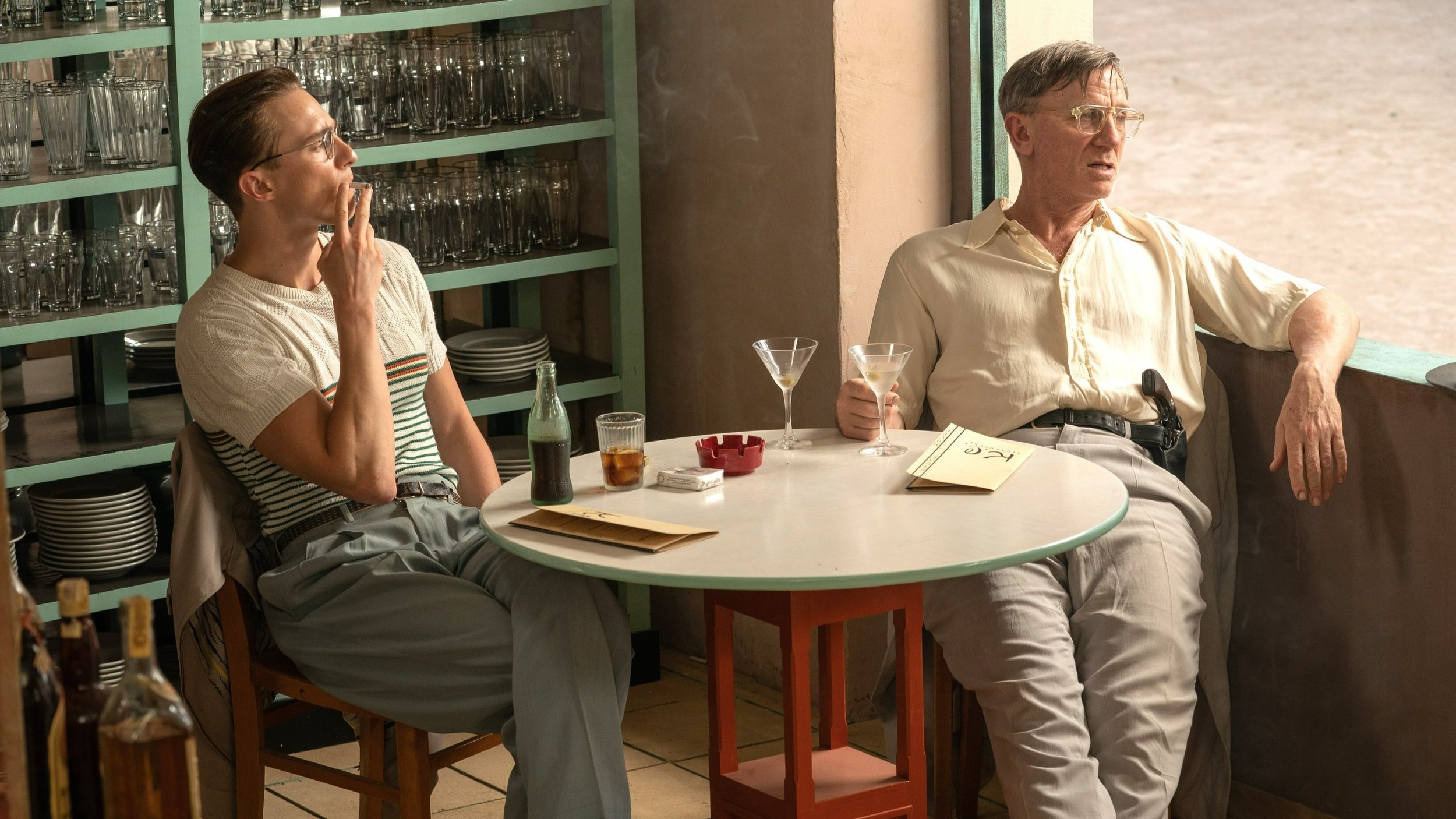
A memo to Luca Guadagnino. You are allowed to make movies that aren’t about people trying to fuck weirdly. It’s not some kind of magic trick. There’s no safe to crack to find the secret formula. You can just do something normal. Queer is anything but normal, and as usual for Guadagnino, not in a fun way, just an intentionally off-putting one. I admit I’ve never read the novel this is based on, nor have I read any of William S. Burroughs’ works, so I concede that there may be some wonderful nuance I’m missing. But as far as a product on the screen is concerned, Queer just sucks.
The film is set in post-World War II Mexico, but you might not realize it, given that Guadagnino overloads the soundtrack with anachronistic 90s grunge songs, including a good deal of Nirvana (originals and others covering). Ostensibly Trent Reznor and Atticus Ross did the score, but I couldn’t distinguish anything through the “trailerized” version of “All Apologies.” Anyway, Daniel Craig plays William Lee, apparently a stand-in for Burroughs himself, a fancy expat writer who uses highfalutin language while he spends his days getting blitzed on tequila and trolling for younger men. He occasionally talks to his friend Joe (Jason Schwartzman again) about their various sexual exploits, and nothing much of any consequence happens. For the entire first half of the movie it seems, the plot is a repeating cycle of Craig talking about getting some dick, Schwartzman talking about getting some dick, Craig getting drunk, and then he gets some dick. Fascinating.
Craig also has two major nominations so far (three if you count the Critics’ Choice Awards), and he’s certainly a great and versatile actor, but this is just a nothing performance. All there really is to it is that there’s this meta novelty where instead of playing James Bond and scoring with cock-hungry sluts, he’s just the cock-hungry slut on his own. It’s weird, really, particularly in the current age of political correctness where some get up in arms if a performer plays someone who’s not in their demographics, and there was mild backlash before for Craig playing Benoit Blanc as a gay man, but somehow not now. I don’t get it.
In the midst of his hedonism, one day Lee’s eye is caught by Eugene Allerton (Drew Starkey), a pretty young ex-soldier who confuses his gaydar. He looks and acts like he might be queer (because sexual diversity is, ironically, very rigidly defined in its behaviors), but Lee just can’t quite nail down whether he’s straight or gay. So the only natural recourse is to stalk him endlessly and get him so drunk that he sleeps with him with no resistance, just to see how “open” Eugene is to the idea of being butt buddies. Then he invites the young man to accompany him to Ecuador so he can find some ayahuasca because he thinks it’ll unlock telepathic abilities.
Yup, the entire plot of this movie is a guy who wants to bang every man in sight and then trip balls. I don’t need to sit through a nearly two-and-a-half hour film for that. I can just take an edible and go to any bar in West Hollywood if I want that experience.
There is exactly one good thing about this flick, and that’s Lesley Manville. She plays Dr. Cotter, a scientist in the jungle who studies the ayahuasca plants for their potential medicinal qualities. She’s essentially a redneck living in a South American rainforest, and she’s a hoot for the three scenes she has, pointing guns and snakes at Lee and Eugene for trespassing, and then watching over them while they take their hallucinogens. If Hollywood wants to make a “Best Actress Showcase” for her, I’d be on board.
Otherwise, this is a complete waste of time. It’s just another entry into the Luca Guadagnino Trying to Make Weird Sexy But Just Making Sex Weird Cinematic Universe, the LGTMWSBJMSCU as I call it. Rolls right off the tongue. I didn’t care much for The Last Showgirl, but it’s goddamn Citizen Kane by comparison, and that’s before we get to the blatant Stanley Kubrick ripoff scenes at the end, like he’s trying to posit Queer as some kind of hybrid successor to 2001: A Space Odyssey and Lolita. Fuck off, Luca, and turn off the fucking.
Grade: D+
Join the conversation in the comments below! What are your thoughts on these films? Did I miss something crucial that would have helped me enjoy them? Who would you like to see given a puff piece movie to shamelessly campaign for an Oscar? Let me know! And remember, you can follow me on Twitter (fuck “X”) as well as Bluesky, and subscribe to my YouTube channel for even more content, and check out the entire BTRP Media Network at btrpmedia.com!

 I Actually Paid To See This
4 thoughts on “Back Row Thoughts – Please Give Me an Oscar I Don’t Deserve”