
With just a few days to go until Oscar nominations come out, the great clearing of the backlog continues. I’ve watched a LOT of movies over the last month, trying to be as thorough in the leadup to the annual Blitz as possible, which sadly necessitated putting reviews on the shelf in order to, you know, sleep on occasion. As such, while I’m almost certain to finish this year’s International Feature shortlist, there are still entries that I haven’t gotten around to that didn’t make the semifinal cut, even though I saw them weeks or months previous.
It’s a shame, because the three remaining also-rans I’ll be tackling here tonight all deserve to be seen and enjoyed. Also, while my personal sample size is relatively small (when it’s all said and done, I’ll have taken in just under 1/3 of the total eligible field), each of these would have made my personal top 15, well above a fair few candidates still in the running, and certainly ahead of the presumptive victor in this year’s contest (more on that in a couple days).
Funnily enough, each of these three films also kind of fits into a neat thematic grouping. It’s weird how often that works out. I certainly don’t intend it that way, but I’m thankful when it does, because it makes it easier to get them out in bulk rather than devoting individual posts to each one (though I most definitely could if necessary). In this case, all of these pictures fuck with timelines to one extent or another. One creates a Möbius Strip with two parallel plots, another plays with the concept of memory, and the most traditional of the bunch rotates between the perspectives of its leads as they travel perpendicular paths. Unfortunately, only one of these is available for general public consumption (via VOD rental), but if you’re interested, you should by all means keep them on your radar.
La Palisiada – Ukraine

You would think Ukraine’s entry this year would be another chronicle of the ongoing invasion by Russia, especially since last year’s film, 20 Days in Mariupol, was shortlisted for this award and won Documentary Feature. However, this is about a different war at home, one told in a distinctly avant-garde fashion. The first feature from director Philip Sotnychenko (who notably couldn’t travel with the film as it made its critical press tour because he was 35 at the time and thus was not allowed to leave the country in case he was called in to serve the national defense), La Palisiada is essentially two stories that feed into one another in a perpetual cycle of trauma, violence, and gallows humor. It’s tough to follow at times, but once you get the hang of what Sotnychenko is doing, it becomes utterly fascinating.
Set in the present day as well as the 1990s, the film is something of a neo-noir about two policemen (played by Andriy Zhurba and Novruz Pashaev) investigating the murder of their colleague. In the days after the fall of the Soviet Union, when Ukraine was still a fledgling independent nation, there was massive confusion and opportunism when it came to law enforcement. The events of the film deal directly with the adoption of Protocol 6 of the European Convention of Human Rights, which forbids the death penalty except in relation to acts of war, a convention that Ukraine signed onto. As such, there’s a sense of urgency in the film to capture the person responsible for the murder and execute him before they can no longer legally do so. Shoddy interrogations, mass arrests of separatists (a brilliant one-take where 30 some odd people lie on the floor and are told to raise their heads just enough to appear on camera for identification purposes as it moves down the line), and a clumsy recreation of the incident with a suspect clearly performing from a scripted confession demonstrate an absurdism that somewhat comically mask the dire consequences of the investigation itself.
This non-linear plot flows into, and from, an introductory sequence set in the modern day, where a bunch of artsy hipsters (all played by Ukrainian filmmakers having a knowing go at themselves) whining about issues that mean nothing. At the center of this is a woman and her boyfriend, the latter of whom looks for any excuse to start an argument, seemingly just to feel important and assert an authority he doesn’t have. He insults the woman’s family, tries to get special treatment due to his sensitivities, and even attempts multiple times to blow off his supposed lover in social situations. This is how confident he is that in his privileged life, he’s untouchable.
Both stories meander, leaving the audience frustrated and squirmy, because nothing’s really happening, just a constant retread of stuff we’ve already seen. But this is 100% intentional. We’re meant to feel unease and yearn for something drastic to break the pattern of deliberate monotony. I distinctly recall someone sitting next to me in the screening muttering to himself, “Will someone just shoot this prick, already?” in regards to the hipster boyfriend. That’s the response Sotnychenko was aiming for, which makes the eventual breaking points all the more hilarious and oddly cathartic.
This definitely isn’t a “normal” movie, but that was always the point. One of the producers (who was old enough to leave the country), did an introduction and a Q&A afterward, and the big takeaway I’ll always remember is that even he admitted that this picture had no Academy ambitions when it was chosen. When Sotnychenko got word that Ukraine was submitting it, he was honestly baffled (at least according to the producer), because this was not designed to be entertaining, rather a surreal thought experiment. As such, it won’t appeal to everyone, especially if you’re looking for a bit of international escapism. But with that upfront warning, I was able to lower my guard and open myself up to whatever was going to be thrown at me. I’m glad I did.
Grade: B+
Drowning Dry – Lithuania
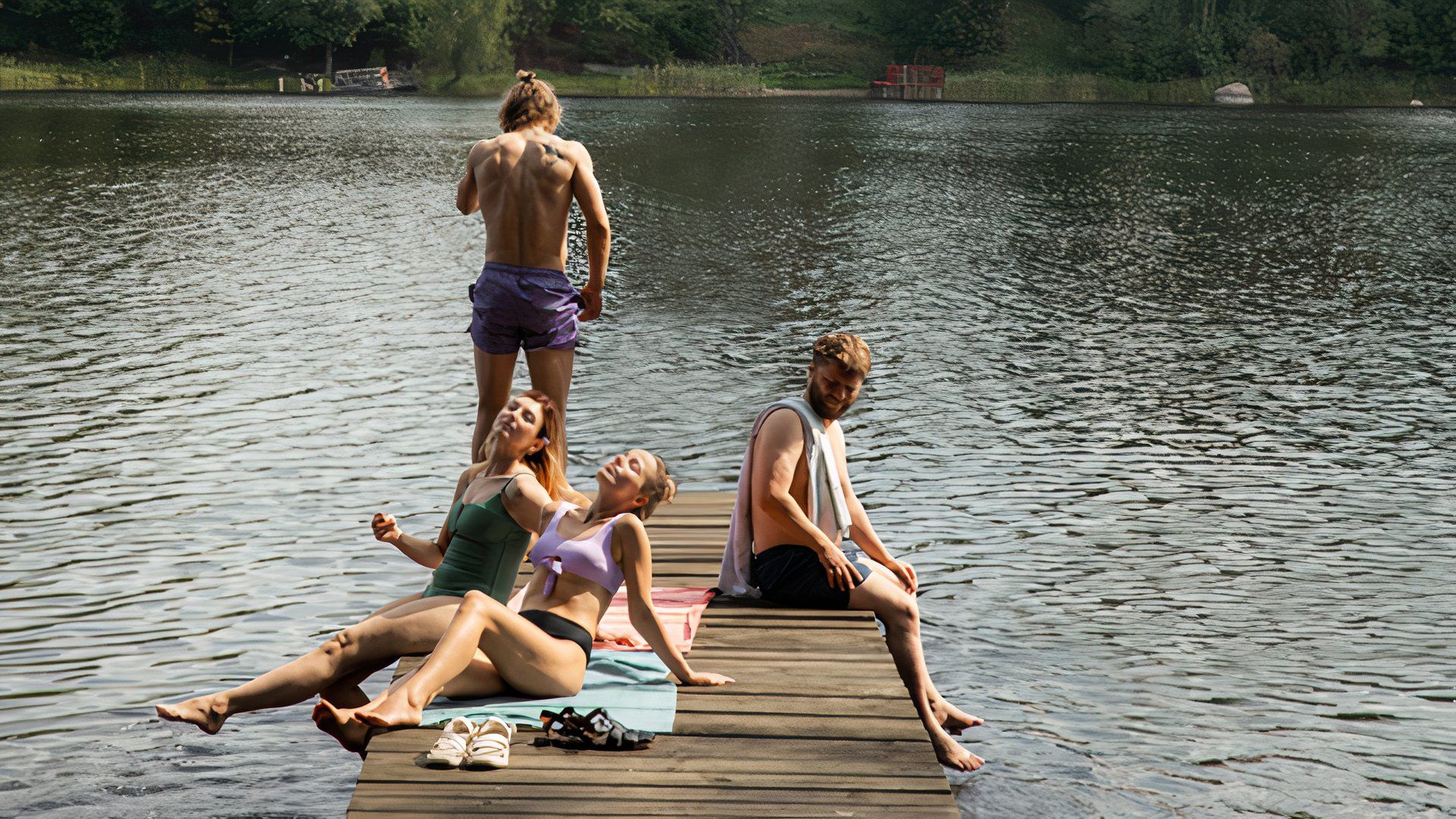
I saw Lithuania’s entry, Drowning Dry, at a private screening while it was campaigning. Sadly, I was the only one who attended. I had a lovely chat with the film’s PR rep, and I sincerely hope this film finds an audience (it played publicly just a couple weeks ago at the Palm Springs Film Festival), because my instant reaction was, “This needs to be seen.” As I told the young lady, I absolutely despise stream-of-consciousness literature (the likes of James Joyce and William Faulkner), because the prose and narrative are so disjointed that I feel like I have to read the same paragraphs and pages a dozen times to understand what’s going on. However, I adore stream-of-consciousness films, because we get the visual representation of the cerebral journey. This picture is a perfect example.
Directed by Laurynas Bareiša in his second feature (his first, 2021’s Pilgrims, was also submitted by Lithuania but not nominated; I hear it’s fantastic, though), Drowning Dry plays with the concept of memory, and how all of us are essentially unreliable narrators for our own lives. There’s a scene in Heretic that summed up this idea fairly well. As Hugh Grant is playing his game with the two young missionaries, he waxes philosophical about the idea, saying in basic terms that when we recall something in our minds, we’re not remembering the moment itself, but instead the last time we remembered it. Details can change, emotional attachments can be manipulated, and very smart people can take advantage of that. I’m sure the thesis has been tested and stated in far more eloquent terms, but it’s stuck with me for a while, even though, ironically, I don’t remember the exact wording of the dialogue.
That’s essentially how Drowning Dry works. For the first half of the film, it feels like a fairly straightforward drama with mild suspense elements. A pair of sisters, Ernesta (Gelmine Glemzaite) and Juste (Agne Kaktaite) arrange a weekend getaway at a secluded lake house with their families. Ernesta’s husband Lukas (Paulius Markevicius) is an MMA fighter who just won a significant match, while Juste’s husband Tomas (Giedrius Kiela) is celebrating his birthday. Along with each couple’s respective child (Ernesta and Lukas have a son, Kristafus, played by Herkus Sarapas, while Juste and Tomas have a daughter, Urte, played by Olivija Eva Viliüné), it looks to be a fun time all around. Stories are shared, good food and drink are ingested, the sisters dance in sync to “I Love You Always Forever” by Donna Lewis (I’ve always hated that song), it’s a very happy occasion.
Except that it’s not, of course. Throughout this opening act, there are multiple moments of tragic foreshadowing. Ernesta is beside herself after Lukas’ match, ever worried that he’ll injure himself permanently in the ring. As the couples drive to the lake house, Tomas decides to act a bit macho and pass a slower vehicle ahead of him, despite the road only being one lane in each direction, as a means to show off his truck’s horsepower, so Lukas answers in kind, only to nearly hit another car coming down the opposite lane that he couldn’t see until he was against traffic. This all comes to a head one day at the lake, where Tomas playfully throws the kids off the dock and into the water, but only Kristafus comes back up. Realizing what’s going on, Lukas dives underneath to try to find Urte in the murky water, and we cut to black.
That’s when the tables are turned on the viewer. Instead of seeing the aftermath of the rescue attempt, we instead go back to the previous night’s cookout, only this time Ernesta and Juste are dancing to a completely different song. Small details that we just saw mere minutes before are completely altered. The children sit in different chairs, Lukas demonstrates some MMA moves on Tomas, but they’re not the same ones as before, little things that you wouldn’t notice in isolation, but that instantly start piling up. Then we start flashing forward to different outcomes to Urte’s emergency, some tragic, some triumphant, some in between, including a meeting with a man who received a life-saving organ donation from someone in the group. It’s all very eerie and confusing, but altogether borderline magical.
It all comes back to one of the most universal experiences we have as human beings. Someone will talk about past events in which we were involved, but something will feel just a bit off, leading to the natural response of, “Is that how it happened?” because in the moment, we honestly don’t know, and really, we can’t. All we can do is rely on our brains to be accurate, and that’s not always the case. Bareiša enhances this effect through a pretty simple tactic, and that’s having the bulk of the film be improvised. The screening I attended included a pre-recorded interview with the director, and he let us in on this aspect of the process. While there was a firm script, the four main actors were encouraged to add or drop lines of dialogue at their leisure, with the only real guideline being to always act as their characters would. The child actors, being children and all, had more organized rehearsals and shoots where the screenplay was followed more closely, but when they’re not on set, it’s a well-orchestrated free-for-all. It’s so simple, yet it does so much for the credibility of the final product.
This is what I mean when I say this needs to be seen. People need to take in this form of storytelling, and truly ask themselves how much they trust their own memory. I spent three years watching my mother’s deteriorate at a fairly rapid pace, but even before the dementia hit, she was aware that her recall abilities were not great. It came up a lot in our phone conversations. She’d call it “losing words,” because she couldn’t figure out the right term for something in the middle of a chat. Honestly, I’ve experienced it myself. If you’ve seen me on episodes of No Rest for the Weekend, you’ve undoubtedly noticed a few times where I struggle to find the right thing to say while giving an off-the-cuff review. It happens to all of us, and it’s something we need to take seriously. This film gives us a profound stream-of-consciousness portrayal of this phenomenon and plays it in very drastic ways, to make sure it lodges itself into your mind.
Grade: A-
12.12: The Day – South Korea

There isn’t much representation for Asia on this year’s shortlist, with just two semifinalists among the 15 (Palestine and Thailand). And yet, the continent has the second-highest tally, as North America, South America, and Africa each have only one film in the running, while Europe has 10. At least some of them take place in non-European countries. Anyway, South Korea, one of the premier countries for new and unique cinema, gave us a somewhat normal entry this year, which may be why it didn’t advance. But if that really is the reason it was left off, then the Academy has done the public a major disservice, as 12.12: The Day might be more orthodox than most, but its subject matter is all too important right now.
Directed by Kim Sung-su, the film is a dramatized retelling of one of the most significant events in modern Korean history, the military coup of December 12, 1979. After a period of martial law in the wake of the assassination of President Park Chung-hee, plans are put in place for new elections and full civilian rule. This does not sit well with the ambitious Chun Doo-gwang (Hwang Jung-min), who has spent his career cultivating followers and favors in a corrupt manner to rise up in the military order. Aware of his conniving behavior, General Jeong Seung-hwa (Lee Sung-min) has Chun reassigned away from Seoul, where he has no influence, and places the scrupulous Major Lee Tae-shin (Jung Woo-sung) in charge of the Capital Garrison.
Incensed, Chun puts his long-laid plans into effect, staging a coup d’état with his loyalists. On the night of December 12, he all but declares civil war, laying siege to Jeong’s offices and running pincer maneuvers all over Seoul. From there, the film becomes a cinematic game of real-life chess, as Chun and Lee are given rotating focus as they try to outwit each other and gain an advantage. The action is thrilling, the story very easy to follow, and the performances are quite strong.
More importantly, though, this is a movie that is very relevant right now, and not just for locals. In this country, today was a very dark day, as we just inaugurated a racist, rapist, Nazi wannabe and convicted felon as President, four years after he staged his own failed coup, and among his top priorities is to pardon everyone who committed crimes on his behalf in that insurrection and prosecute anyone who dared hold him accountable. What was once a victory for democracy and the rule of law will now be quickly reversed and dismantled, with petty extrajudicial vengeance threatened against anyone not currently and constantly kissing his ass.
Meanwhile, look at South Korea today. Even if you don’t know the history of the December 12 Coup (though the film will make it quite apparent), the country has come a long way since the days of those types of power grabs. They’ve literally impeached and removed two Presidents in the space of the last five weeks, including arresting the incumbent for corruption. Clearly they’ve not solved all of their problems, because politicians still try to pull this shit, but the government and the people are at least willing to take swift action to punish criminals, regardless of their political station and power. As has been made clear over the last four years, we are somehow not.
I really only have two complaints about the film. One is that it’s just too long. It runs nearly two and a half hours, and honestly, you could cut a half hour and lose nothing. This is most obvious during the climax, as Lee makes his final push against Chun, and the affair is padded out for several minutes simply for the sake of false tension and cool-looking dramatic shots even when the outcome is abundantly clear.
The second is that, for whatever reason, director Kim decided to use aliases for the characters. This might make sense if this was a more fictionalized account rather than a factual retelling with dramatic embellishments, but it’s not. Also, it’s not like the Korean audience doesn’t know who these people are. This is fairly recent history (45 years ago), and it happened in a very public space with high-profile individuals, including one who eventually became President himself. It’s not like you need to change the names to protect the innocent here, especially when the fake names are so close to the real ones. For example, Chun Doo-gwang, our main villain, is actually Chun Doo-hwan. The only difference is a slight variation on the last syllable (and presumably a different character in the Korean language). It’d be like making an American movie about Ronald Reagan and naming him Ronald Raygun. What’s the point? Is there some law in South Korea where dramatization requires this as a means to avoid potential slander penalties? That’s all I can think of, because otherwise this just comes off as cheesy, and it definitely doesn’t fall under the umbrella of plausible deniability as I’ve ever known it. If I have any Korean readers, I implore you to enlighten me on this, because it’s been two months since I’ve seen this flick, and it still boggles my mind.
In the end, though, these are minor gripes. The film was a big hit in its homeland, earning over 140 billion won (about $98 million U.S.), making it the fourth-highest-grossing Korean film of all time. That’s really impressive, and well-deserved. Not knowing any of the story going in, I found myself on the edge of my seat for a good deal of the runtime, and while the characterizations were a bit one-note (Chun bad, Lee good), it’s no worse than anything Michael Bay’s ever shit out, so who am I to quibble? The intellectualism was saved for the tactical volley between the two leads, as well as the spot-on production values, particularly the editing, which kept the visuals tight and engaging. I’m not sure why this didn’t get more love from Academy voters, but I get the feeling that if you take the time to rent it, you’ll enjoy it just fine.
Grade: B+
***
That’s all for this edition, and with that, the eliminated films are off my docket, and we can move on to the shortlist itself. Obviously I won’t be able to review everything before nominations come out on Thursday, but I’ll have a few days before the Blitz starts proper, and given that the 15th semifinalist – Armand from Norway – is coming out on February 7, I’m likely going to hold off on breaking down the International Feature category as a whole until I see it, so I’ve got time to trickle out the remaining candidates. We’re getting ever so much closer to the main event, so keep it locked for more coverage!
Join the conversation in the comments below! Do any of these films appeal to you? Do you enjoy when movies play with timelines? What’s an event from your life that you remember a certain way but everyone else insists played out differently? Let me know! And remember, you can follow me on Twitter (fuck “X”) as well as Bluesky, and subscribe to my YouTube channel for even more content, and check out the entire BTRP Media Network at btrpmedia.com!

 I Actually Paid To See This