
The Oscar Blitz begins proper in 24 hours, people. The annual marathon labor of love is just a day away! I’m so excited I can’t sleep! I’m also running myself ragged and begging for sleep! The things we do for our art. HAH! Like what I do is art.
Anyway, adjacent to the Blitz coverage will be me scrambling to get all my videos done and clear out the remainder of my review backlog for 2024 cinema. Yesterday, I took you through half of the International Feature semifinalists still on the back burner, and tonight, we finish the job. Four films, four countries, all seen in the normal course of public viewership. One of these four was ultimately nominated, but what about the others? Did they deserve a spot? Well, if you saw Emilia Pérez, you already know the answer to that question. But we can’t undo what fools have already done (and if I could I’d have so many higher priorities), so let’s at least give these projects their due.
The Girl with the Needle – Denmark

Denmark’s entry is half horror, half true crime, and all-around cool. Directed by Magnus von Horn, the film is an eerie tale of a dream life that quickly turns into a nightmare, only for the truth behind the trauma to be even worse than imagined.
Vic Carmen Sonne gives a fantastic performance as Karoline, a poor seamstress in Copenhagen who yearns for death. I’m not talking about her own, of course (at least not yet), but that of her husband Peter (Besir Zeciri). There’s no malice in this wish, only a plea for relief. Peter left months before to fight in World War I, and has not been heard from since. However, because he’s not been officially declared dead, she can not receive any benefits as a widow.
Forced out of her apartment and made to live in squalor, things suddenly start to look up for Karoline as she begins a relationship with her wealthy boss, Jørgen (Joachim Fjelstrup), eventually becoming pregnant, and the two get engaged. The bliss is extremely short-lived, however, as Jørgen’s mother (Benedikte Hansen) rejects Karoline outright and refuses to allow the marriage. Jørgen, curiously able to stand despite lacking a spine, instantly buckles and sends Karoline away.
Jobless and with child, Karoline goes to a bathhouse, where she attempts a self-administered abortion using a long knitting needle. She is stopped by a woman named Dagmar (Trine Dyrholm) and her daughter Erena (Avo Knox Martin). Dagmar informs Karoline that she operates a clandestine adoption service out of the candy shop she owns, and instructs Karoline to give her the baby once it’s born. She does so, and Dagmar assures her that the child will go to a loving family. Unable to pay for the adoption, Karoline is hired on by Dagmar as a nursemaid to feed incoming babies until they’re claimed.
Shot in black-and-white, there’s a classic horror moodiness to everything that follows, from Dagmar’s suspicious outings to deliver the babies to their new homes, to the servile and eventual maternal connection Karoline develops with Erena, to the tragic fate of Peter, who does return, but in a state so shocking to Karoline that she actually prefers the secretive life she now lives.
If you’ve ever read the case of Dagmar Overbye (which I had never heard before I went in), you’ll know where the story eventually leads. While this film is very loosely based on what actually happened, von Horn depicts it in heartbreakingly beautiful and disturbing terms. I recommend seeing it blind if you can, then diving in to the real facts afterward. It almost makes you wonder if he could have gone even further.
Grade: B+
How to Make Millions Before Grandma Dies – Thailand

I mean, on name alone you know this is going to be interesting! Directed and co-written by Pat Boonnitipat, this is the first Thai film to ever make the shortlist, and quite frankly, I would have loved to see it nominated. It’s funny and sweet in ways that stop just shy of being too “safe,” yet the plot and overall message will be instantly accessible to American viewers. It had a theatrical run back in the fall, and it’s currently available to rent online. You should definitely give it a look if you can.
The story is a basic morality tale told in comedic fashion about family members jockeying for an inheritance. Mengju (Usha Seamkhum), the titular grandmother, has been diagnosed with terminal cancer, and while her children and grandchildren initially hide this fact from her, she makes it clear that all she wants is a nice burial plot when she goes, one close to her own parents, so the family can still be together. She’s brash and set in her ways, like most elderly relatives in movies, but there is a sweetness and earnestness to her character that’s recognizable right from the off.
Her grandson, who simply goes by “M” (Putthipong Assaratanakul), rarely can be bothered to even visit Mengju, much less care what happens to her. He’s far too focused on video games and his ambitions to become a profitable online streamer, though he can’t catch a following. After meeting with his cousin Mui (Tontawan Tantivejakul), who has just come into a nice sum of money from her late grandfather after spending a year as his primary caregiver, M plots to do the same. He moves in with Mengju and pretends to want to spend more time caring for her, banking on her leaving him her house upon her passing, so that he can sell it. He’s so sure of his success that he lists the house on a real estate app the very day he puts his plan into motion.
A lot of the plot beats are very familiar if you’ve seen similar capers before. M and Mengju don’t get along at all to start out, but they warm to each other. When M reveals Mengju’s prognosis to her, she turns it on the rest of the family – M’s mom Sew (Sarinrat Thomas), wealthy uncle Kiang (Sanya Kunakorn), and good-for-nothing uncle Soei (Pongsatorn Jongwilas), who constantly steals from Mengju to pay his gambling debts – and naturally they all fall over each other trying to accommodate her, creating competition for M. He eventually begins to seriously question the ethics of what he’s doing, and Mengju finds out about his deceptions as well, leading to a bittersweet and life-affirming resolution.
None of this is revolutionary, but it’s executed so well that I don’t care how formulaic it is. The two lead actors are cinematic first-timers, and they’re terrific, playing off each other as if they’ve been doing this all their lives. The themes of neglect and taking family for granted are relayed so perfectly through action that the film could have been silent and the point would have still gotten across. Even the ending, treacly though it is, will definitely catch you in the feels because Pat teases it just right over the course of the runtime.
Maybe I was more susceptible to like this because of what I had to go through the year before, not knowing what my mother’s final wishes were and having to basically fly by the seat of my pants, even though my sister and I thought we had prepared for the moment in the three years between her dementia diagnosis and her passing. But seeing the antics mixed with the genuine sentimentality and the peace of mind of knowing exactly how you want to leave this world behind definitely put a smile on my face, and I’m willing to bet it will for you as well.
Grade: A-
Waves – Czech Republic

I was kind of surprised this didn’t get nominated, if nothing else than for the political parallels between the film and the current state of affairs in our own government. Set in 1968, Waves concerns a Czechoslovakian radio station operating under watchful authoritarian eyes from the Soviet Union, culminating in the Warsaw Pact invasion of the country and subsequent silencing of independent media. Here in America, we’re currently living under a regime that spent its first term demonizing the free press like never before, and in the leadup to its current term has already threatened to pull broadcast licenses, revoke reporter credentials, and got one of the major networks to settle a meritless defamation lawsuit in hopes of being left alone, even though we all know that kowtowing to Donald Trump only emboldens him.
The film features a young engineer named Tomáš (Vojtěch Vodochodský), who lives with his younger brother Pavel (Ondřej Stupka), an idealistic college student. It’s Pavel’s dream to work for Czechoslovakia Radio and its charismatic lead journalist, Milan Weiner (Stanislav Majer). However, it is Tomáš who ends up landing a job there, almost completely by accident. Absentmindedly “winning” the interview via a test no one knew they were taking, Tomáš is put under state pressure to act as an inside informant, reporting on any activities that the government, or Moscow, might find subversive, under threat of retribution against his brother.
He’s able to keep his cover for a while, handing over only minor information to keep Pavel safe, but naturally the spies want more and more, particularly names of people they can arrest and the locations of any sensitive information they have on political and military leaders. Tomáš does his best to play both sides, but he’s forced to fight for his own freedom when Prague is invaded and the radio station besieged.
This is an appropriately engaging thriller, well written and tightly paced. My only real issue, like with I’m Still Here, is that it feels too straightforward and too ordinary, like the Czechs were trying to make an American film for American audiences that just happened to deal with their history and be performed in their language. I definitely enjoyed myself, but admittedly, I do find it hard to keep the memory of it fresh in my head because it didn’t leave all that much of an impression.
Grade: B
From Ground Zero – Palestine
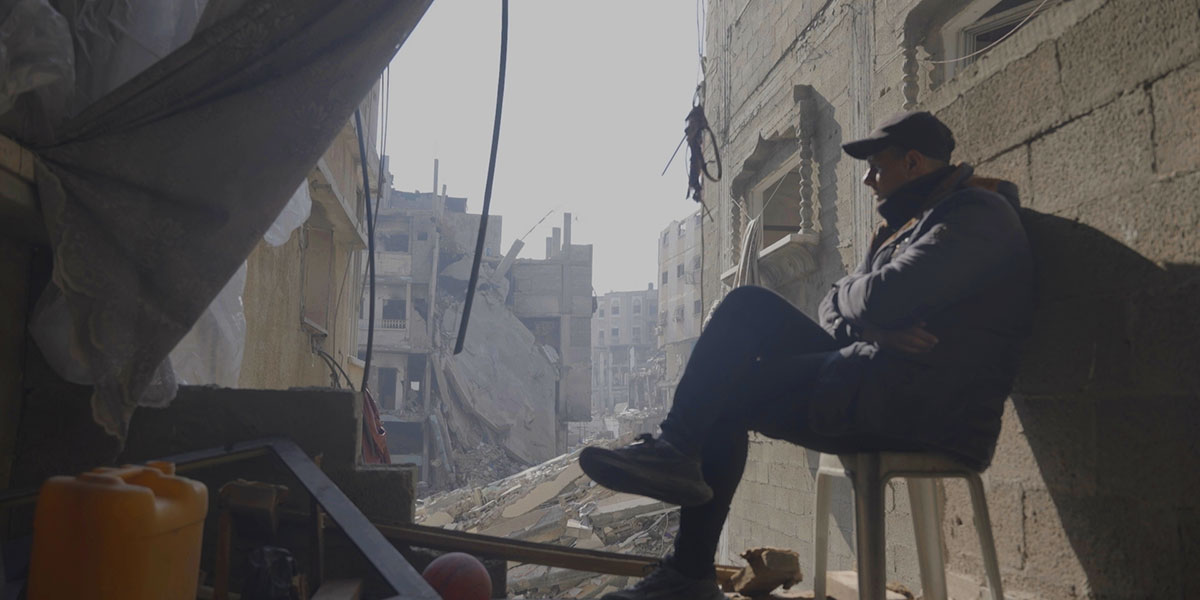
A couple years ago, a completely fraudulent film was created called Tell it Like a Woman. It wasn’t a real movie, just seven disparate shorts knitted together to justify commissioning Diane Warren for a song so it could get nominated. Sadly, the shenanigans paid off, and I had to sit through two hours of drudgery just to hear Warren pay some singer to tell the world she deserves all the accolades.
This year, the war-torn nation of Palestine (yes, I recognize its right to exist, just as I do Israel’s) has upped the ante with From Ground Zero, a collection of 22 shorts from filmmakers all over Gaza that demonstrates the horrors of the genocide being committed against them. Unlike the previous craven anthology, this one actually merits its existence because all the films are related, and because the devastation made producing these vignettes extremely dangerous. Most importantly, there is no agenda behind this entry, other than a plea for peace.
None of the films lasts longer than 5-10 minutes, but they all have something impactful and memorable to say. Some are fictional narratives, like No Signal, which is just a man and his son trying to call his brother’s phone under the rubble of a bombed out building so that they know where to search for him. Others are personal documentaries, like Sorry Cinema, where director Ahmad Houssana apologizes to the artform he’s dedicated his life to for having to shelve his ambitions for the sake of survival.
Each of these shorts is equal parts devastating and inspirational in its own way. But what really floors you is a) just how many different stories can be told in the midst of this war crime, and b) how real the danger and impact is. For example, one of the more lighthearted films, Waneesa Taxi, about a man who rides around Gaza City in a cart pulled by a donkey offering aid and rides wherever he can, ends quite abruptly without resolving the story. We then see director E’temad Weshah explain exactly why this is the case, why she had to cut off her own artistic contribution. It breaks your heart, because you know what’s coming, but the confirmation of your fears doesn’t dull the impact, and you’re left stunned at the fact that you’re sitting in a theatre watching what is, ostensibly, a piece of entertainment, shoveling popcorn in your face while real people are suffering needlessly.
I know the Academy doesn’t really want to wade into this conflict, a rare aversion to making political statements, given the diversity of its membership and their international relations. To wit, between this film and two documentaries concerning Israeli aggression, only one actually got nominated, and that’s focused on the West Bank rather than Gaza. But if ever there was a film that demanded the Academy’s attention and endorsement on a humanitarian level, this was it. It’s not enough to just recognize Palestine as an international body that has an Oscar committee (2005’s Paradise Now and 2009’s Omar were actually nominated), you have to call out injustice and evil, no matter who commits it.
Grade A-
***
That’s all for this mini-series. If the scheduled release of Norway’s Armand goes ahead next week as planned, I will officially clear the International Feature shortlist, and I’ll provide a standalone review in due course. In the meantime though, I’ve got to get some rest, because tomorrow we BLITZ!
Join the conversation in the comments below! Which of these films appeals to you the most? What issues do you think are most important to depict in movies? What’s the sweetest thing you ever did for your grandma? Let me know! And remember, you can follow me on Twitter (fuck “X”) as well as Bluesky, and subscribe to my YouTube channel for even more content, and check out the entire BTRP Media Network at btrpmedia.com!

 I Actually Paid To See This
One thought on “Back Row Thoughts – Jet-Setting, Part Two”