
Usually, the Best Director contest is an easy one to parse and predict. Essentially, all we’re asking is who had the best cinematic eye, who did the best job getting great performances out of their cast, and most importantly, who best executed the creative vision of the overall film? I normally get a bit of assistance on that last point, as the nominated films are often written or co-written by someone else, meaning the director also has to translate the writer’s ideas. There’s cross-pollination to be sure, but you typically get a sense from the divisions in those categories (along with Best Picture), who the Directing Branch, and the Academy writ large, holds in higher esteem on this specific front.
Not so this year. For only the second time since I’ve done the Blitz, all five of the filmmakers up for this award are also candidates in their respective Screenplay categories (three Original, two Adapted). This may help me narrow things down when I cover the scripts later on (Original Screenplay tomorrow!), as Oscar voters tend to prefer “spreading the wealth.” Whoever doesn’t win here could very well get a consolation prize for the writing, which sadly shortchanges the nominees that aren’t in the running here, and in some cases all but eliminates them.
So how do I judge this year’s field? Well, in keeping with the criteria mentioned above, I’ve basically got it down to two key questions. First, what was the point of the film? I don’t just mean in terms of pure entertainment. I’m asking what the director hoped to accomplish with this work. This leads into the second question, how well did they get that point across? This concerns the various technical and artistic elements employed, as well as the quality of the writing and performances, insofar as they’re within the director’s control. I know that sounds kind of nebulous, but hopefully as I dive into these five contenders, it will become more clear. In every case, I’m pretty sure I know what these people were going for, it’s just a matter of how effective they were, and obviously a lot of this is up to interpretation.
If there’s a positive to take away from the uncertainty I have this year, it’s the fact that this is, for the most part, a fairly open race. We’ll have some clarity in just over a week, as the Directors Guild hands out their awards this weekend, along with the Critics’ Choice Awards, and the BAFTAs are the following weekend. If I had to guess, I think I know who the winner will be, but it’s not a certainty, mostly because there’s no “Career Achievement” candidate this year. The nominees have a combined 37 feature films under their belts (23 of those belong to Jacques Audiard and James Mangold), and all are first-time nominees in this field (Mangold was previously nominated for Best Picture for Ford v. Ferrari and Adapted Screenplay for Logan; Audiard’s 2009 film, A Prophet, was nominated for International Feature, and as director he would have likely accepted on France’s behalf had it won). No one here is “due” for a win, is what I’m saying, which means everyone’s in with basically level odds, though I’d wager one candidate has fallen off due to recent events. This is ostensibly a pure judgment call for the first time in years, and even if momentum and consensus builds behind one of the hopefuls over the rest of the field, that’s still something to celebrate.
This year’s nominees for Best Director are…
Anora – Sean Baker
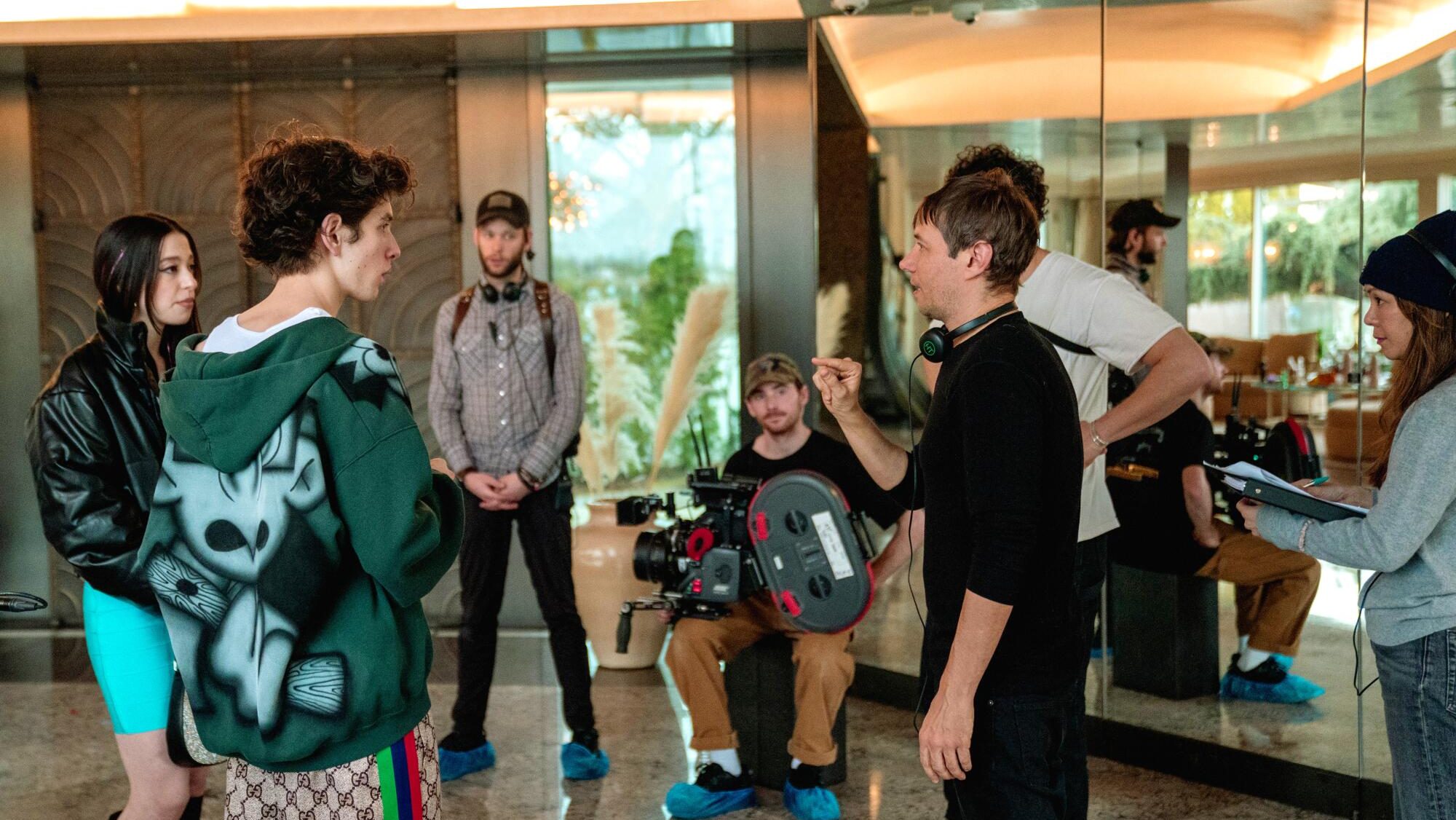
Baker has eight features to his name, and he’s been steadily increasing his influence with the last five, all of which deal with sex workers in sympathetic but realistic terms. I personally haven’t seen Starlet or Tangerine, but I have seen the others, and you can see marked improvement each time out. With Anora, the point isn’t just to have another day in the life of someone in the adult industry, but to craft a truly relatable Cinderella story around her, making this his most accessible film yet to a wide audience.
He often depicts his leads as being on the bottom rung of society. In The Florida Project, Halley couldn’t make ends meet while living in a motel, eternally out of work and hustling tourists any way she could, even bringing her daughter into it. Mikey from Red Rocket is a former pornographic superstar looking for a comeback, because as a man in the industry, he has a longer shelf life. His estranged wife and co-star, Lexi, however, has aged out and lives in a very small house in rural Texas. By contrast, his title character this time out is far from wealthy, but she certainly gets by. Ani understands the transactional nature of her job, flirts properly for bigger tips, and supplements her stripping by sleeping with big money clients. She knows she can’t do this forever, so she’s getting the most out of it while she can, and is quite savvy when it comes to the financial aspect. Even as her whirlwind relationship with Vanya escalates, she keeps the money moves at the fore, negotiating her “exclusive” status with him as well as the size of her wedding ring.
The tragedy – and much of the comedy – comes when she starts to take her eye off the proverbial ball and begins to actually believe this might be genuine, that in her own messed up way, her hard work has finally paid off and she’ll be afforded a life of comfort and romance. Not only does that come crashing down with the arrival of enforcers on behalf of Vanya’s parents, but when it’s all said and done, the similarly well-meaning Igor serves as a symbol for all she lost, and where so, so many dreamers wind up. In another world, Ani and Igor would be perfect for each other, but after experiencing the highest of highs, the realization that she’ll always have to settle finally reduces her to a tearful breakdown, the return of the ring (so she can sell it) her only real consolation.
That’s an amazing escalation from Baker when it comes to story and characterization. He’s had plenty of compelling types in his previous films (while I hated The Florida Project, I loved Willem Dafoe’s performance), they were often general behaviors and tropes made flesh rather than being fully-realized. Not only is Ani a complete person with agency and drive, but so too is Igor, a character who could just as easily been left to the side as occasional comic relief. Because Baker treats them both with an unbelievable degree of humanity based on the realities of working-class life, he gets top-level performances out of both Mikey Madison and Yura Borisov. If you see just the trailers for this film, you’d think it was a glorified Best Actress Showcase for Madison as an up and comer, but once you watch the whole thing, you’re genuinely amazed at how great of a job Borisov does, making this a double-bill that no one saw coming.
From a technical standpoint, Baker pretty much took on most of the responsibilities himself. He had a dedicated DP this time, a luxury he can now afford after beginning his career filming on smartphones. But pretty much all of the above-the-line work apart from that was his first and foremost. He wrote the film, directed, produced, and edited the final product. This was his baby from beginning to end. He knew exactly the kind of story he wanted to tell, and took it upon himself to tell it precisely as he desired on his own terms. This is completely his movie.
The Brutalist – Brady Corbet
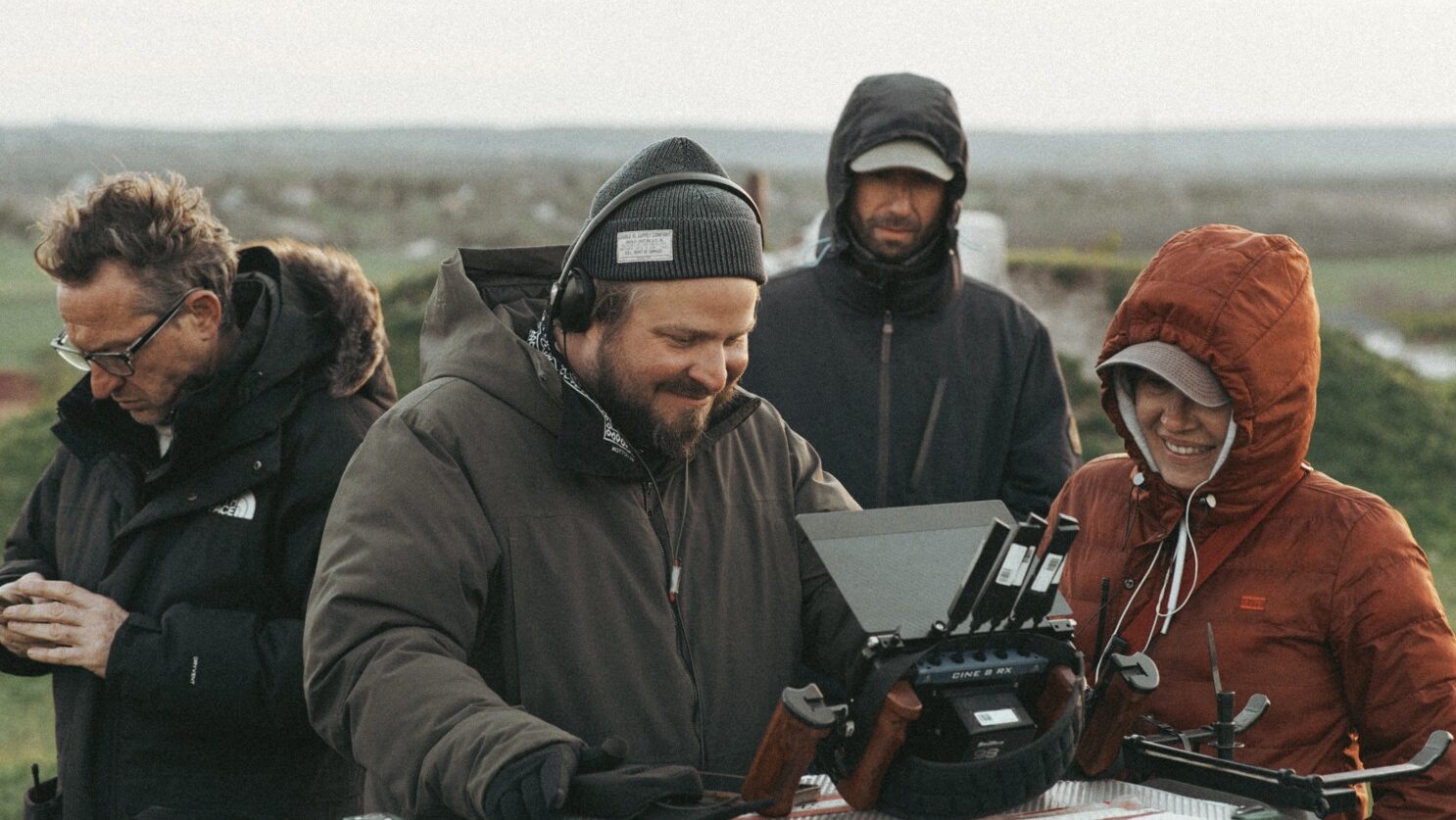
Brady Corbet has made no secret that this film is perhaps the most near and dear to his heart based on his family history. The intent from the very start was to create a complete and thorough celebration of immigrants who figuratively and literally paved the way for future generations to have equal opportunity and a chance at a prosperous life. Their experience is the true foundation of the American Dream. Corbet wanted to show just how hard it is, was, and likely will continue to be for those who look to our land as an ideal, especially in our current era where a significant portion of the population – and our national leadership – acts with open hostility towards them.
The title intentionally has a something of a double meaning. In pure fact, it’s a reference to the style of architecture employed by the main character, László Tóth, emphasizing durability and function over fancier forms, as endurance is its own form of artistic expression. Brutalism wouldn’t itself be named until about 10 years after World War II, but the elements were there. As a thematic device, the name is meant to invoke images of violence and perseverance, as each day of László’s life in America is a struggle, for him as well as his family. Whether overtly or subtly, he is beaten down at every turn, and his will to exist and be acknowledged is what sustains him through the cruelty of his patrons as well as society as a whole.
I’ve said before that I think the film is a bit too long, but that’s only in the sense of narrative efficiency. From where I sit, you can cut 30-45 minutes and still get the general point across. But to Corbet’s credit, lingering on these weighty issues is part of the process. There are plot holes here and there, and far too much time is spent on László’s various drug addictions, but they are designed to serve the overall characterization and grind that is day-to-day life, particularly when the wealthy, elite, and bigoted seem to delight in dangling their personal Damoclesean Sword over his head, threatening his livelihood and even his life should he behave in any way that they don’t approve of. The immigrant experience, particularly for European Jews in the wake of the Holocaust, isn’t that different from how we treat black and brown migrants today. The Statue of Liberty has that lovely, aspirational poem on it, but once they actually set foot on our soil, there’s no shortage of people ready and eager to remind them on a daily basis that they’re not exactly welcome here. Corbet understands this better than most directors dealing with this subject, and he doesn’t spare the rod for a moment.
So how effective is the messaging? Well, it depends on your own level of endurance. There’s a lot to wade through in this film, and even if it was an hour shorter that would still be the case. Corbet makes sure to get every ounce of pathos and energy he can out of his cast, and only shies away from the consequences of the characters’ actions in the final scenes. The ending is intentionally vague, which I don’t necessarily agree with (I feel the audience needed either the catharsis of a full Harrison comeuppance or the tragic reality of him getting off scot-free), but I respect the artistic choice. There are a few areas that could have been a touch more disciplined, like a firm establishment of why the grown up Zsófia talks while the teenage one didn’t (when we first see her, now married and speaking openly, I honestly wondered if this was a new character), but at the same time, life doesn’t always have a logical progression. Minor flaws aside, this is still a grand, intense, and heartfelt piece of work, worthy of recognition, and Corbet’s earnestness shines through in every frame.
A Complete Unknown – James Mangold
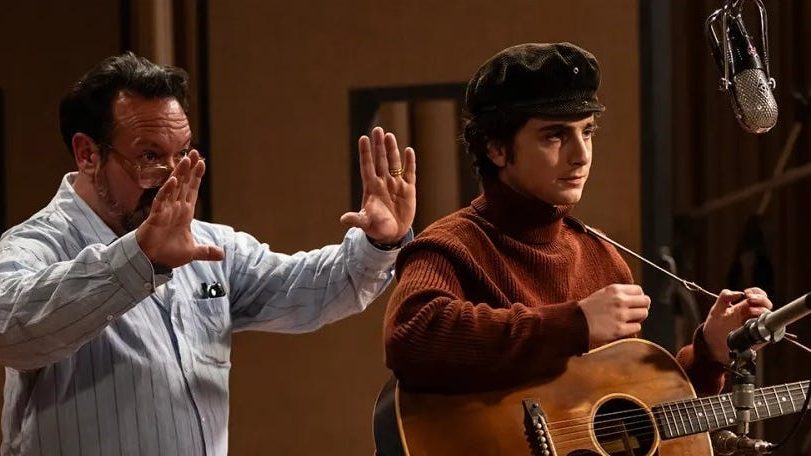
You could argue that James Mangold had the easiest task of the five nominees, as he’s already done a fantastic take on an iconic musician before, having helmed 2005’s Walk the Line. He knows what audiences like, he knows how to get fantastic performances out of his cast, and he knows how to translate the musical experience to the viewer in (mostly) historically accurate and massively entertaining ways.
So what makes this job different and better to garner such high praise? Well, because like so many other films being honored this year, he stepped up his game and delivered more of what works without cluttering the affair with things that don’t. Similar to Anora, A Complete Unknown could have just been a showcase for Timothée Chalamet’s acting talent, but Mangold got nomination-worthy turns out of pretty much the entire cast. Chalamet, Edward Norton, and Monica Barbaro all got nods, but you could also make cases for Boyd Holbrook (how weird it would have been to have two actors get Oscar nominations for playing Johnny Cash in different films from the same director), Dan Fogler, and Elle Fanning. Given the latter’s output to date, that is shocking to say the least. Seriously, did any of you watch Nutcracker 3D, The Beguiled, or the Maleficent movies and think she would ever make such a great showing? Because I did watch them (some of them, anyway), and I sure as hell never thought that.
From a story standpoint, Mangold changes things up by keeping the focus squarely on Bob Dylan’s early career. It’s taken as read that everyone in the audience knows the basic plot points, and how influential Dylan’s music has been for decades, so rather than go the same route he did with Walk the Line, which was much more comprehensive and romantic, A Complete Unknown sticks to the formative years and only brings his love life into play as a demonstration of how chaotic and mercurial Dylan’s mind can be. The previous film was about learning who Johnny Cash was, while this one is more about “getting to know” Dylan while keeping him a somewhat mysterious and unpredictable quantity.
There’s a much more experimental quality to this portion of Dylan’s career, and Mangold translates that into the technical aspects, with particular attention paid to how Dylan evolved from pure folk to blues-infused rock, toying with new instruments and arrangements to create unique sounds. Mangold enhances this by emphasizing a more collaborative, communal experience when it comes to music, highlighting moments where Dylan shares the stage, screen, and studio with other musicians, fans, and political influences. It’s a nice juxtaposition to have someone so outwardly solitary be at his best when he’s forcing himself to not be alone. This carries over to the audience, fully engaging a multigenerational crowd that has known, loved, and learned from his work, and makes them feel like passengers or companions to the story, rather than just viewers. I still remember the auditorium spontaneously bursting into “Like a Rolling Stone” during the credit roll when I saw the film on Christmas Day. It’s because Mangold created a fully immersive and intimate experience, and that’s why he’s on this list.
Emilia Pérez – Jacques Audiard

I’m going to say something that might sound completely batshit at first, especially if you know my opinion of Emilia Pérez as a work of cinema. I believe that Jacques Audiard did the most extensive and all-encompassing job of the five filmmakers here tonight in executing his vision and getting his point across to the masses. The problem is that the point was to cravenly create the ultimate Oscar Bait movie and shamelessly shill for awards. He made his intentions perfectly clear, and he accomplished exactly what he set out to do. It’s just that what he did is a prime example of everything wrong with this process.
It feels like the most cynical form of alchemy in recent movie history, as if Audiard watched For Your Consideration and The Producers and thought to himself, “Hmm, I bet I can make a real Springtime for Hitler and engineer an Awards Season sweep in the process.” From beginning to end, the entire film is an exercise in disingenuousness, and you can count the Academy box checks as you go. Sexual diversity? Check. Ostensibly strong female leads? Check. Musical (which AMPAS has always loved)? Check. Lip service to vulnerable communities? Check. It’s all there, but it’s only surface level at best, just enough to justify a marketing campaign so that it could rack up as many nominations as possible. It reminded me of a project I tried to do back in college. As part of one of my screenwriting classes, I tried to come up with a script where two talentless ad writers would essentially try to hack the Oscars by creating a movie that could somehow be eligible for – and win – every category purely through strategic gladhanding, even though the movie itself would be the most god awful piece of crap imaginable. I scrapped the idea after realizing it was too stupid to be ever be believable or real. Twenty years later, here we are.
You can see just how minimal the effort is in nearly every element of the film, and this is all down to Audiard and his true priorities. Forget doing anything functional like actual research into Mexico or the trans experience. Don’t bother with things like sensitivity, plot logic, or rising above basic outdated stereotypes. He had this idea, which began as an operatic libretto, and from there he just changed what he had to in order to make this into a film that he could sell for prestige that it didn’t earn, knowing that Academy voters, while all well-meaning professionals, like to support “cause” films, so all he needed was to say “trans movie,” and that was enough to get people on board to support it. From there it was just filling in gaps for eligibility. Write a few songs. They’re terrible, but given that the Music Branch nominates Diane Warren every year, I’m sure they can be persuaded to nominate one or two of them. This is a movie about a trans person, so do a makeup job for two scenes where the star presents as male again, and get a nod for Makeup & Hairstyling. Be French, get an International Feature nomination, even though the movie is in European Spanish instead of Mexican Spanish. Cast American actors, particularly an underappreciated one like Zoe Saldaña, so she can maybe get a win, and we’ll do our best to do damage control when the casting director literally says there wasn’t any Mexican talent worth casting (save Adriana Paz). Throw together a mariachi-esque musical score and incorporate some weird sound effects to collect a few more nods.
The goal was never to make a coherent film. It was always to accumulate hardware, and it’s easy to see through the bullshit because the majority of the nominations have nothing to do with the substance of the film, only its perceived platform, which was immediately lambasted once the groups featured actually saw the damn thing. Audiard did not set out to make art, he set out to get praise, and his dismissive attitude towards any criticism only illustrates the point. The only way this becomes a great work is if it’s somehow revealed years down the road that this was all a huge troll job to expose how easily some people can be manipulated by political buzzwords.
The Substance – Coralie Fargeat

Just like with Sean Baker and Anora, Coralie Fargeat was in many ways a one-woman army when it came to The Substance. She directed, wrote, produced, edited, and was heavily involved in the production design, cinematography, and makeup effects, micromanaging nearly every element of the film. And just like with Anora, that very hands-on approach took what could have been an entertaining but inessential work and elevated it to the pantheon.
It is no easy feat to combine drama, body horror, and satire, but Fargeat makes it almost seem effortless. Similar to Bong Joon-ho and the Daniels, she’s able to bend genre to her whim with each scene. One moment we’re having a legitimate examination of how a woman is devalued as she ages compared with men who only get more powerful, and the next we’re spraying blood on a little girl and birthing a tit from an eye socket. It’s absolutely insane how much she has to juggle here, but never once is there an indication that it’s overwhelming on a creative level, like she’s trying to do too much. In its sick, twisted, royally fucked up way, every progression in this film, from the tragic to the transcendental, somehow comes off as logical.
This is the smallest core cast of the five nominated films, but Fargeat gets every last drop possible from them, as if she’s doing her own spinal tap of their talents. Dennis Quaid is the perfect amount of Weinstein-esque creepy and rapacious. Margaret Qualley, whose star has been rising since The Nice Guys, gives her best performance yet, and that’s amazing enough considering her turns in Once Upon a Time… in Hollywood, Poor Things, and Kinds of Kindness. And then of course there’s Demi Moore, who is billed as having something of a comeback arc, but her time away from the camera was her own choice, not an industry-imposed exile, so she just gets to show off the expert-level ability she’s always had. Fargeat brings out the best in all three of her main players, reminding us that skill has no age limit, especially if you give them the right material.
From an artistic and technical perspective, my jaw still drops to the floor when I remember how well orchestrated all this is. The influences of Stanley Kubrick and David Cronenberg are hard to miss, but Fargeat takes them in new and remarkable directions. The juxtaposition of the glamorous but fading Elisabeth’s apartment with the dingy alleyway where she retrieves the titular Substance is an amazing contrast of outward appearances versus internal motivations and personal trajectories. The camera tricks and body doubles that help sell the illusion of the mirror’s reflection have been done before, but their use shows that classic movie magic still works better than cheap CGI. You just have to commit to making it look good. And of course, I could go on about the horrifying makeup prosthetics for DAYS.
But none of it would matter if the story wasn’t sound, and Fargeat keeps things focused and relevant. The best satires are the ones that lean into their absurdity so that the societal wrongs they’re spotlighting are seen properly as foolishness. It’s about blowing up an issue to farcical levels in order to reduce it to its core stupidity. That’s what Fargeat does here. Yes, there are some ambiguities that could be clarified, but the thesis is not only sound, but extraordinary. Even as we progress as a species, women are still seen as a commodity relative to their sexuality, which not only denigrates their own sense of self-worth, but creates an inherently predatory and dangerously competitive paradigm where they’re forced to battle each other – and themselves as individuals – in order to sustain themselves and survive in hostile environments. Misogyny and capitalism work hand in hand to maintain this abusive status quo, turning its victims against themselves just so they can even approach the glass ceiling, to say nothing of breaking through. In the years following #MeToo, where a literal rapist is President of the United States, that truth is a horror show by itself. The fact that Fargeat turns it into a wickedly funny and delightfully gory spectacle is some next level genius.
***
Wow, I had a lot to say this time. This is by far the longest breakdown of this year’s Blitz to date. But honestly, it was kind of needed, because all of these nominees put a lot on themselves to bring these films to life. The days of a great director just being someone who formulates shots and competently guides actors may be long gone if this is the way things continue to trend. So yeah, you have to look at basically everything when judging them. There’s a reason they’re the listed “author” of the film. The Best Picture award may go to the producers (of which the director may be one), but these are the people who see the vision through to the end. Even when I hate the finished product, I will always respect that.
My Rankings:
1) Coralie Fargeat
2) Sean Baker
3) Brady Corbet
4) James Mangold
5) Jacques Audiard
Who do you think should win? Vote now in the poll below!
Up next, we wrap up Week 2 with our second video breakdown of the Blitz, and we’ll be checking in on three of these nominees again. It’s Original Screenplay!
Join the conversation in the comments below! What’s the most important aspect of a director’s job in your eyes? Who did the most complete job last year? How much fun would it be to tell your crew, in all seriousness, “MORE BLOOD AND DISEMBODIED BOOBS!”? Let me know! And remember, you can follow me on Twitter (fuck “X”) as well as Bluesky, and subscribe to my YouTube channel for even more content, and check out the entire BTRP Media Network at btrpmedia.com!

 I Actually Paid To See This
2 thoughts on “Oscar Blitz 2025 – Best Director”