
There are basically three types of so-called “popcorn movies.” The first is the slew of mindless IP sequels, reboots, and other crass cash-ins, typically released during the Summer Blockbuster Season, which only exist to fill studio coffers and require almost no effort. There’s nothing essential about them, and most are just downright garbage (see, or rather, don’t, every Jurassic Park sequel, Fast and Furious entry, and Godzilla film not named Minus One). The second category is what I like to call “Turn Off Your Brain” fun films. Here you can see that there was a definite attempt at making something of quality, regardless of the source material, and even though they may not rise to pantheon levels, there’s still a legitimate reason to catch it on the big screen or a larger format. This is where you find the likes of Sisu, the first Doctor Strange, and the John Wick franchise. Finally, you have those rare gems that truly achieve something more, cementing their places as true works of cinematic art despite the trappings of the formula – Black Panther, Terminator 2: Judgment Day, and most recently, James Gunn’s Superman.
So the question is, where does Edgar Wright’s new remake of The Running Man fit in this triad? Given that I named it the “Redemption Reel” for November, I was certainly psyched for it to be in the third group. You can certainly argue that I am a “simp” as the kids say, for Wright’s work, as I absolutely love his filmmaking style, and a property like this seems almost tailor-made for his cinematic eye. However, now that I’ve taken it in, I’d say it’s firmly in the second. This is not a knock on the film whatsoever. If anything, we need more flicks like this to help revive the theatrical model. This version of The Running Man begs to be seen in a crowded auditorium on the most massive surface you can reasonably afford. It’s just not an all-timer, which, given Wright’s stellar output to date, may feel like a step downward, but there are dozens of hacks out there who would kill for something this “disappointing.”
This rendition is much truer to Stephen King’s 1982 novel (under his Richard Bachman pseudonym), which doesn’t matter to me as much as it might for others. For some, fidelity to the source is the key to a proper adaptation. I’m always of the mind that if the final product on the screen is coherent and entertaining without betraying the original work’s creative vision, then I’m fine. As I said when I previewed the film earlier this month, the 1987 Arnold Schwarzenegger picture is apparently nowhere near the novel’s story, mostly just recycling the concept and a few character names for the sake of an action movie that is pure, distilled 80s, but it’s still my favorite campy Arnold film. The one-liners, the neon colors, the stunts, and the casting of Richard Dawson as Killian make for one of my cinematic guilty pleasures. It was also the first R-rated film I ever saw in its entirety. As a little kid, I was kind of scared of the violence (I had to turn it off after Sub-Zero’s demise the first time I tried to watch it), but as I grew, I not only noticed the sillier elements, but appreciated them as a complement to the killing. To this day it’s still great to watch after you “Turn Off Your Brain.”
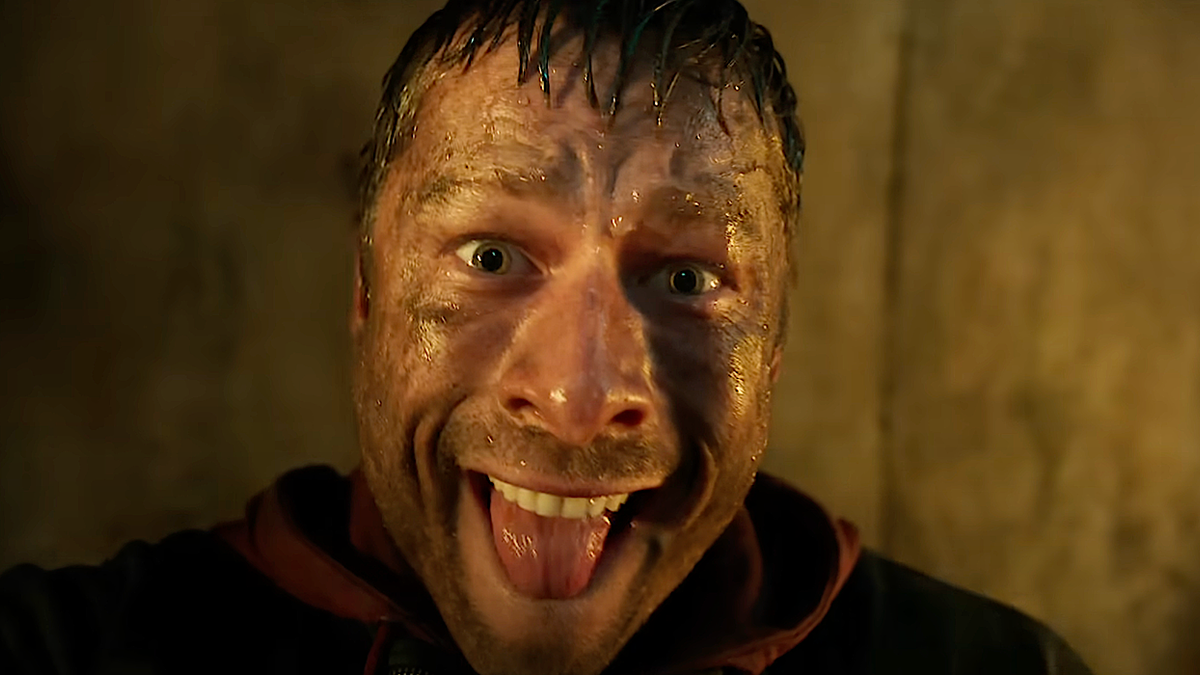
This new version is the same way, only flashier, a touch more poignant, and featuring a much more believable lead. Glen Powell, who has quickly become an A-lister over the last three years, is that perfect blend of leading man and everyman. Yes he’s jacked (and there are a few beefcake shots for fan service peppered throughout the picture), but you could also suspend your disbelief enough to buy that he’d be a schlub at the end of his rope. It’s certainly far easier to accept than an Adonis with a thick Austrian accent somehow being named “Ben Richards.”
The trick Wright pulls is not to make Powell’s version of Richards into this innocent crusader for justice, but rather a hot-headed malcontent. He’s honorable, certainly, as most of his financial troubles stem from him lashing out in support of his unionized coworkers in direct defiance of his bosses and corporate overlords owned by The Network, the mass media conglomerate that basically controls all content and government functions (including, pointedly, law enforcement) in this dystopian version of 2025, but he’s also quick to anger and violence, which grants a degree of credibility to the idea that he’d be blacklisted from employment, leaving him unable to pay for medicine for his sick daughter, and forcing his wife Sheila (Jayme Lawson from Sinners) to work as a hostess at a strip club in order to afford black market drugs.
The point is, this Richards is obviously flawed, which is what helps the audience latch onto him. He’s not some paragon of virtue with biceps for days. He’s a well-meaning fuck-up, a cautionary tale for any of us watching, letting us know just how far we can fall through a series of bad decisions and worse luck. It’s also a uniquely American problem, as the film goes to decent lengths to illustrate that all of this not only takes place solely in the United States, but that any other country would be a preferable escape if anyone could afford to leave. Remember, we live in the only industrialized nation on Earth without at least the option for single-payer, government-funded universal healthcare. In order to set this film in any other land, say, Wright’s native United Kingdom, you’d have to create an expository incident for that resource to be taken away. Here in the States, it’s just an extreme eventuality based in current reality. The less mental bandwidth you have to devote to the minor issues of worldbuilding, the more you can save for the stunts and ‘splosions.
The crux of the conflict is in how the game – and the world writ large – is rigged against our protagonist (and any other poor soul in his position). Richards begins the film watching Network game shows, trying to figure out which would be right for him to get some quick cash. He settles on a particularly exploitative program where overweight individuals are meant to run on a giant hamster wheel while answering trivia questions. When it’s convenient for the show to ditch the contestant, the host (Sean Hayes) inserts a completely ridiculous and difficult question, which of course the player gets wrong, and the wheel speeds up to the point where he’s violently thrown off to severe injury at the very least.
However, even that idea proves to be a con job, as Network auditions are desperation cattle calls, where applicants are put through a battery of tests a la The Hunger Games and then assigned to a show. They can of course, decline the offer, but despite Richards’s adamant desire to not participate in the titular death game, that’s the one he’s given. Executive Producer Dan Killian (a deliciously smarmy Josh Brolin) notes that no contestant has survived the 30 days necessary to win the billion-dollar grand prize (in a fun touch, the “New Bucks,” the currency of this parallel universe, has Arnold’s face on the bills), but adds that Richards can earn more than enough money to ensure his wife and daughter’s escape from the slums should he meet his end, and no matter what they’ll be protected by the Network in exchange for Ben playing.
This is enough to get Ben to sign on, but he quickly learns just how much is against him in the name of entertainment. The show’s host, Bobby T (Colman Domingo looking like he’s having the time of his life) paints him as a lazy, ungrateful miscreant to make the audience hate him. A network of spies, both human and technological, can inform on him for their own cash prize at any time, even earning a huge bonus if they kill him themselves instead of the show’s designated “hunters” (led by Lee Pace as the masked Evan McCone). When Ben meets an underground resistance influencer in Boston (Daniel Ezra), he’s shown video proof (cleverly via analog media like VHS tapes) of how the show intentionally casts certain character types and artificially prolongs the chase for the sake of ratings before killing the contestants anyway. This game, like the very concept of social mobility, is not meant to be won by the dreamers, but to last just long enough to make for “good TV” (or FreeVee, as it’s called in the film) before the status quo is lethally reinforced.
Now, as a game show writer/producer myself, a LOT of this satire rings true. I’m bound by Non-Disclosure Agreements not to go into too specific of details, but I’ve seen plenty of situations where outcomes or results were manipulated for the sake of what people far above my pay grade consider “good TV.” For the most part, these efforts do stay on the right side of the legal line (we’re not talking Quiz Show-style match-fixing or anything), mostly because there’s always the randomness of the human element as an incalculable variable. For example, Survivor may cast 20 people per season, but they usually only intend on there being about five to six true contenders, and oftentimes the twists and turns of the season can be predicated on that presumed ending. But people can still surprise you and overcome those obstacles, so technically the powers that be are not cheating. That said, it doesn’t stop a producer from demanding a dishonest edit to paint a participant in a certain way, something I’ve seen personally before, and which infamously came to light 20 years ago when Joe Millionaire implied forest fellatio via sound effects in the finale, humiliating the losing contestant. There are also rumors that the show’s protagonist was told who to choose as the winner because it would make for a more satisfying storyline, but those haven’t been fully substantiated.
When the film’s social commentary sticks to that angle, it’s quite resonant. We’re currently living in an era where naked corruption is everyday news and the exploitation of the most vulnerable for profit/lizard brain endorphin release is national political policy. As I mentioned in TFINYW, our current Secretary of Homeland Security has literally explored the possibility of a battle royale-esque reality show where immigrants would fight for a fast track to citizenship (not even the guarantee of citizenship, just the privilege of jumping the line a bit). There is some truly evil shit going on that makes this movie feel not all that far-fetched. And when we keep that focus, it makes the action sequences where Ben ducks, dives, escapes, and kills with a sardonic glee all the more cathartic. One of the best elements of the flick is the use of deepfakes to alter what Ben says (especially when he’s exposing the bullshit going on around him), turning his charisma into horridly depraved bragging about killing the innocent. The tactic was briefly used in the 1987 version as well, with Arnold’s refusal to fire on civilians in the opening being changed to him excitedly mowing down the poor to justify his arrest and forced participation in the game. However, 40 years ago that seemed like just another wacky concept. In the here and now, it’s all too real and common. Hell, the guys from South Park have an actual series of deepfake videos on YouTube where they turn Donald Trump into a zany local news reporter, and it’s VERY convincing. We now live in an age where disinformation is incredibly easy to create, spread, and disseminate, making this Ben Richards’s plight seem all the more plausible.
It’s when we deviate from that into meaningless filler that the film occasionally misses its mark. For example, there’s a Kardashians-esque parody show on FreeVee called The Americanos, about an entitled family of rich societal cancers pretending their wealth is a burden (the family matriarch/Kris Jenner stand-in is played by Debi Mazar, best remembered as Spice to Drew Barrymore’s Sugar in Batman Forever). Several people, including Ben, watch the show on their free time, as does a late ally named Amelia (Emilia Jones from CODA), glued to the screen in her self-driving car. On the surface, it appears the joke is that even the “best” of us, like Richards and the soon-to-be-converted elite Amelia, are susceptible to trash television, and there is truth in that. But really, if The Network controls everything, then this is just the least objectionable viewing option for the masses. You can’t really assert that even the good guys endorse this stuff if there’s no other choice (there is eventually the hyper obvious suggestion to just “turn it off” towards the end, but that’s too little too late). It’s in line with my complaints about pop music since the turn of the century. When record company execs and the Ryan Seacrests of the world simply tell you that some new mass-produced dreck is your favorite song without offering an alternative (including coopting so-called “Alternative” stations to just be minor-key pop), you’ve robbed the audience of any real decision-making ability, and rendered terms like “hit” utterly moot. When you’ve saturated the market with only your product, you haven’t made something great, you’re just another monopoly.
Similarly, the supporting characters – and their plot utility – are hit and miss. Richards begins the game with two other candidates, Tim Jansky (Martin Herlihy of Please Don’t Destroy) and Jenni Laughlin (Katy O’Brian seemingly carving out her niche/typecast as “buff lesbian”). They’re both obvious cannon fodder, and apart from being used for early exposition, they really serve no purpose other than to illustrate Ezra’s point about casting, which means we’re just waiting for them to die and hoping it’ll be cool when it happens. Now, the 1987 version of Laughlin (and Marvin J. McIntyre’s Weiss) were also marked for death the moment they were introduced, but they were also active elements in the story, assisting Arnold (and Maria Conchita Alonso) until it was time for their characters to go, thus raising the stakes. They spent time with Arnold, generating just enough pathos for us to care when they met their respective ends. Jansky and Laughlin here are just mile markers, killed off-screen (but also on-screen for the purposes of the show), and have no involvement with Richards once the game begins. As such, we have no reason to give a damn about what happens to them.
As for the others, we have William H. Macy as Molie, an underground tech and arms dealer, and supposed close friend of Richards, whom the latter visits during his 12-hour head start on the show in order to get supplies. The scene they share is good, but it feels incomplete. Molie reveals that he was about to give Richards a job as his assistant before he agreed to be on The Running Man, but since we never met Molie before, and his only involvement afterward is a “SHIRE! BAGGINS!” torture scene, the irony and sentiment are lost. Karl Glusman of Nocturnal Animals plays Frank, the only other named hunter pursuing Richards et al. There’s a scene where he’s injured, giving Richards the chance to escape, or kill him and escape, which poses an intriguing moral quandary, but the moment is never given a chance to be fully explored. The only side player who leaves much of an impression is Michael Cera as Elton, this film’s closest analog to Weiss, a resistance nerd who’s turned his house into a Home Alone death trap, leading to one of the most fun sequences in the entire flick.
Thankfully, these misfires are rare, and the overall product is a wonderful piece of action-packed escapism. The fight choreography and camera movements are typically superb, the type of cinematic slickness that is Wright’s stock in trade. The production design is fantastic, both in the contexts of the world Richards inhabits and the nuts and bolts of the TV show. The soundtrack, as always, is excellent, with Oscar-winner Steven Price (Gravity) blending an appropriately tense ambient score with some very fun catalog tracks, chiefly Tom Jones’s cover of “Keep on Runnin’.” The script, co-written by Wright and his Scott Pilgrim collaborator Michael Bacall, is snappy, efficient, and often hilarious. In short, Wright has made his own campy 80s movie 40 years on from the 80s themselves. If you think too much about it, your experience might be dulled, but if you do, you’re missing the point. This is a prime example of what a popcorn film should be. It won’t be an all-time classic, but it’s a damn good time that’s meant to be enjoyed at the multiplex.
Just try to ignore the mirror occasionally being held up to your face as you indulge in the carnage.
Grade: B+
Join the conversation in the comments below! What film should I review next? How long do you think you’d last on the show? Do you prefer this version or the Arnold one? Let me know! And remember, you can follow me on Twitter (fuck “X”) as well as Bluesky, subscribe to my YouTube channel for even more content, and check out the entire BTRP Media Network at btrpmedia.com!

 I Actually Paid To See This
One thought on “Catch Me if You Can – The Running Man”