
Awards Season is firmly underway, and we’re getting ever so close to the main event. The Independent Spirit Awards announced their nominees this morning, and the Golden Globes will reveal their list next week, though obviously I put far, Far, FAR less stock in the latter. A week after that, the Academy will release their shortlists in multiple categories, putting us in “Go Mode” for next year’s Oscar Blitz.
In the meantime, we still have the overall list of Animated Feature submissions to hopefully complete, a challenge even more daunting than usual, given that several films I’ve taken in this year were not included in the exhaustive 35-picture rundown. Just over a week ago, I gave proper space to three entries from the fall months (one of which was among those left off, and for good reason), so now it’s time to finish this bit of the specialty feature backlog. All three of the pictures contained herein were in fact submitted, so at least we’re still making progress. I have sincere concerns about completing the list this time around, what with the tightness of holiday season funds and the fact that I’ve taken five days off work the last three weeks due to illness and injury, but we’ll keep chugging along as best we can.
Chainsaw Man – The Movie: Reze Arc

Like Demon Slayer, I’m aware of the popular Chainsaw Man manga and anime, but I’ve never actually read or watched it. Still, while movies from anime TV shows aren’t always submitted to the Academy, my gut told me to check this one out just in case, just like Demon Slayer. And just like that other action IP, I found myself thoroughly entertained, to the point where I do genuinely want to catch up on the series to more fully understand it (the film also won the domestic box office when it first came out, equaling Demon Slayer‘s earlier accomplishment as well). I’d say Demon Slayer ranks higher, but largely it’s a matter of preference, though there is one area where this one comes up short in a direct comparison of the two.
For those as uninitiated as I was, the story revolves around a teenager named Denji, voiced by Kikunosuke Toya in Japanese and Ryan Colt Levy in English (I opted for the English dub this time around). He’s a devil hunter who can transform into a superpowered warrior with chainsaws in place of his arms and head in the heat of battle. After a successful mission, his boss at the ironically-named Public Safety division, Makima (Tomori Kusunoki/Suzie Yeung) takes him on a date as a reward. It’s clear that Denji is attracted to Makima, and this rare opportunity to bond outside of work means a lot to him, especially when Makima reassures him that he has a metaphorical heart notwithstanding his physical demon heart, which apparently ties in to his powers. I’m probably butchering the lore, but that’s the gist I got.
Now somewhat smitten, Denji is further stunned by the flirtatious advances of a barista named Reze (Reina Ueda/Alexis Tipton), who shows up out of nowhere in a rainstorm, initiating a meet-cute. As they get closer, Denji has very conflicted feelings, but eventually does fall for Reze, only to be betrayed when she reveals herself as the “Bomb Devil,” sent to assassinate him.
If you’re upset that I just revealed the “big twist,” well, that’s part of the major flaw with the film. From the instant Reze appears on screen, you know exactly where this is going. I didn’t even know what the “Reze” in the title meant, as the name of a manga/anime arc can go in any number of directions. But before she even stated her name, the circumstances of their meeting just screamed, “Oh, that must be ‘Reze,’ and she’s totally the villain, right?” Now, admittedly, part of my own fandom entered into this assumption. I’ve been an admirer of Alexis Tipton ever since I got back into anime back in 2010. Her voice just has that perfect blend of seductive and dangerous that makes a lot of her characters fun and easy to pin, similar to Jamie Marchi. If you know, you know. So yeah, the instant I heard her voice, I knew how this particular arc would bend.
But even without the voice, it wouldn’t have mattered. Had I watched and listened in the original Japanese, my main issue would still stand, which is that the reveal isn’t properly hidden at all. Reze is too perfect of a love interest to be believable. Don’t get me wrong, I really dig her design (and the fact that the film wasn’t afraid to do a little fan service and earn its R-rating), Tipton’s voiceover is near-perfect, and when she drops the charade she’s a total badass. But she is 100% shonen wish fulfillment, and it shows, to the detriment of the character and the pacing of the plot. Even when we’re supposed to get some pathos out of her eventual fate, it’s kind of lost because we only got to care about her as an object and wait for the axe to fall.
Still, the movie is a ton of fun, especially the action animation. The fight scenes that make up the back half of the film are incredible, filled to the brim with detail and chaos, and yet it all makes a weird semblance of sense. Just like with Demon Slayer, I can see why this character – and the series writ large – has legions of fans. Reze’s ability to turn anything into a ballistic weapon that still attacks with deadly precision, juxtaposed with Denji’s pure berserker attack style, make for some truly cinematic set pieces, particularly in the climax.
There are other issues aside from the “twist,” but most of them boil down to the presentation style. In Demon Slayer, things felt like they were made for a movie, by which I mean that the formatting lent itself to the plotting, pacing, and formula of a big screen epic. With Chainsaw Man, a lot of the backstory and supplemental information is left as read for most of the runtime, before we get exposition dumps well past their point of utility. In that sense, this movie feels more like four episodes strung together rather than a film. It’s still balls-to-the-wall awesome at times, but if you’re like me and went in blind, there were a lot more questions left unanswered than in Demon Slayer. I plan to find those answers by immersing myself in the show down the road.
Grade: B
A Magnificent Life

Sylvain Chomet is no stranger to this competition, as he’s already been nominated for the Animated Feature Oscar. He earned that nod (as well as one for Original Song) for The Triplets of Belleville from 2003. If you’re like me and loved the art style of that film, then A Magnificent Life will be, at minimum, an enjoyable visual experience. There are also quite a few fun and insightful bits in this cartoon history lesson.
The film is an animated biopic about the life of Marcel Pagnol, a playwright and filmmaker who was a pioneer in early French cinema. Framed around an imagined conversation with his younger self while writing an article for a magazine, we hit the standard beats of a celebrated career. We see his upbringing, successes, romances, shortcomings, tragedies, and pointedly, his fight for artistic integrity and independence during Nazi occupation.
There are a lot of touching moments to be had, particularly the exaggerated way Marcel approaches his professional work and his private passion for trying to invent a perpetual motion machine. He juggles the egos of his actors, the histrionics of his family life, and his own personal vices in a way that’s endlessly endearing, and Chomet’s distinctive animation only aids the affair, transporting things into the borderline fantastical.
There’s also one odd bit of production that’s worth mentioning. I saw this as part of the Los Angeles French Film Festival, where it was curiously screened in English rather than its native French. My guess is that the decision was made because this is a family film, and any children in the audience would be bored attempting to read subtitles for 90 minutes.
Now, as we’ve seen many a time, an English-speaking cast typically won’t do French accents, but local dialects are crucial to Pagnol’s story as presented here. Having grown up in Marseilles before moving to Paris to make his fortune, there are several scenes where some high society Parisians look down on Pagnol and his ilk as being the French equivalent of country bumpkins, evidenced by their accent. So how do you get this across in English with a British voice cast? Simple, really. Have all the Marseilles-based characters speak with Welsh accents! It shouldn’t work, but strangely enough, it does. Not unlike Pagnol himself in several scenes, we get on a meta level a very clever workaround for a creative obstacle. Mind you, this plays visually much better in the animated scenes than in restored footage of Pagnol’s films, as 2D animation is much easier to adapt for lip flap and audio syncing purposes than live action, but I kind of have to tip my hat to the team for the attempt alone.
If you’re a fan of film history, I think you’ll enjoy this. I’m not sure this is really all that accessible for a younger audience, mostly because they won’t know or care who Pagnol was. But the flick is sweet, and very well designed. I’m kind of amazed how vivid the imagery sticks in my mind over a month later.
Grade: A-
Little Amélie or the Character of Rain
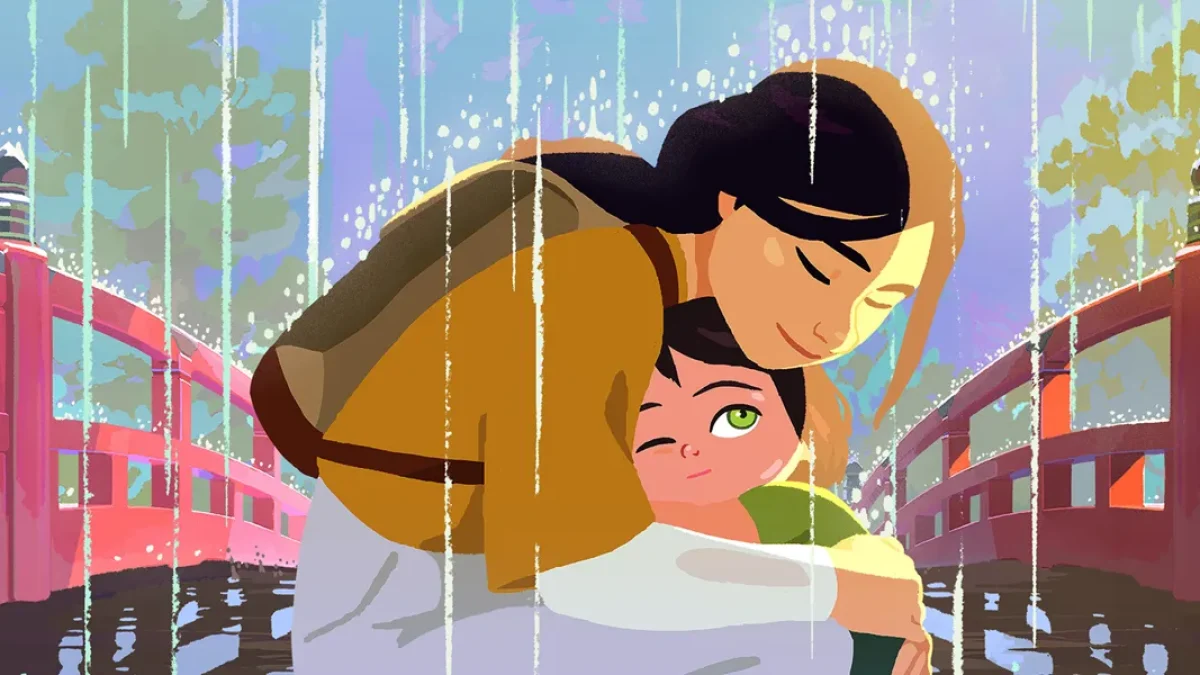
Well, we’ve had a French movie and a Japanese one, so why not end by combining the two? Directed by Maïlys Vallade and Liane-Cho Han, and based on the semi-autobiographical novel by Amélie Nothomb, this is, by a considerable margin, the best animated film I’ve seen so far this year, a trippy and heartfelt tale of existentialism and self-awareness. It’s a coming-of-age story encapsulated in the youngest of ages, one that will dazzle as well as attack your emotional centers.
Amélie (eventually voiced by Loïse Charpentier in the main action, with narration by Emmylou Homs) is the youngest of three children born to a couple of Belgian diplomats living in Japan. For the first two years of her life, Amélie is depicted as being in a vegetative state, with her inner monologue proclaiming herself as a god who merely observes the world around her rather than participating in it. On her second birthday, an earthquake finally snaps her out of this stasis, causing her to scream and become a hellion until her grandmother (Cathy Cerdà) gives her some white chocolate, a proper form of worship in the young god’s eyes. Eventually she starts speaking, but not in a way that calls for help or expresses curiosity. Rather, as her inner voice denotes, it’s more performative and perfunctory, with her first words (“vacuum cleaner,” adorably) being more an endorsement of the one thing she doesn’t find mundane.
To help around the house, the family hires a live-in nanny named Nishio (Victoria Grosbois), who forms an instant rapport with Amélie, or “Amé” for short, which when translated to kanji forms the literal character for “rain,” hence the title. Nishio represents the first relationship in Amélie’s life that doesn’t have a rote explanation, and therefore she becomes attached in hopes of learning more.
Their dynamic is nothing new – there are many stories about kids and their caretakers, from Mary Poppins to Mrs. Doubtfire and dozens more in between – but the angle is something fairly unique. A lot of the abstract concepts on display in this film are presented in a straightforward manner, but can easily be interpreted on a number of different levels. Take, for example, Amélie as a “vegetable.” It’s played completely straight, with the parents initially worried that their daughter will be catatonic her entire life, but then warming up to the idea and even finding happiness in it, only for it all to be shattered when Amélie becomes, for want of better term, a “normal” toddler. Now, I have no idea if the child was meant to be this way for real, or if Nothomb herself actually experienced it, but as a viewer, it made for one of the best visualizations I’ve ever seen of a child learning object permanence. The vast majority of us have no recollection of our first years (my earliest memory is waking up in a hospital at age three after suffering an ear infection; my mom and aunt surrounded my bed while the nurse gave me all the orange juice I could drink), so why not fantasize that you’re a being outside of existence, a deity to be revered, with information simply passing through you until you’re ready to retain it? It’s utterly brilliant!
Amélie’s time with Nishio falls along a similar line. What we’re seeing is, for all intents and purposes, the formation of a human soul, a personality, one guided with love, humor, and all-too-necessary sadness. Nishio tells stories of her upbringing, how she survived World War II (the film takes place in the 60s), and introduces Amélie to different aspects of Japanese culture. These are actions that some frown upon, but for this little girl trying to compartmentalize it all, we get to see how this process works, how opinions and emotions evolve, and how she reconciles her feelings about those around her in a way that’s as innocent as it is profound. The progression from Amélie learning about Nishio’s childhood loving the beach to a near-death experience is gut-wrenching, but also beautiful and, amazingly enough, completely logical. This is a film that child psychology majors should study as part of their curriculum.
Complementing this incredible storytelling is an absolutely gorgeous art style that combines elements from anime with traditional 2D hand-drawn Western animation, similar to what Arco also accomplished this year. I was reminded fondly of the works from Cartoon Saloon, like The Secret of Kells and Song of the Sea (somewhat appropriately, the screening I saw opened with a new short from Cartoon Saloon called Éiru). But whereas that other film emphasized the fantastic nature of the adventure, this film grounds its visuals in reality before bending your mind in directions you didn’t think possible. Amélie, Nishio, and all the others look like hybrid characters, but there’s also a surprising touch of realism in their designs. This is particularly true when it comes to Amélie’s eyes, which become brighter and more lively and expressive as the story plays out.
I’m not gonna lie. I may or may not have partially dehydrated myself while watching this, I was sobbing so much. The way this film explores emotional development and memory just cut me to the quick, and I lost count of the times I felt tears just streaming down my face as it all unfolded. Despite the record number of submissions for the Oscar, this has been kind of a down year for animation, with my personal bottom six movies to date all being cartoons. There have been some good and even great films here and there as well, but this is the first one that hit that perfect note for me that makes the artform so essential. The beauty of animation is in its limitless possibilities for storytelling. This is the first entry that truly makes good on that promise. There will undoubtedly be other, more popular films vying for the prize, but this one already has a special place in my heart. It’s my hope that this is one day held in the same regard as Inside Out.
Grade: A
Join the conversation in the comments below! Have you seen any of these films? Which was your favorite? Is there an anime show that you want to see adapted for the big screen? Let me know! And remember, you can follow me on Twitter (fuck “X”) as well as Bluesky, subscribe to my YouTube channel for even more content, and check out the entire BTRP Media Network at btrpmedia.com!

 I Actually Paid To See This
4 thoughts on “Back Row Thoughts – Animation Autumn-ation, Part 2”