
I’ve got this wonderful tingly feeling all over my body. Oh wait, no, that’s hives. Anyway, I’m stuck in my room all weekend, so I might as well make the most of it with some batch reviews. A few days ago, the Academy released its shortlists for half the categories at next year’s Oscars, including International Feature. So far I’ve seen 20 films that were submitted for this prize, and of them, nine made the initial cut. That means there are 11 more that didn’t. One of them, 2000 Meters to Andriivka, I’ve already reviewed in this space. That leaves 10 more to bring briefly into the spotlight and give them their due. Just about any of these would have made for a worthy nominee in one respect or another, so it’s more than worth it to check them out if you get the chance. As always, I’ll present them in the order I saw them.
Dog of God – Latvia

I saw this back during the summer, I believe as a screener from the Tribeca Film Festival, but it’s been so long that I could be misremembering. What I haven’t forgotten in the last several months, however, was how trippy and viscerally gorgeous this film is. It’s also been submitted for Animated Feature, with directors Lauris and Raitis Ābele giving a special thanks to Gints Zilbalodis, whose Oscar-winning Flow helped open the door for Latvian animation on the world stage.
You know you’re in for something delightfully fucked up when the movie itself opens with a surreal sequence straight out of Rob Zombie’s art, where a werewolf – in Latvian folklore, werewolves apparently are humans drawn into the servitude of dark gods (hence the film’s title) rather than a wolf-humanoid hybrid – literally castrates a giant, the fluid from its detached testes being used as a healing potion in witchcraft.
It only gets weirder from there. In a mix of several influences, including folklore, the true story of self-proclaimed werewolf Thiess of Kaltenbrun, The Peasants, and even a touch of Disney’s Hunchback of Notre Dame, we see a sprawling plot involving a young barmaid accused of heresy (she uses the salves from the giant’s nut sack to treat the wounds of prostitutes) by the local priest who lusts after her like a medieval Claude Frollo, who also abuses his altar boy (but not like that), treating him like a slave because the young man is his illegitimate son.
The animation here is stunning, a mix of psychedelic neon colors placed over rotoscoped live acting. It makes for a hypnotic sequence of events where the lines of reality, fantasy, and pure delusion blur. It’s equal parts eye-popping and jaw-dropping. I sincerely wish more audiences got a chance to see this, but for some reason it still has yet to get an American release despite it being a co-production with the U.S. It’ll have to get a qualifying release of some kind within the next week to maintain its Oscar eligibility (and maybe it already has and I just don’t know about it), but I sincerely hope it gets a wider audience. For a long time this year this was my highest-rated animated feature. It likely won’t get nominated, but it deserves your attention, especially if you like bright, gory horror.
Grade: A-
The Mysterious Gaze of the Flamingo – Chile

Stories about sexual diversity have done well for Chile in this competition, evidenced by A Fantastic Woman winning the Oscar just a few years ago. You would think that would give The Mysterious Gaze of the Flamingo a leg up, especially after it won the “Un Certain Regard” contest at the Cannes Film Festival. Alas, it was left by the wayside. It’s a very interesting project, but it does get lost in its own sense of magical realism at times.
Taking place in the early 80s, a young girl named Lidia (Tamara Cortés) lives in a communal house in a desert mining village where all the denizens are drag queens and prostitutes. In particular she’s raised by the frail Flamingo (Matías Catalán), who has come down with an unexplained illness. Sitting in the audience, we all know that it’s very likely AIDS given the queer atmosphere and the timeline of the film, but it’s still such a new phenomenon (especially in rural South America) that it doesn’t have a name yet. It’s simply referred to as a plague.
Rumors spread in the village as some of the miners themselves start getting sick and dying. A local legend develops that the disease spreads through the romantic glances of people who fall in love, and Flamingo is blamed for being too seductive when a jilted former lover becomes ill and obsessed. After tragedy strikes, Lidia must learn to heal and find her own place in a world where most boys tease her and her only “male” influences dress like women and put on cabaret shows. There’s even some absurdist fun as the remaining miners try to hold the queens hostage in their own home, blindfolding them so that they cannot bewitch the men.
The fantasy sequences that illustrate this literal male gaze as a means to spread illness are certainly creative, but they also pull you out of the movie. There’s also an entire subplot about the house matriarch/patriarch, Mama Boa (Paula Dinamarca) falling for a widower and eventually getting married. Again, it’s kind of interesting and sweet, but it also represents some major tonal whiplash and sends the movie straight off the rails. Had things been a bit more focused, I think this would have at least made the shortlist. Still, if you’re curious, you won’t be upset for taking the time to look this one over.
Grade: B
Happy Birthday – Egypt
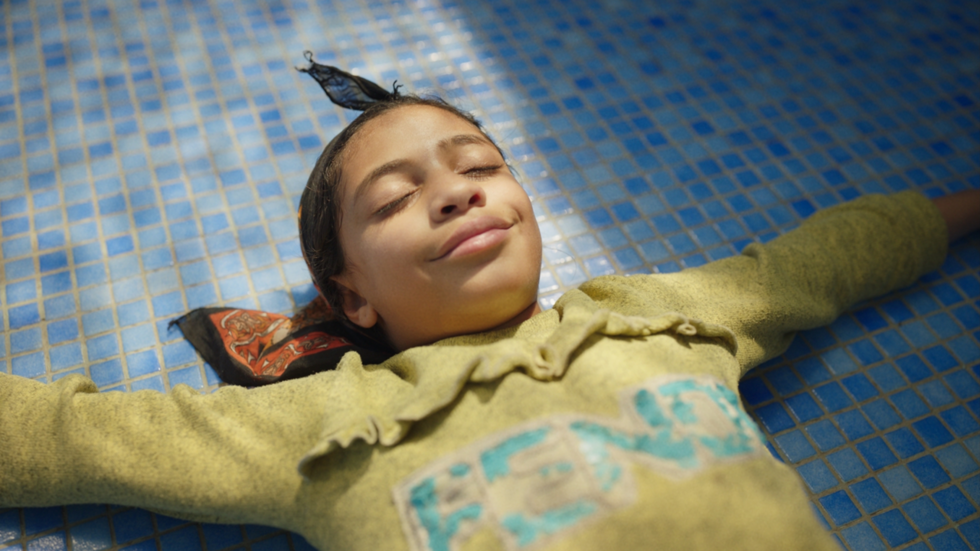
The Iraqi film, The President’s Cake, ended up on the shortlist, which means the similarly-framed Happy Birthday became expendable. The two movies are totally different in terms of plot, but they both involve impoverished young girls doing thankless work around an important birthday celebration, so I’m guessing the Academy voters thought this was the least essential of the two.
The film opens with a young girl named Toha (Doha Ramadan) waking up another girl named Nelly (Khadija Ahmed) on the morning of her birthday. Nelly is super excited to have a party, but Toha doesn’t know about any of that. At first you think it’s because she’s so young, but it quickly becomes clear that this is not a sister-sister dynamic as the scene would suggest. Rather, Toha is a live-in servant, despite the fact that she’s only eight years old. She’s employed by Nelly’s mother and grandmother, the former of whom is going through a separation with her husband and is planning to move the family out of their gated Cairo suburban home, and thus hasn’t planned for a birthday party.
Toha makes it her mission to create the perfect party for Nelly on just a few hours’ notice, and Nelly’s mother Laila (Nelly Karim) reluctantly obliges, taking Toha around high-end shops to find supplies and a dress for her daughter. Conflict starts to arise when the shopkeeper tells Laila that Toha, as a servant, is not allowed to try on dresses in the boutique, as she’s beneath their station in life. Laila defends Toha, but once all the preparations are made, she surreptitiously has Toha’s sister come pick her up and take her home to their poor fishing village, lying that Toha’s mother is ill, as an excuse to make sure Toha herself can’t attend the party she planned, for the same classist reasons.
It’s one of the saddest moments in a child’s life, when they come face-to-face with the harsh realities of the world. In this case, Toha sees first hand just how disposable she is as a person. She’s praised when she’s useful, but she’s still considered persona non grata when it comes to the fruits of her labors, never minding that as a child, she shouldn’t be laboring in the first place. Her efforts to sneak her way into the party and get just a taste of the good life are noble, endearing, and ultimately a sad reminder of just how mean the world can be for no reason.
Grade: B+
Magellan – Philippines

The first film I saw at this year’s AFI Fest was the Filipino entry, Magellan, about the life of the explorer who had such a major influence on the island nation’s development. Directed by Lav Diaz, a master of “slow cinema,” this movie can be seen as a bit of a slog at over two and a half hours, but during a post-screening Q&A, he jokingly called it a “short.” For comparison’s sake, he’s also in the process of making a companion film focusing on Magellan’s wife Beatriz (played here by Ângela Azevedo) that will run for nine hours. Yeesh.
You can kind of guess the tone of this portrayal of history by the opening scene, where a nude island native goes about her business near a stream, when something catches her eye. After some timid spying through some bushes, she runs back to her village in hysterics, praising the gods for finally sending a white man as their savior. This is meant to show the absurdity of colonial thinking, and it’s juxtaposed with a much more harsh account of events.
The real draw here is Gael Garcia Bernal as Ferdinand Magellan. Over the course of the film we see him lauded for his leadership, condemned for his dissent to the crown when asking for expedition funds, fighting off a mutiny at sea, and his doomed voyage that did eventually circumnavigate the globe, but not with him living to see the end of it. He definitely has Captain Bligh’s arrogance and sense of self-superiority, which is ultimately his undoing, along with his smug assertions of religious right to subjugate entire nations. It makes one wonder how, knowing all this, the Philippines still became a country with a nearly 80% Catholic population, but that’s a discussion for another time. Bernal’s performance is a lot of fun either way.
I also really enjoyed Diaz’s cinematography here, keeping things in Academy ratio simply because those were the cameras he could afford for the project. He makes great use of them, however, playing with focus and natural light to give the viewer just enough information to draw their own conclusions while keeping some scenes almost playfully ambiguous. But yeah, two and a half hours is way too long for the story he’s telling, and the fact that he considers this “rushed” pretty much guaranteed this wouldn’t advance any further in the competition. I am curious to see some of his other works, but at the same time, if I’m going to devote 12 hours to a film experiment, I’ll just marathon the extended cuts of the Lord of the Rings trilogy.
Grade: B-
Orphan – Hungary

The last film in this batch comes from Hungary. The title, Orphan, is meant to be a touch ironic, as our child star, Andor (not Cassian), played ably by Bojtorján Barabas, does in fact have parents. He just doesn’t want to admit the truth behind his own upbringing. In a story set in a chaotic time in Hungary’s past, he’s a boy looking for his place in the world and for the validation of a loving family, but he just can’t grasp the cruelty and compromises that had to be made to get him to this point.
The film is set in 1957, after the events of World War II and the uprising against communists in Budapest. In the midst of all of this, Andor’s father has gone missing. He’s presumed dead, but there’s no evidence one way or the other. He waits every day for news, and his mother Klára (Andrea Waskovics) does her best to keep his spirits up, well aware of the likely outcome (the film is loosely based on director László Nemes’s father and his attempts to reconcile his parentage post-war). She also has to keep her head down somewhat, as her family is Jewish, and still bears the scars of hatred from the Holocaust. Before long, a well-to-do butcher named Berend (Grégory Gadebois, who’s had a stellar career in French cinema) comes along, making lascivious passes at Klára and demanding to be part of her life. It’s then revealed that Klára had an affair with him in exchange for money and protection during the war, and it’s very possible that he is actually Andor’s real father.
Andor of course refuses to accept this possibility, and certainly won’t abide the attempts for Berend to adopt him, particularly after he sees the way Berend abuses his mother. The inner conflict raging inside the young man is highly engaging, and it makes you truly wonder how you’d react in a similar situation. It all leads to a very tense climax where the promise of a bad life rather than no life at all becomes a serious dilemma. At times the film is melodramatic to an extreme degree, but for the most part, the histrionics are narratively justified, and the cinematography that largely keeps the shots framed from Andor’s perspective is a solid touch.
Grade: B
***
That’s all for this edition. I’ll be back soon with the other five entries that sadly didn’t make the semifinals. Then we’ll get into the remaining candidates still up for what could be a very competitive category (for once). Stay tuned!
Join the conversation in the comments below! Have you seen any of these films? Do you think any of them should have made the shortlist, or even been nominated? How would you like to be raised by a house full of drag queens? Let me know!And remember, you can follow me on Twitter (fuck “X”) and subscribe to my YouTube channel for even more content, and check out the entire BTRP Media Network at btrpmedia.com!

 I Actually Paid To See This
One thought on “Back Row Thoughts – Visa Denied, Part 1”