
I can honestly say that I didn’t intend to do a third installment of this miniseries. I figured the two batches I’d already done would be sufficient to see out the fall months. But then the Academy released the list of accepted films for the Animated Feature contest, and I saw that there were a whopping 35 entries, a new record. Over the last two posts, I took a look at six candidates vying for the prize. In the few weeks since, I’ve taken in several more, including one today, on the official last day of the season. I may not be able to complete the journey yet again, but damn it if I’m not going to try. So let’s get to it!
Stitch Head

I have to start out with something of an apology. Stitch Head came out around Halloween, for obvious reasons, and I actually saw it before Chainsaw Man, but I neglected to include it in the previous rundown. Normally I review movies in the order I see them (or in the order within the batch review), but I simply forgot.
That should honestly tell you all you need to know about this film.
It’s not bad, per se, just utterly unmemorable. There’s a lot of obvious cribbing from the likes of The Nightmare Before Christmas, both in the character designs and tone (though the animation is standard 3D CGI rather than stop-motion), but just like our lead character, it really doesn’t have much of an identity. That said, it is a bit fun in some areas.
Asa Butterfield voices our hero, a sort of Igor-esque lab assistant to a mad scientist (Rob Brydon). Stitch Head was the first creation of the Professor, who has gone on to make several more monsters over the course of some indeterminate amount of time in the Castle Grotteskew (get it?), to the point that Stitch Head himself barely registers. He’s so ignored, in fact, that the running gag of the story is that his name is just the first description any human or monster can think of when looking at his patchwork face. Stitch Head takes it upon himself to “educate” the newly-created feral beasts, going through what is admittedly a quite clever conveyor belt of conditioning to help them acclimate to their new life, and also to warn them against going down to the village below, lest they provoke an angry mob to storm the castle with torches and pitchforks.
Meanwhile, in said village, a small-time circus owner named Fulbert Freakfinder (Seth Usdenov) arrives in hopes of ginning up some income. However, he finds no takers for his sideshow. That is, until a curious young girl named Arabella (Tia Bannon) informs him of the castle. From there, Fulbert makes his way up the mountain and lures Stitch Head away on the promise of love and attention.
There’s an intriguing premise here in the idea of transactional fame and artificial affection, but the movie is more concerned with zany antics and a precocious female sidekick. There are times when the animation looks appropriately cool, and a whole lot of others where it looks akin to the Russian Pinocchio movie that used Pauly Shore for the lead voice. Sometimes the action, music, and comedy gel completely. And then we have a completely out of nowhere usage of an Air Supply song in the climax. The movie looks like it’s trying to tell its story completely through a series of memes without recognizing that most of them are memory holed as soon as you look at them for two seconds. I can definitely say I was entertained, but I also lost track of the plot every time I rolled my eyes. I mean, when you can’t even bother to explain WHY the mad scientist keeps obsessively making monsters to the point where Stitch Head is beyond an afterthought, then why should he be anything more to a wider audience?
Grade: B-
Endless Cookie

I had a chance to see this as the closing feature of this year’s AFI Fest, but that would have meant staying at the theatre well past midnight on a Sunday when I had work in the morning. Thankfully, it still got its qualifying release, and all I can say is… huh.
Directed by Seth Scriver, and primarily starring him and his half-brother Peter, the film exists as a surreal documentary about Peter and his family. The two share a father, but have different mothers. Seth’s mom is white, and he lives in Toronto, while Peter’s mother was Cree, and he lives far up north in the Shamattawa First Nation territory. Part of the “plot” of the film is Seth constantly securing grant money simply to travel the thousands of miles distance to record Peter’s anecdotes, which Seth then plans to animate.
There’s a rich variety of characters, mostly made up of Peter’s seven children, all of whom are animated in very odd fashion. Peter’s nose is bright red to match yellowish skin, making him look more like a duck than an indigenous man. Others take the forms of skunks or octopuses. The youngest daughter, Cookie, is literally a cookie. The stories are fun, if disjointed, and half the action revolves around the construction of a tipi on Peter’s land, because otherwise, there’d be no through line. As Cookie herself notes towards the end, this whole process took about nine years, even though Seth’s initial grant was for seven months.
The reason the film gets away with being essentially pointless is that a) it’s technically a documentary, so the mere act of observation and commentary is sufficient, and b) Seth’s animation is really intriguing, sort of like a mix of various shows you’d see on Adult Swim. I mean, for God’s sake we have a five-minute discussion on whether or not one of Peter’s daughters can have a box of chicken burgers from the supermarket. This really is just a wacky way to literally illustrate two brothers shooting the shit for two hours. I’m glad I didn’t stay up in late October for this, but I’m also glad I took the time to give it its proper due in the theatre when it came out publicly. A lot of the images are still seared in my brain, and that’s no small feat.
Grade: B
Black Butterflies

The issue of climate change is one of the most serious of our time, which makes it eternally consternating that our current government treats it like a hoax designed to make them less wealthy. This is a real problem, with real solutions, but it takes political will to do anything about it. Instead, we as a nation would rather play pirates for Venezuelan oil than acknowledge the real consequences of inaction. Black Butterflies takes an artful approach to the subject, dramatizing the lives of three disparate women around the globe whose struggles in life can be directly tied to climate issues, like a synchronicity of tragedy.
Valeria (Laura Gómez), a resort waitress in Saint-Martin, is forced to flee the island after Hurricane Irene with her two children in tow. She goes to France, as Saint-Martin is an overseas French territory, and thus she has citizenship. Her husband, who was injured in the storm helping others to safety, is not allowed to accompany them, because he’s Dominican. Valeria works nights as a nurse and helps her children through school, but she’s exhausted and needs her husband by her side. Unfortunately, because climate change is not an accepted cause for refugee status, she’s put through an endless cycle of red tape with no end in sight.
Shaila (Miranda Gas) is a rice farmer in India, living on a small island just off the mainland. The last few harvests have come up short, leaving her and her husband strapped for cash. After a strong monsoon floods their farmland and practically submerges their island, Shaila has but one option to make money: a maid service that would send her to Dubai through the “Kafala System,” an exploitative process by which a person is sponsored to travel for work, and in exchange they surrender their passports to their employers until the debt of the visa is repaid, meaning they cannot legally leave their job, no matter what abuses may occur. This was infamously highlighted a few years ago with the migrant laborers who suffered and died building soccer stadiums for the World Cup in Qatar. Shaila is just another victim.
Finally, there’s Tanit (Bella Agossou), an African woman living in a tribal community in the desert. The lack of water for years on end has driven her polygamous husband to lead a “water war” with a neighboring clan for control of their dwindling wells. Fearing for her life and the retribution of her gods, Tanit flees with her children to Nairobi, where she must reduce herself to prostitution in order to survive.
All of this melancholy is rendered using beautiful, hard outlined 2D animation. The titular insects serve as harbingers of death and disease, an ever-present omen of the consequences these women and their families must endure due to global indifference. Those who have the most to give offer nothing but shame and ignorance, while those with everything to lose somehow lose even more. It’s heartbreaking, but also entirely preventable. The questions before the audience are, what will you do to make a change, and how will you hold the powerful accountable to make sure it actually happens? There are no easy answers, but this film shows quite plainly that doing nothing is not an option.
Grade: B+
Scarlet

The latest from anime virtuoso Mamoru Hosoda is yet another shining example of his nearly unrivaled ability to draw pure beauty. Similar to Mirai and Belle, Hosoda gives the audience a stellar lead that just makes you ache for how gorgeous she is both inside and out.
Using Hamlet as a framing device, our titular princess, voiced by Mana Ashida (no English dub cast as of yet; the film gets a wider release in February after its Academy qualifying run last week), is devastated by her uncle Claudius (Koji Yakusho) murdering her father Amleth (Masachika Ichimura) and usurping the Danish throne. Sworn to revenge, Scarlet trains herself as a warrior, only to meet her own untimely end when Claudius gets the drop on her.
Sent to a purgatorial world between life and death and outside of linear time, Scarlet must hunt down Claudius, who has taken over this “Other World” on the promise of leading the masses to a glorious paradise on top of the highest mountain. His only request is that Scarlet be destroyed, killed in this world as well, and turned into nothingness. Along her journey, Scarlet, hardened and dead set on her own vengeance, meets an unlikely companion in Hijiri (Masaki Okada), a paramedic from modern-day Tokyo, who refuses to believe that he’s died, and who works to aid and heal everyone they come across as an act of goodwill. Through their association, Hijiri learns some very harsh truths about the world, disabusing him of his naivete, while Scarlet softens bit by bit, hoping for some deliverance from her pain and a life of peace. A vision of herself in Hijiri’s time, dancing in the streets with glee, offers a heart-wrenching glimpse of what might have been.
The animation here is just top notch, incorporating 2D, 3D, new digital techniques, and rotoscoping to create a truly unique visual experience, so much so that the qualifying run was done exclusively in IMAX theatres. The facial expressions and character models exist outside the norms of both Western and Anime aesthetics, occupying a lovely middle ground that feels almost tangible. There are some who might brush off Scarlet as another pink-haired heroin like the online “Belle” of Hosoda’s previous outing, but the two could not be more different. More importantly, while that film took most of its inspiration from Beauty and the Beast, this picture starts with Hamlet and then begins incorporating several other influences, from The Lord of the Rings to The Divine Comedy. Hosoda knows better than most in his industry how to weave familiar themes into something altogether new and exciting, because when it’s all said and done the spectacle is still anchored by compelling, believable leads. He’s created a lot of memorable characters over the years, and Scarlet is sure to be included among his best.
Grade: A
All Operators Are Currently Unvailable
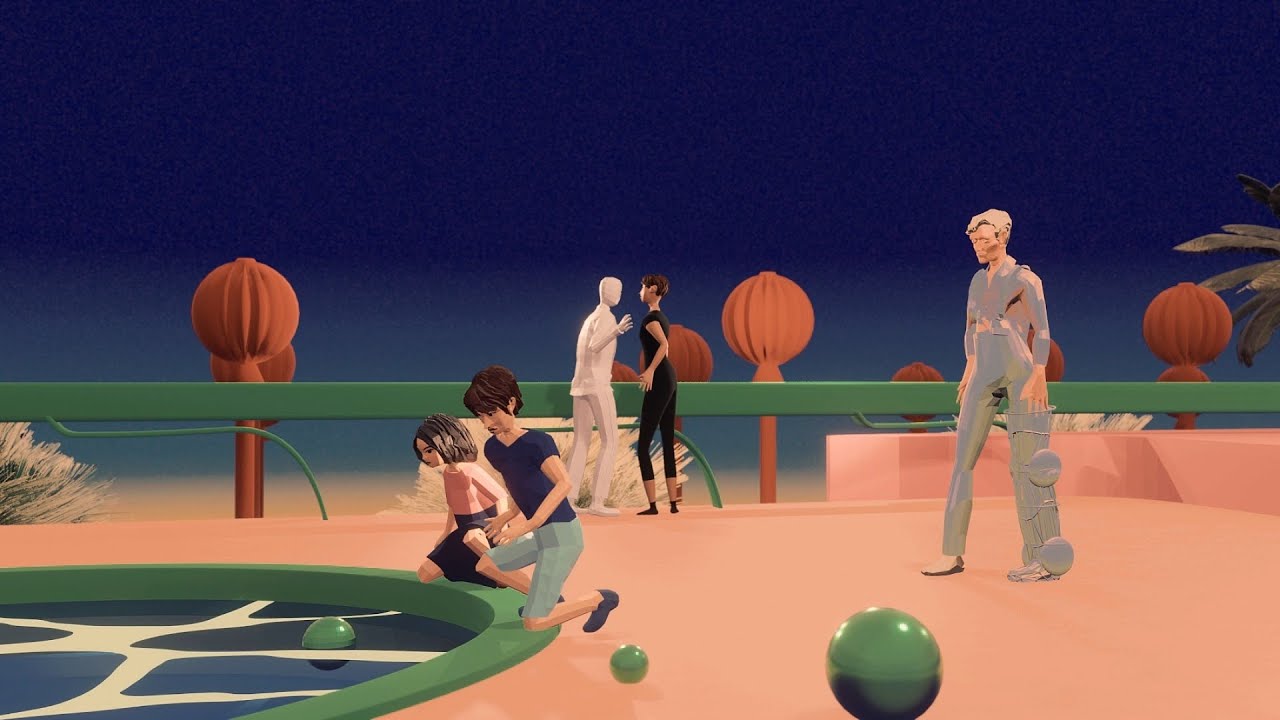
We finish tonight by going from one of the strongest outings of the year in animation to one of the absolute worst. The second feature from Dalibor Baric is a pretentious exercise in faux-existentialism wrapped in an interminable meta layer cake of absurdism that just goes absolutely nowhere.
Ostensibly, the story is about a washed-up screenwriter named Roman Novotny (Nikša Marinović). He’s been out of work for a while, so his agent gets him a job as a scenario writer for a series of travelogue videos at an experimental resort where the guests act out the scenes written for them, called “Simula Peninsula” (get it, cause it’s a simulation?). Upon his arrival and meeting with the resort’s manager, Dr. Doppler (Boris Bakal), he sets to work, but everything is not as it seems. Before long, we’re in a trippy loop of illogic, where everyone is in their own personal Hell and there’s no escape.
Think if someone tried to make the Eagles’ “Hotel California” into an animated film, only the animation was a poorly-rendered, half-assed copy of the animation from the “Money for Nothing” video, only that shit came out 40 goddamn years ago. It only takes about 20 minutes to get the point of the movie, and yet it still goes on for another 100 soul-cleaving minutes that refuse to end. The only momentary changes we get are brief switches in the art style, which vacillate between charcoal sketches and wireframe animatics. Oh, and Roman writes underwater in a pressure suit for some reason.
None of this makes a lick of sense, and it just feels like a troll. There’s no deeper meaning to any of this, and we’ve seen the “what is reality” psychosis plot done a ton of times before. This offers nothing new except for shitty subtitling, where some of the text is oddly spaced, sometimes it’s in bold and sometimes not, character names are identified before the characters introduce themselves, and the software can’t even handle the simplest of accents, to the point where an antagonist known simply as the “Fiancé” (Frano Maskovic) has his moniker displayed on screen with an error symbol rather than the “é.” It’s that bad.
Compare this to Endless Cookie above. Neither of these films has a point to it, but at least the documentary was bright, creative, and memorable. Here Baric can’t even be bothered to light a scene or have the characters’ lips move half the time. This feels like someone testing out AI software with horrifying results rather than an actual movie with a narrative. It’s just two hours of nothing that ends just as abruptly and unceremoniously as it began. To think that this was entered into the competition for the Oscar and yet Hola Frida! wasn’t. Good lord!
Grade: D-
***
That’s it for this batch, and this miniseries (for real this time). There are still several more animated hopefuls to check out, and I’ll get to as many as I can in due course. Join me then!
Join the conversation in the comments below! Have you seen any of these films? Which was your favorite? If you could make a documentary about your family, how would you go about it? Let me know! And remember, you can follow me on Twitter (fuck “X”) as well as Bluesky, subscribe to my YouTube channel for even more content, and check out the entire BTRP Media Network at btrpmedia.com!

 I Actually Paid To See This