
As we enter the final days of 2025, the viewing schedule kicks into overdrive. We’re just over three weeks from Oscar nominations being announced, and there’s still so much to see. Among mainstream contenders, I still need to watch Wicked: For Good, Marty Supreme, Bugonia, F1, and probably Weapons, to say nothing of all the stuff Netflix is plugging as it tries to buy Warner Bros. and kill the studio model forever. I also have however many animated films I can track down (I did get one of my four missing entries via VOD, and another was ostensibly available on YouTube for the past week, but every time I tried to watch it I was blocked), a bunch of documentaries (I’ve now seen three of the shortlisted 15), and the remaining International Feature semifinalists (four to go – two on Netflix, two in theatres).
As such, it’s time to finish polishing off the foreign also-rans. When the shortlist was announced earlier this month, I had seen 20 films that were submitted by various countries for the competition, with nine of them making the first cut. Of the 11 remaining, I had only reviewed one, so I decided to batch the other 10 into two five-movie installments. We’ve already handled half of the fallen hopefuls, and now it’s time to give the others their brief moment in my tiny spotlight. They all had something to offer for Academy voters, but I can understand why they didn’t quite measure up to what’s looking like the most stacked race in years.
Eagles of the Republic – Sweden

I really enjoyed this film, mostly because it has the feel of a political thriller that, were it an American release, you’d see it during Summer Blockbuster Season. It’s the third and final installment in Tarik Saleh’s “Cairo Trilogy” starring Fares Fares, following The Nile Hilton Incident and Boy from Heaven/Cairo Conspiracy, the latter of which was also submitted by Sweden and made the shortlist. This is easily one of the least essential of the entries I took in this year, but it was still a lot of fun.
Fares plays George Fahmy, the modern day Egyptian equivalent of Clark Gable and other classic Hollywood leading men. In Cairo’s studio system, he churns out many fan-favorite films with his costar Rula (Cherien Dabis) and lives the privileged life of an A-list celebrity. He dates a much younger actress (Lyna Khoudri) while estranged from his wife (Donia Massoud) and teenage son (Suhaib Nashwan), but his reputation is rock solid. That changes when he’s approached and essentially blackmailed into starring in a propaganda film chronicling President Abdel el-Sisi’s rise to power.
Fahmy is reluctant to make government movies, as he wants to be seen as politically neutral, but also because the proposition is absurd on its face. He’s over six feet tall with a svelte figure, a full head of hair, and a face that looks like a combination of Adrien Brody and a young Judd Hirsch. The Egyptian leader is… not any of those things, and yet Fahmy is expected to play him without any prosthetics or makeup to alter his appearance. Fahmy only agrees once goons threaten his son.
What follows from there is a dangerous game where a government official named Mansour (Amr Waked) micromanages the production and spies on Fahmy, while Fahmy himself begins an affair with Suzanne (Zineb Triki), the wife of the Defense Minister. Everyone gets caught in the crosshairs as it becomes ever more clear that the film itself is just a front to expose a coup plot within el-Sisi’s cabinet.
This has all the earmarks of a great popcorn film. Fares gives a terrific performance, the camera work is solid, the script makes sense within context, and Alexandre Desplat provides yet another perfect score to fit the silliness and seriousness of each scene. This movie feels very Hollywood, with the only major meta statement being the fact that Fares, as a Swedish citizen with Egyptian heritage, has a bit more freedom to critique his family’s home country than domestic actors. Sometimes that’s enough to get the Academy’s attention, but this year it feels more like a disqualifying aspect. Still very enjoyable.
Grade: B+
My Armenian Phantoms – Armenia

This is the most basic of the bunch, and there’s really not much to say. Directed by Tamara Stepanyan, this documentary definitely held my interest, but it’s not for a wide audience. This is a deeply personal, and deeply educational, look at a very specific sector of film history, which will be fascinating for some, but it’s the very definition of niche.
Stepanyan is the daughter of Vigen Stepanyan, one of the early stars of Armenian cinema during the Soviet era. Through the use of archival footage and home movies, Tamara tells the story of her father’s career, how she came to love film as much as him, and how the medium evolved through the back half of the 20th century. It’s a very fun history lesson, and the affection and nostalgia from Tamara are on full display.
If you know going in that this is all there is, you’ll probably enjoy yourself. But if you’re looking for something more, you just won’t find it. The film is well-researched and very sentimental, but unless you’re hankering for a lesson in Armenian cinema history, you won’t get much out of this other than a love letter from a daughter to her late father. That’s not to say this is a bad movie by any measure. It’s just very limited in scope, and especially in as competitive a year as 2025, it just doesn’t hold up. It’s still very sweet and informative, though.
Grade: B-
A Poet – Colombia
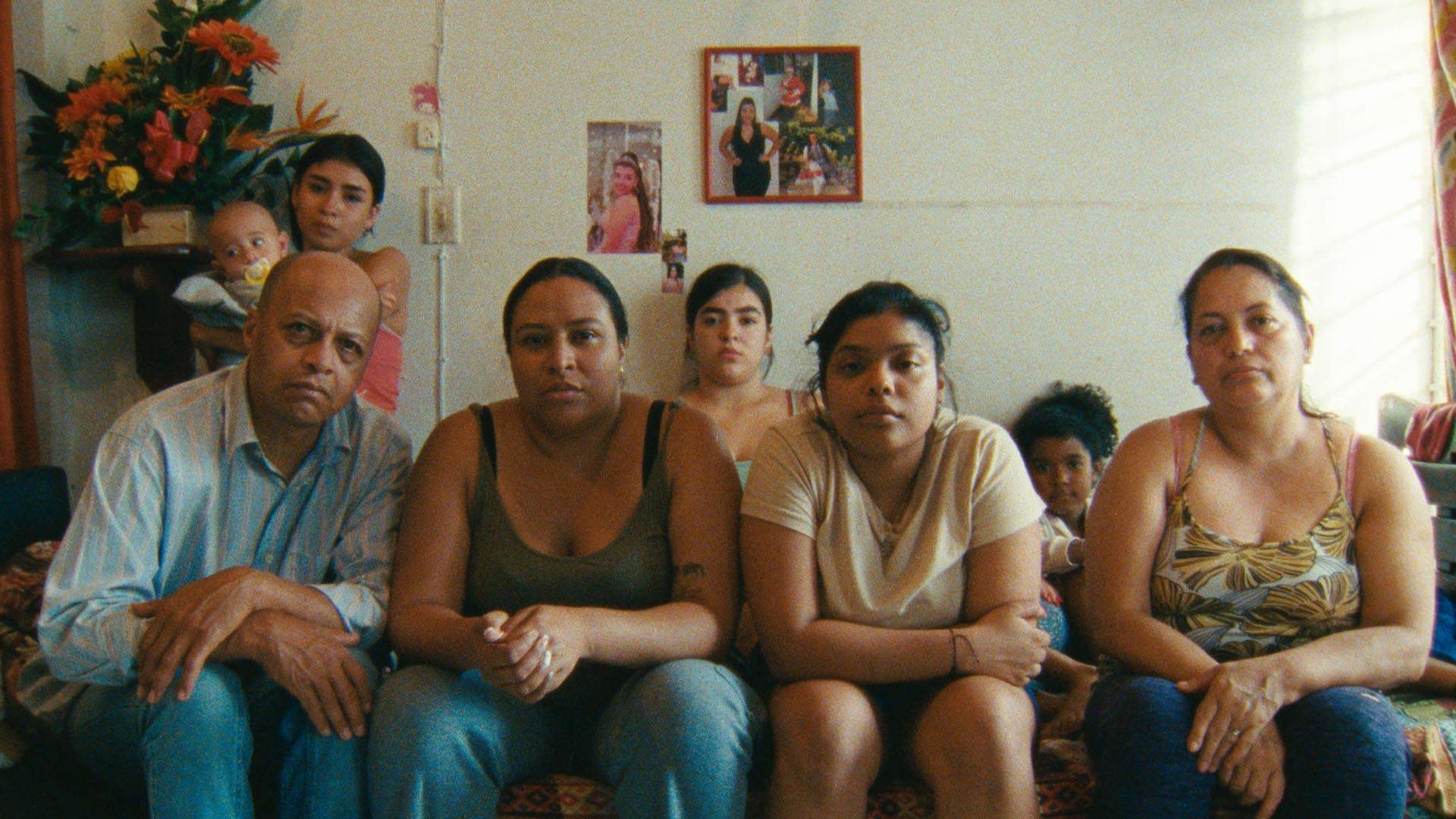
Directed by Simón Mesa Soto at a time where he himself admits he was about to give up on film as a career, A Poet is a tragicomic farce about what it really looks like to let go of your dreams. The melodrama is dialed up way past 11 in this flick, and given the travails of the last 18 months, it certainly hit home for me, mostly because I don’t want to end up looking as pathetic as our erstwhile protagonist.
Oscar Restrepo (Ubeimar Rios) is a talented poet who won numerous prizes and praise in his youth, but now that he’s middle-aged, he’s unable to sell any of his works and is dealing with a severe case of writer’s block. He’s out of work, living with his mother, and is estranged from his own teenage daughter (Allison Correa). Faced with financial ruin and eviction, he takes a “last resort” job as a high school English teacher, a position he feels is beyond degrading, as kids just don’t care about literature.
That attitude changes when he meets Yurlady (Rebeca Andrade), a poor student who shows remarkable promise. Seeing some poems she’s scribbled into a notebook, Oscar takes it upon himself to mentor the girl, using his contacts in the literary world to showcase her talents and get her some scholarship and grant money. In Oscar’s eyes, helping Yurlady succeed will help rehabilitate his career and perhaps foster a new generation of poetry enthusiasts.
However, Yurlady is less than excited about the whole thing. All she really cares about is getting money and food for her large and impoverished family. She plays along with the attempts to make her into a social media brand, but only for the most basic of monetary aims. As things ramp up, she realizes more and more that she doesn’t want to be a poet. Writing is just something she likes doing, but she has no intention of making a career out of it, and the desperation with which Oscar insinuates himself into her life, to the point where she gets drunk at a convention and Oscar has to comically carry her large frame home in a way that invites scandal and innuendo, only further solidifies her desire to keep her station in life.
Oscar is not a sympathetic character. In fact, he’s a deadbeat loser who won’t compromise his artistic desires for his own good. It made me very self-conscious to watch, because I’ve spent the last year and a half in a similar state. The big difference between us is that I have more than opened myself up to other work possibilities and career shifts so that I can get my finances back on track. Oscar just bitches and moans, but it still cut me to the quick. Thankfully, his sad sack nature is played properly for laughs, so we’re able to set the more “real” elements aside. The film does end on a hopeful note at least, and the comedic bits are very solid.
Grade: B+
Reedland – Netherlands
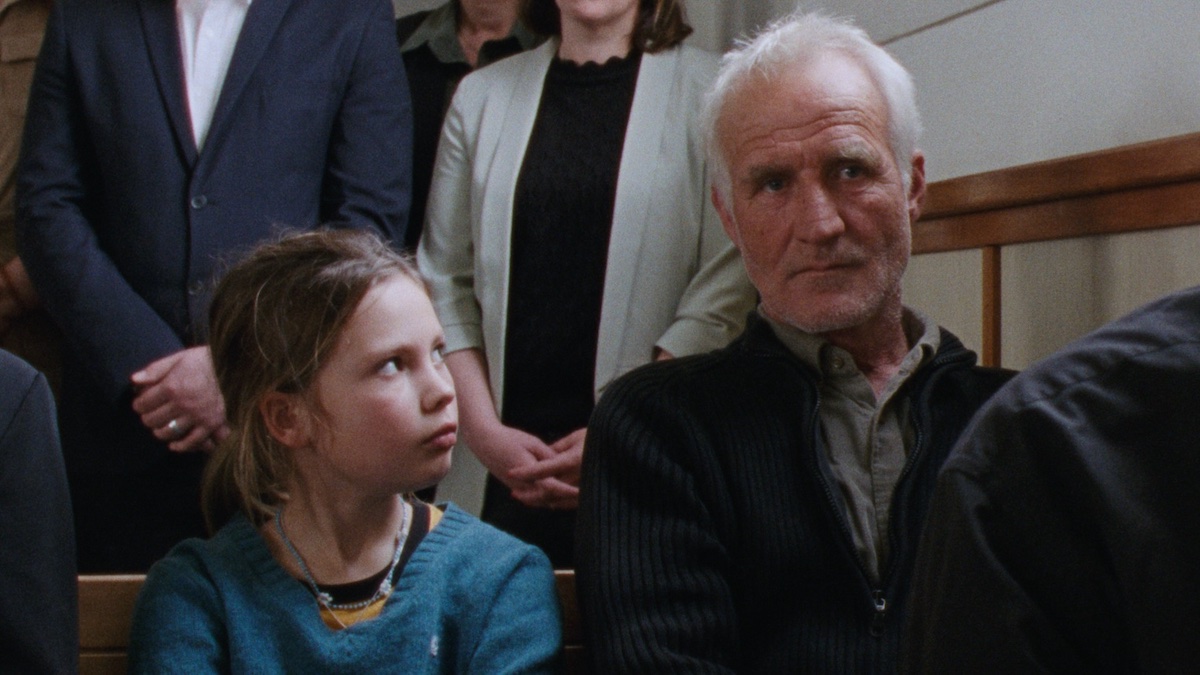
This year’s Dutch entry campaigned hard, but ultimately didn’t make it into the later voting rounds. Playing like a European version of True Detective or Winter’s Bone at times, the film takes a very introspective look at tragedy and the ways in which an insular rural community will protect its own.
For the first 10 minutes or so of the film, I honestly thought I was watching a nature documentary, as our lead Johan (Gerrit Knobbe) silently goes about his daily routine of cutting and packaging reeds on his farmland. He sells what he can and burns the excess, retreating to his house at the end of the day for a solitary meal. Not a word of dialogue is uttered until the arrival of his granddaughter Dana (Loïs Reinders) for an extended stay while she finishes up her school term.
One day, Johan’s world is rocked by the discovery of a dead body on his land. A teenage girl has been raped and murdered, the only clue being a set of motorcycle tracks entering and leaving the scene. Stoic but protective of Dana, Johan takes it upon himself to investigate the incident, particularly when his neighbors all default to blaming an ethnic boy from a neighboring village who used to date the girl. What little evidence there is points to the son of Johan’s next door neighbor, but it’s certainly not enough to arrest him. When the boy taken in on purely racial reasoning is also released due to a solid alibi, the community is content to leave the situation alone, but Johan will not settle for inaction, especially while caring for Dana.
In his feature debut, director Sven Besser takes a very moody approach to the proceedings, with a particular focus on Johan’s sense of guilt, both at being unable to prevent the murder and his own sexual proclivities, especially for younger girls. He harbors an attraction for a high school student, for example, which he tries to get past by watching porn, but ends up more frustrated when the cam models demand money he doesn’t have. Meanwhile, he has to maintain decorum for the sake of his position in the community, as most of the residents care more about European Union tariff and land lease policies than the grisly end to a young woman’s life. The closer Johan gets to the truth, the more uncomfortable it makes the rest of the town, and the more likely it becomes that retribution will fall on him.
Besser’s cinematography goes a long way towards getting these themes across, particularly the omniscient way he films scenes like it’s something out of National Geographic. It’s essentially saying that all the horrible things going on are just part of the course of nature, something that cannot be prevented or properly punished. It’s a very promising first effort, and I’m curious to see what he does next.
Grade: B
The Tale of Silyan – North Macedonia

Six years ago, Tamara Kotevska made Oscars history, when her film, Honeyland, was nominated for both International Feature and Documentary Feature, the first ever to do so. While that accomplishment obviously won’t be equaled in 2026, her latest effort, The Tale of Silyan, is another remarkable look at the relationship between man and nature.
The film’s title refers to a Macedonian folk tale about a boy who wanted to leave his village to see the world. When he departs, his father curses him, and the boy Silyan turns into a white stork. He flies away, but cannot exist in the animal world. He returns home, seeing his father’s regret, and the two reunite, though the father does not know he’s caring for a bird that is his lost son.
That story frames the documentary, where a farmer named Nikola has worked and lived happily with his family for decades, growing various vegetables and selling them at market. His life isn’t glamorous, but he’s always made enough to get by. As the events of the film take place, however, his fortunes have changed. His customers – mostly grocers and restaurateurs – refuse to buy his products at the normal prices, insisting he undercut himself to maximize their profit margins. Nikola would rather destroy his crops than sell them at a loss, and so he does. His wife, daughter, and grandchildren move to Germany in search of better economic situations, while Nikola stays home, trying to sell plots of his land to survive. He has little success, and the government isn’t helping with any subsidies in the offseason.
Despondent, Nikola takes a job driving a tractor in a garbage dump. It’s there that he finds a white stork (a symbol of his town) with a broken wing. Filled with a sense of purpose, Nikola takes the bird in and nurses it back to health until it’s able to fly again. The mission to save the stork beautifully illustrates Nikola’s nature as a caregiver, and the value of keeping his home intact.
Kotevska’s photography is absolutely stunning here, making use of natural light and color to a superlative degree, to the point where the scenery almost feels like something out of a fairy tale. Late-stage capitalism is a very predatory institution, but Nikola is here as an example of how we can heal through caring and cooperation. In the wild, the stork would be easy pickings, but Silyan shows the value of humanity as a force for good, so long as we act in for something greater than ourselves.
Grade: A-
***
That does it for our dearly departed contenders. Fifteen films are still in the running, and I’ll be churning out reviews for them in the coming days. Oscar nominations come out on January 22, and with luck, I’ll have the entire shortlist cleared by the 9th. It always feels good to finish off a category before it officially starts.
Join the conversation in the comments below! Have you seen any of these films? Should any of them have made the shortlist? Have you ever helped an injured animal? Let me know! And remember, you can follow me on Twitter (fuck “X”) and subscribe to my YouTube channel for even more content, and check out the entire BTRP Media Network at btrpmedia.com!

 I Actually Paid To See This
One thought on “Back Row Thoughts – Visa Denied, Part 2”