
We’re a little more than a fortnight away from Oscar nominations, and one of the more intriguing subplots regarding the ceremony – and Awards Season writ large – this year is the good number of foreign films that will end up competing for mainstream hardware. Not only is this shaping up to be the most competitive International Feature contest of the decade to date, it’s entirely possible that we’ll see four or five global submissions nominated for Best Picture and several other marquee categories.
One of the strongest contenders is The Secret Agent, the entry from defending champion Brazil, directed by Kleber Mendonça Filho (who helmed Brazil’s 2023 candidate, the documentary Pictures of Ghosts). A superbly crafted neo-noir thriller, Filho expertly replicates the New Hollywood style of the 1970s to create a smart, poignant, and genuinely suspenseful affair, anchored by one of the best performances of the year.
Wagner Moura stars as Armando, a former college professor in 1977, who goes into hiding during the final years of Brazil’s military dictatorship, a period of time where political dissidents and basically anyone in favor of basic things like free speech, were routinely rounded up, disappeared, and murdered by the state (this practice was also the centerpiece of last year’s winning film, I’m Still Here). Due to some personal history with a corrupt businessman, Armando has had a hit put out on him. He lives in a small commune with other marked individuals, all living under assumed identities, in the care of the matriarchal Dona Sebastiana (Tânia Maria). It’s there that he makes some friends, has an affair, and is able to spend a few brief moments of normalcy with his son Fernando (Enzo Nunes), who lives with his late mother’s parents for safety’s sake.
Armando does odd jobs for various resistance movements while also taking on some work at a government archive office under the alias of Marcelo, where he looks for information on his own mother, who may also have been vanished by the regime, and of whom he has no memory. Between dirty cops, assassins, and just plain dumb luck, Armando finds himself caught in multiple crosshairs, and eventually must attempt to flee the country to save his own life.
Moura’s performance is one of the best I’ve seen in a while, making for a likely stacked Best Actor field in a couple of weeks. He stands shoulder to shoulder with the likes of Michael B. Jordan, Leonardo DiCaprio, and Ethan Hawke, to the point that awards voters should have a very difficult decision. He infuses Armando with pathos, reason, and in a bit of a departure for similar protagonists, a fair degree of self-reflection for his own sins while lamenting the danger he’s in for crimes he never committed. In lesser hands, seeing him quip about random events, reminisce about his wife, and wax malevolent about his various pursuers would feel like tonal whiplash, but for Moura, it not only comes natural, but feels oddly logical. He’s a very human figure, meaning he’s flawed, but still worthy of being a rooting interest because you can tell he’s trying to do right by his son, his friends, and ultimately himself.
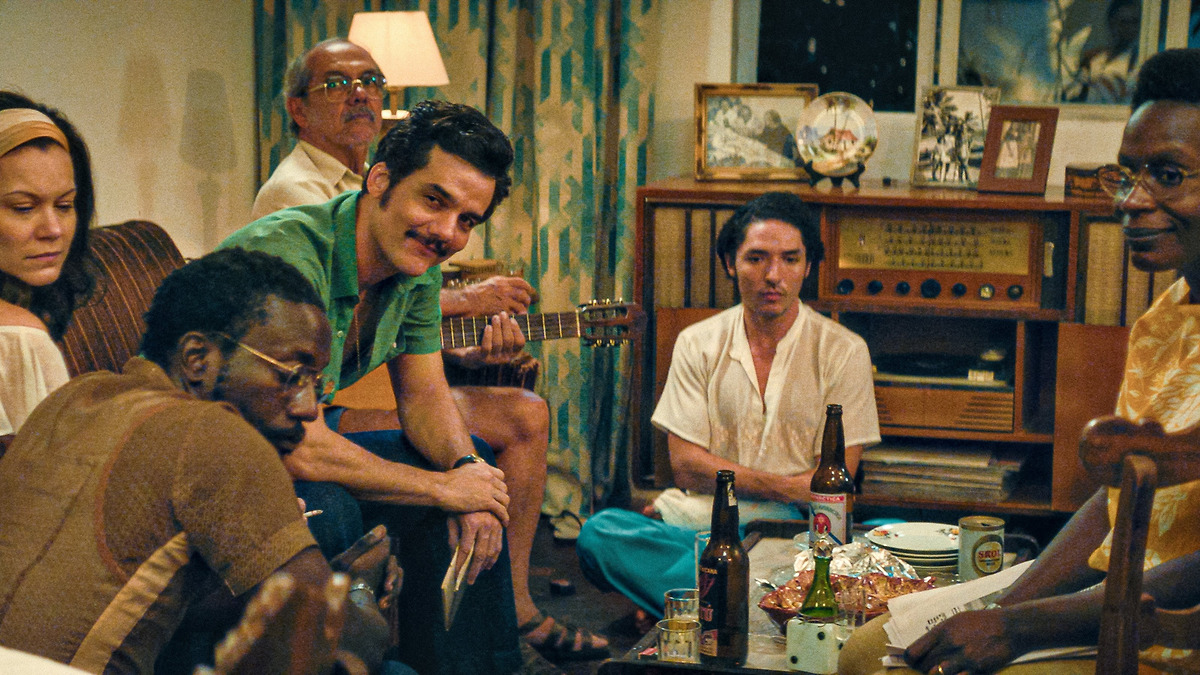
Filho takes it from there, piecing together an absolutely cracking narrative, filled to the brim with the stylish confidence of 70s cinema, particularly The French Connection, and includes some very clever references – both direct and indirect – to Jaws. Whether it’s something as subtle as the opening scene where Armando pulls up at a gas station that just happens to have a dead body decomposing in the dirt on the premises (similar to the shark’s first victim when her body washes up on the beach in Amity), the more direct and darkly comic severed leg of an assassination victim being discovered in a tiger shark’s stomach, or the nuanced discussion of various hunting and survival strategies that mirrors the drunken story hour aboard the Orca, Filho knows how to massage our nostalgia while still making something that can stand on its own, as all of these scenes also have relevance to the historical context in which the film is set.
You also get a sense of the same affection for the media of the movies that Filho displayed in Pictures of Ghosts. A good portion of that film was about discussing the famous theatres of Recife, where he grew up. Here, Armando’s father-in-law, who serves as Fernando’s guardian (Carlos Francisco), works as a projectionist at the local cineplex, making him something of an analog to Cinema Paradiso‘s Alfredo. Just as he works tirelessly to keep his grandson safe, so too does he spend his days preserving the art of cinema that Filho holds so dear.
The action is broken up with scenes set in the present day, where a student named Flavia (Laura Lufési) pores over archival footage, news clippings, and recordings to piece Armando’s story together. This not only gives the audience some well-timed moments to breathe as the action ramps up without derailing the plot, but also serves as the moral center of the film. As we’ve discovered all too viscerally in the last few days, weeks, months, and years, the old adage about repeating history when we refuse to learn from it has proven true time and again. In the back half of the 20th century, several South American nations went through similar travails of repression and state-sanctioned homicide. Obviously this section focuses on Brazil, but you can find equally appalling situations in Argentina, Chile, Venezuela, and others. The sad part is, it’s starting to happen again. Both Argentina and Brazil have flirted with quasi-authoritarian rule. The United States is once again inserting itself into the region by kidnapping heads of state and instigating de facto coups. Economies are floundering. It’s not all that hard to believe that the entire continent could backslide if the people aren’t vigilant. The scenes with Flavia serve as that all-too-necessary reminder.
By the time we get to the high-octane climax, we’ve truly earned the moment, and the twists that come with it. Part of what made this era of Hollywood timeless is that while there are scenes and sequences that are lodged in our memories forever (the car chase in The French Connection, Michael’s checkmate montage in The Godfather, the “Attica!” scene from Dog Day Afternoon, etc.), we were always given proper buildup and character development to make them land. It’s something that modern action and thriller films often forget or disregard in favor of explosions and one-liners, which makes a lot of them fall flat or become instantly forgettable. If we don’t care why something exciting is happening, or about the people it’s happening to, then it’s just noise. It can be entertaining noise, certainly, but it rarely leaves a lasting impression.
Filho and Moura work overtime to make sure that doesn’t happen here. The moving parts around Armando come together brilliantly to set up a conclusion with actual stakes where the outcome can genuinely affect us on a deeper emotional level. It’s not the hardest thing to do, but so few choose to do it. Here, we get exactly what’s needed, and we’re grateful for it. It’s a more than satisfying payoff to everything that preceded it, and it makes sense on a thematic level. Obviously I won’t spoil it, but I will give you this personal detail to make my point. The film has just come out in American theatres, so you can hopefully go see it right now before it gets its likely nominations. I saw The Secret Agent for the Mill Valley Film Festival in early October. It’s been three months since I’ve seen this flick. That ending is still fresh in my mind. That’s how you know it worked.
Grade: A
Join the conversation in the comments below! What film should I review next? Do you enjoy movies from the New Hollywood era? What would you do if you knew there was a hit out on you? Let me know! And remember, you can follow me on Twitter (fuck “X”) and subscribe to my YouTube channel for even more content, and check out the entire BTRP Media Network at btrpmedia.com!

 I Actually Paid To See This
2 thoughts on “The Shark Has Such Teeth – The Secret Agent”