
It’s a rare thing when a foreign film gets a public release in the United States, and even rarer when it’s picked up by major distributors for a wide release in mainstream theatres. You can imagine then my pleasant surprise when Park Chan-wook’s No Other Choice got not only that treatment, but a Christmas debut, meaning it’s meant to compete with all the other Awards Season hopefuls and favorites. That’s very ambitious, from both a creative and a business perspective. Clearly there’s something special about this picture to garner such advance endorsements, not to mention a place on the Academy’s shortlist for International Feature, right? Right?
Yup.
Okay, that wasn’t the best fake-out ever performed, but that really is the long and short of it. No Other Choice is a fantastic dark comedy from beginning to end, a macabre look at just how fucked so many people are in the modern economy. It really is tragically ironic that we’re in a period in this country where financial prospects are dire for just about everyone but the super rich, and yet in 2025 it was two Korean filmmakers willing to put the fine point on it through their art: Park here and Bong Joon Ho with Mickey 17. While this film is more serious and direct than its sci-fi farcical counterpart, the central thesis is the same, that of hard-working people being forced to trade their humanity for the sake of survival in late-stage capitalism.
In an interesting departure from other works in this quasi-dystopian motif, this film focuses on someone who works in management, but whose bread and butter is decidedly blue collar, bridging the gap between the day-to-day hourly workers and the monolithic corporate machine that abuses them. Man-su, played excellently by Lee Byung-hun, is a supervisor at Solar Paper, a plant that makes sturdy, pulp paper for industrial and commercial use. He’s been at the company for 25 years, has worked his way up to a management position, and was even given the “Pulp Man of the Year” award for his efforts. He lives an ideal life with his wife Mi-ri (Son Ye-jin), stepson Si-one (Kim Woo-seung), daughter Ri-one (Choi So-yul), and their two dogs, playfully named Si-two and Ri-two as a pun on the kids’ names. Their house is the same one Man-su grew up in, where he suffered a severe childhood trauma, but with his earnings he not only bought it, but turned the on-site barn where he witnessed tragedy into a greenhouse where he maintains a horticultural hobby as a means of renewal and personal therapy.
He’s literally living the life that millions of us here in the States would categorize as the “American Dream,” just a nice house, a steady job with room for advancement, and a loving family. That’s all that so many of us want out of our brief time on this planet. The fact that this is in Seoul rather than, say, Indianapolis, is a testament to the universality of the modern human condition. The vast majority of us don’t want or need to be billionaires, celebrities, or captains of industry. We just want to do our part in society and have a few peaceful comforts as the fruits of our labors.
So of course, the moment Solar is bought out by American investors, over a quarter of the employees are unceremoniously laid off, including Man-su. Still, he’s confident in his skills, and is sure that he’ll be back on his feet with another paper company in three months. So of course, we jump ahead thirteen months with no progress. Man-su is working stock at a store, but it’s not nearly enough to get by, and he quits in order to take an interview at Moon Paper (the “night and day” metaphor is apparent right from the off), where his nerves get the better of him. Now without any income, the family is forced to make some serious sacrifices. All extracurricular activities are abandoned, chiefly Mi-ri’s tennis lessons and dance classes, the dogs are given to Mi-ri’s parents on a temporary basis, and they begin attempts to sell the house. The only luxury they maintain are Ri-one’s cello lessons, as she’s something of a prodigy, and being neurodivergent (she’s antisocial and only speaks in repetitions of other people’s dialogue) it’s the only way Man-su and Mi-ri can attempt to connect with her. Mi-ri herself gets a part-time job as an assistant to a young attractive dentist (Yoo Yeon-seok), making Man-su jealous and insecure.
After months of becoming increasingly despondent and desperate to resume his career, Man-su hits a breaking point. Seeing a brash and idiotic paper man named Seon-chul (Park Hee-soon) acting like a fool on social media, flaunting his wealth as an “influencer,” Man-su decides to kill him and try to take his position. The attempted murder is aborted, not because Man-su has a sudden attack of conscience, but because he realizes that so many people are in his position that, even if he were to knock this guy off, he’d likely have stiff competition for the job. So naturally, he does the only logical thing: he creates a fake company and advert, soliciting applications from all the other out-of-work paper pros in the city, and determines that two possible candidates could fare better than him, so they must be killed as well. There’s Beom-mo (Lee Sung-min), another middle-aged manager who’s accomplished similar things to Man-su, who has languished into alcoholism over the course of his unemployment, and Si-jo (Cha Seung-won), a younger professional reduced to working in a shoe store on commission to provide for his teenage daughter.
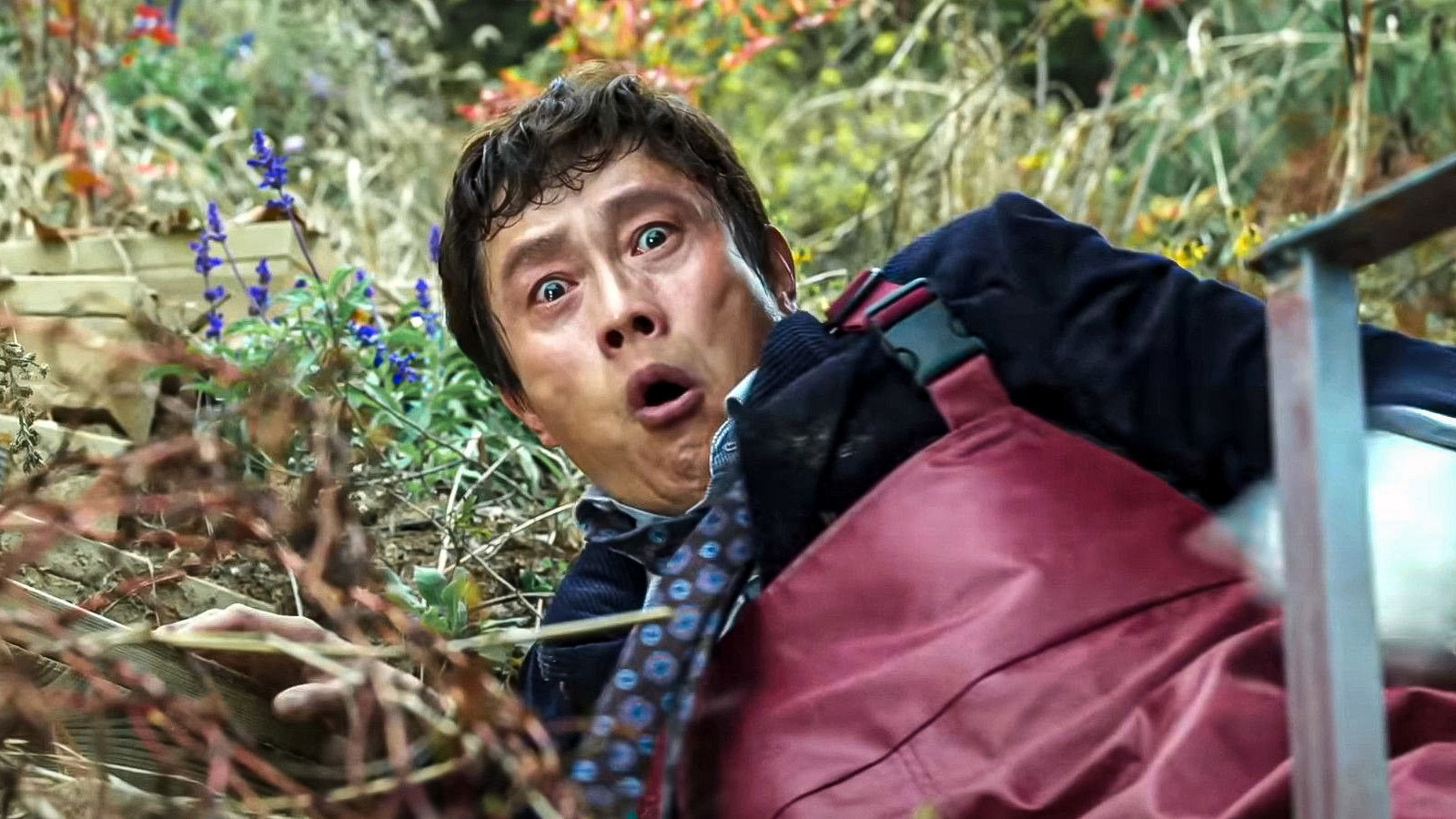
The sheer morbid nature of this plot works for several reasons, first and foremost the fact that so many people can relate to Man-su’s plight. I know I can, and not just because I used to work in a paper factory (a summer job more than half my life ago; it was a positive experience, mostly because I could invoke the Simpsons “box factory” jokes honestly). It’s been over 18 months since I last worked a gig in my field of expertise, and two weeks ago I lost the stopgap job that was supposed to tide me over until I got going again. There are some prospects on the horizon, and I can at least collect unemployment for about the next four months, but it is soul-rending to go through this, especially when I know I have the talent and skills to be successful and prosperous in my industry. It leaves you in a very dark place when you realize that everything you’ve worked for could be for naught as moneyed interests callously leave you behind in search of more profit and wealth to hoard.
The film’s title comes up I believe three times in the story, and all three times it’s devastating in its own way. Two of them are from suits invoking it to justify massive labor cuts. There’s never a reason given, like efficiency or redundancy or an untenable cost of the workforce, mostly because we all know those excuses are bullshit anyway. There’s not a single major corporation out there that’s actually losing money. It’s just that the people on the top want to make sure they don’t profit by slightly lower margins, and they want to keep their wealthy shareholders happy enough to ensure that they themselves aren’t replaced. The usage of “no other choice” in these instances is just a way to end discussion on the topic and assuage any sense of guilt those responsible might have. The other utterance comes from Man-su himself, realizing he’s at the end of his rope and he’s in too deep on his scheme to turn back from the edge. It’s either finish the job (and people’s lives in the process) or finish himself. For him, having gone so far down this road, the only way out is through, even though he knows he’s become something of a monster in doing so. Part of the sardonic humor is the irony that he’s willing to murder rather than simply try another path, and yet as he’s trying to kill people he lectures his own victims about their unwillingness to pivot. He’s just that far gone, and while he’s responsible for his own actions, it still comes back to the active choices of those insulated few who say they didn’t have any other option while they count their millions.
The second major factor is the acting. Park gets the absolute best out of his cast, making the most out of every moment. Lee Byung-hun is obviously the standout, and there’s a bit of a meta resonance because most fans know him as the Front Man on Squid Game, a show about the most downtrodden literally killing themselves and each other for the amusement of super wealthy “VIPs” in hopes of surviving to the end for life-changing money. There’s an unintentional comic irony that in another context, even he’s seen as disposable. But beyond Lee, the whole cast is superb. Son infuses Mi-ri with sympathy, energy, and surprising sex appeal. Lee Sung-min as one of Man-su’s targets is hilariously pathetic, and the scenes involving his cheating wife, played ably by Yeom Hye-ran, make for some of the best physical comedy of the year. Even young Choi, playing the detached Ri-one, gives us something truly special, as you can tell she’s aware of what’s going on around her but can’t express her feelings, ironically making her the emotional center of the picture.
Finally, there’s the actual humor. The script, co-written by Park and three others, is based on Donald Westlake’s 1997 novel, The Ax (this is the second adaptation, the other being a 2009 French film), and is infused with clever commentary juxtaposed with absolutely madcap violence. There’s something fascinating, not to mention hysterical, about how quickly Man-su falls once he takes the crucial first step towards homicide. It’s not that he dives head-first into this new life of crime, but rather stumbles ass-backwards into it, and as a result becomes so much more removed from his basic humanity. It’s poignant that he can begin the film practicing a passionate speech about standing up for his workers when the layoffs become apparent, but before long he’s basically acting like Barry Keoghan at the end of Saltburn. It’s even more significant, and almost knee-slapping funny, that he’s both so inept at killing (again, the slapstick is damn near perfect) and yet so cockily cavalier about it all when talking to police, almost intentionally drawing unneeded attention and scrutiny on himself. The nihilism is cranked all the way up as Man-su continues to endanger himself and his family in the name of saving them. I’d have been rolling in the aisles if I weren’t somewhat in his shoes (not that I’m contemplating anything as drastic as he does).
This film could have easily gone off the rails at any point, but Park is far too disciplined to let that happen. In the midst of all the chaos, his cinematic eye remains the constant, keeping things grounded even as people are wrestling for a gun and turning other unfortunate souls into fertilizer. No Other Choice thrives on the inherent lie in its title, because there’s always another option. Companies can stop destroying lives for their avarice. Workers can find new career paths, even though it’s a painful and often degrading process. Or maybe, just maybe, we can do what Park never explicitly states, but that hangs over the proceedings like a dark cloud waiting to be parted by bright sunlight. How about we just stop fighting each other while those responsible for our suffering continue to consolidate their power, and work together for something better?
Grade: A
Join the conversation in the comments below! What film should I review next? How many foreign films have you seen in a regular theatre? How far would you go for your “dream” job? Let me know! And remember, you can follow me on Twitter (fuck “X”) and subscribe to my YouTube channel for even more content, and check out the entire BTRP Media Network at btrpmedia.com!

 I Actually Paid To See This