
When I was in my junior year of college, I took my first screenwriting course. The goal was to create a solid first draft of a feature-length script in the 14 weeks we had in the semester. Early on, we pitched our ideas to the professor and the rest of the class. Of the entire group, there’s only one story that vaguely I remember apart from my own. One girl in the room, who was a full-on hippie and proud of it, decided she wanted to do an “opposites attract” romance between an environmentalist and a logger, with the former choosing to live in a redwood to protest and prevent it from being cut down. I recall exactly two other things about the screenplay. The first was that it was called Butterfly, even though my classmate feigned ignorance about Julia “Butterfly” Hill, who famously did camp out in a tree for two years to prevent a forest from being cut down. The second was an early scene involving the logger and his co-workers, with the group being so one-dimensional evil that one of the characters literally shouted, “It’s tree murdering time!” at the beginning of their shift.
This class was over 20 years ago, and I haven’t thought about it in ages, but it came right to the front of my mind while watching Avatar: Fire and Ash. Way back when, I gave my friend constructive criticism that such dialogue was so patently obvious that there’s no way it would work or get sold in the future. How wrong I was, because with each passing installment, James Cameron’s storytelling in this series becomes that much more insultingly transparent and stupid, and yet these movies make billions. After the last entry, I was hoping that there would be at least some degree of introspection and improved plotting with the remaining three films planned for the franchise, and yet, here we are, with another chapter that continues to spend pointless hours using amazing visuals to still boil the whole message down to, “Nature good, humans bad” while stealing tropes from numerous better films. The problem is that, three movies in, we’re used to the 3D effects and the world-building of Pandora, and it’s no longer enough to sustain the runtime, forcing us to turn to the more basic elements of character and narrative, and they are woeful.
It’s even worse this time around. With so many longer movies these days, the issue is that there’s not enough plot to fill the duration, and so the filmmakers resort to padding to stretch things out. That was one of the problems with The Way of Water as well. Here, it’s the opposite, with the story being completely overstuffed with superfluous nonsense that we just end up wading through miles of bullshit before we get back to the same simplistic moralizing. A ton of stuff happens, but it’s almost all meaningless, and we’re left feeling even emptier than before.
This story, such as it is, begins basically where the last one left off. Lo’ak (Britain Dalton), now the eldest son of Jake Sully (Sam Worthington) and Neytiri (Zoe Saldaña) after the death of Forgettable Na’vi child #4 in the Titanic ripoff climax of the previous film, grieves the loss of his brother and the fact that Jake seems to blame him for everything. He narrates that he feels alone and isolated because his father doesn’t trust him, never really considering that it’s his own fuck-ups that cause said distrust.
Meanwhile, Quaritch (Stephen Lang) continues to hunt the Sullys and any tribe they associate with, both for personal revenge and to reclaim his human son, Spider (Jack Champion). Because of this, and because Neytiri’s hatred of humans has only grown since the last film, they decide to take Spider to the small group of scientists remaining on Pandora doing research after the first movie’s battle. They make a deal to travel with the “Wind Trader” tribe, a group of Na’vi who remain neutral in all conflicts for business purposes, and who sail on airships mounted on flying animals. During the transport, they are attacked by the Mangkwan clan, a tribe that lives on a volcano and worships fire, led by the shaman Varang (Oona Chaplin, best known as Talisa from Game of Thrones; where’s a Red Wedding when you need one?). Sensing an opportunity, Quaritch forms an alliance of convenience with Varang, offering her tribe guns and other weapons in exchange for their help securing Jake and Spider.
Now, in a competent movie, this is the basic story, and on the whole, it wouldn’t be a bad one. Varang is the one new element in this film that has legitimate intrigue, because her tribe was nearly decimated by a volcanic eruption, their prayers to the Pandoran deity Eywa left unanswered, so they had to violently fend for themselves. She’s also the one Na’vi who leans into her, shall we say, feminine wiles, to get things done, finding an attraction to Quaritch’s physical prowess and military strength. You can still have Lo’ak being insecure and desperate for his father’s approval, maybe having him get his shit together to help win the day in the coming war and prove himself without devolving into melodrama, and you could have a tight, focused affair that probably clocks in somewhere between 90-120 minutes. I mean, if Cameron had kept things this lean, the only major joke I’d make is that the first film introduced a forest/earth-based tribe, the second one a water tribe, and this time around a fire tribe and the Wind Traders, so naturally the next film would give us the “Heart Clan” so we could summon Pandora Captain Planet.
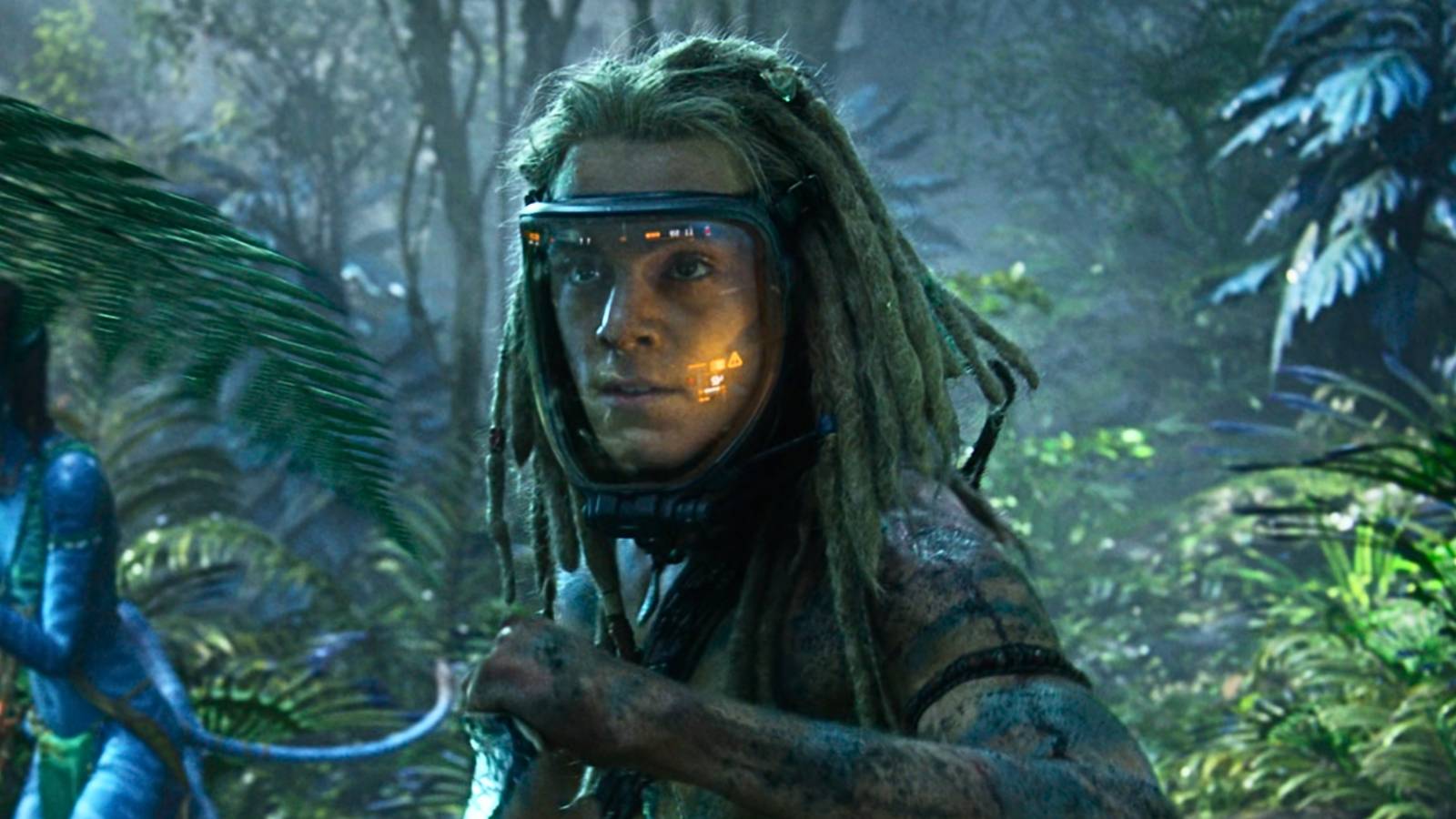
But nope, we’ve got over three hours to fill, so here’s all the extraneous other plot threads…
*deep inhale*
- Spider’s oxygen mask runs out of power, leaving him suffocating, so Kiri – the semi-artificial Na’vi child born from Sigourney Weaver’s avatar – plugs her hair thing into the ground, somehow summoning mycelia to enter Spider’s body and form a symbiotic network that allows him to breathe Pandora’s air without machinery.
- Quaritch, along with Dr. Norm Spellman (Joel David Moore) returning from the first movie for no reason, separately determine that Spider’s condition could be reverse engineered, which means humans could permanently colonize Pandora. This makes Spellman nervous and drives Quaritch and General Ardmore (Edie Falco) to want to capture the boy even more.
- Both Jake and Neytiri on separate occasions consider killing Spider for their own safety.
- Spider also gets his own hair doohickey so he can be the first human to link with the planet in human form.
- Kiri is still trying to connect to “Eywa” but continues to have seizures when doing so, and finally learns the truth of her conception, which is bullshit that Jake, Neytiri, and Mo’at (CCH Pounder returning for no reason) had been intentionally hiding from her.
- We’re still hanging out with the water tribe, where Ronal (Kate Winslet) is very pregnant. She and Neytiri have a feud about random stuff.
- Neytiri suffers an arm injury in the first battle and has to learn to shoot a bow again.
- Captain Scoresby (Brendan Cowell) somehow survived the last film, only losing an arm so that his Ahab-esque obsession with killing the space whales is even more painfully obvious. Oh, and Giovanni Ribisi is back for no reason because he wants all that sweet space ambergris money. Jemaine Clement still objects to a brick wall.
- The space whales have an Entmoot about whether or not they should join the fighting despite being pacifists by nature.
- Spider and Kiri have a romance.
- Tuk (Trinity Jo-Li Bliss) is there.
Jesus. Christ! There are enough plot threads to finish the entire series of five films plus a whole other sequel series, and yet almost none of these have any consequence to the real meat of the events of this film. It’s all future table setting, loose ends from the past, or self-contained tangents. All the while, Cameron continues his trend of ripping off other IPs, this time cribbing from Lord of the Rings, Star Wars (Neytiri even gets her own Death Star-esque trench run in a late fight scene), and The Ten Commandments, with the absolutely baffling moral equivalent of “His god IS god” in the final resolution. Yeah, after three movies of finger wagging about environmentalism, this film hinges on a definitive statement of Pandora’s one true faith. Fuck me sideways with a chainsaw!
I can’t remember the last time I saw a movie so full of content that I just desperately wanted to end. It’s ironic that a project so full of stuff could feel so hollow, but here we are. It’s like Cameron threw every plot idea he could think of at us, and rather than actually focusing on anything and saying anything meaningful, he was content to let it just be dead air with a bunch of pretty visuals. The only interesting moments are those that relate to Varang, and the boredom in every moment she’s not in screen is palpable, because whenever she’s not there, we’re just counting down until she comes back so that we don’t have to rehash the same tired points over and over again with characters we didn’t miss when they were gone in the last movie. Honestly, film classes should study this monstrosity in the future as the new textbook definition of “bloated.”
The closest we come to something resembling character growth – which is really hard to do in a movie with over 30 named characters – is Jake pleading with Quaritch to choose a better life for himself. He’s been reborn into a Na’vi body, the same as Jake was, and that gives him a second chance to change who he is. There’s a degree of poignance in that, but it’s wasted on a one-dimensional baddie like Quaritch (a flaw that’s even more glaring in 3D), and since Cameron has spent three movies refusing to evolve, what hope do we honestly have for our main antagonist?
From a technical standpoint, the movie is still gorgeous, though this edition has the fewest new features to explore with Pandora. Varang’s tribe doesn’t really have a whole fire-based environment to explore, just some charred woodland and a couple burnt landscapes. Everything else is basically still centered on the water tribe, and the only new creatures are the very brief glimpses we get with the Wind Traders. You would think this might mean that the world feels more lived-in this time around, but it doesn’t, because we spend far too much time at the sterile science labs and military facilities with all their holograms and other bits of visual noise.
Speaking of noise, there was a major sound issue when I saw this flick. Unlike the last two outings, I opted for a 3D presentation on a normal size screen rather than going for a full IMAX experience. Visually, the picture looked fine, but from an audio standpoint, something was very wrong. The sound effects and music were mixed properly, but the dialogue was compressed and severely filtered. It was as if every line was said through Spider’s oxygen mask. I looked this up after the fact, and it appears I wasn’t alone in this. Apparently Cameron sent very specific sound system calibration settings and instructions when the film was released. Any theatre that couldn’t accommodate those demands got this fucked up mix. To me, that’s just bad form. I understand that these movies are designed for larger formats, but we’re not all made of money, and we shouldn’t be penalized for using the resources at our disposal. I made a choice for a smaller screen, but there are several markets where IMAX and similar formats aren’t even available. So if you either chose to save some money or didn’t even have access to the “proper” medium, you’ve basically been cheated for not spending more cash. Boo!
The best thing I can say about Fire and Ash is that it had potential. Varang is a fun character, and some of the plot ideas could have worked if James Cameron gave them the proper space to develop instead of cramming everything possible into the 3.5-hour runtime. Pandora still looks great, but we are accustomed to it by now, so we needed something new to keep us engaged, and on the basic levels of story and character, this ended up being the worst Avatar film yet, with not enough of a unique visual profile to keep the audience’s attention. This could have been a bold effort that took the series in exciting new directions, but Cameron settled for the same effects (which are still top notch, to be fair) and an even more cartoonish degree of ecological villainy. I was honestly waiting for one of the whalers to scream, “It’s space fish murdering time!” just to hammer home my own lack of vision on profitability from over two decades ago.
Grade: C-
Join the conversation in the comments below! What film should I review next? Does this series need to just die already? What would you do if you grew a magical dreadlock? Let me know! And remember, you can follow me on Twitter (fuck “X”) and subscribe to my YouTube channel for even more content, and check out the entire BTRP Media Network at btrpmedia.com!

 I Actually Paid To See This
3 thoughts on “Burn it All Down – Avatar: Fire and Ash”