
Over the last few years, Netflix has continued to grow and grow into a cultural powerhouse, consolidating its content licenses and making big swings towards trying to change the entertainment industry, if not take it over entirely. They’re currently mired in a battle with Paramount to buy Warner Bros., attempting to pull one of the most storied studios in film history into its ever-expanding portfolio. It’s a no-win scenario for most fans of cinema, as David Zaslav’s leadership at Warner’s has been one disaster after another as he’s red-lined entire productions for tax write-offs, Paramount’s hostile takeover bid is seen as a brazen attempt by its ownership to curry favor with Donald Trump, and if Netflix wins, they’ve already announced their intention to give theatrical films a mere two-week window before going to the streamer, which could kill the movie house and its business model forever.
More to the point, the overall content has not been great of late. While there are films and TV shows that many enjoy, myself included, the formulaic development process has become slapdash and intellectually insulting. Just this week Matt Damon revealed that when he and Ben Affleck were working on The Rip, they learned that Netflix basically stipulates in their production contracts that high-intensity action scenes need to be front-loaded rather than being built up for the climax, and that there’s an expectation that the major plot points be verbally reiterated at least three or four times to accommodate those not paying attention and playing with their phones while the flick is on in the background. That may work for streaming-only fare, but we’re talking about the future guardians of the WB water tower. Can you imagine how lame it will be if we’re in a theatre, giving a film our undivided attention, and the characters are repeating the same information we’ve already heard three times before? Just so they can prepare for the eventual at-home audience? It can only make movies worse.
And yet, every year, Netflix is a major player during Awards Season, putting their full marketing heft behind several projects. So as we creep ever closer to this year’s Oscar Blitz, I figured the best way to cover the glut of candidates was to once again divide them by format. We’ll start with animation, as it’s the easiest to cover. It’s become very apparent over the last few weeks that KPOP Demon Hunters will almost certainly win Animated Feature, and maybe even Original Song for “Golden.” I admit I’m not a fan, but you can’t argue with the fact that it’s one of the most popular films in Netflix’s history, if not THE most popular, and somehow it’s become a pop culture phenomenon over the last year. But that doesn’t mean the Big Red N isn’t hedging its bets. They’ve also got four other films on the official Animated Feature list, just in case. I’ve already covered one (Lost in Starlight), so for the first installment in this year’s mini-series, let’s polish off the other three. Will any of them be nominated? Well, there’s some push for at least one of them, so I’d say there’s a chance.
In Your Dreams
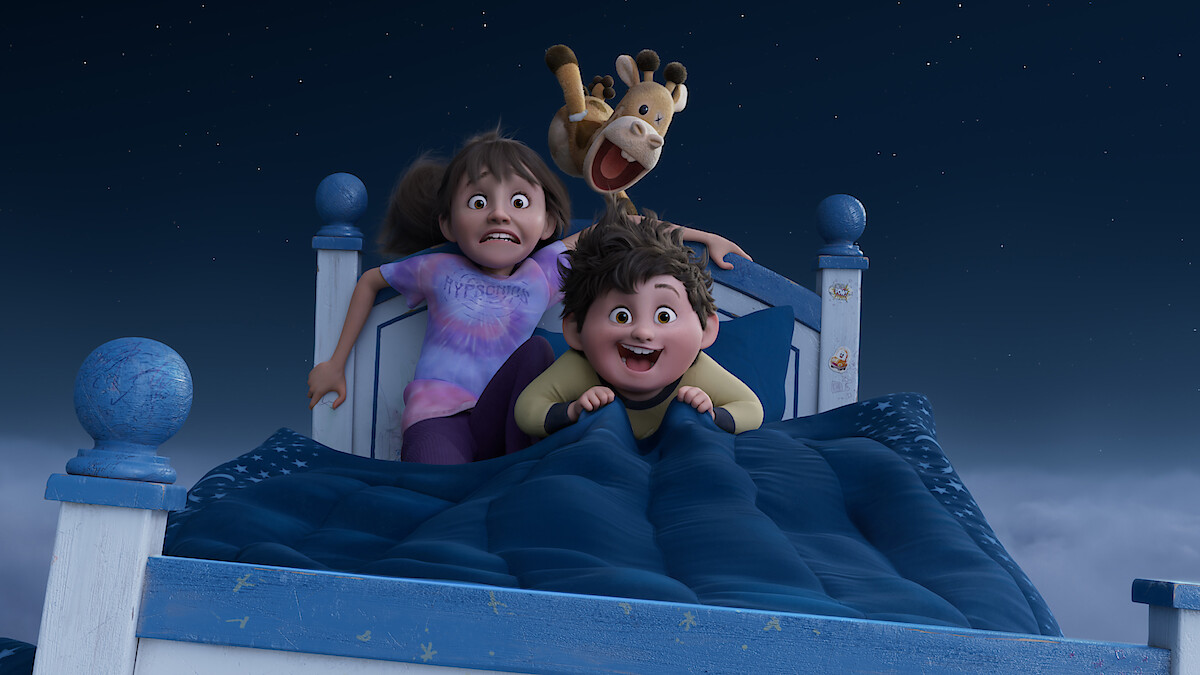
I was a bit intrigued when this was announced, as a story about a kooky young boy in a magical world, along with his older sister, sounded a bit like an attempt to one-up Elio. Still, the trailer looked interesting, so I had hope that there’d be something imaginative here that would be worth recommending.
Unfortunately, dear reader, there is not. It’s a perfectly safe film for children, but that’s also its biggest drawback. In Your Dreams has infinite potential, but realizes almost none of it in the name of playing things as safe and formulaic as possible, to the point where even the more creative scenes feel like cheap knockoffs of Pixar.
Stevie Ting (Jolie Hoang-Rappaport) is a 12-year-old girl who believes in everything being structured and orderly. At the beginning of the film, we see her “perfect life” as a child, playing games and forging strong emotional bonds with her adoring parents, Michael (Simu Liu) and Joanne (Cristin Milioti). Then, wouldn’t you know it, those silly adults had to go and procreate again, giving us Elliot (Elias Janssen), a rambunctious, messy troublemaker and aspiring magician. Why, these two kids are just polar opposites, AND THEY HAVE TO SHARE A BEDROOM! Seriously, is this a sitcom from the 60s? They even have a line of tape dividing the room!
Anyway, Michael and Joanne are having marital troubles, as Joanne is interviewing for a teaching job that would mean moving to Duluth, while Michael wants to stay put and keep trying to make it as a musician (the couple were a rock duo in their youths). The discord could lead to divorce, to which I say, cue the Tony Stark line. But for Stevie, this is the end of the world, and she can’t get past her own anxieties enough to settle down and move on with life.
She starts having nightmares, and somehow Elliot shows up in them, a representation of her fears and frustrations. The two eventually find a book about the Sandman (Omid Djalili), which states that if they can reach him in the dream world, they’ll have their most precious wish granted. Somehow, this is actually real, and as the two continue to dream and interact with each other in the subconscious world, they realize that if they work together, they can reach the Sandman and wish for their parents not to split, so that they can “go back to how it was before.”
From there it’s a pretty standard adventure where inanimate objects talk, walk, and make fart jokes, most notably Tony Baloney (Craig Robinson), Elliot’s stinky stuffed giraffe that Stevie once hid behind the refrigerator because she could no longer handle its smell as a result of Elliot’s lack of cleanliness. The kids grow closer, then they find out that their wish isn’t all it’s cracked up to be, that nightmares can actually be a good thing, and that sometimes parents grow apart without losing their love for their children. We’ve seen this time and time again.
This might have been fun despite the tired clichés, but the filmmakers never take a single creative risk. Rather than exploring cool dream imagery, what we get in most sequences feels like rejected scenes from Inside Out. Rather than exploring the real concept of lucid dreaming, we just attach that label to pure nonsense where two children share the same dreamscape and manipulate it at the whims of the screenwriter. Rather than come up with a single original joke, we get endless toilet humor. Somewhat ironically for a film about dreams, just about every plot device and visual flourish comes off as tired and mundane.
Again, if your kids have never dealt with these issues, this is a perfectly safe entry point, but it could have been so much more. In dreams literally anything is possible, and yet we spend several minutes on the old recurring nightmare of teeth falling out and making your bed fly. There was no limit to what this film could have accomplished, and yet it settled for the easiest solution at every turn without a second thought, similar to Stevie’s myopic motivations. This flick won’t actively damage your children’s psyches, but it definitely fails at the task of sparking imagination. Somehow this might actually knock off Little Amélie when nominations come out on Thursday.
Grade: C+
The Twits

Adaptations of Roald Dahl novels are pretty hit and miss. You have absolutely brilliant adventures like Willy Wonka and the Chocolate Factory, James and the Giant Peach, and The Witches, while at the same time you also have mediocre-to-garbage entries like Wonka, The BFG, and the remake of The Witches. So when Netflix green-lit an adaptation of The Twits, you could feel the collective clenching of a million anuses in nervousness.
And it’s a good thing, too, because had we unclenched, the torrent of shit still wouldn’t have compared to this odious ball of nothing. Dahl himself famously never liked any adaptations of his work, but this one is so bad I’m surprised he didn’t rise from the grave to send everyone involved to the juicing room.
One of the things you have to remember is that Dahl was kind of a dick, and certainly a curmudgeon for most of his life, and oftentimes he took out his aggravations and grievances through his books, which are pretty mean-spirited for children’s fare. The Twits is a perfect example, as the entire idea was born from his hatred of beards. Yeah, facial hair irritated the man so much that he created an entire story around bumbling assholes, one of whom happened to have a big, bushy beard. In the book, Mr. and Mrs. Twit basically spend most of the story one-upping each other with silly and harmful pranks because they’re so miserable that their only happiness is in exploring new ways to show how much they hate each other.
Sadly, that base characterization is about the only thing from the book that translates to the screen. I’ve said time and time again that strict fidelity to source material doesn’t matter all that much when it comes to adaptation, so long as the story we come up with is compelling in itself. But that’s the problem here. Rather than being a bit cheeky with its lead characters, even the core story of Dahl’s novel is lost, replaced with a paint-by-numbers story of orphans (complete with plucky female lead because the focus groups love that) that just happens to involve the titular Twits, and dozens of shoehorned references to other Dahl properties.
In the book, Mr. and Mrs. Twit (voiced in the film by comedian Johnny Vegas and veteran character actress Margo Martindale, respectively) are former circus performers hoping to make a comeback by trying to get their pet monkeys, called the Muggle-Wumps, to perform whilst standing on their heads. Mr. Twit even uses glue as a means to force the primates upside down for hours at a time. Eventually, the Muggle-Wumps turn the tables, literally, by gluing all the Twits’ worldly possessions to their ceiling, forcing them to believe they themselves are upside down. The Twits are then glued in place, allowing the Muggle-Wumps to go free while the couple contract the “Dreaded Shrinks” and collapse in on themselves until they’re dead. Like I said, Dahl loved to be mean, but the meanness had a point to it, as the Twits were so dumb as to fall for such an easily disproven lie that leads to their own destruction. They’re hoisted with their own petard, which is why it’s okay to be a touch nasty with them.
In this film, however, only basic acknowledgement of the story remains. Here, the Twits are building an amusement park in hopes of bilking the local townsfolk out of all their money. However, the park is structurally unsound and well below code, so they attempt to swindle people and eventually run for mayor, selling the lie that they can make the town a tourist destination again, and by extension make everyone rich. The only salient point here is that idiots will vote for anyone who promises them wealth, even if they’re obvious con artists only out for their own interests.
Standing in their way is Beesha (Maitreyi Ramakrishnan from Turning Red), the de facto leader of a group of tykes-by-committee in the town orphanage. Beesha keeps the group together and hopeful due to her own rock solid belief that her parents simply dropped her off and are totally coming back. Bubsy (Ryan Lopez), a precocious young boy, is about to be adopted, but before he leaves, he wants to go to “Twitlandia” (is this meant to be a Portlandia reference for all those kids who love Roald Dahl and ironic hipster comedy?) because he’s never been on a ride, so Beesha agrees to take him. Seeing the sorry state of the place, and having no money, Beesha and Bubsy are about to abandon the park when they come across the Muggle-Wumps (a family voiced by Natalie Portman, Timothy Simons, and Rebecca Wisocky), who look nothing like monkeys – they’re more like unholy hybrids of Furbies and Koosh balls – and are from Loompaland instead of, you know, AFRICA! The Muggle-Wumps can talk, and Beesha and Bubsy can understand them, because in this film’s world, if you have a deep enough sense of empathy, you can communicate with animals in plain English. Anyway, after hearing their plight, Beesha and Bubsy free the Muggle-Wumps from the Twits, taking them back to the orphanage to protect them. This incurs the wrath of the Twits, who go to cartoonishly stupid lengths to get back their furry Smurf slaves as part of their master plan to… get rich. Phase One is Get Muggle-Wumps, Phase Two is ?, Phase Three is PROFIT!
All of this nonsense robs the adaptation of anything resembling Dahl’s sense of storytelling, substituting nods to Wonka bars for actual plot. What we get in lieu of his delicious insanity is an orphan rebellion, an entry-level lesson in being nice to people, which flies directly in the face of Dahl’s intent (the sentiment is temporarily defenestrated when Beesha et al seriously consider killing the Twits before backing down), and an exploding butt. No seriously, the town mayor, idiotically named Wayne John John-John (Jason Mantzoukas cashing a check), literally eats a cake filled with laxatives and his buttocks explode in a giant fart. Look, just because Charlie and Grandpa Joe beat the Fizzy Lifting Drinks by burping, that doesn’t mean gas is the only source of comedy… unless you’re writing a shitty Netflix movie.
Even the animation can’t save this. The Twits themselves look comically abstract, and their amusement park is properly batshit, but everything else is just standard-issue CGI. This entire film should look like a 3D fever dream painted like a lost episode of Ren & Stimpy, and instead we get two off-model characters, blue Muppet rejects, and the same generic plasticine human models that we’ve seen for the last 30 years. This is goddamn awful!
How hard was it to get this right? All you needed was some crazy absurdity as two horrible people played pranks on each other. Instead, we get a run-of-the-mill kids story with Roald Dahl branding attached to it, with none of the heart, or humor, of its creator. Honestly, the biggest prank of all seems to be trying to convince audiences that this would be any good.
Grade: D
Mahavatar Narsimha

This is something of a special case, in that this isn’t a Netflix-produced film nor a Netflix-owned production. It’s an Indian film that just happens to be available on Netflix in the U.S., but for my purposes it still counts. This is a dramatization of some Hindu mythology, which for me is kind of refreshing, seeing as how I’ve waded through three separate animated bible films in the last year, and sat through the propaganda of an Asian cult. Maybe this deep and ancient religion will offer some fun visuals and creative storytelling.
Eh, not so much. It’s an ambitious effort, certainly, the first in what’s planned as a seven-film series exploring the 10 avatars of the god Vishnu, and the flick is now the highest-grossing animated film in India’s history, so clearly there’s an audience for it. I just don’t think I’m it. I’ve been curious about Hinduism for years, and I’ve enjoyed what I’ve learned since middle school on the subject, which I’m guessing is only a tiny fraction of all there is to know, so I was most definitely open to what this movie could show me. Unfortunately, the quality of the animation is pretty low, and the overall message has the same core flaws that a lot of Christian movies have, in that devotion is the key to success and happiness rather than righteous actions.
The film starts with a woman named Diti (Vasundhra Bose) becoming amorous with her husband, the sage Kashyapa (Dinesh Varma). She says that she’s the only wife in his harem who has yet to have children, and she wants to bear him a son. Kashyapa scolds her for trying to be sexual while he’s meditating, but eventually he relents and his kama meets her sutra. However, because of the time of their relations, Diti is cursed to give birth to twin demons. You can already see my issue here, as it is entirely the fault of the woman for being horny rather than a shared responsibility with the man who sated said horniness. The demons, Hiranyaksha (Sanchit Wartak) and Hiranyakashipu (Aditya Raj Sharma), grow up to be incredibly strong, and they declare war on Vishnu (Uplaksh Kochhar). The former is killed by Vishnu in the form of Varaha, a great boar warrior, and while the latter vows revenge, Vishnu has his own plan.
Hiranyakashipu spends years in the Himalayas, training, meditating, and exposing himself to all manner of suffering in order to receive a boon from Brahma (Abhishek Sharma), the creator god and part of the Hindu trinity which also includes Vishnu and Shiva. He asks for immortality and the power to bend the heavens to his will, making him the god of all gods. Brahma, who is something of a rival to Vishnu, grants the request, knowing there are loopholes to be exploited so that Hiranyakashipu can one day be killed. While that’s going on, the weather god Indra (Dixoan Shah) kidnaps Hiranyakashipu’s pregant wife Kayadhu (Priyanka Bhandari) and imbues the fetus with a devotion to Vishnu. He is born as Prahlad (Haripriya Matta), heir to the demon clan, but he grows up loving only Vishnu as the one true god.
This behavior angers Hiranyakashipu to no end, and the demon king goes to great lengths to kill his own son as punishment for worshipping Vishnu. This leads to some pretty epic sequences where various forms of violence are turned on their would-be dispensers, leading to their deaths and dismemberments in Vishnu’s name. Prahlad remains safe, ever praising Vishnu’s name and chanting mantras and prayers to remain untouchable (but not in the caste system kind of way). It all leads to a climactic battle between Hiranyakashipu and Vishnu, now taking the form of Narsimha, a lion-headed berserker.
Despite the rudimentary animation – this is like, three steps up from those Korean videos where cartoons gave an overexaggerated recap of the news from a few years back – some of these set pieces are pretty amazing, mostly because the production doesn’t skimp on the gore. We see heads chopped off, bodies bifurcated, and limbs strewn about several environments with nary a thought for the sensitivity of the audience’s eyes. Though at the same time, sexuality is treated in the most chaste manner possible for the subject matter. The act of love must be censored, but a lion eating a demon’s head? Totally fine, make that shit as graphic as possible. Mixed messages.
As for the story itself, it’s interesting, but very basic and far too centered on devotion and blind worship, which even if you’re religious, is just not all that compelling. We live in the real world, where no matter how devout you are, for the vast majority of people, things don’t work out all the time, if ever. So to have the message that simply putting your faith in Vishnu, or any deity, somehow makes everything alright because it was alright for this kid thousands of years ago in a mythological tale is just disingenuous. It’s especially galling for a country like India, which still has a caste system in place (though not as rigid as in past decades) that allows for ethnic and socioeconomic discrimination based simply on what sector of the populace you were born into, which is at least in part informed by someone’s religious interpretation of your worth as a person. The serenity of Prahlad sounds nice in theory, but rings hollow in practice, is what I’m saying. Again, I’m no expert on Hinduism, but from what I’ve learned over the course of the last 30 years or so, that’s my understanding. Even if I’m wrong on that front, the message of the film is still clear that absolute fidelity to a deity to the point of fanaticism is the only path to salvation, and that’s just flatly wrong on its face. The movie opens with a disclaimer from the filmmakers stating that this is just their interpretation of their faith, and it’s not meant to offend anyone, but again, that assertion feels empty when you see a kid being caught by a cloud after being pushed off a cliff because he prayed to Vishnu the entire way down. Try that in real life, kids. See what happens.
For a comparison, take the Chinese New Gods series from a few years ago. The two ideas aren’t that far off from each other, as they’re both bombastic, high-concept animated interpretations and adaptations of ancient mythology. The difference is that with New Gods, the emphasis is on storytelling and spectacle, with the Chinese filmmakers and audiences understanding that these are just fables and folklore taken to new creative heights. With Mahavatar Narsimha, we’re looking at the genesis of a series that’s far more committed to getting people to believe this stuff actually happened, rather than making it entertaining. Both approaches can work, as both series have been financial successes in their home countries. But one has a more welcoming and universal appeal, at least so far.
Grade: C
Join the conversation in the comments below! Have you seen any of these films? Could any of them upset the Demon Hunters? Just how badly can you screw up a Roald Dahl adaptation? Let me know! And remember, you can follow me on Twitter (fuck “X”) as well as Bluesky, subscribe to my YouTube channel for even more content, and check out the entire BTRP Media Network at btrpmedia.com!

 I Actually Paid To See This
2 thoughts on “DownStream – For Your Consolidation, Part 1: Animation”