
The Oscar nominations are officially out, and the annual Blitz is on! I’ll determine my coverage schedule over the next few days, with the first breakdown coming on Monday, February 9. In the meantime, though, I have a TON of films still to review, 36 to be precise. Yeah, between stuff that got nominated, stuff that wasn’t, and stuff I haven’t even seen yet but need to because it’s up for at least one category, I have just shy of a Kevin Smith joke still to critique and grade.
Part of this glut is because I’ve spent the last few weeks mainlining just about everything I could from the Academy’s shortlists into my eyeballs, and trying to prioritize mainstream fare with independent offerings. Some get the full review treatment, while others are best grouped into a batch post. Between the December holidays and the final weeks of my previous job, free time has been in short supply. I always try to get as much done as possible before the nominations come out, but I am a massively imperfect human, so naturally I get backed up. Insert whatever constipation joke you can think up, now.
This first post will deal with several of the films on the International Feature shortlist. I’ve gone over seven of them so far, but I still have eight more to process, including one of the nominees. This year’s competition was the strongest field I’ve seen since I started going full completist. Of the 92 films submitted, 86 were deemed eligible by the Academy, and I saw 27 of them. Of those, I could make a case for 20 of them to have received a nomination. That’s how stacked this contest was. Even the ones I didn’t care for all that much had something to recommend.
So let’s get to the task of giving these pictures their due. For this column, I’ll be looking at four entries on the shortlist that I watched as part of festival coverage last year (chiefly Mill Valley and AFI Fest). All of them have gotten a stateside release in some form, and are currently available in theatres right now, so if you’re curious, you should definitely check them out.
The President’s Cake – Iraq

Iraq has only submitted a film to the Academy 17 times in its history, beginning in 2005, and this is the first time they’ve made the shortlist. The President’s Cake isn’t a pantheon entry by any measure, but its importance can’t be denied, as it represents a crucial step forward in the country’s development since the fall of Saddam Hussein’s regime. So what better way to demonstrate that evolution than with a project that shows just how odd his reign was?
Set during the events of what we called “Operation Desert Storm” in response to Hussein’s invasion of Kuwait, the film reduces the danger of living under authoritarian rule to an event that’s usually a cause for joy. As part of his totalitarian ego, Hussein made it federal law that the entire country had to celebrate his birthday as a national holiday, including small ceremonies and gestures from towns and villages, as well as offerings and gifts to Hussein himself. All of this went on despite the fact that Iraq was buckling under crippling sanctions and international pressure due to Hussein’s actions. Among the compulsory party favors is a cake prepared by schoolchildren. In a tiny, poor riverside village, where the kids have to paddle a canoe just to get to school, the “honor” of making the cake falls to a young girl named Lamia, played by Baneen Ahmad Nayyef. Lamia, who lives with her diabetic and disabled grandmother Bibi (Waheed Thabet Khreibat) and a pet chicken, is tasked with finding the ingredients and baking the confection, even though groceries are scarce and prohibitively expensive thanks to sanctions, and Lamia has never made a cake in her life.
Bibi, fearing for Lamia’s safety, had encouraged her to skip school on the day the birthday jobs were to be assigned, and had even tried to give her an out with an excuse for a well-timed trip to the bathroom, but it was all for naught. The two take a taxi to Baghdad the next day to buy the needed supplies, but for Bibi, this is her last chance to save Lamia, attempting to have a friend take her in as a foster, because her failing health means she won’t be able to protect Lamia should anything go awry. Lamia, realizing what’s about to happen, runs away, meeting up with her friend Saeed (Sajad Mohamad Qasem), the son of a disabled beggar, to hustle and barter around the city for the ingredients, while Bibi teams up with the cab driver Jasim (Rahim AlHaj) to try to track the kids down and get them to safety.
The dueling madcap pursuit plots are well-written and well-paced, keeping things lively while balancing both light and dark tones. There’s a decent mix of comedy involved, especially as it relates to Lamia and her chicken. It’s kind of like Moana at times. Unfortunately, writer-director Hasan Hadi isn’t able to maintain the momentum. Things eventually turn quite melodramatic, and honestly, we in the audience don’t get a real sense of Lamia’s motivations. There are a couple nebulous hints that there will be reprisals if she doesn’t make the cake, but nothing specific, so it’s difficult to engage when she takes actions that put either her goal, or her security, at risk. My guess is that this played much better for Iraqi audiences than Western ones, as they lived through Hussein’s regime, and the mere threat of consequences likely struck much deeper than it did for those of us who only experienced it vicariously through news reports.
But this is also why the film is important, dare I say, essential. It’s been just over 20 years since Hussein was deposed, tried, and eventually executed for his crimes against humanity, and Iraqi society has finally healed enough where they can talk openly about his cruelty and malice. Whatever your feelings are about our invasion of Iraq in 2003 (I was certainly against it), the world is unquestionably a better place without monsters like Hussein in it, even if only marginally so. Many of the actors in this film lived through the worst parts of his rule, something that the child leads thankfully never had to experience. So getting to the point where they can have honest discussions about the horrors they faced, even if filtered through the lens of a child who doesn’t fully grasp the situation, is a crucial step forward. That alone makes it worth your time, and while some elements don’t entirely work, it is hard not to appreciate and enjoy this artistic breakthrough on the world stage.
Grade: B
Sirāt – Spain

The last of the films that made the final cut for me to discuss, Sirāt also got a nod for Best Sound this year, and was shortlisted in three other categories (Casting, Cinematography, and Original Score). This should mean that it’s a phenomenal piece of work, right? Well, I’m conflicted. I recognize the superlative elements, and I totally get why it has a 92% rating on Rotten Tomatoes. But honestly, I just didn’t like it. This is because, for me, the most important parts of a movie are character and plot, and that’s where this picture really suffers.
As opening text reveals, the title is a reference to As-Sirāt, a mythological bridge in Islamic tradition that all must cross as their form of judgment after death to determine their eternal fate. The bridge is, as quoted on screen, thinner than a strand of hair and sharper than the finest blades. Think of it like crossing the River Styx in Greek mythology or St. Peter’s judgment at the pearly gates of Heaven for analogs in other religions. It’s an oversimplification, most likely, but it did help connect some dots for me. The bridge also serves something of a meta purpose for the film, which takes place in the deserts of Morocco, not far from where the Strait of Gibraltar bridges the gap between Spain and Africa.
It’s here that we meet Luis, played by Sergi López (probably best known to American audiences as Captain Vidal from Pan’s Labyrinth), and his son Esteban (Bruno Núñez Arjona), who show up at a large desert rave event looking for Luis’s missing daughter, an enthusiast and participant in rave culture. The pair wend their way through the crowds dancing as if in a trance, hoping to find any help or information on her whereabouts. The young woman is not at this particular party, but a small group thinks she might be heading for another get-together a few days away. When the Moroccan military shows up and shuts down the concert, all the Europeans are told to evacuate back to their home countries. Instead, the group, consisting of Josh (Joshua Liam Henderson), Stef (Stefania Gadda), Jade (Jade Oukid), Tonin (Tonin Janvier), and “Bigui” (Richard Bellamy), break off from the exiting caravan in two vehicles to head to the next site. Luis and Esteban join them, even though their run-down car is not built for these terrains.
At first, Luis and Esteban (along with their dog) remain at arm’s length from the ravers, but eventually, they form rapports, initially out of need for resources, and then as genuine people. However, tragedy soon strikes, and the odyssey across the desert quickly turns into a fight for survival, and there’s no certainty as to who will make it home, if any of them.
Now, at first glance this sounds pretty good, and honestly, the elements for which it was shortlisted and nominated by the Academy make sense. I’m definitely not a fan of rave music, but it’s integrated well into the film, particularly the opening set-up of all the speakers and DJ stations, as well as the throbbing pumping of the “sick beats” (trademark Taylor Swift, used without permission, because fuck anyone who tries to copyright common phrases) when the party gets underway. The cinematography is absolutely gorgeous, making the sense of scale feel both awe-inspiring and hopeless at the same time. It’s immaculately shot. Also, as you could probably guess from the fact that all but one of the ravers are performing under their own names, these are not professional actors, but actual celebrated members of the global rave community, and yet they turn in decent performances. I could easily have understood if it had gotten nominated for the Academy’s new Casting prize.
But once you get past all that, and actually deal with the characters and the story, for me it just all fell apart. I don’t understand the ravers’ motivations apart from “more rave,” and to me that’s just insufficient. When armed militias are telling you to get the fuck out, and you actually see the native Moroccans getting arrested for these shows, I immediately write you off when you decide your own safety is of less concern than drugs and EDM. The instant that they broke off from the line of evictees, I was out. I can suspend disbelief, because clearly not everyone makes logical decisions in life, but when a character has the answer to save their own life staring them in the face, and they act in a way that completely rejects the basic instinct of self-preservation, I have no sympathy when they eventually die. I’m sorry. You had an out. You refused to take it. Good riddance to stupid idiots. It’s especially galling when the main instigator of the plot is that Luis’s daughter is missing, believed to have been kidnapped or worse from one of these events. That’s two giant red flags, and yet these people decide that hallucinating to computerized noise is more important than survival.
Then there’s the underlying metaphor about As-Sirāt. From what I’ve been able to read, the idea is that below the bridge are the fires of Hell, and damned sinners attempting to knock people off, dooming them to the same torture as themselves. The idea is that one’s voyage across the bridge goes faster or slower depending on righteous acts done during life, and there doesn’t appear to be a mulligan should someone fall. If you don’t make it to Paradise, you burn. That’s it. So, knowing that, it’s a complete betrayal when you consider the innocence of the first two victims, who die quite horribly in this purgatory. It’s a moment meant as shock value, rather than one that aligns with the actual themes the film is trying to get across. The problem is further exacerbated when this plot point derails the actual story, abandoning the narrative entirely, and without resolution.
That’s where this film comes up incredibly short for me. It’s very well made, I won’t question that. But the story is told in a glaringly shitty way, one that flies in the face of the stated thesis of the project itself. And to compound matters, while the performances range from fine to good, none of the actual characters warrant any sympathy once the body count starts to mount. I get why a lot of people like this, but for me, when you fail at those crucial aspects of a film, I can’t get behind the finished product.
Grade: C-
Sound of Falling – Germany

I’ve mentioned before that I have problems with stream-of-consciousness stories. In literature, I can’t stand them, and having to read works like The Sound and the Fury and A Portrait of the Artist as a Young Man in school infuriated me. Just tell the story, dammit! I’m all for flourishes, but make sure your audience can understand what the fuck is going on before you fuck with the presentation to make it even more obtuse and confusing. I’m better with films, however, as the visual medium usually helps fill in the narrative gaps, and oftentimes I’m actually delighted by what I see. Still, there are extremely frustrating entries, which is why I remain a detractor of the works of Terrence Malick, particularly The Tree of Life. If I’m watching something, especially if it goes over two hours, and I have to – either internally or externally, depending on where I’m viewing the film – scream, “WHAT THE FUCK IS GOING ON IN THIS PICTURE?!?!?!?!?!” that’s a failure.
This is why, ultimately, I was only marginally satisfied with Germany’s entry, Sound of Falling, which I saw at AFI Fest without any context or background information. All I knew before I entered the auditorium was that it was submitted for International Feature (and later shortlisted), and that it was getting a good amount of buzz. When it comes to foreign films, I like going in as blind as possible, because I don’t want my experience colored by highfalutin critical praise. When I sat down, the film was introduced by one of the festival coordinators, who lauded it as a deep and touching look at multiple generations of women living at the same farmhouse. What she failed to mention is that none of these generations actually interact with each other. Instead, they’re all separated by various circumstances (mostly deaths and marriages) and that they seem to occupy the same temporal space, evidenced by movements, gestures, and feelings shared in a vacuum by the four leads at various stages of life. When you hear something like “four generations in the same house,” your initial instinct is to think of a great-grandmother, a grandmother, a mother, and a daughter, or something similar. Even that tiny summation altered my perception and set expectations that just don’t apply with this film, and led to some irritating confusion.
Had the speaker been more specific, like saying these characters lived “separate” lives in that house, or that the story spans over 100 years, that might have helped things. Or better yet, we could have just left the effete praise alone and let us judge the film for ourselves without a biased lead-in. We in attendance all know that AFI Fest is a curated festival with no feature competition, and every movie brought in has already screened to acclaim at another festival, so we didn’t need a fawning introduction, but rather silence, or an explanation of the presentation style so that we don’t drive ourselves insane trying to follow what’s going on. When I have to look at Wikipedia for a plot summary, that’s a major issue. It doesn’t mean that the film can’t be good – and to be clear, overall I do think this is a decent movie – but being properly prepared is key, and a generic and easily misinterpreted statement doesn’t help.
All that is to say that if you do decide to watch the film, I want you to know what you’re in for and be as clear as possible on that point, because this is stream-of-consciousness, and the plot unfolds completely out of sequence. Also, sadly, many of the characters are either interchangeable or the same people at different ages, adding to the potential for consternation.
There are basically four main characters. The first is a young girl named Alma (Hanna Heckt), in segments taking place in the early 1900s. The second is Erika (Lea Drinda), likely one of Alma’s nieces, along with her sister Irm (Claudia Geisler-Bading), living during the 1940s. Next is Angelika (Lena Urzendowsky), Irm’s daughter in the 1980s. Finally, we focus on Lenka (Laeni Geiseler), who would be Angelika’s granddaughter, in the present day. The family tree here is beyond flabbergasting.
Anyway, all four leads experience similar things and reflect on similar problems. Death, gender roles, sexual exploration, and the general abuses of the world around them, all repeat in almost cyclical fashion. For example, Alma is named for a previous Alma who died as a child, and she wears the deceased Alma’s clothes around the house and in family photos. This is contrasted with the teenage Angelika, whose final moment on screen is intentionally walking out of a photograph with the rest of the clan, never to be seen again (yet apparently she had grandchildren). One stays rigidly in the family while the other rebelliously leaves, with both instances filtered through family portraits.
These are creative ideas, but we never spend enough time with any of these characters to truly let them connect with us in the audience, because there are so many of these reflective scenes. Angelika is sexually liberated, prancing around the house naked and flirting with both her cousin Rainer (Florian Geißelmann) and uncle Uwe (Konstantin Lindhorst), which is contrasted with Lenka developing a more subtle attraction to her “cool girl” friend Kaya (Ninel Geiger). Lenka’s sister Nelly (Zoë Baier) strikes a late pose that implies an attempt at suicide, similar to how Alma’s brother Fritz (Filip Schnack) suffered a devastating injury, and how Angelika nearly kills herself via combine harvester. It all connects from a plot and presentation standpoint, and once you catch on, it’s pretty good. It just takes a while for it all to connect with us on the other side of the fourth wall.
This is one of those cases where a lack of plot actually helps the experience rather than hindering it. Stream-of-consciousness is very difficult to pull off properly, and stories that have too many beats are often bogged down by the literary device. Thankfully, this isn’t the case here, as most of the scenes are just vignettes with parallels across each of the four timeframes. Nothing truly important to an overall narrative happens to any of the four girls, just common experiences. This is where director Mascha Schilinski is able to make up some ground, and ultimately deliver a satisfactory experience. We already have so much to take in on a visual or thematic level. If we had an overarching series of events, it would be unsustainable.
On the whole, this is a fairly okay film. It’s just very frustrating in parts, because the underlying concept leaves us grasping at straws for a while. Again, part of this for me stemmed from an arguably misleading introduction, but the format is still difficult in and of itself. If you’re really into this style, or if you can prepare yourself for it, you’ll probably enjoy it. That said, I can easily see why this was just too dense for Academy voters, to say nothing of the general public.
Grade: C
Kokuho – Japan
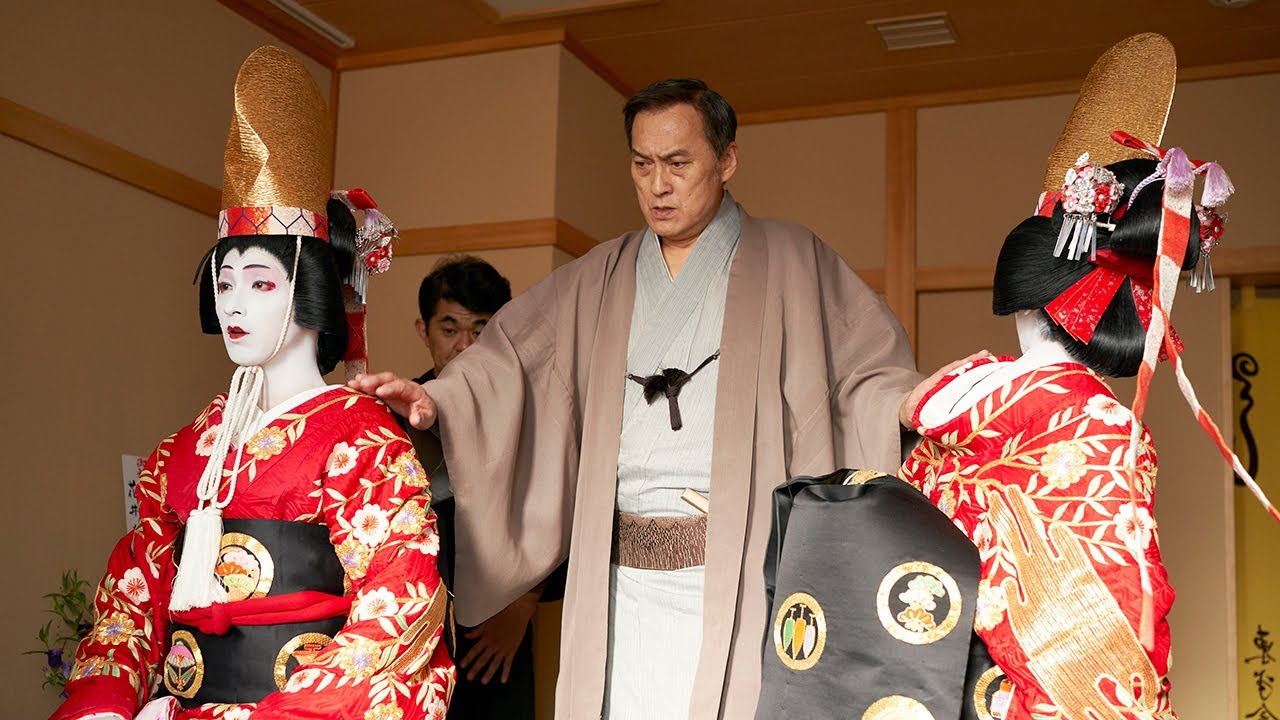
My favorite of AFI Fest, and of the entire International Feature field for most of the competition, Kokuho is an absolute feast for the senses, a dazzling work of visual art and a beautiful, thorough story of talent versus tradition. It ended up only getting an Oscar nomination for Makeup, but to think that’s the only wondrous part of this epic is to sell it incredibly short. There’s a reason why this has become the highest-grossing live action film in Japanese history (anime dominates the all-time list), and if you can endure the runtime (just over three hours), you’re in for a cinematic masterpiece, one of the best of 2025 full stop.
Meaning “national treasure,” Kokuho is, at its core, the life story of a man who overcame every societal obstacle to achieve greatness. Based on the novel by Shuichi Yoshida, the film revolves around the art of kabuki theatre, specifically the actors called “onnagata,” those playing the roles of women in the all-male casts. It’s here that we meet Kikou (Ryo Yoshizawa), the son of a yakuza boss who doesn’t want a life in organized crime, but instead yearns for a career on stage. He gets his first chance to perform at a New Year’s party thrown by his father (Masatoshi Nagase), where he’s joined in the audience by renowned onnagata Hanai Hanjiro II, played by Ken Watanabe. Hanjiro is impressed by Kikou’s talent, but the revelry is short-lived, as a rival yakuza gang storms the compound and kills Kikou’s father. After an ill-advised and aborted attempt at revenge, Kikou is taken in by Hanjiro and trained in kabuki.
This, however, is not as simple as it would seem. See, in Japan, kabuki is seen as a hereditary vocation. The skills, the training, the roles, and eventually even the stage names, are traditionally passed down generation to generation. If a man is a successful kabuki actor, it is expected that his son becomes one as well. When Kikou is adopted, Hanjiro already has a son in training, Shunsuke (Ryusei Yokohama). This young man has “kabuki blood” in him, and already has his life path laid out before him, including the eventual inheritance of the name Hanai Hanjiro when his father retires. By taking on an apprentice, Hanjiro is disturbing what is believed to be the natural and proper order of things, and training both Kikou and Shunsuke simultaneously could disrupt things further. It’s especially controversial when it turns out that Kikou is far more talented than Shunsuke.
In an American film, this would be grounds for some serious melodrama, bordering on soap opera tropes. Thankfully, director Lee Sang-il (he gained worldwide acclaim for the hilarious Hula Girls in 2006 and has had a solid output since) is far more clever and disciplined. Rather than lashing out at one another through jealousy and entitlement, Shunsuke and Kikou grow up as brothers, supporting one another through the trials and tribulations of their intense training, and even openly commenting on how “Hollywood” it would be if they actually resented each other. Both become solid onnagatas in their own right, and initially Shunsuke is actually happy that Kikou’s talent might actually free him up to pursue other avenues. There are some histrionics eventually, but Lee makes sure we earn that pathos by forming a solid, loving rapport between the rivals first.
As time goes on, Kikou becomes famous, but it comes at a hefty price, particularly from those who rigidly want to see him punished simply for existing outside of his pre-determined station in life. The fact that he has tattoos is seen as him not abandoning his yakuza past. Having an illegitimate child makes him immoral. When Shunsuke leaves kabuki, clearing the way for Kikou to inherit and become Hanai Hanjiro III, traditionalists are incensed and eager for his fall from grace. Kikou has just enough vices in his life to allow for the possibility.
Everything about this film is just radiant. The performances are all incredible. Audiences around the world have known and loved Ken Watanabe for years, but Yoshizawa and Yokohama steal the show at every turn, to the point that Watanabe almost serves as an entry point for Western viewers to connect with the material long enough to get sucked in. Yoshizawa and Yokohama both trained for over a year to get the stage movements and dialogue intonations down for their roles so that they could perform effectively at kabuki itself. This isn’t method acting, it’s full-on immersion and commitment to accuracy and credibility, something that becomes even more astounding given how young these actors are (31 and 29, respectively). They gave up significant portions of their youths to make sure they got this right, and that dedication shines through in every scene.
In addition, the production elements are some of the best you’ll see. The Academy nominated the hair and makeup jobs, which are decidedly on point, but there’s so much more. The camera work is insane, making a space as small as a short stage feel like a grand landscape. There are dream sequences where snow falls poetically onto Kikou’s shoulders as if being kissed by the divine. The costuming is jaw-droppingly beautiful, from the intricate stage outfits to the simple kimonos worn in quieter moments. The sound design is spectacular, allowing you to truly take in the operatic nuances of the kabuki readings. The script is incredibly smart, not just in how it subverts clichés as mentioned above, but in how it gives you enough information to guide you along the way without holding your hand.
The biggest example of this is in the kabuki performances themselves. As we see each one, on-screen text tells us the title of the play and the most basic of plot summaries. The small synopsis lets us know what we’re watching, but it’s up to us to internalize it and understand the thematic impact. For instance, Hanjiro and Shunsuke perform Two Lions, a famous dance where an older lion prepares his young son to lead the pride by tossing him off a cliff and forcing him to fend for himself. It’s amazing to look at, and we’re given just enough information to know that this has a meta implication, as Hanjiro is trying to make Shunsuke stand on his own and command the stage, as he’s meant to one day take his father’s place. So many lesser films would beat this idea into your head through repetitive and clunky dialogue (see… well, any movie on Netflix, as we’ve recently learned). Here, though, the filmmakers know that the audience is intelligent, so they just give you the bullet points. Everything else is up to you. They provide the tools, you do the rest. That’s an amazing degree of creative maturity.
The only drawback, as previously mentioned, is the runtime. And to be clear, it’s bound to be a flaw for some people, but it didn’t bother me in the slightest. You can argue that the film suffers from what I call “Lord of the Rings Syndrome,” where the film is stretching three hours or more, and there are several spots where you can end the film logically, but the creators choose not to. I can see this being a hurdle for some, but it wasn’t an issue for me. I put this down to two reasons. One, I was too fascinated by what I was watching to care how long it went on. Two, this is presented as a life story for Kikou, meaning by design it’s supposed to be as long as necessary to properly convey all the important details, which is how the novel (over 800 pages long) is written. For our purposes here, that means seeing everything of relevance from Kikou’s first performance to the moment that he’s ready to retire and has made peace with all the influences in his life, for good and bad. Yes, you can easily end the film once Kikou and Shunsuke reconcile, years after their falling out. But this isn’t Shunsuke’s story, it’s Kikou’s, and there’s so much more to cover. That’s why we don’t simply jump from the argument to the reunion. A lot of Western and Hollywood films would do that, but that’s not Japan’s style, and it’s not the style for this particular story’s subject matter. Kabuki is a delicate, detailed performance art, where dances can last for hours on end, or just a few minutes, depending on the piece. The emphasis is on making sure that the time is taken to do it properly, and get all the needed emotion across, no matter how long it takes. To speed through a series of plot beats would be to betray the very artform they’re portraying.
I’m very upset that this ultimately didn’t get nominated for International Feature, because it simply means fewer people will see it apart from completists like myself who try to cover every category, including Makeup & Hairstyling. This is a film that deserves to be seen and studied by audiences the world over, and leaving it off (especially in favor of Sirāt) feels like a disservice to those who understand the beauty of real culture. I get that the runtime might put some off, but if you give yourself permission to immerse yourself in this cinematic enchantment, you’ll be better for it.
Grade: A
***
That’s it for this installment. We still have four more films on the International Feature shortlist to cover, and we’ll get to them in due course. There are also 28 other flicks to plow through as we get closer and closer to the Oscar Blitz proper. God, I’ve missed this!
Join the conversation in the comments below! How many International Feature submissions have you seen? Which ones are the most important? How exactly is a small, one-layer cake supposed to feed an entire classroom of kids? Let me know! And remember, you can follow me on Twitter (fuck “X”) as well as Bluesky, subscribe to my YouTube channel for even more content, and check out the entire BTRP Media Network at btrpmedia.com!

 I Actually Paid To See This
2 thoughts on “Back Row Thoughts – International Festivities”