
We’re a week away from the Oscars, and starting tomorrow, the Blitz enters the home stretch. Even though I published my first new review of the year yesterday, I still have five more films from 2025 left to cover. Two of them I’ll hold until Saturday, as they kind of fit into their own separate category, so that leaves three for tonight.
As previously mentioned, I did my best to clear the Documentary Feature shortlist, but couldn’t quite make it work this time around. When nominees were announced back in January, I had gotten through two thirds of the list, or 10 films overall. Of the remaining five, one was nominated, and naturally, it was an indie that was being self-distributed by the filmmakers. That meant that, even if it was convenient to see the four eliminated semifinalists, the only priority was tracking down the one that was still in contention. It ran locally for a week, the literal week before the shortlists were revealed, so no one who would eventually know its importance got a chance to see it during its run.
Thankfully, the Laemmle chain was able to arrange special one-time screenings at two of its locations, which gave me the opportunity to take it in, and thus complete the category AND the Oscars field for the 11th year running. If there’s any lesson in all this, it’s that either Hollywood needs to get its head out of its ass and distribute documentaries again, or the Academy needs to similarly de-rectum their crania and serve as the default distributor for any nominated film that doesn’t already have one.
Okay, rant over. Time to actually give the three remaining docs their due, especially since one has a decent chance of hearing its name called in victory in seven days’ time.
Holding Liat
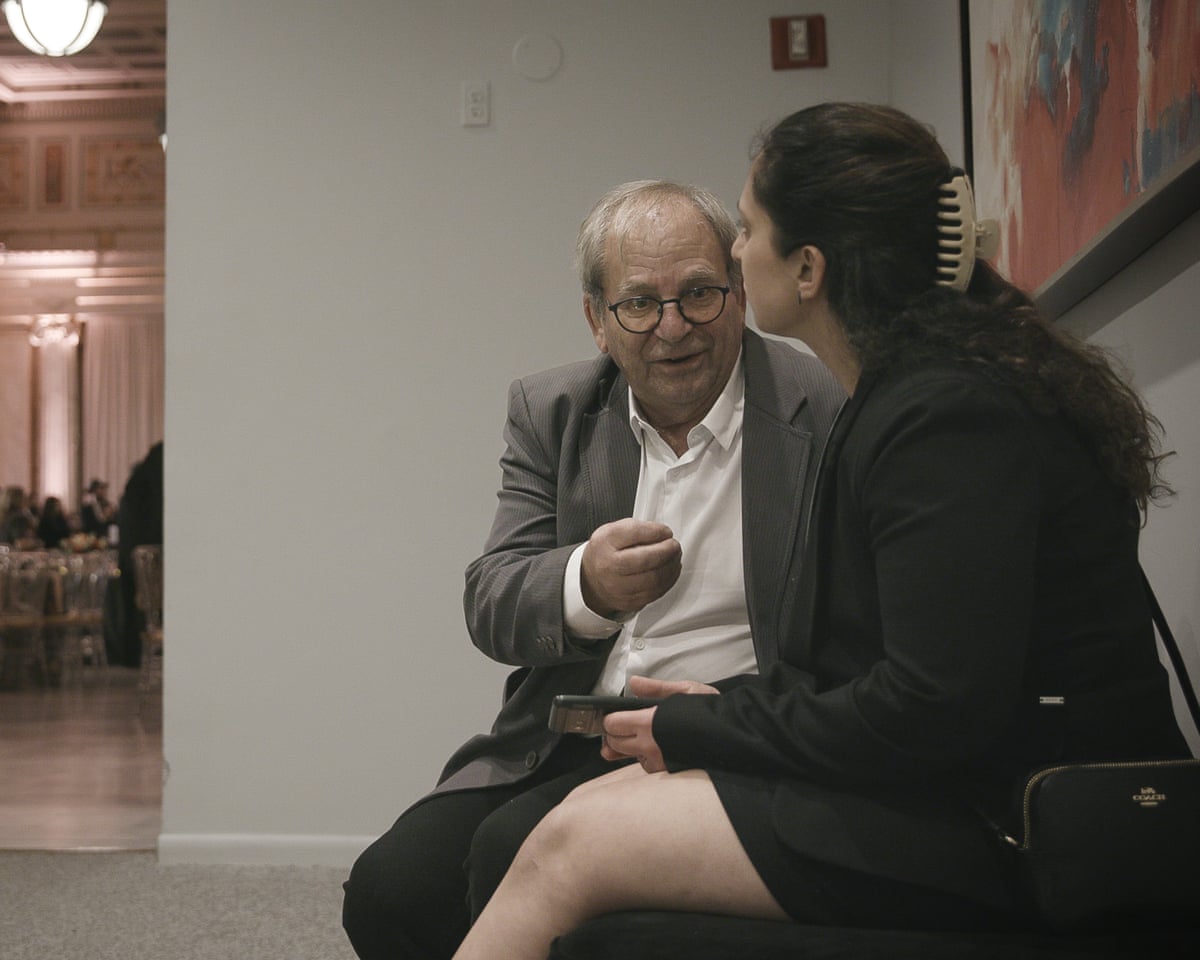
A lot of times, making a film can be a deeply personal experience. No better is this illustrated than in Holding Liat, directed by Brandon Kramer. A relative of the film’s main subject, upon learning the news that drives the events into motion, he and producer Lance Kramer simply pick up their cameras, make some calls, and dive into story, maintaining a respectful and disciplined remove, considering how close they are to it.
As part of the Hamas attack on October 7, 2023, about 250 people were taken hostage in and around Gaza, including dual US-Israeli citizen Liat Beinin Atzili and her husband Aviv, abducted from the Nir Oz kibbutz. The film concerns the efforts of Liat’s parents, particularly father Yehuda Beinin, to secure the couple’s safe release. The drama comes from the fact that Yehuda is an avowed pacifist and outspoken critic of Israeli Prime Minister Benjamin Netanyahu, and is unwilling to toe the line on any political narrative, as he feels that prolonged violence will only make the situation worse. As an American citizen, Liat’s case draws media attention here at home, and Yehuda uses that opportunity not only to get help from our government in getting Liat back, but also to leverage and appeal for peace.
The unfortunate truth he confronts is that far too many are filled with bloodlust and see the dollar signs that come with war profiteering. On a sponsored trip to Washington to meet with lawmakers, Yehuda joins the families of other hostages in pleading for help, but finds far too many in Congress willing, if not eager, to use the situation to advocate for complete alignment with Bibi’s agenda, including sending more weapons and repeating tired and patently false talking points that Palestinians support terrorism. Yehuda’s exacerbation is two-fold. One, he knows that Bibi is a monster (he’s literally been indicted by the International Criminal Court for war crimes thanks to his genocide in Gaza), and has been using the hostage crisis as a means to consolidate power, silence dissent, and exterminate what remains of Palestine and its people. Two, as Yehuda and others observe, Bibi seems more concerned with prolonging the war than with getting the hostages back. He’ll bomb hospitals and slaughter civilians and children, but his actions aren’t bringing anyone home. When Yehuda brings up these issues, his sponsors make subtle attempts to sideline and silence him, and he’s even chastised for talking to a Palestinian lobbyist and coming to an understanding on common ground despite their religious and societal differences. It’s like human decency itself is being censured.
Yehuda is very loud and passionate, which rubs some in his family the wrong way. Liat’s sister, who lives in Oregon, grows tired and frustrated with his rants. Liat’s teenage son is angry and vengeful, at times musing that he doesn’t care if every Palestinian is wiped out so long as it gets his mother back. Brother Joel, a history professor, left Israel because the socialist ideals of the kibbutz system were overtaken by colonialism, and criticizes Yehuda for continuing to live in such a corrupt country where these attacks can and do happen regularly. Wife Chaya, a normally laid back grandmother, argues with him constantly about not losing sight of the only goal that matters – Liat’s return.
The filmmakers go to great lengths to show a spectrum of ideas and emotional reactions to the crisis, all while doing their best to remain as objective and unobtrusive as possible. That’s extremely difficult, as this is a member of their family we’re dealing with here, and knee-jerk revenge fantasizing is a lot easier. Thankfully, they do keep the heart of the matter front and center most of the time. We see numerous video calls with an army liaison in charge of the investigation into Liat and Aviv’s kidnapping, hoping for clues to their location, as well as giving Yehuda and Chaya regular updates on Liat’s status as the first ceasefire in the war approaches. The catharsis of reunion is somewhat subdued by the dark reality of the moment, the human cost to date, and the atrocities still to come. It’s laudable how the Kramers were able to keep their distance and not insert their own viewpoints, keeping this as observational as possible within context. In an ongoing conflict that thrives on heated narratives and reactionary violence, the biggest achievement might be the fact that anyone was able to keep a cool head throughout this ordeal.
Grade: A-
Folktales

In a sea of absolute downer documentaries, it’s nice to have something of a palate cleanser, an actual bit of pleasantness to serve as a respite from all the human misery that tends to dominate the genre of late. Folktales is that momentary salve, a simple but significant look at how certain young people can find some direction thanks to some non-traditional education and the love of a good bunch of doggos.
Directed by Heidi Ewing and Rachel Grady, the filmmakers behind the terrifying Jesus Camp (seriously, it’s one of the scariest movies I’ve ever seen because of how those poor kids are brainwashed to become Christian terrorists), Folktales is a complete 180 from that previous effort, showcasing a positive communion between young people and nature, with an emphasis on possibilities for the future rather than rigidness and hatred. The picture takes place at the Pasvik Folk high school in Norway, where teenagers take part in a one-year immersion program in the Arctic Circle. They essentially spend an additional academic year after their regular graduations learning how to survive in the wilderness, become self-reliant, and raise sled dogs. The goal is that, after they finish the program, they’ll be better equipped to deal with the challenges of the real world.
Although we meet several of the 30-odd students from around the world, including an American, most of the focus is on three members of the class: Hege, Romain, and Bjørn Tore. Hege is the most memorable of the bunch, and gets the most screen time. A recent high school graduate whose father died when she was very young, Hege is directionless and unsure of what comes next in life, as she never had proper guidance from the rest of her family and friends. She’s always been loved and supported, but she has no idea what she wants to do with her life, and often finds herself trapped in a grief cycle when it comes to mourning her dad.
The staff at the school are supportive but firm. They teach the kids the skills they need, give them the tools to succeed, then for the most part leave them to it. The biggest test is during the Polar Night, a period of perpetual darkness in the Arctic where the Sun never crests above the horizon. During this bitterly cold month of winter, the class is tasked with camping in the woods for two full days, with only their wits, limited supplies, and the company of their chosen canine. The bond the kids share with the huskies is heartwarming in the extreme, and their resilience is admirable, especially for the more socially awkward students who aren’t sure if they can hack it.
Overall, the movie is inessential. Obviously all the teens will deal with loneliness, anxiety, homesickness, and self-doubt, but the film wouldn’t be made if there was any real chance at failure. Folk schools like Pasvik have been around for years, and are seen as an innovative form of experiential education. Given, with Ewing and Grady at the helm, we could have been in for an exposé of some kind of massive abuse scandal, but since we’re shown the amount of love and care on display pretty much from the beginning, it’s an easy assumption that things will be pretty safe. But honestly, I’m glad that this isn’t nearly as heavy as the other shortlisted films. It had no chance of winning, but in a year where pretty much every other entry deals with tragedy, war, discrimination, corruption, and murder, I’m grateful for a story like this. The fact that two of the best documentary filmmakers of this century are behind it makes it all the more comforting.
Grade: B-
Cutting Through Rocks

Finally, we come to the film that put completion at risk. Directed by Mohammadreza Eyni and Sara Khaki, Cutting Through Rocks won the Grand Jury prize for International Documentary at last year’s Sundance Film Festival, and was named as a Critic’s Pick at New York’s Film Forum. You’d figure that would be enough to get commercial distribution, but no, it was left to the filmmakers to ensure that their work got seen yet again. I’m glad it happened though, as this is one of the best films of 2025 full stop.
The story focuses on Sara Shahverdi, a divorcée from a remote village in Zanjan province in northwestern Iran, about 200 kilometers from Tehran. An assertive and self-sufficient woman, the film opens with her literally cutting through rocks along the property line of her house as she builds a new gate for her driveway. Largely immune to criticism from others, she takes pride in her ability to provide for herself, help her neighbors, and ride a motorcycle. She’s about as free and liberated as a woman can be in Iran, and she’s often the loudest voice in settling family disputes, including an early scene where she berates her brothers for tricking their sisters into signing away their shares of their father’s inheritance.
Encouraged by the women in her community, Sara then runs for a seat on the village council, winning one of the five positions, and thus becoming the first woman elected to local political office. During the campaign, she faces the usual misogyny of the more traditional residents, who tell her they’ll vote for any man over her simply because they’re a man, kind of like how there are somehow millions of people in this country who will vote for a rapist, convicted felon, or an accused murderer, simply because they have an “R” attached to their name rather than a “D.”
As the highest vote recipient in the election, Sara is awarded the official seal of the village, meaning she’s the one who actually puts the stamp on any new legislation or municipal orders. This does not sit well with the other council members, including her own brother, who suddenly demand that the seal be kept in a rotation, which would allow them to enact their own agendas unilaterally. Sara is having none of that, and is not afraid to shout down those who would enshrine a legal double-standard due to this minor threat to their masculinity.
Sara’s main objective is equal rights for women, though she approaches it in a small yet pragmatic way. The first priority is to get married women equal ownership of property. She accomplishes this through a sly declaration that property rights can be forfeited in the event of a married man’s death without an official deed, and the only way to rectify it is to apply for said deed with the wife co-signing. This automatically makes the wife the primary heir, and gives her community property rights in the event of a divorce. It’s a clever bit of legal subterfuge, but she sells it beautifully as an act of love, convincing even the most stodgy older men of the community to prove their affections by acknowledging their wives as equal in at least one legally-binding sense.
The second task is to encourage young girls to continue their education, as most students end up dropping out and getting married as teenagers. One girl in particular is already betrothed by her parents to a man she’s never met, essentially being sold as property. Sara agrees to take the girl into her own home as a means of keeping her in school, and she delights in teaching several members of the class how to ride motorbikes just like her. Unfortunately, not everything can work out, and minds can’t change overnight. The girl’s uncle sees her riding with Sara and violently accosts the group, later asserting authority he doesn’t have to ensure she returns home and goes through with the marriage.
It’s a tragic end to one of the major subplots, but on the whole, the film is incredibly hopeful. It shows that change doesn’t come easy, but it does come eventually, if people are dedicated to seeing it through. Through every insult and threat that comes her way, Sara endures, proving herself a hero and role model simply by existing. I’d be interested to see how audiences reacted to this film before its nomination versus now, when the U.S. and Israel have launched an illegal war against Iran, killed the Ayatollah as part of a regime change mission, and continue to assault military and civilian targets. On the one hand, the world is a better place without Khamenei in it, but on the other, his even more hardline son has been picked as the new Supreme Leader, and our initial attack literally destroyed a girls’ school and killed over 100 students and teachers inside. Is this how positive change happens? I’m guessing no, especially since I’ve already lived through three separate Middle East wars to date. Obviously it has no bearing on the quality of this particular film, but it could play a part in whether or not it wins next Sunday.
Grade: A
***
That’s it for all the shortlisted and nominated Oscar hopefuls from 2025. As I said, there are still two movies from last year that I haven’t reviewed yet, but pointedly, those were bits of Academy bait where the voters did not bite. I’ll take them on this coming Saturday, before we finally close the book on last year’s cinematic canon in one week. Join me then!
Join the conversation in the comments below! Did you see any of these documentaries? Should any or all of them be nominated? Do you think you could train sled dogs, or would you just cuddle them non-stop like me? Let me know! And remember, you can follow me on Twitter (fuck “X”) as well as Bluesky, subscribe to my YouTube channel for even more content, and check out the entire BTRP Media Network at btrpmedia.com!

 I Actually Paid To See This