
So as I’ve mentioned more than a few times, I ponied up the dough to join Film Independent about a year ago. The membership fee was more than worth it, as it afforded me access to private screenings and discounts for a ton of indie and foreign films in the lead-up to this year’s Oscar Blitz, to the point where I’ve seen more International Feature submissions than I ever have before, and by the time I clear the shortlist, I’ll have seen close to half the total field.
The other major perk is getting to vote for the Independent Spirit Awards, the pinnacle for prestige cinema outside the Hollywood system. Some of the movies that end up being recognized get commercial releases, while others are so low-budget that if they’re ever made fully public, it’s typically in an on-demand or streaming-only context. There are films up for hardware this year that the wider audience will basically never get a chance to see, while others, like Nine Days for a fairly recent example, will get nominated for the year that it circulated through festivals without distribution and not come out until after the calendar turns over.
Since most people don’t have the time or ability to go to a bunch of film festivals, the voting populace needs to be able to see the nominees in order to make an informed decision. Thus we have screeners. Film Independent, like the Academy, has an online hub for members to view submitted and nominated entries. Not every candidate makes their work available, and obviously not every voter will care to see anything beyond their preferred choice, especially if they have friends involved in the featured projects. But you all know me, I’m a completist, so I want to see as much as my eyes can take in.
That brings us to this latest mini-series. I’ve been hacking away at the screeners, whittling down the list as I go, as even the organization encourages members not to vote for categories where they don’t see all the nominees (this goes for movie and TV contests). Some of the hopefuls aren’t available, but most are, and a good number of them got public releases that for one reason or another I didn’t see in theatres. So that’s what we’re going to be covering here. Over three installments, I’ll be breaking down various candidates that made it to general audiences. I won’t reveal how I plan on voting in any category, as there are rules against that, and I won’t be covering anything that hasn’t been distributed, save for documentary and/or international fare. Instead I’ll save those for full reviews once they do premiere, presumably later this year. The first two parts will be about basic narrative features, while the third will concern the aforementioned docs and foreign pictures. We begin with a whopping five condensed reviews tonight, so let’s not waste any more time! As always, I’ll rate them in the order I watched them, and don’t be surprised if you hear one or two of these titles called out when Oscar nominations are revealed on Tuesday.
Past Lives

Released by A24 back in June after it wowed audiences at the Sundance Film Festival, Past Lives is one of the major indie sensations of the year, and like Everything Everywhere All at Once before it, it’s hoping to ride a wave of momentum from critical and audience praise to at least some recognition by the Academy. It’s been placed on multiple Top 10 lists, including AFI and the National Board of Review, and received several Golden Globe nominations. It’s definitely mounting a huge campaign, and quite frankly, it deserves every ounce of kudos it gets.
Written and directed by playwright Celine Song in her feature debut, this largely autobiographical film is one of the most bittersweet love stories in recent memory, and a tender meditation on life’s random “what if” moments. It’s insightful, ponderous, assertive, and empathetic in ways few other films can muster, hopefully rewriting the rules on how romance is depicted on screen.
Taking place over the course of 24 years, the story revolves around Nora Moon (a transcendent Greta Lee in adult form; Moon Seung-ah as a child), a Korean-Canadian-American writer who emigrated from her home country when she was very young. A bright student who was quick to tears whenever things didn’t go her way, the kid version, named Na-young, found a friend and protector in Hae-sung (Teo Yoo as an adult; Yim Seung-min in younger form). The two share a strong bond, the kind of puppy love that we all experienced at one point or another in our formative years. Knowing that they’re about to leave South Korea for Toronto, Na-young’s parents arrange a supervised date for the two, so that she can have a pleasant memory to keep with her when they go. It’s only at the last possible moment that Na-young tells Hae-sung that she’s going away.
Twelve years later, Nora has finished college and is beginning her writing career. While perusing Facebook, she sees that Hae-sung has left messages on her father’s page asking after her, unaware of her name change. She reaches out, and they reconnect over Skype, rekindling their friendship as if they were never separated. However, Nora can sense that Hae-sung’s feelings might be a little deeper than that, and she has to make a decision for herself as to whether she wants to pursue her career or him. She chooses the former, opting to pause contact indefinitely. She then goes on a retreat where she meets the charismatic Arthur (John Magaro), whom she later marries.
Fast forward another dozen years, and Nora is living a happy and successful life with Arthur, and she has also resumed contact with Hae-sung, who informs her that he’s coming to New York to visit. He’s doing alright for himself, working a steady job and dating a woman, though he’s conflicted about taking things to the next level and committing to her. Seeing Nora again, face to face, for the first time in two decades, will hopefully bring him clarity.
There’s a strange tiptoeing that goes around in this artificial love triangle, but it never once feels awkward or cringe. All three parties have legitimate questions and doubts about each other, but they’re handled maturely, without wild speculation or rom-com tropes. The idea of fate comes into play, based on a Korean concept where every time two people interact, it’s part of a cumulative effect from their souls over the course of all of their incarnate lives. The more they see each other, the more the universe binds them together. This leads to introspection about how Nora, Hae-sung, and Arthur might have known each other thousands of years before now, but also reinforces the fact that we have free will and make our own decisions. Nora has chosen Arthur, and deep down, Hae-sung knows he must choose someone else. It takes the romantic tautology of “maybe in another life” and bears it at its most literal and vulnerable, and I absolutely love it.
The performances are very strong, as is Song’s script. There’s so much emotional honesty on every page that I can’t help but replay scenes over and over in my head. We all wonder about what might have been, the one that got away, and we reminisce about the more innocent days where saying “I like you” or giving someone a peck on the cheek was just downright adorable, because as children we didn’t think about any positive or negative nuance. I still remember the first girl who ever kissed me, the way-out-of-my-league girl in high school that I could have actually dated had I made a move at the right time, the woman I was too afraid to ask out because we worked together and I didn’t want to risk uncomfortable run-ins or HR intervention if I didn’t properly read the signs. It’s impossible to not occasionally dwell on these moments and idealize them. Song understands this and translates it to screen better than anything I’ve seen in a long time that didn’t involve actual alternate realities.
More crucially, though, she also makes it clear that we can’t move forward as if that nostalgia is real life. Eventually we all have to take stock, recognize existence as the sum of our experiences, and progress, painful as that may be, because when we do, we’re all the better for it. That’s something we can all appreciate, no matter where the invisible hand of destiny might guide.
Grade: A
All Dirt Roads Taste of Salt

I remember seeing the trailer for this as I was making the TFINYW column for last November. The cinematography looked gorgeous, and the blurbs about how the film would be a poetic look at life in the rural black south intrigued me greatly, reminding me fondly of the likes of Moonlight and Beasts of the Southern Wild. Unfortunately, Raven Jackson’s debut felt more to me like The Tree of Life. It’s occasionally stunning, but needlessly confusing and without a concrete narrative.
It’s an artistic film, don’t get me wrong, and I love this kind of work, but there has to be something grounded and accessible for an audience to latch onto in order to keep up with the journey the filmmaker wants to take us on. As noble as Jackson’s effort is, I think she falls short of that necessary connective element. There are some fantastic moments, but they’re fleeting, ultimately leaving us with a stream of consciousness that might read brilliantly (especially if you’re into William Faulkner), but doesn’t quite translate on screen.
Ostensibly, the story is about the life of a woman named Mack, played at three different stages of her life by Kaylee Nicole Johnson, Charleen McClure, and Zainab Jah. Living in the deep south with her parents (Chris Chalk and Sheila Atim) as well as her sister Josie (Moses Ingram and Jayah Henry), a lot of emphasis is put on slow, extended takes, oftentimes without seeing the characters’ faces. We’re a good 10 minutes in before we get a clean look at any of the main players. Instead, there’s a lot of focus on hands, paying extreme attention to very subtle movements of fingers and wrists, as well as multiple shots of the backs of heads. It’s intriguing to look at, but this also contributes to the problem, as I didn’t know who anyone was for large swaths of the first two acts, as Mack and Josie wear their hair in similar braids, and shooting them from behind makes it very difficult to distinguish who’s who.
It gets even harder as we begin jumping back and forth through the timeline. I think there’s a love triangle between Mack, Josie, and a boy named Wood (Reginald Helms, Jr. and Preston McDowell depending on the moment), and one of them has a child with him (I’m gonna say Josie, but I could be wrong), but it all sort of just melts into itself, rarely giving the audience any hints as to what the narrative actually is. This is intentional, as dialogue is kept to a minimum, and there are some shots that go on for interminable amounts of time without any significant action (a late scene has older Mack literally stand by the river in a wide shot, and over the course of about two minutes she takes three steps to the edge of the bank, the camera remaining static throughout). This is the main frustration I had with Terrence Malick’s so-called masterpiece. No matter how pretty the scenery is, if I’m left screaming, “WHAT THE FUCK IS HAPPENING HERE?!” at multiple points, that’s a failure in storytelling.
Sometimes the sparse dialogue works to great effect, however. There’s a scene where it’s never explicitly stated, but we can easily infer that mother Evelyn has died. We’re outside a church. Everyone’s dressed in black. The girls are sat in the back seat of a car with who I assume is their grandmother (Jannie Hampton). They sit in silence for a long time, the old woman just staring at the pair, who make no movement. Suddenly, grandma utters what may be one of the most beautiful lines I’ve heard in a while when it comes to the subject. “She’s gonna miss you,” she says. She repeats herself several times, lips quivering with each go, before she calmly tells Mack and Josie to go with their father. That’s about as perfect as you can get. It’s such a simple sentence, and yet it’s beyond powerful, and oddly comforting. You won’t just miss your loved one, but they’ll miss you, too. Whether you believe in an afterlife or not, there’s something reassuring about that. If there is something beyond this life, then she’s off on her next adventure, carrying the memory of her daughters with her as she goes. If there’s nothing, then there’s still that absence, which proverbially makes the heart grow fonder, even if it’s no longer beating. I adore this scene.
There are similar snippets that really work, like Evelyn and Isaiah dancing to their favorite song, or Josie bathing her newborn baby Lily in the sink, slowly cupping water in her hands to transfer it over to the infant as she goes. It just never coheres into a whole for me. I wanted to love this, because any attempt to experiment with storytelling conventions in an artistic way is to be lauded. And every so often, Jackson breaks through with something profound. The rest of the time, however, like the cloudy water made when Mack runs her hands through the river, it just comes out muddy.
Grade: C+
How to Blow Up a Pipeline
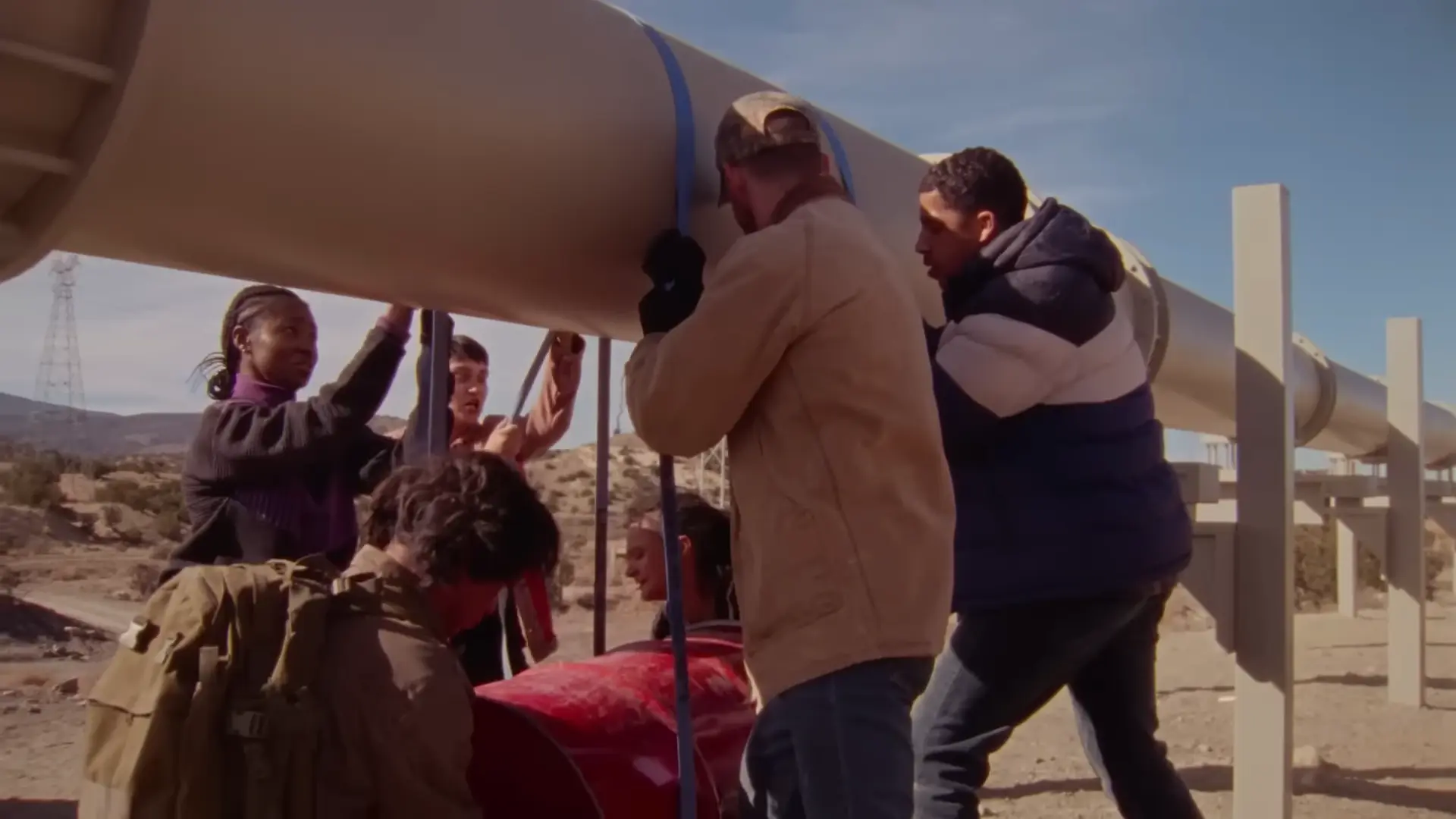
I was looking forward to this film all throughout last winter. It generated a lot of buzz coming out of Toronto in 2022, and the previews looked fantastic and funny. And honestly, with a title like How to Blow Up a Pipeline, how could you not be at least a little curious? Unfortunately, it premiered the day my mother died, so naturally it fell by the wayside as I handled much more important matters. By the time I got my life back on track, it was already gone from theatres. Thankfully I got this second chance, and it’s every bit as fun as I had hoped.
I love it when a writer takes a novel approach to adaptation. The best example of this is, well, Adaptation., in which Charlie Kaufman wrote a psychological meta comedy about suffering from writer’s block while attempting to adapt a non-fiction book. How to Blow Up a Pipeline walks a similar path. Rather than taking a narrative from a well-known book, writers Ariela Barer, Jordan Sjol, and Daniel Goldhaber (the latter of whom also directs) instead craft an original story based on the political arguments of Andreas Malm’s 2021 work of the same name, where he argues that in the face of the climate crisis, polite protest is no longer enough, and that Fight Club-style sabotage is warranted, with precautions in place to prevent collateral damage and casualties. The trio essentially makes a heist movie, bringing in disparate characters from vastly different walks of life to pull off such an operation, demonstrating how easy and effective it could be.
This earned the film some criticism by those who think it was outright promoting these acts, but that’s just disingenuous. You might as well ban Speed for all the knowledge it gives domestic terrorists about how to put a bomb on a bus. Just because there are homemade explosives doesn’t mean the movie actually teaches you how to create them yourself, and if an indie flick makes you want to explode stuff, you’ve probably got much bigger problems in your life. The real idea is that this situation affects everyone, regardless of their social or political standing, and we all have to come together if anything is going to get fixed.
Presented in a style evoking the likes of Reservoir Dogs, the film centers on the titular act of vandalism, with cutaways and flashbacks to the backstories of the parties involved. At the center is Xochitl, which is apparently pronounced “SO-chee.” Apologies to anyone if this sounds insensitive. I’ve just only seen the name written, never heard it spoken before. Yay, learning! She’s played by co-writer Barer, and has become radicalized since the death of her mother from heat stroke (thank Jeebus I didn’t see this when it came out) after an unseasonably hot summer in Long Beach, where there are a lot of oil rigs (I’ve driven past them a fair few times). A bright and talented college student in Chicago, Xochitl begins to spiral after her tragedy, eventually dropping out of school and quitting her advocacy groups because they only want to do the same old peaceful protests that she believes go nowhere. Her passion is noticed by classmate Shawn (Marcus Scribner from Black-ish), who begins working with her to recruit a group of like-minded individuals looking to make a major symbolic strike.
They are eventually joined by Michael (Forrest Goodluck), a North Dakota indigenous native who lashes out at oil prospectors for taking tribal land, and who teaches himself how to rig explosives. Often softspoken, the moment he loses his cool is a great bit of social irony, as he accosts a white oil worker from South Carolina, asking him where he’s from and telling him to go back there. Rounding out the crew are Xochitl’s best friend Theo (Sasha Lane), who has developed leukemia from chemical exposure; Theo’s girlfriend Alisha (Jayme Lawson), a volunteer at a homeless shelter; Dwayne (Jake Weary), a Christian conservative Texan who lost land to oil companies that was in his family for generations due to Eminent Domain; and stoner anarchist couple Rowan and Logan (Kristine Froseth and Lukas Gage). You could not ask for a more diverse and seemingly incompatible group of people, and yet they all believe in the same goal: using improvised bombs to detonate a local oil pipeline on Dwayne’s old property at two strategic points – one above ground and one underneath – that will force the pipe to shut down the flow of oil without it spilling into the environment or igniting to pollute the air.
Each of these characters has their own reasons for doing this, and no matter where you fall on the political or socioeconomic spectrum, you can at least qualify their beliefs, even if you don’t outright endorse them. They’re amazingly clear-eyed about what the risks are, what their exposure could be, and the fact that they will be labeled as terrorists, even though they’re planning for nearly every contingency to make sure there is no actual threat to humanity or wildlife, and they’re not trying to “scare” anyone into abiding by their demands. The goal is sabotage, not violence, and this is a key distinction. You may still not approve of their methods (Xochitl is introduced by slashing the tires on an expensive SUV and then leaving a note on the windshield explaining why she did it; I would certainly be pissed, especially because my SUV is old, isn’t that expensive, and I can’t afford to replace the tires; it was the best car I could get at the time, and I’ve been trying to replace it for years, so this would only be a devastating setback if it were me), but the script takes care to make sure you understand them before you judge.
The only knock I have is with the format. Again, it’s highly derivative of Quentin Tarantino’s debut, but at least the movie seems to be aware of that fact and has a bit of fun with it. However, that doesn’t excuse the more hackneyed ways it plays into heist movie clichés. The biggest one involves a member of the group who we’re shown is working as an informant with law enforcement. Everything this person does is sketchy, implying a major backstab moment, which means you can tell this is going to be a part of some “twist” where it turns out the betrayal was a part of the plan all along. No one is surprised by this, and it just wastes time that could be better spent developing the characters. it wouldn’t be so bad if it wasn’t so obvious, or if there were a few red herrings strewn about in the form of other characters acting suspiciously, but we’re just left with this one option.
That’s a little disappointing, but on the whole this is really good. The concept is solid, the visuals are sound, and the young ensemble cast does commendable work, particularly Barer and Weary. This is an immensely fun hypothetical, and hopefully it inspires people in all the right ways. If nothing else, I’m very excited to see what this group does going forward.
Grade: A-
Upon Entry

The one truly international film in this set comes from Spain. Written and directed by Alejandro Rojas and Juan Sebastián Vásquez, this intense and intimate thriller reminded me heavily of Ennemis Intérieurs, a French entry that was nominated for the Oscar for Live Action Short back in 2017. The themes are very similar, and the claustrophobic setting is quite effective. However, like that previous effort, this should have been a short rather than a feature.
Diego and Elena (Alberto Amman and Bruna Cusi) are a loving couple from Barcelona who have obtained a visa to emigrate to the United States. The plan is to arrive in New York, meet with Diego’s brother outside the airport for a brief hello (he’s in the U.S. on a green card, but is not yet a citizen), and then get a connecting flight to Miami, where they will live with Elena’s aunt and uncle, who are naturalized, while they find work. Diego is a project manager and Elena is a dancer and teacher.
The early part of the film suggests that Diego is a bit forgetful, and that his clumsiness might delay their transition. For example, as the cab leaves their house he fumbles in his pockets before finding his passport, and as the plane is about to land he sneaks off to the bathroom and leaves the customs forms to the still-sleeping Elena. They aren’t filled out until they’re in line waiting to be granted entry. Of course, something goes wrong when they reach the front of the line, and are thus detained and interrogated.
Diego thinks it’s because his passport was reported stolen and replaced, raising a red flag that their documentation can easily clear up. But as he and Elena eventually learn from Border Patrol agents Barrett and Vasquez (Ben Temple and Laura Gómez), they suspect that Diego is only with Elena to piggyback off of her visa, which she won in a lottery. They accuse Diego of using Elena to sneak into the country, bring up that he was previously engaged to an American he was dating online, and try to pressure him into admitting that he’s just fishing for a green card. What began as the start of an exciting new life turns into a high-stakes bullying session that threatens the couple’s status as both potential citizens and lovers.
There are myriad reasons why this worked so much better in Ennemis Intérieurs. First of all it was one-on-one, whereas this is two-on-two. In the short, a man is interviewed in a police station, and what at first seems innocuous becomes an actively threatening situation, as he’s accused of harboring terrorists. The back-and-forth between actors Hassam Ghancy and Najib Oudghiri is incredibly tense, as the latter holds all the cards, and the situation escalates at a steady pace. Here, Barrett and Vasquez just play “Bad Cop/Bad Cop,” with both of them threatening Diego and trying to turn Elena against him in a way that never feels like it’s trying to accomplish anything.
That leads into the second part, the subtext. In the French short, the encounter is used to lay bare some harsh truths about the country’s colonial past, as the action takes place in Algeria. Here, there’s no real connection between the U.S. and Spain that warrants suspicion, so there’s some half-assed asides thrown in about Diego originally coming from Venezuela, an authoritarian socialist state and adversary of America. There’s also a brief radio news report about Donald Trump in the opening scene to set the timeframe of the story and create an atmosphere centered on his xenophobia. However, that doesn’t really work. For one, Trump was more than okay with Europeans entering the country (just look at his wife), so he wouldn’t necessarily have a problem with Spain. He effectively banned people from majority Muslim nations from entering, which is its own form of disgusting bigotry, but Spain was close enough to “white” for him to tolerate it. As for the Venezuela link, yeah that lends more into his Latino hatred, but even that point is undercut by having Vasquez, a Latina officer, conduct the questioning. In essence, neither Diego nor Elena presents a threat to the country, so there’s no reasonable excuse to detain them. Even the “chain migration” undertones don’t follow logically (again, look at Melania’s situation), because if Diego wanted to use that route to get into the country, he could just wait and use his brother as a sponsor. If they think Diego will be mooching off the government, they need to explicitly state that, because otherwise there’s nothing to instigate this plot where Vasquez and Barrett say that they have final say whether they get in, regardless of whether or not the State Department approved a visa, which is just nonsense. Even if there is a mechanism by which lower-level agents can overrule the visa office, it just doesn’t come off as realistic.
Third, and most crucially, this story can’t maintain the suspense for over an hour. The French film ran for 25 minutes, meaning it could keep ramping things up until a quick climax, then have a minute of falling action for us to catch our breath. Even at a relatively scant 76 minutes, this level of intensity cannot be sustained. As such, we have to artificially create more ways for Diego to get into trouble. When the couple is brought to an interview room, at first they’re together, and they’re told to turn off their cell phones and pack them away. When there’s no officer in the room, they wonder if they’re being monitored on video. The answer is, of course, if the department is competent they are. It’s never stated in the film one way or the other, but common sense would say that they definitely are being watched. Diego protests multiple times that he should at least be able to call his brother waiting outside to let him know they are delayed, and while it’s a dick move by CBP to not grant him that, once they say no, you have to abide by it. You don’t want to risk doing anything suspicious or disobedient that could make your situation worse. So what happens when Diego is left alone? He goes right for his bag and turns on his phone, hoping to get a signal and call his brother. Of course he doesn’t turn it back off, and when the agents return, it rings, and he has to surrender it for backup. He also – and I can’t believe how stupid this is – sees Vasquez’s unattended case file on him and Elena, and actually grabs it, attempting to read whatever they’ve got on him. He even drops the papers like a clumsy fool.
At that point, I’ve lost all sympathy for this guy. The agents are assholes, but he’s an idiot. This is a shit process, but you have to follow the rules. They hold everything. You have nothing. Don’t give them an excuse to make your life hell. I can actually relate this back to two personal experiences I’ve had. The first was from about a decade ago. I went to a soccer match with a friend. There was a long line to get from the train station and parking garage into the stadium, and people were being herded along by police. A guy a few feet from me was openly smoking a joint, so the cops pulled him out of the line and arrested him for “being stupid.” Their words. I’m all for legalized weed. Most of us are. But you know what you don’t do? Smoke it IN FRONT OF A COP IN A PLACE WHERE IT’S STILL ILLEGAL! That’s how I feel about Diego. I would deport his ass just for being dumb.
The second is from 20 years ago. I was dating a woman from Scotland at the time, and I was going to see her for two weeks because our relationship was rocky and we wanted to patch things up. I flew into London overnight and was supposed to make a connection to Glasgow. However, I was detained by British Customs, as I accurately declared on my immigration form that I was unemployed at the time. I was very tired because I hadn’t slept but for a few minutes on the flight, and was a little loopy while answering the agents’ questions. I gave them my girlfriend’s home address and phone number, but they couldn’t reach her because she was already at the airport. I tried to give them her mobile number, but I couldn’t remember it in my sleep-deprived state (weirdly I still remember the home number all these years later).
They asked me why I was coming to the U.K. for a “vacation” when both of us were out of work (she had quit her part-time job two weeks before). I explained that the tickets were bought while we both still had jobs, but had recently lost them, and that the tickets weren’t refundable, so there’s no point in them going to waste. It took a couple of annoying hours, but I responded respectfully to everything they asked of me, and I even got a laugh out of the main agent when she asked if my girlfriend was British and I told her, “No, Scottish. She’d ream me out if I called her a Brit,” agreeing with the assessment and asserting her Welsh pride. Eventually, they let me in, stamped my passport, and gave me a stern warning to make sure I made my return flight, and that if I missed it they would come to her address and have me deported and banned from the country for 10 years, noting that an unemployed man making an international flight to a country with a much better social welfare system than the U.S. is considered suspect. I totally got what they were saying, and it made a degree of sense. They booked me on the next flight to Glasgow, as I had missed my connector, and I arrived three hours later than planned. It ultimately had no effect on my trip.
I tell this story not to be a lecturer or some tone deaf imbecile who thinks all police violence is avoided by just being compliant, but to prove the point that Diego’s actions in this movie are manufactured for the sake of cheap drama. There’s a time and a place to assert yourself, but you have to have leverage if you want to negotiate a position. He has none in this situation, and yet he’s constantly finding ways to make matters worse for himself, jeopardizing his relationship and possibly his life, as the agents note that if they let Elena in and not him, he doesn’t go back to Spain, but back to Venezuela, where he’s actually a citizen, and that could prove deadly. Any sane person would swallow their pride, ask only for clarification to make sure he’s on the same page with the agents, and then do whatever is necessary to get that stamp on the passport. After that, you’re gravy. You can call your brother and apologize, then move on with your life and get your fresh start. Everything he does in this movie is artificially illogical just to put up a dramatic roadblock and pad the runtime.
There’s a way to tell this story properly, and unfortunately for the filmmakers, it’s already been done. I applaud the effort, (especially the sound design, as that does create some nervous moments) and the performances are solid. But ultimately the film doesn’t actually say anything, and the basic story it’s telling is stretched out beyond plausibility. It’s an interesting start for these creators, but in the end it comes up short.
Grade: C+
BlackBerry

Finally tonight we have BlackBerry, which came out in May of last year, yet another entry in the odd subgroup of films based on corporate origin stories. Directed by Matt Johnson and co-written with Matthew Miller from Operation Avalanche (will they become “The Matthews” for an Oscar run in the next few years?), the movie tells the relatively true story about the rise and fall of the titular smartphones in the late 90s and 00s. Hewing very close to the likes of The Social Network, the film is enjoyable, but largely forgettable.
Jay Baruchel stars as Mike Lazaridis, the co-founder of Research in Motion, or RIM, which created the BlackBerry (and be thankful this isn’t a full review, because you just know I would have made the headline, “A RIM Job”). The film begins with him and his partner, Doug Fregin (Johnson), preparing a pitch for their all-in-one handheld device that stores emails in addition to calling and texting. They meet with a disinterested Jim Balsillie (Glenn Howerton), who cares so much more about his own rise up the business ladder. After the presentation fails, the pair go back to their office, which is filled to the brim with gamers and other stereotypical nerds (there’s literally a scene where one guy refuses to get off the modem to free up the phone line because he’s arguing with someone in a Star Trek chat room).
Balsillie comes back to them and offers to help them sell their device in exchange for a share of the company and the title of CEO. Mike and Doug eventually agree, with the condition that Mike be Co-CEO. From that point on, Balsillie takes over the whole operation, wheeling and dealing to sell what would eventually become the BlackBerry, with Mike demonstrating to the executives at Atlantic Bell (later Verizon) his technological breakthrough to have each device act as its own email server. The combined strength of Mike’s tech wizardry and Balsillie’s sales technique wows the board, particularly John Woodman (Saul Rubinek, who played a villain in an episode of TNG, so I hope that geek hogging the modem is pleased), and before you know it, we’re off to overnight success.
The story is ultimately one of hubris for Balsillie and distraction for Lazaridis leading to a karmic downfall. For the former, his troubles begin right from the opening, as before he takes his meeting with Mike and Doug, he pulls a power move in a different presentation despite direct orders from his supportive boss not to do it. Thus, he’s fired, making him take on RIM as a means to prove he was right. This leads to his pride getting the better of him, hiring engineers with the legally dubious practice of backdating stock options so that he’s effectively paying people tens of millions to join the company, successfully fighting back a hostile takeover from the head of Palm Pilot (Cary Elwes) and trying to buy the Pittsburgh Penguins and secretly move the NHL team to Hamilton, Ontario.
For Mike, the theme is white noise. The first scene demonstrates his annoyance with a buzzing coming from Balsillie’s office intercom, a product of mass-production from China that he feels lacks human touch and expertise, so he disassembles and fixes it right there in the office while he and Doug are waiting for Balsillie to show up. As the movie goes on, he loses touch more and more with his roots and his empathy, eventually acquiescing to using Chinese factories to manufacture BlackBerry phones in hopes of competing with the newly-released Apple iPhone.
On the whole, both lead actors do a tremendous job, giving both Lazaridis and Balsillie more dimensions than reality would normally dictate. You can read a ton of articles about the historical inaccuracy of the film, but as a character study, they hit the right notes for the most part. If there are flaws to be had, it’s in Howerton going a little too far over the top at times and Baruchel’s appearance. On the latter point, I don’t really care that Baruchel looks nothing like the real Lazaridis, who is of Greek and Turkish descent and is a lot rounder in frame than Baruchel’s slim figure. I care more about the horrendous hair and makeup job in the back half of the film that makes him look like the twink love child of Julian Assange and Draco Malfoy.
The real drawback of the movie is Doug. Johnson’s writing and portrayal is intentionally nothing like the real Fregin. In the film he’s much more animated and loud than the real man who eschewed the spotlight and focused on getting things done. Again, that doesn’t really matter if the character that Johnson develops is still compelling. He’s designed to be the audience cipher, but he’s just incompetent and annoying. Strutting around every scene in a tank top and a 70s hairband, the man is a straight up goober who does absolutely nothing. He’s far more concerned about playing Warcraft or holding “Movie Night” in the middle of the day than actually doing any work.
And yet, we’re meant to feel bad about him being shunted to the side by Balsillie, and then again by Charles Purdy (Michael Ironside), hired to head up operations at RIM when production starts to slow. He’s a complete slacker without an ounce of seriousness, who’s basically only there to be the one to tell Mike, “It used to be about the MUSIC, man!” I can get behind this idea if we were to see him do something, anything. But he’s just a lazy sidekick. He never contributes to the development of the BlackBerry in any meaningful way, he constantly argues with Balsillie on even the most basic tenets of running a company, he stands around with his mouth agape while others do the actual legwork, and while he’s presumably a good friend to Mike, he never offers any constructive input. He’s too busy watching Raiders of the Lost Ark to even help put together the prototype for this product he ostensibly wants to be a big seller. By the time he’s posing Lazaridis the sanctimonious rhetorical question of, “You know why these people are willing to work 80 hours a week for you?” I just want to smack him in the face and scream, SHUT UP AND DO YOUR JOB YOU WORTHLESS FUCKING LAYABOUT! I’m all for work-life balance, but you do eventually have to WORK! This version of Fregin is a leech, not a leader, and every moment he’s not on screen is better for the movie. If we’re to compare this directly to The Social Network, this would be the equivalent of Andrew Garfield’s character just sitting in the room and eating nachos the whole time while asking for half the credit, which would eliminate any sympathy we have for him.
Apart from that, however, the movie is solid. Derivative, but solid. I don’t think it’ll blow anyone’s mind, but as corporate cautionary tales go, it’s alright. The story is intriguing, if massively exaggerated. The core performances are very good, allowing Baruchel and Howerton to stretch their dramatic legs for once. For the most part, the central ideas get across effectively. This is a perfectly cromulent film. At no point while watching it did I wish I was watching something else… though I did play on my phone for a while (Pixel, not iPhone, because fuck Apple).
Grade: B
***
I know that was a lot to get through, but this is the life I’ve chosen for myself. Keep it locked here for the next installment, when we’ll tackle five more features. Pray for me.
Join the conversation in the comments below! Have you seen any of these films? Which was your favorite? How many times did you cry watching Na-young and Hae-sung as kids? Let me know! And remember, you can follow me on Twitter (fuck “X”) and YouTube for even more content!

 I Actually Paid To See This
6 thoughts on “Back Row Thoughts – The Spirit Stragglers, Part One”