
Awards Season is almost over, and as such, I’ve got to wrap up all my old business from 2023. This includes the two films I had to watch after the Oscar nominations came out, as well as the final four publicly released films that got nods at the Independent Spirit Awards. It was incredible binging so many different stories and performances in the run-up to the voting deadline, to the point that for once I was actually happy to lose some sleep.
However, the time has come to put this chapter to bed. The ceremony was held last week, and the winners have been crowned. All that’s left to do is go over a few more also-rans that garnered attention, some of them quite well-deserved. Thanks as always to those who kept up with this sporadic mini-series over the last few weeks (click the links for Part One, Part Two, and Part Three if you want to catch up), as this has been quite the adventure. Let’s get to the finish line!
Fremont

In a bit of unintentional irony, Fremont is a story about melancholy, loneliness, survivor’s guilt, and exploitation, and yet it’s set in the city that was just this week named the happiest in America. Funny how that works out.
Anaita Wali Zada stars as Donya, a former military translator in Afghanistan who fled to the U.S. after we ended our operations there and the Taliban took back over. For eight months she’s been living in Fremont, CA and working in San Francisco at a fortune cookie factory. She’s made one close friend in the form of co-worker Joanna (Hilda Schmelling), who encourages Donya to put herself out there and enjoy a social life.
Through several therapy sessions – which in themselves are hard to secure because of her refugee status – Donya learns to open herself up more. However, her world is still far from ideal. She feels isolated and guilty, not just for making it to the States when so many others couldn’t, but because her former friends and neighbors saw her as a traitor for working with our armed forces. She escaped mostly to help her family save face, but that also means she may never see them again.
She is reminded of this perception in a rather odd way. When her boss Ricky (Eddie Tang) promotes her to actually writing the fortunes, his wife Lin (Jennifer McKay) begins to resent Donya more and more, looking for any excuse to make her life miserable. She gets her opportunity when Donya takes a random chance and puts her phone number in a fortune, which sadly Lin herself finds. Looking for petty revenge, Lin pretends to be a suitor texting her and sends her to Bakersfield for a humiliating errand, but after an encounter with a friendly mechanic (Jeremy Allen White), it turns out Lin might have done more good than harm, ironically making her fortune come true.
There’s a lot of creative and pensive misdirection in this film, and Zada gives an excellent performance. The film is moody, but never outright morose, showing that in order for happiness to come in any form, you have to give yourself permission to feel that way. The narrative can be a bit plodding at times, but on the whole, the movie definitely has its heart in the right place.
Grade: B
Birth/Rebirth

When it comes to Frankenstein-esque adaptations, Poor Things got all the attention this Awards Season, and rightfully so. But there’s a sleeper hit in the form of Birth/Rebirth that you should check out if you get a chance, if nothing else than for the fact that this leans much more into the horror element.
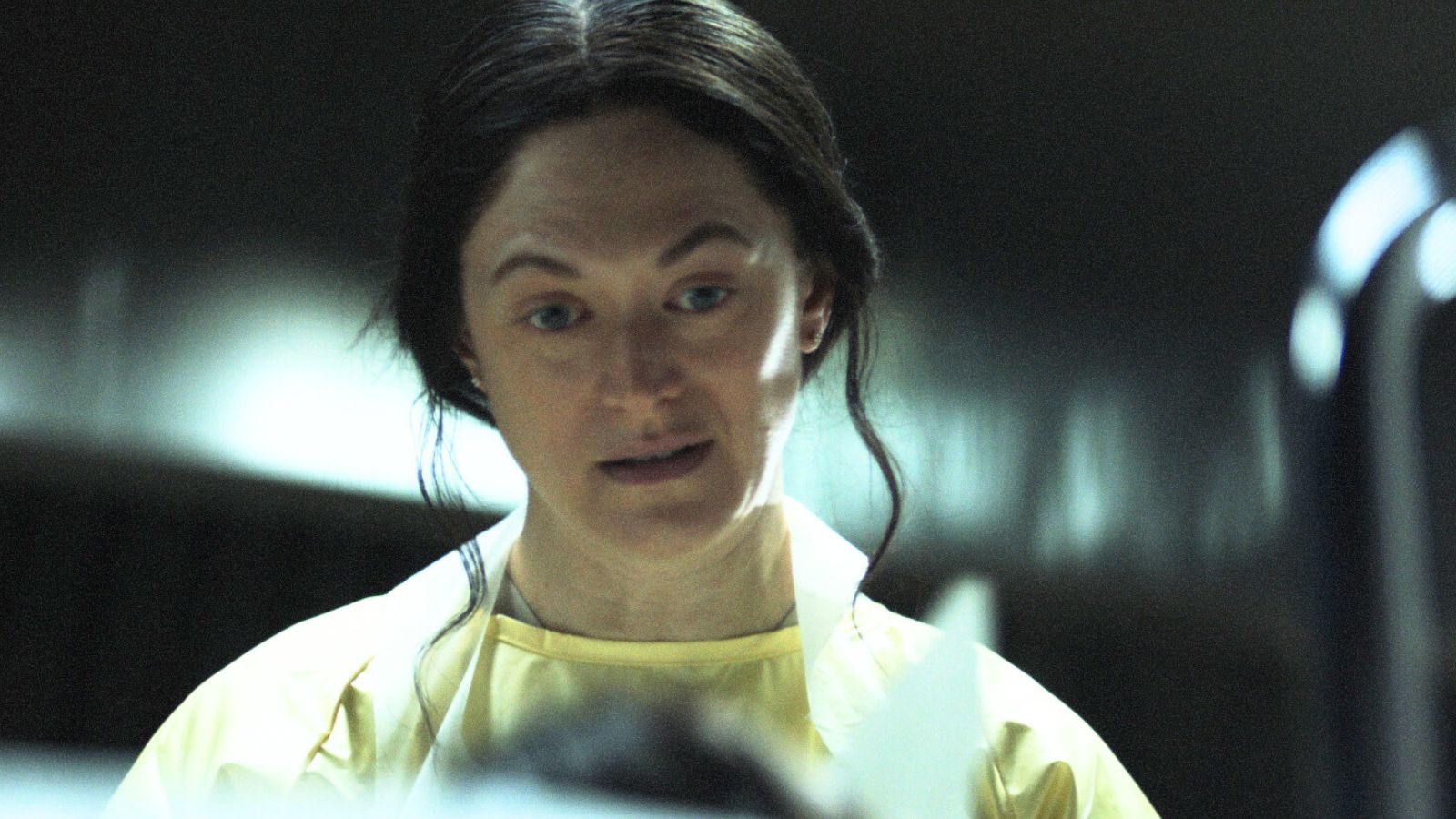
Since the dawn of medicine, doctors and scientists have sought to conquer death in a figurative sense. However, Dr. Rose Casper (Marin Ireland gets an appropriate character name) takes the task literally, working in a morgue and experimenting with cadavers to find ways to reanimate the dead. She’s succeeded with a pig, and is ready to move onto a human test subject. That candidate comes unwittingly from a nurse at the hospital where she works named Celie (Judy Reyes), who tragically loses her five-year-old daughter Lila (A.J. Lister) to meningitis.
Rose finds human reproduction distasteful, but she goes through the biological motions in order to impregnate herself and then abort, using the embryonic stem cells for her experiment. Absconding with Lila’s body, she puts her plan into action, but is tracked down by Celie, who barges in on Rose’s apartment to find her dead daughter alive, though developmentally undeveloped. Between the two of them, they must continue the experiment however they can, which in itself has dire consequences.
I absolutely love the dynamic between Ireland and Reyes, as the former is basically a sociopath while the latter is super empathetic and ethical. They’re a perfect foil for one another. The film also asks poignant questions about the value of life and the lengths some would go to in order to extend it. Lister also does well in a largely physical performance, conveying simple emotions in complex ways to show her growth back into personhood. It’s both inspired and delightfully creepy.
If there’s one complaint I have, it’s in the casting of Judy Reyes. She does quite well, don’t get me wrong. But after Scrubs, are you seriously going to make her play a nurse again? Really? Couldn’t even promote her to a full doctor? I’m just playing around, but I can’t act like that wasn’t in the back of my mind. She even has a line where she argues with Rose by saying something akin to, “I can’t do this on my own,” and my only response was, “Well duh, you’re no Superman.”
Grade: A-
Monica

I mentioned in the last installment that Film Independent’s mandate for diversity could ultimately backfire by having too many entries that fall into certain demographic pigeonholes. Well, much like the documentary Kokomo City, here now is a fictional tale about a trans woman that has a significant amount of its runtime devoted to the fetishization of sex with a woman who still has a penis. The film isn’t all about that, but it’s enough of a presence as to be noticeable.
At its core, Monica is really about coming to terms with your identity and staring anew rather than succumbing to drama and histrionics. The title character, played by Trace Lysette, is on a break from her boyfriend, and is trying to balance giving him space with attempts to reconcile. These somewhat desperate please are put on hold when she’s contacted out of the blue by her sister-in-law, Laura (Emily Browning). The two have never met, as Monica left home when she came out as trans, and she and her brother Paul (Joshua Close) have not spoken since. However, circumstances force the issue, as their mother Eugenia (Patricia Clarkson) suffers from a brain tumor and requires in-home care that Laura and Paul (who have three children, including a baby) can’t handle on their own. Monica makes the trip home to see the woman who turned her away, but who now no longer recognizes her, from a combination of both memory loss and the drastic nature of Monica’s transition. Essentially meeting each other again for the first time, the two form a rapport and learn to respect one another without ever explicitly addressing the elephant in the room.
The film definitely has its high points, mostly due to its empathetic and patient nature in dealing with the central issue, and for the most part, Lysette handles the material well. There are a few areas where it falls a bit short for me, mostly when it comes to Monica’s emotional priorities. Even while she’s watching her mother wait for death, she cares more about her ex-boyfriend or hooking up with random dudes at the bar. She even has a cliché moment where she leaves at the end of the second act because it’s all too much for her to take, only for her to turn right back around after listening to a song in her car. I like the relationship she forms with her niece and nephew, who never even question their new “aunt,” but it gets a bit maudlin in places, particularly a climactic scene where the nephew sings the national anthem for a school pageant. Laying it on just a bit too thick, there.
Still, I liked the honest and frank discussions about what life is like for a trans person coming to terms with themselves in an unsupportive environment. “She didn’t recognize me,” Monica tells Paul after her first meeting with Eugenia. “Did you honestly expect her to?” answers Paul. Between that and a touching exchange about how Paul misses his brother but accepts his sister, the film does on the whole hit the right notes.
Grade: B-
Passages

This film, however, does not. Somehow it has a 94% rating on Rotten Tomatoes, but I’m sorry, I just don’t see it. I’m all for nontraditional romance stories, and I love Ben Whishaw as an actor, but everything else fell absolutely flat for me, particularly our ostensible lead.
Franz Rogowski plays Tomas, an eccentric film director working in Paris on his latest project. After an opening scene where he berates an actor for not walking down the stairs correctly, we cut to a nightclub where he’s celebrating the end of filming with his husband Martin (Whishaw). When Martin goes home to get some sleep (he has his own high-demand work as a graphics designer), Tomas meets a schoolteacher named Agathe (Adèle Exarchopoulos). They hit it off and eventually have sex. This leads Tomas to believe that he is now bisexual instead of gay. Martin is clearly hurt, but he refuses to stand in the way of Tomas’ happiness and experimentation.
The situation leads to a full-on affair, where Tomas impregnates Agathe, finally leading Martin to break off their relationship, as he always wanted a child (either through adoption or surrogacy), and Tomas always refused, yet now he’s knocked up a side piece. He begins sleeping with Amad (Erwan Kepoa Falé), an intellectual writer, and demands that Tomas move his things out of their apartment and give him the keys to their country house so that it can be sold. After Tomas meets Agathe’s parents, he gets second thoughts, goes rushing back to Martin, and proposes a sort of throuple situation where Tomas sleeps with both Martin and Agathe, and all three raise the child together. It works out just as well as you’d imagine.
I can only guess that the critics who loved this movie did so because of Tomas’ character. Rogowski plays him well, but that doesn’t stop me from hating him. Tomas isn’t some dilettante experimenting in different meanings of love. He’s a whiny little bitch who only craves attention and can’t stand it when everyone isn’t fawning over him. The heavy lisp of the character as he vacillates between English, German, and French makes every word out of his mouth utterly grating. Rather than feel sorry for those he uses, I feel nothing but anger at Martin and Agathe for putting up with his nonsense for even a single minute, much less marrying or conceiving a child with him.
I’m sorry. I know I’m in a minority here. But I just found him insufferable. The most unbelievable thing about this entire farce is that two intelligent, emotionally stable people would willingly have vigorous sex with someone so completely unworthy of them. What a waste of great actors and good story potential.
Grade: D
***
That’s all for the Spirit Awards! WOO! Somehow, the busiest part of my year is rapidly approaching its end. I can feel my well-earned nap coming ever closer. Thanks again for taking this journey with me, and I hope that if you saw any of these films, you enjoyed them.
Join the conversation in the comments below! Did you see any of these films? Which was your favorite? Do you think you could be happy writing fortunes for cookies? Let me know! And remember, you can follow me on Twitter (fuck “X”) and YouTube for even more content!


One thought on “Back Row Thoughts – The Spirit Stragglers, Part Four”