
Every year the goal in the leadup to the Oscar Blitz is to see as many films as possible shortlisted by the Academy in various fields. It’s not always possible, but I still make the attempt. Of the 10 categories that get these semifinal treatments, I was able to complete four of them, which is pretty good. The ones I couldn’t do – at least so far – were Makeup & Hairstyling (I don’t have Showtime, so Beau is Afraid fell off), Original Song (because fuck Hunger Games), Documentary Feature (I messed up my chance to see In the Rearview, and since it wasn’t nominated, it’ll probably stay on the festival circuit and be quietly released on streaming a few months from now), and the Shorts (I don’t bother hunting these down because most of the entries aren’t ever publicly available).
When I do clear a list, I make a point in including my rankings for the full set within the category when I break it down during the Blitz itself. For this year that’ll be Original Score, Visual Effects, Sound, and the one that concerns us tonight, International Feature, which I’ll be handling in full on Monday. This is the field that I attack most aggressively, as there are literally dozens of hopefuls that are never obligated to be shown in the United States, so I do my best to get my eyes on as many as possible. There were 88 eligible submissions this year, meaning 73 were left out after the first cut, nearly five out of every six. As such, the odds that you’ll just come across the eventual semifinalists and nominees are far slimmer than for any other contest. I was able to see 38 entrants (would have been 39, but Housekeeping for Beginners got pushed to April when it didn’t get to the shortlist), which is more than I’ve ever done before, and yet it wasn’t even half of the contenders. This is daunting.
As the Blitz rolls along, I as ever provide my opinions and ratings for everything, especially since some of them were nominated for the Independent Spirit Awards. I’ll cover those next weekend, as they cross-pollenate with the Spirit Documentary category as well. But for our purposes tonight, we have four to review. Three of them complete the Academy’s shortlist as planned, before I officially cover the category for the Blitz in a couple of days. The fourth just happened to get released domestically last weekend, and there’s really no other place to put it, so consider it a bonus. We’ve got just a few more stops on our annual world tour, so let’s jet set!
The Monk and the Gun – Bhutan
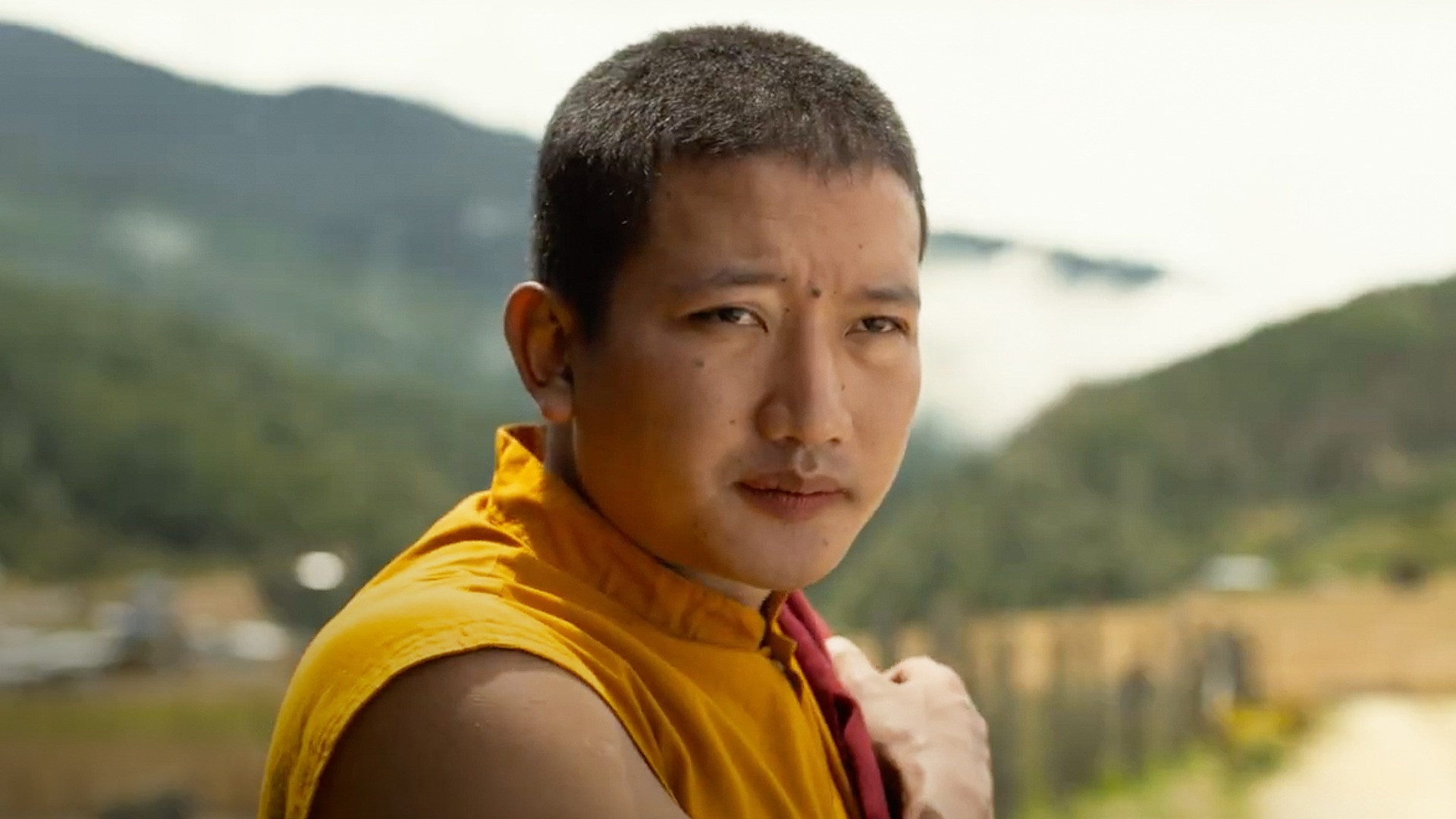
This delightful satire – which is out in theatres right now in a limited release – comes to us from Pawo Choyning Dorji, the filmmaker behind the adorable Lunana: A Yak in the Classroom, Bhutan’s first ever film to be nominated for International Feature. Here he falls one step shy of returning to Academy glory, which is sad, because this film is even better than his impressive debut on the world stage.
Set in 2006, the story takes place in one of the oddest events of the modern era. Bhutan is a very traditionalist Buddhist nation, and one of the last on the planet to modernize with technologies like television and the internet. It is also the world’s youngest democracy, and the only one ever attained without bloodshed, as King Jigma Singye Wangchuck chose to abdicate his absolute monarchy in favor of a constitutional one, including allowing for the possibility that any ruler may be impeached from the throne if the people willed it.
This is where we find ourselves for this lovely farce. All around Bhutan, government officials are holding mock elections, purely for the purpose of educating the public on how they are run. In the rural town of Ura, an administrator named Tshering (Pema Zangmo Sherpa) and her assistant Phurba (Tandin Phubz) are having particular trouble, as the insular residents don’t see the point in having reforms, as they already love their king unreservedly. Still, Tshering presses on, leading to some pretty hilarious bits of irony, including a landslide vote because of the color scheme used for the mock candidates, and Phurba encouraging the citizens – randomly placed on two different sides of the vote for demonstration purposes – to yell at each other in hateful ways because they support a different candidate.
It’s a very silly reflection of how political divisiveness works for the rest of the world, but it has real-life consequences. An apolitical woman named Tshomo (Deki Lhamo), has been recruited to help Tshering liaise with the townspeople and run the mock election. She has no stake in the outcome, but she sees the unsettling effects of their efforts. Her husband Choephel (Choeying Jatsho) supports a possible opposition candidate, and because of that their daughter Yuphel (Yuphel Lhendup Selden) is bullied by loyalists to the entrenched councilmember, calling them “traitors.” As funny as some of these moments are, they can turn dark very quickly, a key warning to the viewer.
Meanwhile, up in the mountains, the town lama (Kelsang Choejay, the actual lama of Ura) breaks from a long period of meditation to send his attending monk Tashi (musician Tandin Wangchuk) on a sacred mission. With the change in government approaching, the lama decides that the moment should be met by them to ensure that the people do not go astray, and tasks Tashi to return to him in two days’ time with two guns. The central mystery of the film lies in what any Buddhist religious leader would want or need with such weaponry, and how anyone could get it in a country so cut off from the rest of the world.
The answer comes in the form of an American named Ron (an excellent Henry Einhorn), a collector of firearms, who has travelled to Ura after learning that one of the locals has somehow come into possession of an old rifle from the American Civil War. Working with a fixer named Benji (Tandin Sonam), they arrange a private sale of the rifle, with Ron taken aback by the fact that his offer is actually too high and considered something of a karmic imbalance. A sale is agreed, with Benji and Ron leaving for a city two hours away to get the money. When they return the next day, they learn that the gun has been given to Tashi as a religious offering, so now, in truly absurd fashion, Ron and Benji have to haggle with a monk who has no need for money or material goods in order to secure the gun that Tashi only keeps for his master for some unknown motive.
The convergence of the three story threads, including their eventual resolution, is pretty perfect, tinged with ironic good humor against a cathartic moral. There are simple lessons to be learned about materialism, modernization for its own sake, and the silliness an outside observer might detect in aspects of our lives that we’ve always taken for granted. Ultimately, the proper path is one that leads to happiness and serenity, however one manages to get there, and Dorji gets that across through clever writing, solid performances, and absolutely gorgeous cinematography that makes Bhutan look like Heaven on Earth. See this if you possibly can. It will put a huge grin on your face, fading only when you realize this should have easily been one of the final five nominees.
Grade: A
The Mother of All Lies – Morocco

We’ve had a lot of heavy foreign documentaries this year about the societal ills of the Middle East and North Africa, from the beautiful Four Daughters, to Rojek, to Palestine’s entry, Bye Bye Tiberias (which I’ll get to in the Spirit breakdown next week). Morocco’s salvo, The Mother of All Lies, adds another crucial perspective to this collective healing process. The feature debut for Asmae El Moudir, the film is hard-hitting, sympathetic, and brutally honest.
Taking eight years to complete, the project began with a simple question – why are there no photos in her house? Learning that her domineering grandmother Zahra forbade all forms of photography and artwork for years (save a single portrait of the late King Hassan II), the simple act of withholding information drove El Moudir to reconstruct the formative events of her life, as well as that of her family and neighbors, going back to before she was even born. She opened an art studio with her father Mohamed, and began constructing massive dioramas of her Casablanca neighborhood and its residents, recreating several experiences of protest and rebellion, starting with her first true disobedience – going to a photo studio to have her picture taken for the first time, a treasure she hid under her bed for years.
As Asmae’s parents (Mohamed and Ouardia), family friends (Abdallah and Said), and eventually Zahra herself observe and interact with the process, memories surface of a shameful act of repression, the 1981 so-called “Bread Riots,” where sharp increases in food prices led to protests in poorer neighborhoods, answered by extreme violence from the government, where hundreds were killed in the streets and thousands were imprisoned. In a particularly poignant scene, Said uses a miniature of himself in the setting of a jail cell to demonstrate the torture he underwent, watching as acquaintances suffocated in the overly cramped room, begging for his own death rather than endure more, and to this day still not knowing why he was arrested in the first place.
The core of the film, however, is in the relationship between Asmae and Zahra. The old woman is shown to be curt, demanding, and downright cruel at times. For example, when she sees her own miniature, she calls it ugly and deformed, and orders it to be made again. When an artist comes in to draw an outline on a glass surface as a reference portrait, she angrily shoos him out of the room and smashes the glass with her cane.
Still, as we learn, she is to be pitied. She comes by her ways honestly, because she has seen with her own eyes the worst that humanity has to offer, and knows all too well the consequences of speaking truth when the walls have ears. When asked about the death of a young neighbor girl (the full story of her fate is tragic in the extreme, I had to suppress sobs while watching), Zahra hastily makes a motion to zip her lips and scold Asmae for even bringing it up. It isn’t that she doesn’t care. If anything, she feels the pain of this history infinitely more than the others. She chastises them for their own safety, ever worried that one slip could be the end of them. The others talk of an act of heroism she committed during the riots, shepherding people back into their homes and ordering them to close all doors and windows, because she saw a mentally disabled neighbor shot dead just for poking his head outside. She’ll never acknowledge the lives she saved, however, dismissing it as just telling people to stay inside because it was too dangerous; no point in going outside and causing trouble. So many would be dead without her, but she’d rather suffer their hatred in silence for being an angry crone than see any of them harmed. The emotional core between her and Asmae is exemplified by an argument where Zahra insists that Asmae refer to herself as a “journalist” rather than a “director” or “filmmaker,” because artists can be arrested and disappeared, whereas the press have more leeway to challenge authority.
The beauty of it all is not that there are no pictures because Zahra is awful, but because visual reminders of all she has endured are simply too much to bear. In that respect, she is both hero and villain, refusing all admiration for the sake of those she loves. She can be a right cunt, but she knows that it’s for the greater good, including having a caveat that all of the dioramas be destroyed upon completion of the film (which all involved do via ritualistic burning) as a condition for her participation. Future generations can remember her when she’s gone in any manner they want, including photographs and art, but while she still breathes, she’ll fight the small battles to avoid the larger war. Asmae coming to understand and respect this, even when she vehemently disagrees, is why this movie is so crucial.
Grade: A-
Tótem – Mexico
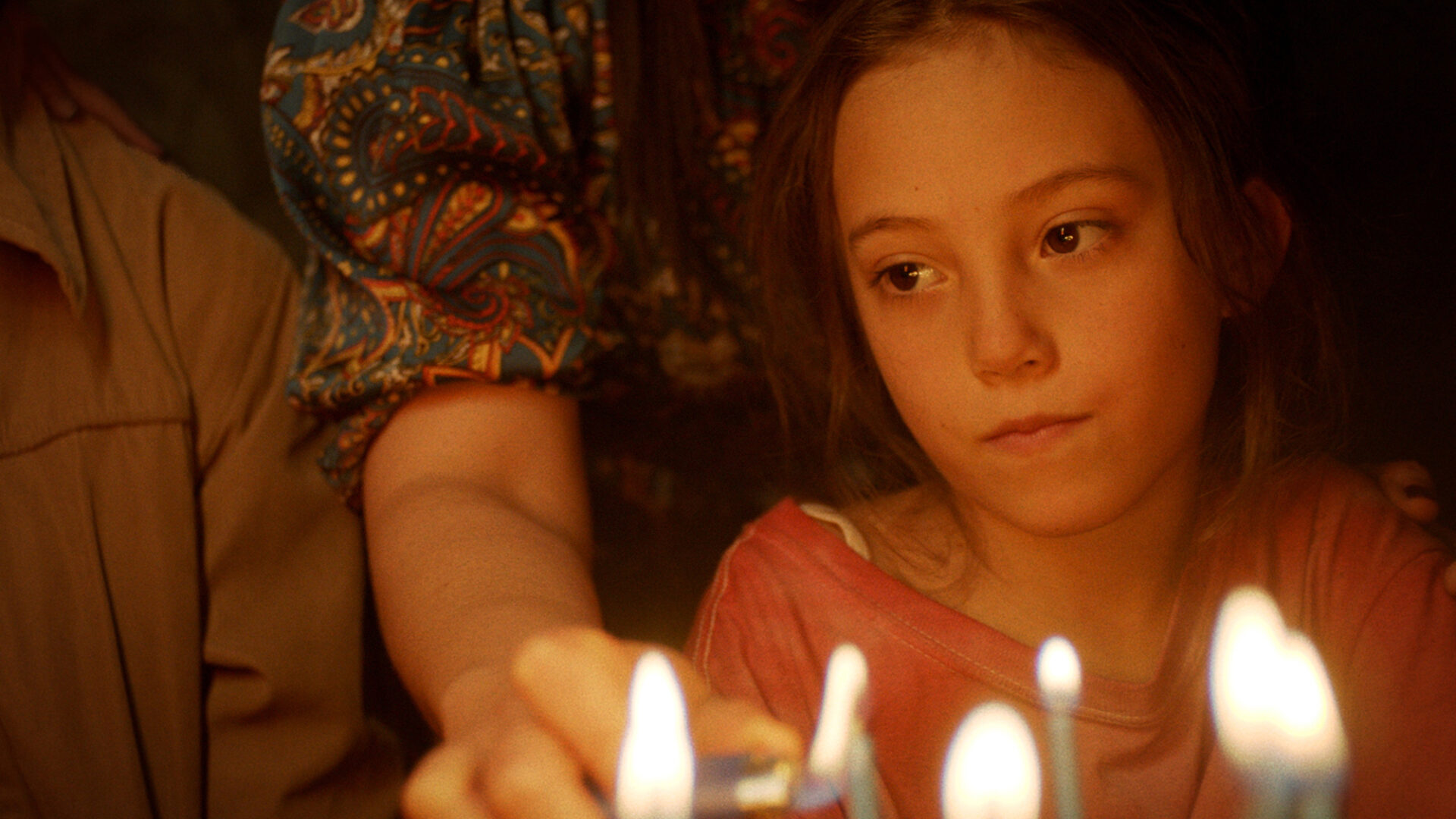
Available in theatres starting this weekend, the second feature from director Lila Avilés (her 2018 debut, The Chambermaid, was also submitted by Mexico, but didn’t make the shortlist), Tótem, is another entry this year that shows a lot of promise, but ultimately would have, in my opinion, worked better as a short, as there’s just not enough story to pad out to 100 minutes. It’s a slow, emotional piece, filled with intriguing characters, but this is one of those films where so much happens without anything happening at all, and while the payoff is excellent, it isn’t quite worth the wait.
A young girl named Sol (Naima Senties) is taken to the home of her grandfather Roberto (Alberto Amador), but she’s not there to see him. Instead, this is the gathering place for a birthday party for her father, Tona (Mateo Garcia Elizondo). Sol hasn’t seem him in weeks, because he’s terribly sick, likely dying of cancer, which has recently just taken Sol’s grandmother as well. While Tona works up the strength to make an appearance thanks to his visiting nurse, Cruz (Teresita Sánchez), Sol’s aunts, played by Montserrat Marañón and Marisol Gasé, work to clean up the house to prepare for guests, and she plays with her cousin Esther (Saori Gurza). Various strong personalities filter in and out of the house as the evening approaches, all leading to the tearful reunion of Sol, Tona, and his wife Lucia (Iazua Larios), enjoying one last great family moment before what looks to be the inevitable.
As it stands, that’s a perfectly fine story. Sol’s family members all have distinct personalities, including a fair few comic relief bits, like a fake psychic coming in to “cleanse” the house of spirits in hopes of healing Tona, who has refused chemotherapy, or Roberto scolding the kids with his electronic voice box. There are also deeply pensive moments, like Sol observing a praying mantis, or putting live snails on the artwork adorning the walls that have been put up in place of Tona’s paintings (by his request). You definitely get the vibe of a big family that fights and loves in equal measure, capped off by a tear-jerking denouement for Sol at the party.
The problem is, there’s just too much running around in circles waiting for the party to begin, and then getting to that eventual emotional climax. We have at least three separate lengthy scenes that take place in bathrooms and sink areas just so people can use the facilities, for example. The movie begins with Sol sitting on a public toilet unable to drop a deuce, only for Lucia to get impatient and pee in the sink while even more impatient people outside bang on the door for them to get out. Esther and her mom Alejandra (Gasé) take a long shower while Sol watches, again from the toilet. Sol later helps Aunt Nuri (Marañón) dye her hair in the kitchen. Why are we wasting so much time on this? There’s no story purpose, and none of these scenes develop the characters in any way, but they go on for 5-10 minutes at a time. Unless the idea is to bore the audience senseless so we can sit in annoyed anticipation like Sol, I don’t see the point. The crux of the story is Sol’s desire to see her dad, perhaps for the last time, and his struggle to pull himself together (both physically and emotionally, as he’s ashamed of his emaciated state) so that he can see her as her papi and not as a dying man. That’s all. We could easily cut this film in half and lose none of the impact of that thematic weight.
The cast all give fine enough performances, and Senties shines as Sol (get it?), handling the very heavy situation with a grace that exceeds her short years. But apart from that, there’s not much here. The cinematography is okay, as is the editing, and there are some cute animals (a cat, two dogs, and a parrot). But this is not a film that knows how to keep the audience’s attention apart from a few well-meaning digs between family members, and if you didn’t grow up in a huge family (I sure didn’t, though my ex did, and I’ve observed this reality), that’s not enough to sustain you for the first 70 minutes. This is a noble concept, and where it matters most, Avilés executes it well. I just wish the buildup had more substance to it to justify the runtime.
Grade: B-
The Breaking Ice – Singapore

As long as we’re here, we might as well check one more movie off the list. Singapore’s entry, The Breaking Ice, is the latest effort from Anthony Chen, who has impressed at Sundance and Cannes with works like Drift, Ilo Ilo, and Wet Season. A simple story about three people at a crossroads in their lives, the film is equal parts coming-of-age story and character study, as each of our leads faces awkward moments of introduction (the figurative ice-breaker) with one another, as well as existential decisions about continuing to live (the potential to sink through literal thin ice).
The story is set in Yanji, a Chinese border city near North Korea. There, a lonely but seemingly well-off man named Haofeng (Liu Haoran), attends the wedding of an old school friend. He’s teased for his introverted nature, as well as for owning an expensive watch. Desperate to extricate himself from the social situation (and avoiding calls from a medical service about therapy appointments he’s missed), he goes outside and sees a bus pull up to the hotel where he’s staying. It’s part of a company for Chinese tourists who wish to experience Korean culture without traveling to the peninsula, with a young woman named Nana (Zhou Dongyu of Better Days) leading the group. Finding her cute, he opts to go on a one-day tour, and gets to know her a bit, mostly the fact that she hates her job and puts on a friendly face for the sake of tips.
Along the tour, they stop at a restaurant where Nana’s friend Xiao (Qu Chuxiao) works as a cook. Xiao has clear feelings for Nana, but he sheepishly hides them, thinking he’s not good enough for her. On the way back to the hotel, Haofeng notices that his phone is missing, and goes into a bit of a panic. Nana, taking pity on him, calms him down and invites him out with her and Xiao for the evening. The three become fast friends, each fascinated by the socioeconomic situations of the other, but all realizing that they’re unhappy. They drink so much that Haofeng misses his flight back to Shanghai the next morning, so Nana invites him to stay for a few more days. They even hook up, with Nana temporarily taken aback when Haofeng discovers a scar on her ankle, the result of an injury that ended her dreams of being an Olympic figure skater. Eventually, even though Xiao is hurt by the fact that Nana slept with Haofeng, the friendship wins out, and they engage in some playful shenanigans before deciding on a whim to drive to the Changbai Mountains to see Heaven Lake, in spite of the wintry weather.
There’s an odd maturity and sense of empathy to the way Chen presents these characters. This isn’t a love triangle, because Nana knows Haofeng is just a fling, and while she acknowledges Xiao’s feelings towards her, she doesn’t reciprocate. And for Xiao’s part, as heartbroken as that leaves him, he accepts her right to reject him, and still considers her a dear friend. So many western films would have turned him into a jealous prick, but Chen is more disciplined than that. The moment Xiao comes over to Nana’s place and sees that Haofeng is still there, he puts two and two together, shakes his head briefly, and offers Haofeng a ride to do some sightseeing while Nana gets herself up and in gear.
This is because, deep down, all three deal with insecurities that threaten their own sense of self, and therefore their lives, so such trifles aren’t worth Chen’s time. It’s fitting that they’ve all experienced some sort of setback or trauma, and that each has a reckoning where they must decide to keep going, for whatever reason they can find. For Nana, it’s an encounter with a bear where her injury may end up being her salvation. For Haofeng, it’s literally creeping to the edge and being called back by something that matters more. For Xiao, it’s the liberation of knowing his destiny is in his own hands for the first time ever. I’ve said it plenty of times before, but as someone who’s gotten to that dark line and made it back, this sort of stuff really speaks to me.
The only real flaw in the story (apart from never resolving how Haofeng loses his phone in the first place or still has a hotel room to crash at days after he was supposed to leave for Shanghai) is a side plot about a North Korean fugitive (Wei Ruguang). Introduced through “newsposition” during the tour, we learn that he has robbed several convenience stores after escaping North Korea. As we know from the documentary Beyond Utopia, China has an extradition agreement with the Kim regime, so this criminal is being pursued by all local authorities, with the goal of capturing him and returning him to the North, where he will be imprisoned and likely killed.
He never interacts with the main cast, and exists wholly outside of the narrative, even though everyone references him on several occasions. For a second I thought it was Xiao, because with the grainy television footage and dark cutaways to him, they did look quite similar. I thought maybe this was a secret that Nana didn’t know, and maybe Xiao stole Haofeng’s phone or something even more nefarious. But no, once it’s established that Xiao and Nana have known each other for years, and that he can’t possibly be the fugitive, all intrigue associated with him goes away. In the end, he’s just a metaphorical representation of how for many people, no matter how hard they try there is no getting away from their lot in life. It’s an interesting idea, but its integration into this particular story feels a tad clunky.
Once you set that aside, however, this is a very enjoyable tale about people stepping outside of their comfort zones and learning about one another. It’s basic, but really well done. The pathos rings true throughout, and the core performances give us reason to root for the eventual happiness of all three, especially once they’ve come to their own edge and found their way back.
Grade: B
***
That’s all I’ve got for this set. We’ll see how these film stack up with the rest of the International Feature entries – including the five nominees – when I break down the category on Monday. Join me then!
Join the conversation in the comments below! How often do you get a chance to watch foreign films? Which was your favorite of the last year? Who’s coming with me to retire to Bhutan? Let me know! And remember, you can follow me on Twitter (fuck “X”) and YouTube for even more content!

 I Actually Paid To See This