Ten years ago, a monumental film came out that took the world by storm, racking up a ton of Oscar wins, and while it appropriately lost to Spotlight for Best Picture, it remains one of the greatest movies of the 21st Century. I’m speaking of course, about Mad Max: Fury Road, a seminal achievement in visual storytelling and pure cinematic style.
George Miller returns to his most beloved franchise later this year with Furiosa, a prequel story about the breakout character of that film, with Anya Taylor-Joy in the title role. The trailers look absolutely fantastic, and I can’t wait to see it. If Miller can give us something even half as awesome as that freaking fire guitar, it’ll be worth the price of admission.
Why do I bring this movie up now? Well, with the promotional material floating about, it’s been bouncing around in my head for a while now. But more importantly, it’s germane to tonight’s category, Costume Design. See, it was Fury Road that sort of changed the rules for this annual contest. Before its win in 2015, the default for this competition was always period wear. Whether it was early 20th Century gangster outfits or medieval ceremonial garb, the name of the game was creating elegance out of classical paradigms. Until Fury Road took home the gold for its insane dystopian dress, you could only find isolated incidents where period clothing didn’t rule the day, like The Adventures of Priscilla, Queen of the Desert and Star Wars. Yeah, just two instances in the span of 40 years.
But ever since this barrier was shattered, the Academy writ large has opted for eye-catching variety. Fury Road‘s victory was followed up by Fantastic Beasts, providing a magical spin on 1920s looks, and since then we’ve had two wins for each of the Black Panther films (which blended steampunk designs with traditional African aesthetics) and one for Cruella, which despite my disdain for the overall profile still at least had wardrobe choices that grabbed attention. Period pieces still have a place in the conversation, evidenced by recent wins for Phantom Thread, Ma Rainey’s Black Bottom, and Little Women, but the game has certainly changed over the last decade, in large part because of Fury Road. We don’t have to just defer to the prettiest gowns anymore. We can truly judge the creativity involved in making characters leap off the screen.
This year, we have a solid mix of candidates, from the traditional to the twisted, in more ways than one. Some still adhere to the old ways, but there are a few interesting angles within that standard, for the most part. I personally prefer it when a film’s garment district takes a few risks, but when done well, I can be convinced that the tried and true is the proper way to go.
This year’s nominees for Costume Design are…
Barbie – Jacqueline Durran

One of the most accomplished costume designers of all time, you have to think that Jacqueline Durran is the front-runner this time out. It doesn’t even matter that she’s got two wins under her belt (for Little Women and Anna Karenina) from eight previous nominations already, her work in Greta Gerwig’s unconventional adventure is simply fantastic, fit to bursting with memorable wardrobes.
It’s appropriate within context of the film as well, given that Barbie was designed to be a fashion doll. For over 60 years she’s come out with hundreds and thousands of outfits and accessories for young girls to customize her look, so naturally the movie would necessitate a massive catalog of costumes, all based on actual Mattel designs (similar to The Lego Movie, actual examples are flashed on the screen as an in-joke).
But simply having the clothing items isn’t enough. They have to bring out the personalities of the characters wearing them, and Durran’s work excels in this regard. From the opening number where Lizzo sings that “pink goes with everything,” we see how Stereotypical Barbie – along with the vast majority of the other Barbies – mixes and matches different pink patterns to be uniform but still distinct from one another. You can then contrast this with the bulk of the Kens, who wear simple combinations of monochromatic shirts and shorts. Sticking out from the group to a glorious degree are Kate McKinnon’s Weird Barbie, with her all-over-the-place aesthetic, Allan’s conspicuous but still ordinary default outfit, and of course Beach Ken, decked out in his Cobra Kai-esque bandana and Ric Flair fur coat when he leads the hostile takeover of the Kens (to say nothing of the final “I Am Kenough” hoodie).
If there’s one area where the costuming comes up short, it’s with the real world characters. Will Ferrell and the Mattel board wear normal business suits, while Gloria and Sasha don typical suburban garb. Even when they get transported to Barbie Land, they basically just convert to pink jumpsuits.
On the whole though, this is more than forgivable, because while the real world denizens help drive the story, they’re far from the focal point. We pay attention to them only for their plot utility, not for their look. So it’s okay to have them be fairly drab, especially when you’re contrasting it with Barbie and Ken’s matching roller blading outfits and cowboy suits. This was a massive undertaking, and there are very few out there apart from Jacqueline Durran who could have pulled it off.
Killers of the Flower Moon – Jacqueline West
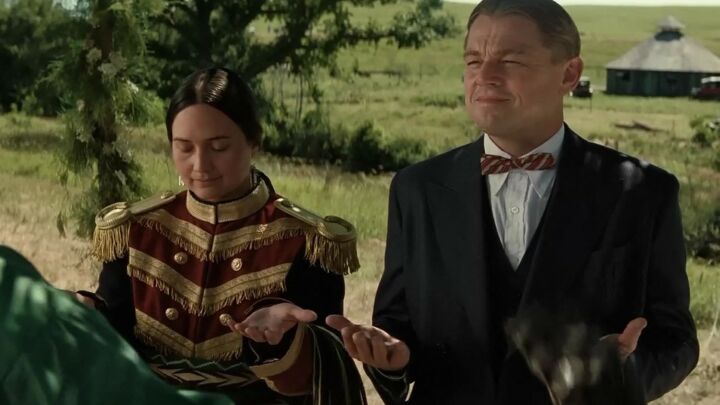
It’s Jacqueline vs. Jacqueline at the top of the category (at least from an alphabetical title perspective), and it’s possible that this one could pull the upset, as this is West’s fifth nomination (the most recent being Dune), but she has yet to win. Her big selling point is the fact that she’s working within the traditional template of period styles, but she’s using it to aid the story and character development.
I mentioned during the Supporting Actor breakdown that one of the best contrasts on screen all year is the look of Robert De Niro in a pristine white suit standing amongst the grieving Osage in their tribal dresses and shawls, all of which have much earthier tones (I told you I’d come back to it). It’s a near-perfect encapsulation of the class and racial warfare at play, done in front of the Osage’s eyes without them being fully aware of what’s going on. As William King Hale, De Niro carries himself with an air of complete superiority, his character believing deep in his heart of hearts that as a white man he is inherently better than the indigenous people, and this is an expert show of that perceived power. The Osage sit, lean, and lie down, overcome with emotion as their friends and family get picked off one by one. Hale, however, stands tall, head and shoulders above them all, looking down on them like the god he thinks he is, gracing them with his benevolent presence, pretending to be their friend as he murders them indiscriminately. He is almost literally a wolf in sheep’s clothing, his bright wardrobe standing out amongst the herd he intends to destroy.
The use of costuming as a visual metaphor extends to Leonardo DiCaprio as Ernest. Initially depicted with a soft brim cap, overalls, and a dirty shirt and pants, Ernest’s wardrobe improves in cost and quality as his relationship with Mollie grows. By the time the plan is hatched to poison her, he’s dressed to the nines in three-piece suits and 10-gallon hats, a tradition that started when Mollie bought him his first one when they began dating. Fittingly, though (pun intended), the hats always look just a bit off on him. Ernest is the first major character that DiCaprio has played who is a fully-functional adult, but just awkward and dumb. His potentially willful ignorance of the plotting going on around him is just the most obvious example, but if you watch the film again, take a look at how the bigger hats sit on his head. They stay in place, but they never quite look right, like they’re just not made for his head. This, I feel, is intentional, a sly declaration that no matter how much he raises his station in life, he’s still a bungling fool.
And of course, we can’t ignore the outfits of the Osage themselves. One of the great side effects of Fury Road blasting open the parameters to judge costuming is that it allowed for much more inclusion of significant cultural looks. We’ve had a few noteworthy standouts here and there (Memoirs of a Geisha, for example), but they were still kept in the context of something glamorous or ethereal, a romanticism of outward appearances. Here, we just get to see how the Osage people dressed a century ago in their daily lives, how they mixed their heritage with what was – at the time – a modern aesthetic. No better is this illustrated than with Mollie and her sisters, who alternately don traditional robes and high-end dresses and suits. Anna notably gets killed while wearing a red flapper dress. It’s a fantastic blend of styles. If you’re going to stick with period dress in your movies and vie for the Oscar, this is one of the better ways to do it.
Napoleon – Janty Yates and Dave Crossman
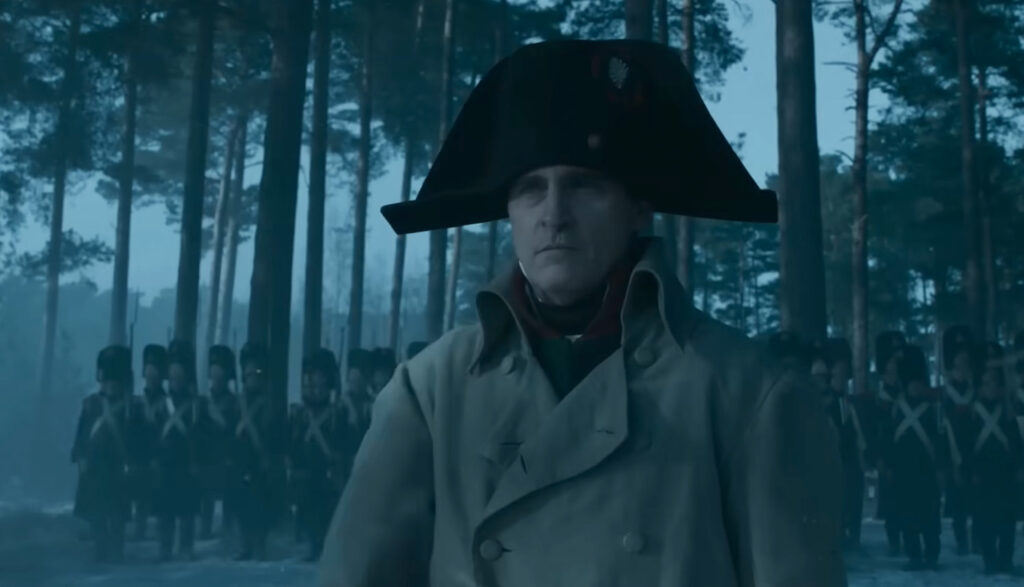
This is the first nomination for Crossman, while Yates has a win from her only previous nod (Gladiator). A frequent collaborator with Ridley Scott, I get the feeling that Yates (and Crossman by extension) will have to settle for the honor of the hat tip, because nothing really stands out here beyond the standard period piece conventions. I honestly wonder if the Costume Designers Branch just needed a fifth entry to round out the category, and decided on this as a sort of legacy nomination for a previous winner who hasn’t been up for the award again in over 20 years.
It’s not that the costumes are bad, per se, just ordinary. The one that stood out the most to me throughout the whole film is the uniform Joaquin Phoenix wears when he executes his takeover of the French government. As he runs out of the room, then huffs and puffs his way back up the stairs to complete his coup, ironically announcing, “Shall we vote?” his outfit contains what appears to be a rendering of the tricolor French flag wrapped around his waist like a belt.
That’s pretty much it. Everything else is just standard issue. The military uniforms, royal robes, court garb, it’s all been done before. Unless we’re trying to make it seem novel that Josephine wore a dress that allowed her to spread her legs, I don’t know what kind of approach we’re going for. I wish I had more to say, but sadly, I don’t. The costumes look just fine, but almost nothing grabs or keeps your attention. I guess I could say that Napoleon’s hat looks stupid, but it looked stupid in real life, so I can’t exactly hold that against the design team. Yeah, this is a nothing burger.
Oppenheimer – Ellen Mirojnick
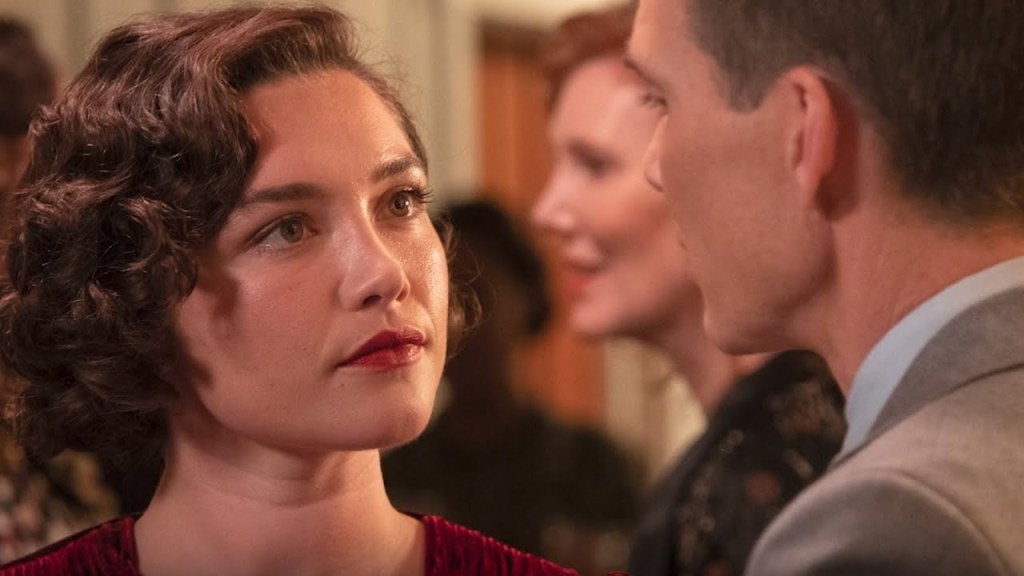
Ellen Mirojnick has waited a long time for her first ever nomination, having worked on major projects since Fatal Attraction back in 1987. If you look at her credit list, it’s quite impressive. I’m genuinely surprised that she wasn’t nominated for The Greatest Showman or Basic Instinct, at least.
Anyway, Mirojnick had kind of a unique challenge for Oppenheimer, as she had to make outfits that would pop in both color and black-and-white photography. The next nominee also dealt with these design schemes, but for Mirojnick, the color palette was much more of a road block. You’re dealing with characters wearing very drab business suits in the 1940s. Even when they’re in full color, the hues are muted, which presents the real conundrum. How to you make outfits that were designed to blend in, stand out?
The answer is that you create situations for them to do so. The pivotal encounter between Oppenheimer and Albert Einstein is instigated in part because Einstein’s hat blows off his head. Lewis Strauss’ suits seem to fit more tightly as the story progresses, as subtle sign that he’s living high on the hog and amassing too much power. This is juxtaposed with Oppenheimer’s gaunt figure looking too thin for his outfits. At several points, especially as the Trinity test approaches and during the security hearing, it looks like his clothes might simply fall off of him. You give Emily Blunt a dark but bright blue dress that’s quite conspicuous in a room full of literal and figurative stuffed shirts. And of course, you take advantage of the scenes where there are no clothes. As much as has been made about the sex scenes, I certainly remember what Florence Pugh and Cillian Murphy were wearing before they were wearing nothing.
Of all the nominees, this was probably the toughest assignment, and Mirojnick pulled it off admirably. I don’t think it’s enough to win, but the nomination is appropriate because she was able to make the everyday wardrobe still seem important in the right moments.
Poor Things – Holly Waddington
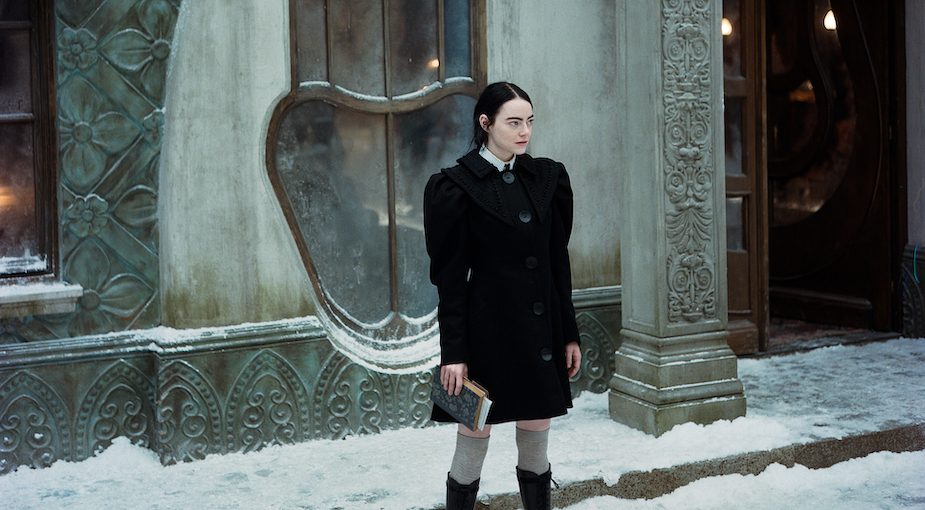
Holly Waddington is the greenest nominee in this field, as Poor Things is only her sixth credit as a full costume designer (though she notably assisted on Lincoln and War Horse). What a way to announce yourself to the world, though! Like Killers, this is another example of a portfolio that takes its cues from traditional period pieces, but puts an exciting and delirious new spin on it.
The costuming in this movie is all about contrasting the main character with the rest of the cast. While Willem Dafoe and Ramy Youssef wear slightly exaggerated suits and lab outfits for their Frankenstein-esque roles, pretty much everyone except Bella is clad in standard Victorian era garb. There are slight variations on the form, like Kathryn Hunter’s tattoos or the somewhat whimsical uniforms of the cruise ship crew, but for the most part, they hew very close to what we’d consider normal for the time.
And then there’s Bella herself. As a supplement to her rapid psychological, behavioral, and intellectual development, her wardrobe is appropriately slapdash at points and downright modern in others. I mean, where else in this era of Europe would you see a woman dancing around in a long skirt and a tank top that revealed her midriff? Bella is a conspicuous person, and her outfits suit that weirdness, rapidly changing and adapting as the character continues to grow at different paces. Initially she’s put in a somewhat apt period dress with large puffy shoulders, but as the film goes on she graduates to more sleek designs and vibrant colors that complement the production design and lighting schemes. She’s an ever-evolving mystery, and so her clothing must evolve in kind. When that’s set against the more uptight designs for Duncan or Max, the difference is night and day. It’s hard to describe, but the best way I can put it is that despite being something of an artificial lifeform, in that she was resurrected postmortem, her wacky stylings are, in their own odd way, the most natural part of her personality.
***
So who gets my imaginary vote? Well, for me it’s down to three. One uses period designs in compelling ways for an ensemble cast. Another breaks the mold for one character in particular while sticking to what works for the others. The third is the best of both worlds, going for broke with a massive group of players. That’s where I make my separation.
My Rankings:
1) Barbie
2) Poor Things
3) Killers of the Flower Moon
4) Oppenheimer
5) Napoleon
Who do you think should win? Vote now in the poll below!
Up next, it’s something for the men! Or at least, it’s something involving five men. It’s Best Actor!
Join the conversation in the comments below! What do you look for in a great set of costumes? Do you prefer period dress? What other films do you think changed the rules on how we judge these categories? Let me know! And remember, you can follow me on Twitter (fuck “X”) and YouTube for even more content!

 I Actually Paid To See This
One thought on “Oscar Blitz 2024 – Costume Design”