
As I write this, there are less than 48 hours until the voting deadline for the Independent Spirit Awards, and I have… seven more films to watch so that I can make as informed a choice as possible. Nothing like waiting until the last minute, eh? I feel like I’m back in high school writing a term paper, only this time I won’t be bullshitting my way through the whole thing, just sacrificing some sleep. I do not shirk my duties!
A few weeks ago, I started a series to look at the publicly-released films that are up for these prizes, with a carveout for foreign entries and documentaries, as their release model is a fluid process. Last week, when talking about the last few films on the Oscars International Feature shortlist, I said I’d resume this weekend with the Spirit nominees that didn’t make the Academy’s cut. So here we are. I had originally planned on this being the last installment in this series, but while I polish off the last few flicks, I might as well get this one up, as it’s ready to go.
To clarify, this isn’t just a post for foreign films. There’s a bit of cross-pollination between two different Spirit categories here. On one side you have Best International Film, and on the other you have Best Documentary. For the former, I’ve covered all but one of the nominees, for the latter, all but two, and one of those was also submitted to the Academy for International Feature. So to save some trouble, I’ll just handle all three entries in this little Venn Diagram. Good? Good. Let’s do it!
Bye Bye Tiberias
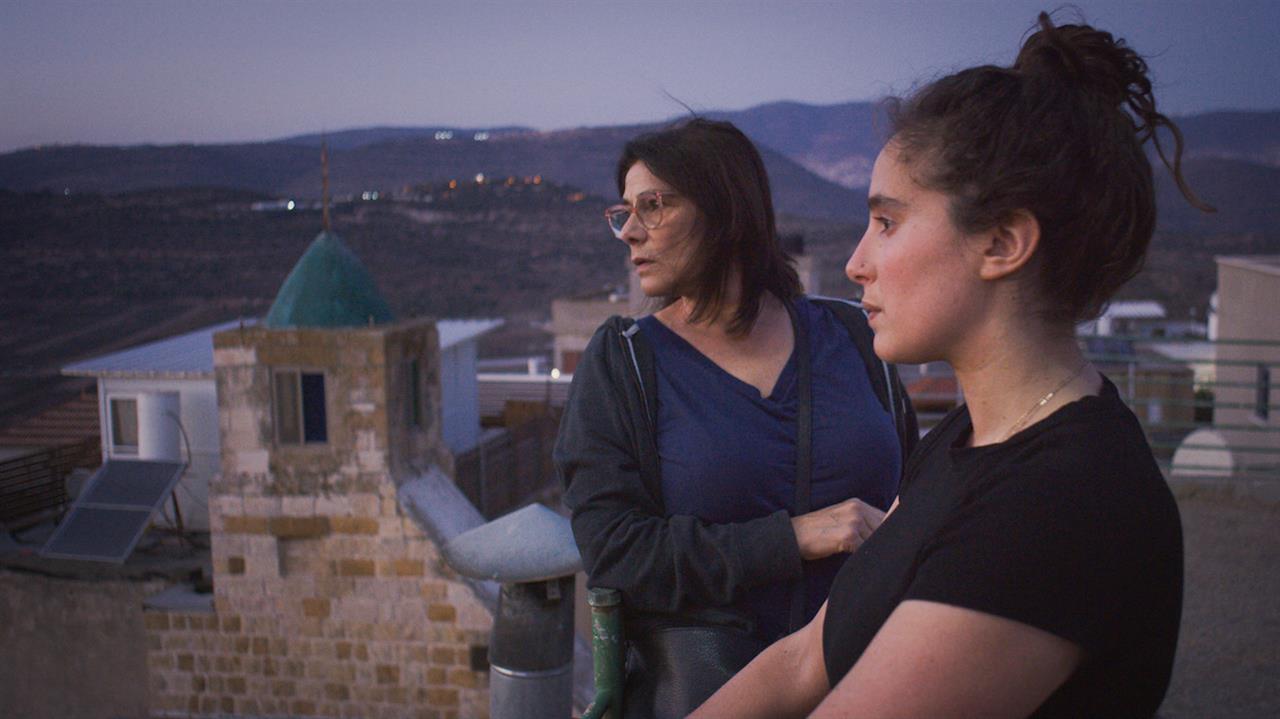
The official submission from Palestine is an intriguing and deeply personal exploration of a family in transition, forced into the open world, and the consequences of all the actions, direct and indirect, that shape their lives. Directed by Lina Soualem and primarily starring her mother, actress Hiam Abbas, there’s a tinge of the current discourse hovering in the background, but really the beauty of the film lies in its deep and intimate introspection.
Tiberias refers to Lake Tiberias in the north of Israel. When Lina was a child, her mother brought her there from France on family vacations, as she had once lived in the nearby village of Deir Hanna. Home videos taken at the time are the only memories Lina has of her cultural homeland, and of her great-grandmother. Hiam, seeking a career in entertainment, left the country for Europe, the first of her extended family to voluntarily depart, and she’s made a good life for herself, but that connection to her roots suffered in the process.
The operative word there is “voluntarily,” as the rest of her kin were not so lucky. As demonstrated through contextual archival footage, personal anecdotes, photos, and home movies, Hiam’s grandmother (Lina’s great-grandmother) was forcibly relocated by British and Israeli forces as part of Operation Hiram in 1948, just one of thousands of displaced Palestinian families as a result of the conflict around Israel’s formalization as a country. Deir Hanna was the ultimate settlement for Hiam’s forebears, leaving the city of Tiberias (and its idyllic lake) behind.
If you think this is a political piece, worry not. The expulsion of Palestinians is merely used for historical context, and there is very little commentary on past and ongoing issues. Honestly, the British get more resentment than anyone else, as they were the ones who directly carried out the evictions in this particular instance. Soualem keeps the story singularly focused on the four generations of women represented in this picture – Hiam, her mother (who actively participates until she can’t), her late grandmother (shown only in personal footage), and Lina herself as the youngest one learning how her family survived and thrived.
This is a loving and heartfelt tale of how we all second-guess the choices we make. Hiam constantly wonders whether or not she did the right thing by moving so far away, pursuing her own ambitions. But as we come to learn, the support is always there because this is a family who has endured so much for their own peace of mind. A story about one of Hiam’s aunts – who fled to Syria and was banned from returning – is of particular note in this regard. The idea of smuggling herself out of one country for safety, and then smuggling herself back in 30 years later just to see the loved ones she had to leave, only for it to be as if she never went away, is touching in the extreme.
I can see why this wasn’t shortlisted. The overall narrative is fairly basic and was covered better in other films, and obviously the Academy didn’t want to be seen as making a political statement endorsing Palestine over Israel given the current situation. But this is worth your time, if nothing else than for its purely uplifting spirit. So many of the documentaries shortlisted by the Academy – and all of the nominees for Documentary Feature – are downright depressing. This would have been an excellent respite, if nothing else.
Grade: B
Mami Wata

Nigeria’s submission, nominated for Best International Film at the Spirits, represents a first for me in the world cinema odyssey. This is the first film I’ve ever seen that essentially uses English as its language, but it’s still eligible in how it’s used. The movie is largely in what’s called West African Pidgin English, basically a hybrid of English words and African tribal syntax, so you can pretty much understand what the characters are saying, but the order and conjugation of certain words comes across differently, adding a cultural nuance that I’ve never before witnessed. This is especially easy to see when the movie cuts to slates for its chapter titles, written out as eventual lines of dialogue on the screen, allowing for instant comprehension.
As for the film itself, it’s beautifully presented, but the plot is too simplistic for my tastes, even though it starts out quite strong. In a small coastal village, the citizens live an intentionally detached, luddite existence, observing ancient traditions and praying to the titular Mami Wata, a water goddess, for their continued serenity. The day to day affairs are run by Mama Efe (Rita Edochie), who serves as a sort of chief, but her official title is “intermediary,” essentially making her Mami Wata’s mortal emissary. She is assisted by Prisca (Evelyn Ily Juhen), who was adopted by Efe as a war orphan, and raises a biological daughter, Zinwe (Uzoamaka Aniunoh), training her to one day take her place.
At first, the story seems to be going down an intriguing road. Zinwe is headstrong and doesn’t believe in Efe’s methods. For example, when a mother loses her child to disease, Efe tells her not to mourn, as we all come from Mami Wata, and the child has simply been called back to her. Zinwe finds this unhelpful and downright distasteful. Now, I agree with Zinwe’s assessment. I mean, no matter how strong your faith is, how are you honestly going to tell a mother who has just experienced the worst thing ever for a parent not to grieve? But the dialogue and characterization are both very strong right from the outset, so when Zinwe leaves, you get the feeling that she’ll go on her own spiritual journey and thus return ready to accept her role, albeit with her own more progressive and empathetic style.
Meanwhile, one day Prisca discovers a man washed up on the shore by the village. His name is Jasper (Emeka Amakeze), and he has somehow survived after being attacked by local warlords who killed his wife. Prisca takes a liking to him, as she came to the village through similar tragedy, and Jasper sees a second chance at life and love, a redemption through this largely untouched slice of paradise.
Both of these plot threads show a lot of potential for intriguing story, enhanced by director C.J. “Fiery” Obasi’s expert use of black-and-white photography and immaculate makeup and costuming. Unfortunately, things go pretty south pretty quick, devolving into tired old tropes about how men are rapacious and evil. While walking in the woods one day, Jasper is summoned over by a man named Jabi (Kelechi Udegbe), a loud and vocal critic of Mama Efe. Every month, people from several neighboring villages come to this one to make an offering of money and their crops to Efe to appease Mami Wata, which Jabi finds foolish, especially when they don’t even have basic modern needs like electricity and hospitals. The death of another local child from a disease preventable by simple vaccines gives him even more cause to plot a hostile takeover. Over a single afternoon and a game of cards, Jabi convinces Jasper to join their side, kill Mama Efe, and annex the village.
I’m sorry, but that’s some bullshit. Nothing established about Jasper in the previous 20 minutes he was on screen even remotely suggests that he’d either a) be so easily tempted back to violence, b) be so instantly duplicitous to those who saved his life, or c) be so gullible as to immediately believe one person’s agenda over another’s after just meeting him. When Mama Efe and Prisca help him recover, he’s grateful for their hospitality, even though he’s skeptical of their beliefs. This takes place over the course of several days, to the point that he’s developed romantic feelings for Prisca, and she even suggests that he could make a home here, whether he subscribes to their mythology or not. But one afternoon of gambling with some misogynistic d-bag, and he’s on board with murder? I don’t buy it.
It’s a shame because everything leading up to this moment is beautiful and poetic. Everything after is just a cheap retread of every lazy “girl power” movie you’ve ever seen, with Zinwe and Prisca joining forces, having a brief wrestling montage, and then totally taking back the entire village even though the men have automatic rifles (somehow Jasper gets in touch with his former arms dealer and gets weapon deliveries despite there being no electricity or phones out here). It ultimately ruins a really promising premise, spiraling to a resolution nowhere near worthy of its amazing production values. This could have been spectacular, but there definitely needed to be about three or four more rewrites to get the story to a satisfying place. The final grade is a reflection of just how great the presentation is, otherwise the narrative shortfalls might have tanked it.
Grade: B
Kokomo City

The only American entry in this set is the final nominee for Best Documentary, Kokomo City, and even then it takes on something of a foreign angle, as it’s about a group of people that might seem completely alien to the average viewer. And depending on where in this country you live, there might be active governmental forces trying to deny their existence. As such, this is a film that’s more about what it represents than what it actually is, and while I can appreciate that larger importance, as a film that you’re meant to just watch, absorb, and enjoy, it’s just okay.
Directed by D. Smith, who in addition to her film work is a Grammy-winning singer, songwriter, and producer, the movie takes a look into the lives of four black transgender sex workers in New York and Georgia (with some asides to Washington, DC and Miami). Born from her own desperation when Smith herself came out as trans, the movie was conceived when she considered turning to sex work herself, wondering what life was actually like for those who did it. Production began while Smith was homeless, filming and editing while riding couches and going in and out of shelters.
Through a series of very frank interviews, Smith shines a spotlight on workers calling themselves Danielle Carter, Dominique Silver, Koko Da Doll, and Liyah Mitchell, obviously all pseudonyms to protect their personal and legal safety. They share myriad anecdotes about how they got into the business, how they’ve promoted themselves, how they’ve been fetishized by men who otherwise identify as straight, and of course, the dangers they face due to their lifestyles, demographics, and vocation. Each of them provides at least one story where a john has either threatened them or been violent with them for one reason or another, most notably the discovery that they aren’t biologically female. In fact, the film is dedicated to one of the four who has sadly not survived this reality.
On the periphery, there are some intriguing interviews with men who engage with these women on one level or another. Some are regular clients, one is a full-on boyfriend to a different trans woman named Rich-Paris, and in a poignant twist, songwriter Michael Carlos Jones, aka “Lo,” talks about a texting relationship he has with a trans woman, where he compartmentalizes and processes his emotions. As he describes it, he loves women, and he developed an attraction to this particular person not knowing they were trans, but falling for her personality, and now he’s coming to grips with his own sexuality, trying to figure out if he can reconcile the emotional from the anatomical.
All of this is fantastic stuff in a larger conversation about trans rights and basic humanity. Smith’s own hardship plays into this metatextual framework, as she was all but blacklisted from the music scene when she came out. She won a Grammy, but the moment she told people that she was a woman in a man’s body, her phone stopped ringing. So bringing in someone like Lo is a great angle, because here’s another person visible in this industry who is willing to talk about his own complicated feelings on the matter rather than just shunning and shaming.
The problem is the actual content of these interviews. I’m not expecting Rhodes Scholar levels of intellectualism, but how many times can these same four women talk about variations on the same subject of how they like to have sex, in barely intelligible slang, peppered with so many n-words that it might as well be a comma? I get the idea of this being more conversational than formal. Smith even said that the camera is positioned in such a way so as to give off the impression that this is just gossip among girlfriends at a sleepover. That’s all well and good. But at some point you have to change the subject, right? At some point it becomes boring and/or gratuitous, right? I know it seems like I’m clutching at straws to find something wrong with this movie, but it really did rub me the wrong way and led to me disengaging with it at times. I can only hear the same story so many times before I roll my eyes and tune out. I was more put off by the casual laughter Liyah has about a client pulling a gun on her before they eventually sleep together than I was at the inevitable image of one of the four leads standing buck naked, complete with fake tits and cock hanging out for the world to see. That’s how overdone some of these talking points were.
The production values leave a bit to be desired, but that’s mostly forgivable when you know the conditions Smith was working under. The lighting’s off, some shots are done with really poor silhouetting, the editing and screen fonts are all over the place, etc. On a more “professional” project, they’d be points worth docking, but again, when you’re homeless, you don’t exactly have the budget for seasoned editors and colorists. It can be annoying at times, but if you turn off that critical part of your brain for this one aspect, you can get past it.
In the end, this is a very important film. It demonstrates in very graphic terms the humanity of a subsection of the populace that many would rather not acknowledge, and it comes in a very dangerous time for them, as one of the leads is tragically no longer with us. The realities and hardships they face must be recognized. It’s not a great film by any means, which is why I grade it below the other two in this post, but it is arguably the most crucial to our ongoing social conversation. That’s worth keeping in mind.
Grade: B-
***
That’s all for this edition. As the Oscar Blitz continues, I have four more planned posts to clear out the remainder of the 2023 film canon. I still have two more posts for Spirit, one more for the rest of the Documentary Feature shortlist, and a final one for the two movies that got nominated that I didn’t see beforehand. And of course, I’ll be continuing regular film coverage for this year as I go. I will sleep someday soon!
Join the conversation in the comments below! Have you seen any of these films? Which one intrigues you the most? Have you ever had the chance to trace back your family history? Let me know! And remember, you can follow me on Twitter (fuck “X”) and YouTube for even more content!

 I Actually Paid To See This
4 thoughts on “Back Row Thoughts – The Spirit Stragglers, Part Two”