
We’re on the cusp of Awards Season, with the end of September and the beginning of October bringing the first major studio hopefuls looking to gobble up hardware. However, there’s still some unfinished business to attend to from last year’s festivities. As previously detailed, I have paid for a membership to Film Independent, which grants me a vote for the Independent Spirit Awards, among other things. As the 2024 ceremony approached, I ran a four–part series here on the blog reviewing the various nominees that got a commercial release during calendar year 2023, as they counted towards that year’s canon. At the end of that, I made note that there were three nominees in the various categories that did not debut to the public last year, and that I would get to them in due course once they finally got their respective runs.
Well, at long last, they’ve all had their go. The first of them, We Grown Now, I’ve already taken care of in a different column, but for the longest time there were still two outstanding. And now, it’s finally time to give them their moment in this miniscule spotlight. Both of these features have not only had their theatrical runs, but are now also available to rent or buy on various VOD services, so if you have any interest, nothing is standing in your way. So with 2024 almost 3/4 of the way over, it’s time to get to the last vestiges of 2023, because I’m nothing if not punctual.
Chronicles of a Wandering Saint
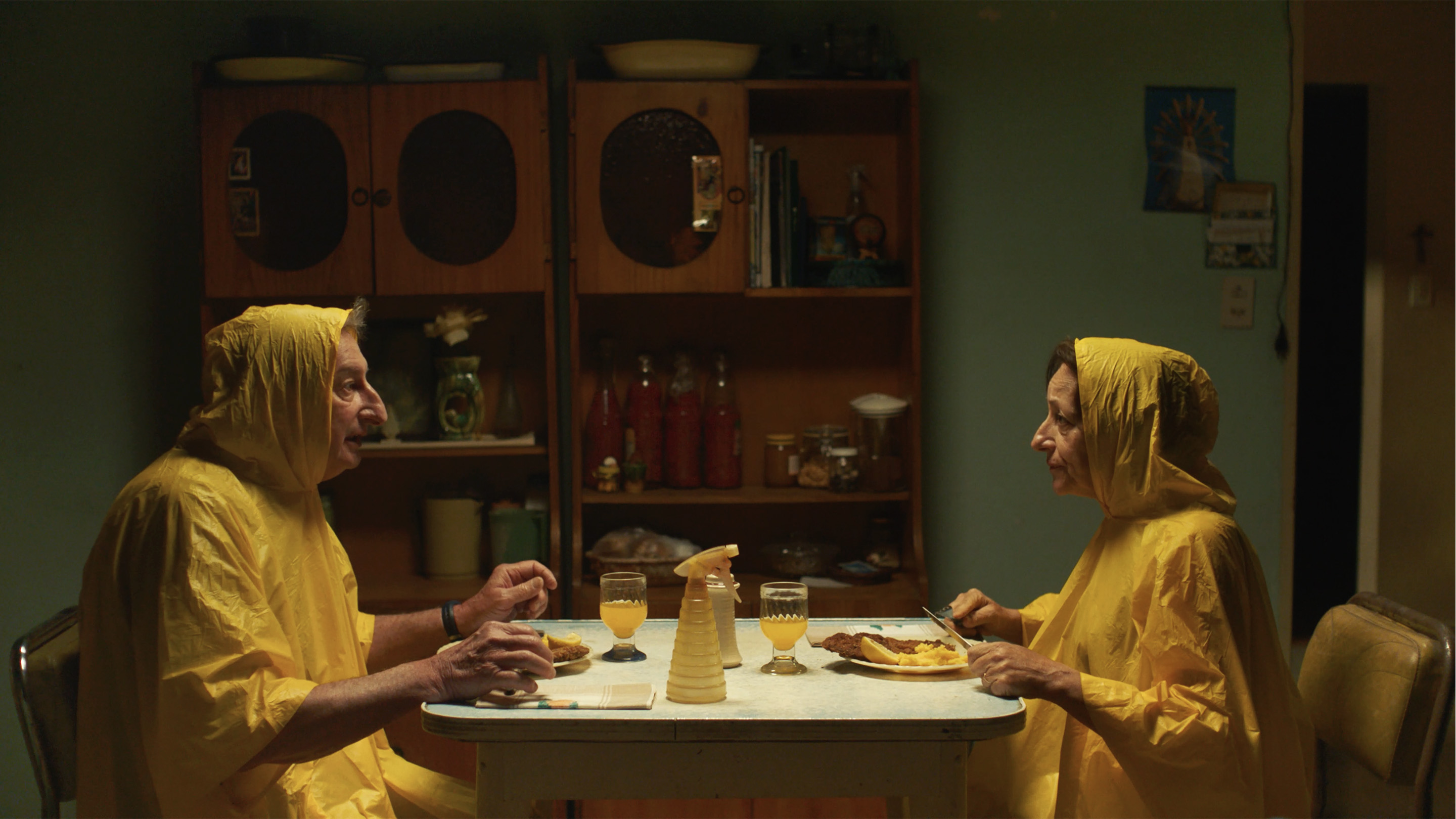
Of all the films nominated this year, Chronicles of a Wandering Saint was the one I was most worried about never getting to review. It’s an Argentine movie, and when the home country doesn’t submit it for the Oscars, it can be a bit of a crapshoot as to whether or not it gets released here in the States. Thankfully it did, and while it’s by no means the best flick I’ve seen in the past year, it’s a far sight better than what Argentina actually did enter, and it deserves your time if nothing else than for its dark humor and refreshing moral.
Written and directed by Tomás Gómez Bustillo (who was doubly nominated for Best First Feature and Best First Screenplay; the Cinematography also got a nod), the picture is a relatively small and intimate affair focusing on appreciating the little things in life rather than succumbing to the folly of misplaced priorities. In a small village, a woman named Rita (Mónica Villa) lives a simple life with her husband of over 20 years, Norberto (Horacio Marassi). Norberto works overnights, saving every bit of money he can in a secret stash under their mattress so that he can afford to take Rita on a lovely trip one day, and also have enough for a comfortable retirement, as they’re both getting on in years. Rita works as a cleaner at the local church, gossiping with a gaggle of other women about the various goings-on in the town, and trying to stand out as being quite literally holier than them in her piety.
Rita’s chance at local stardom presents itself when she discovers a statue in a disused closet, thinking it might be a long-lost artifact of their town’s patron saint. She does some research and finds, much to her chagrin, that it isn’t the correct objet d’art, noting a few subtle yet crucial differences. Undeterred, she opts to have the statue altered – spending Norberto’s secret savings – so that she can be credited with the “miracle.”
Normally, this would be the moment that I’d get really pissed off at a movie like this. It’s no secret that I’m not religious, but as I will always remind, I’m respectful of all faiths, so long as practitioners don’t try to foist their beliefs or life restrictions onto me. Admittedly, though, it is hard not to mock and deride people like Rita, who are so consumed with their own vanity and pride – literal deadly sins – that they lose sight of the life they actually have in pursuit of the divine. It’s one thing to waste your life, but when that waste affects others, it really grinds my gears. So the fact that Rita would steal from her husband, making his extra work all for naught, just so she can pretend to have done something that gets her closer to the Almighty, made for a decidedly disappointing first act, at least from where I sat.
But then something amazing happened, which I won’t spoil, but it kind of has to be seen to be believed and appreciated. Around the half-hour mark, Rita’s plot takes a turn that you might see coming on the surface, but the execution of its aftermath is inspired. A darkly comic irony turns the entire journey on its head, allowing Rita to see the error of her ways, but redemption doesn’t come in the form of a simple apology. In a really smart narrative decision, Bustillo makes perfectly clear that Rita’s actions have real-life consequences that go beyond her capacity to fix, leaving her with a choice that once again allows her to buck common sense, but this time for selfless reasons, and thankfully, Villa plays it perfectly.
There’s not much that truly surprises me with cinema these days, what with the major studios churning out formulaic IPs and stories like an assembly line. So when I am genuinely shocked at how a plot or character turns, it’s something worth celebrating. As I said, Chronicles of a Wandering Saint is by no means stellar, and if you’re like me that first section will almost certainly irritate you, but the reward for sticking with it is very satisfying, so much so that I hope Bustillo gets a lot more opportunities to tell twisted morality tales.
Grade: B+
Mountains
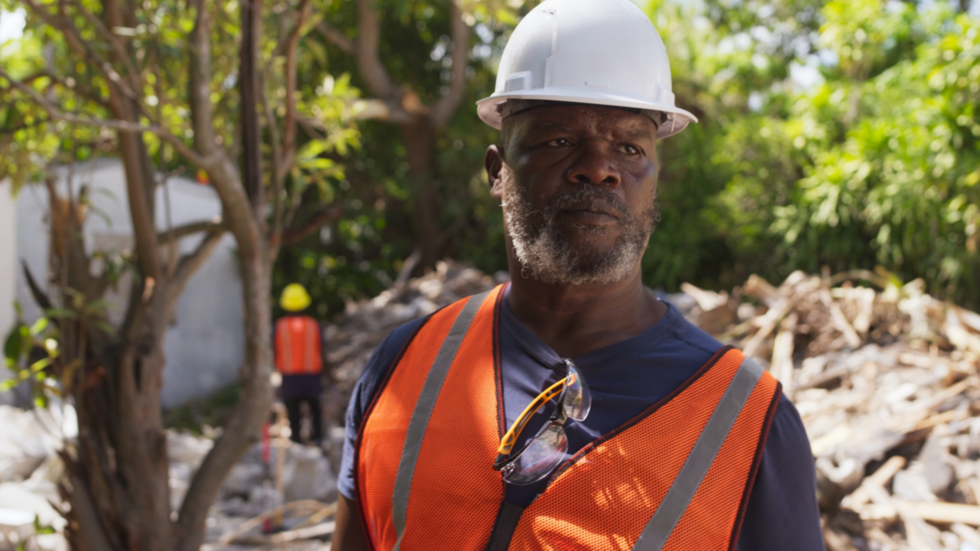
The final entry we have is Mountains, directed by Monica Sorelle in her feature debut, which won her the Someone to Watch Award at the Spirits as well as several special prizes at various festivals. Released in August, this modern spin on a classic story feels all too familiar, and sadly has unintentionally gained poignance since it officially came out. But that’s all the more reason for you to check it out.
Nominated for Best Breakthrough Performance, Atibon Nazaire stars as Xavier, a Haitian immigrant and construction worker living in Miami. He moved to America with his wife, Esperance (Sheila Anozier), and the two have successfully raised a son, Junior (Chris Renois). Xavier, rooted in traditional values, does not approve of Junior dropping out of college to pursue a standup comedy career, nor does he care for the fact that Junior smokes weed. Like many immigrant parents, he and Esperance have sacrificed much to give their child a chance at a much better life than they had, and in Xavier’s mind, Junior is throwing it away on nothing. For what it’s worth, though, Junior’s routine is pretty funny.
Like Norberto up above, Xavier has spent the last several years squirreling away every dime he can save, as he has always wanted to buy Esperance a house with a craft room. They live in a very tiny, cramped home in Miami’s “Little Haiti” neighborhood, and while their needs have always been met, comfort is in short supply. There’s a house around the corner that’s been on the market for a long time, and Xavier wants to put in an offer, but he needs a few more jobs and paychecks before he can make a down payment.
The irony, of course, is that Xavier’s job is to demolish old houses. When older residents die or landlords decide to increase rents to the point that tenants can no longer afford to live there, these properties are essentially abandoned or sold off to high-end developers, who quickly level the modest homes in order to put up newer, far more expensive “luxury” properties, gentrifying the neighborhood. This creates a constant dilemma for Xavier, as his bosses continually harass his coworkers, threatening to have them deported over their immigration status, but he knows he has to play ball and not stick up for his colleagues, in order to get the hours necessary to save for that coveted house, even though the very nature of his job presents a ticking clock, as eventually the wrecking crew might have to come for the very property for which he yearns.
There are elements of A Raisin in the Sun at play here, as Xavier’s entire life has been about “a dream deferred,” and there’s a good generational dichotomy between him and Junior, as the younger is not willing to defer, opting to suffer for his art if it means achieving his goals. There is of course, also the racial/social theme, as Xavier, being more working class and a minority, is objectively valued less than whatever multimillionaire wants to profit off of the basic human need of shelter.
All of this works to great effect, especially because it’s quite realistic. Hell, this is literally happening right next door to me. I’ve lived in Los Angeles for 10 years now, and for the longest time, there was a nice old lady living in a ranch house next to my building. We never interacted much, but the few times we did she was always kind. She passed away last May, and as soon as her survivors emptied our her belongings, the house went on the market. My neighborhood has become increasingly gentrified over the last decade, with several new buildings being put up in place of older houses or empty lots, with rents as high as $5,000 per month for two-bedroom apartments in a bid to attract wealthy Silicon Valley types. These projects are noisy, intrusive, damaging (a building behind ours was put up a few years ago, with the crew driving bulldozers full of gravel to the site through a connecting alley, and local traffic kicked those rocks into my windshield and those of anyone else who had to park on the street, for example), unwanted, and ultimately pointless, as several of those units still sit empty.
When my neighbor died, some of the residents of my building – five units, all owned by their respective residents; my roommate is in effect my landlord – basically asked if any of us could put in an offer on the house, if nothing else than to prevent a new construction project like the ones we’ve been seeing for the last 5-7 years. The house was old, and probably needed a good deal of repairs to make it truly comfortable, but it would be a good investment, and worst case scenario, whoever bought it could do what someone across the street did, which is spend $100,000 to renovate the place and then flip it for $1.4 million. It’s shitty that this is a business model in this city, but at least the work would be contained and there would still be an actual house standing. Had I the resources at the time, I might have gone for it.
Well, no one could put together an offer in time, and after the open house, which was just a formality put on by the realtor, a developer overbid the asking price by $500,000 and locked it up. In January, the bulldozers came in, the house was gone in a matter of days, and since then we’ve been subjected to the building of two massive, three-story duplexes. The crew works six days a week, has commandeered pretty much all the parking on the street, and every day a taco truck shows up to cater their lunch, blaring “La Cucaracha” so loudly as it arrives that I’m surprised the entire block hasn’t become a sea of Trump voters. The basic exterior of the two buildings is nearly done (each of the four total townhouses is expected to fetch what the developer paid for the old house or more, resulting in a massive overcrowding and profit), but based on the track record of surrounding projects, it could still be three more years until I can park outside my own home again or comfortably sleep past 8am on a Saturday.
All this is to say that the shit that Xavier goes through in this movie really does happen, but there’s been an unexpected further correlation between Mountains and the real world, and it’s even sadder than the economics of real estate. A week after the film finally got its domestic run, Donald Trump and JD Vance started propagating this horrible, racist, flatly false conspiracy theory that Haitian immigrants in Springfield, OH were stealing people’s pets and eating them. It’s the latest effort to dehumanize not just migrants but basically anyone who isn’t white, rich, and donating to Trump’s campaign/legal defenses. Vance himself has admitted that this story is a lie, but vows to keep perpetuating it in order to generate rage for his and Trump’s base, and unfortunately the strategy has worked. However, instead of garnering votes or supporters in polls, what’s happened is that schools are getting bomb threats, anyone who looks Haitian (read, black) is getting harassed, and even a sitting Congressman (Clay Higgins of Louisiana) gave them the ominous warning to “get out of our country” by January 20, i.e. Inauguration Day. Never mind that the pet eating didn’t happen. Never mind that the Haitians in Springfield (and Xavier in this picture) are here legally. Never mind that they’re making positive contributions to their towns and working hard jobs. The entire Haitian community in Springfield, and the rest of the country, is now singled out as being cannibalistic savages, and therefore “acceptable” targets of violence. What Xavier goes through in Mountains isn’t nearly as extreme as what’s happening in the 24-hour news cycle, but that level of devaluing of human life and dismissal of basic needs in favor of the powerful is on full display.
The film moves at a snail’s pace at times, which is what ultimately prevents this from hitting the 2024 pantheon, but the conflict shown on Nazaire’s face in every scene tells you almost all you need to know about why a story like this is essential. It’s almost poetic that Xavier’s main job at these demolition sites is to water down the rubble once the houses are razed. The practical purpose is to make it easier for the heavy machinery to grip the wreckage and remove it from the site. In metaphorical terms, it demonstrates just how easily someone’s existence can be washed away.
Grade: B
Join the conversation in the comments below! Have you seen either of these films? What about the rest of the Spirit Award nominees? What do you think will get nominated for next year? Let me know! And remember, you can follow me on Twitter (fuck “X”) and subscribe to my YouTube channel for even more content, and check out the entire BTRP Media Network at btrpmedia.com!

 I Actually Paid To See This
One thought on “Back Row Thoughts – The Final Stragglers”