
It’s been just over a week since the Oscar nominations were announced, and the annual Blitz is already in progress. The timeline is extremely tight this year, with only five and a half weeks between the nominee release and the ceremony itself, which as I’ve previously mentioned is the shortest window since the pandemic. Normally I get seven or eight weeks. Not so much here.
That meant that I had to scramble to take in the six titles that I still had to watch as quickly as possible. Six movies isn’t that tall of an order. Without doing tons of research into my archives, I’d wager that I average around four or five needed each year. It’s certainly doable. The difficulty is the lack of lead time, as I need to see everything in a given category before I cover it, and the lack of a proper preparation gap meant that I had to map out my coverage far earlier than I normally plan to, and in turn that meant that I had to cram all my required viewings into the first week of the Blitz campaign.
Thankfully I’ve gotten through it all, and I was even able to finagle a way to do it that left me with some free time down the road. I had to make some tough choices (as you’ll see tomorrow with the February TFINYW column I had to nix doing a “Worst Trailer” video this month for the sake of my own sanity), but on the whole I think I’ll be able to handle this. Of the half dozen films to watch, I’ve already addressed The Substance on its own because I was so blown away by it, and I polished off The Six Triple Eight as part of my Netflix series, which I’ll conclude with one more Animation installment in a couple of weeks. That leaves four more to go over for Blitz purposes, which we’ll do right now. I somehow watched them all over the span of just a few days. Do they all deserve their respective nominations? For the most part, yes, though there is one major exception. With that in mind, let’s keep this machine going and clear out the last few truly necessary entries.
September 5

Directed and co-written by Swiss filmmaker Tim Fehlbaum in only his second English-language film, September 5 was heavily marketed during Awards Season as a potential Best Picture contender. Instead, it only got a token nominations for Original Screenplay, and you could argue that’s a bit of a stretch, as the film is based on real events and real testimony, just not a previously-published work on the subject, which is why it’s not up for Adapted Screenplay instead. Still, while it will be relegated to also-ran status as a result of the pure glut of late year prestige fare, this is genuinely worth your time, and it’s in theatres now, so it’s readily available should you choose to see it.
The movie concerns the shocking tragedy that was the terrorist attack by Black September on the Israeli Olympic team during the 1972 Games in Munich. One of the most infamous events in sporting history, a dozen athletes and coaches were killed, along with several of the attackers, after a day-long hostage situation when members of an extremist group invaded the Olympic Village and captured the apartments where several of Israel’s number were sleeping. In a sad but historic moment for broadcast history, ABC, the American network covering the Games, was able to relay the events to the entire world on live television. This film is about that fateful day from the perspective of those in the booth, which is what distinguishes it from Steven Spielberg’s 2005 film, Munich, which dealt with the aftermath of the attack.
Peter Sarsgaard carries most of the action as Roone Arledge, at the time the president of ABC Sports, who is overseeing the Olympics coverage, making determinations about which events will be covered live via satellite and which will be broadcast on a tape delay, looking for exciting and emotional stories that will appeal to the American audience. Executing his orders are Marvin Bader (Ben Chaplin), the head of operations, and Geoff Mason (John Magaro) heading up the control room. Just before sunrise on September 5, members of the crew hear gunshots from the studio, which is but a few hundred yards from the athletes’ residence. As soon as they get their bearings, it’s all hands on deck to bring the story to the world, with particular help from production aide Gary Slaughter (Daniel Adeosun) smuggling film in and out of the Olympic Village by posing as an athlete, journalist Peter Jennings (Benjamin Walker) reporting from the scene, and translator Marianne Gebhardt (Leonie Benesch from The Teachers’ Lounge) monitoring radio feeds and delivering real-time information, as she speaks both German and Hebrew.
Over the course of the day (the script is very smart in how it compresses the 22-hour ordeal to just 95 minutes), the crew not only has to deal with obstacles to even send a signal, including police interference and rival networks insisting on taking their bought and paid for satellite windows, but they also have to juggle some serious ethical issues, like whether or not to show the people’s faces or to keep the cameras rolling should someone be shot live on the air. They also have to filter contradictory information in order to make sure they’re not putting out false hope or incorrect facts that could worsen the situation. The delicate nuance employed here is really something special.
All of this is done really well, between the performances (great across the board and I could easily have seen a Supporting Actor nod for Magaro), the tight, dark, and claustrophobic setting of the control room, and the genuine fine line that has to be walked in situations like this. Also, just because he was my favorite newsman growing up, Walker does a note-perfect impersonation of Peter Jennings’ voice. Jennings would eventually become the nightly news anchor at ABC, a position he held until he died of lung cancer (he smoked something like three packs a day) in 2005, and network news has never been the same. A lot was rightly made of the likes of Walter Cronkite, Edward R. Murrow, Dan Rather, and Tom Brokaw, but Jennings was the last of the greats, and it felt strangely comforting to hear such a great approximation of his voice (mixed in with archival footage of him and ABC Sports anchor Jim McKay) in such a stressful situation. That was his gift, the ability to remain a calm, soothing voice in the middle of chaos.
These elements alone would make the film great on their own, but from a personal perspective, what really made it shine was in how well Fehlbaum portrayed how a team of professionals in this industry comes together in a crisis. I’ve spent over half my career in active newsrooms, sports environments, and live television in general. As much as people like to shit on “the media,” we’re all just doing our jobs, jobs we’re passionate about, and we know what our roles are in moments like this. I’ve been in situations where the plans just go out the window and everyone has to get on the same page to cover a breaking story. Most of the time, those were really pleasant moments, like a surprise upset win in the World Cup, or an out of nowhere individual performance like Kobe Bryant’s 80-point game (which happened two weeks into my tenure at ESPN, and it was fascinating to watch as a doe-eyed newbie).
But at the same time, I’ve had to cover sad news in the same fashion. I was working at TMZ the day Prince died. The moment we got a newswire that there was an emergency at his residence/studio, everything was put on hold, including the overnight passing of pro wrestling star Chyna. When I went in that morning, Harvey Levin and crew were in the process of filming that day’s show, as they always were. They took a break midway through, as was routine, and the plan was to get back in the middle of the newsroom and film the remainder in a half hour. The wire came down, and Harvey, to his credit, knew instantly what it meant (Prince had been rushed to the ER a few days before, so his radar was already up, but he has a keen instinct about these things from his decades in the business). He called a source in Minneapolis who refused to comment, and that solidified it. If it was anyone other than Prince, the source would have said at least that. We knew the truth right then and there, and every resource was devoted to finding any source who would confirm the story, because for something as big as this, we needed triple-confirmation before breaking it (TMZ has been burned on this front before), and given the nature of entertainment news, the need to be first was paramount. I was working as a researcher at the time, mostly fact-checking and proofreading articles. My job was to monitor a live feed from outside the compound set up by a local news affiliate, to see who went in and out. As I learned, most emergency vehicles in Minnesota just have their department (Fire, Police, Medical, etc.) as their license plate, so I couldn’t get much. Eventually, I saw a civilian plate, wrote down the number, and gave it to a producer who could trace it and get contact info for the owner so they could try to reach out. I don’t know if that turned into a source, but that was my small contribution to the effort. We were not only first to break the story, we beat CNN by 20 minutes, and traffic was so high that it crashed the TMZ website that day.
This is all to say that Fehlbaum absolutely nailed this aspect that might go unnoticed to the casual viewer. The film does have flaws, particularly the way Marianne is dismissed multiple times for being both German and a woman, which just feels tacked on and unnecessary, but where it really counts, it gets it right. Yes, some characters are composites and some events are dramatized for effect, but the core of journalistic integrity and professionalism under pressure was dead on.
Grade: A-
A Different Man
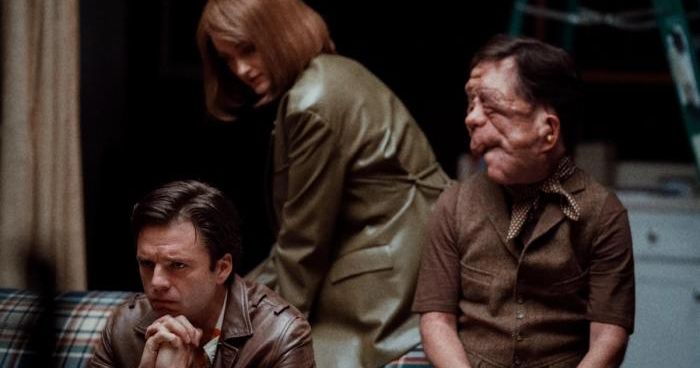
Before I saw The Substance, I would have assumed this would be the morning line favorite for Makeup and Hairstyling without even seeing the movie. When I saw the trailer, I named it the “Redemption Reel” for September because it looked like twisted fun with an absolutely incredible makeup job on Sebastian Stan.
The film is an absurdist take on the idea of self-image and self-worth, and whether beauty really is skin-deep. Stan plays an actor named Edward who has neurofibromatosis, a condition where benign tumors form all over the body, but they can’t be removed and the skin can’t heal. Edward’s case is very severe, as his face is covered in large blemishes that affect his eyesight and speech, and he’s spent his life avoiding the gaze of other people. Despite training at Juilliard, his physical deformities make it so the only work he can get is in workplace sensitivity training videos. Still, he lives a quiet life in New York, and in a fun bit of character-building, he’s trying to learn how to whistle, just for that small degree of normalcy.
Hope quickly comes for Edward in two forms. First, his doctor recommends him for an experimental treatment test group that might be able to remove and heal his tumors. The second is the arrival of his new neighbor, playwright Ingrid (Renate Reinsve from The Worst Person in the World), with whom he forms an instant friendship, as she seems to have no qualms about his physical appearance whatsoever. She’s working on a script for a new play and promises him a part. Things are certainly looking up.
The treatment goes far better than could be imagined, and within months, Edward is completely transformed, looking like the Sebastian Stan we all know and love. However, now that he can present himself to the world, he’s incredibly unsure and afraid, particularly of what Ingrid might think. Using the recent death of another tenant in their building as a pretense, Edward assumes the new identity of “Guy” and leaves the building, claiming that Edward has killed himself, and starts a new life as a charismatic and successful real estate agent.
Some time later, Edward/Guy sees Ingrid in the street and follows her to a small theatre, where she’s holding auditions for her play, called “Edward,” which is essentially about her falling in love with him. He tries out, but does poorly, though he’s able to convince Ingrid to give him the part when he goes a second time, bringing along a rubber mask of his original face. Edward thinks this is a way back into Ingrid’s life, a chance to kindle a romance that he never thought possible, but all that is thrown into disarray with the arrival of Oswald (Adam Pearson, who actually does have neurofibromatosis, and whose most notable role to date was in Under the Skin). Brash, confident, extroverted, and possessed of a joie de vivre that Edward never had in either form, Oswald begins winning everyone over, eventually collaborating with Ingrid to put himself in the play, utterly rewrite it, and eventually cast “Guy” out, driving Edward completely mad, with extreme (but darkly hilarious) consequences.
It’s that last part that’s so crucial from a story perspective. Someone could easily look at the dichotomy between Edward and Oswald as a tacit message that disabled people should just be happy with who they are rather than seeking ways to make their lives more normal, which would be problematic to say the least. But writer-director Aaron Schimberg goes out of his way to show that not only is there no one right answer for anyone in this community, but the whole scenario is thoroughly fucked with silliness and absurdity. It turns out that Ingrid is beyond mercurial and sort of fetishizes Edward and Oswald’s condition, so while Edward certainly doesn’t get his “happily ever after,” there’s a case to be made that he’s better off. Oswald has a boisterous personality, but he’s also kind of a dick, acting like he’s the best friend a man could have, only to take advantage of every opportunity to supplant Edward with a smile on his face. The biggest irony of all, at least from Edward’s perspective, is that once he becomes a “pretty face,” he ends up being rejected because he’s not all that good of an actor, and the fact that he no longer has an overt condition that generates sympathy only further spotlights that he was out of his depth to begin with.
As for the makeup, yeah, it’s spectacular. I’ll go into more detail when I break down the category in a couple weeks, but it’s not just how realistic the prosthetics look to give the impression of Stan’s character having neurofibromatosis, but also the Cronenberg-esque body horror as he loses the tumors. It’s really well done. Will it hold up against The Substance? My gut says no, but that’s in no way meant to denigrate what is some incredible work.
Grade: A
Elton John: Never Too Late
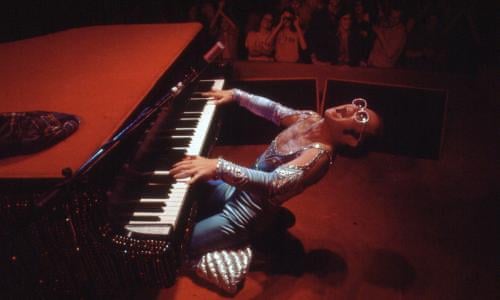
Co-directed by Elton’s husband, David Furnish, Never Too Late is up for Original Song, an ending track duet with Brandi Carlile that provides the film’s subtitle. Available on Disney+, the movie is a pretty standard music biography documentary that offers little in the way of surprises or new information for fans. At best, I’d say it’s a good entry point for those who want to learn about Elton, but as a lifelong die-hard, this didn’t offer much for me.
The film chronicles the “Farewell Yellow Brick Road” Tour from 2022, the last live shows that Elton John performed before entering a state of semi-retirement. Beginning in New Orleans and concluding with his final show at Dodger Stadium – where he had one of his most triumphant moments in his early career – the tour is used as a backdrop for a retrospective on Elton’s career and emotional journey, using a combination of archive footage, interviews with a journalist co-writing his memoir, candid moments with David and their sons Zachary and Elijah, and a few animated segments.
If you’re new to Elton’s music, there’s some fascinating stuff here, like how he grew up, met songwriting partner Bernie Taupin, changed his name, became a star, got addicted to drugs, got clean, and came out about his sexuality. If you’ve never studied his life or his catalog, there’s a lot to learn. If you’re even a casual fan, however, you’ll realize that you get more information and excitement from the fictional Rocketman movie, because none of this is new to you. The only segment that I hadn’t seen in some form before was about his friendship with John Lennon and their collaboration on “Whatever Gets You thru the Night.” That kicked ass.
The biggest sin this movie creates is in whiplashing the audience between the past and near-present, zipping between 2022 and various years in the 60s and 70s. That’s distracting enough on its own, but then it just sort of stops around 1978. We get nothing from his career in the 80s, nothing about his film and theatre work in the 90s, nothing about Princess Diana, nothing about his failed marriage as a means to present as heterosexual. Half his career is just left off for no discernible reason, but we can devote 10 minutes to the awful Dua Lipa club track “Cold Heart” that remixes some of his classics (mostly “Rocket Man” and “Sacrifice”) into a mess of EDM noise.
Essentially, the film is incomplete. I’ve been listening to Elton’s music and following his career my entire life. This barely scratches the surface, and it doesn’t have any solid structure that would explain why. As to the nominated title song? It’s inoffensive, but exceedingly basic. Unlike his Oscar-winning “I’m Gonna Love Me Again,” which had the feel of some of his best work, this comes off like the lesser, moodier stuff of the early 2000s like “This Train Don’t Stop There Anymore,” though with more positive lyrics. That song (with Justin Timberlake playing Elton in the video) and the entire Songs from the West Coast album, was subpar, so I don’t know why Elton, Bernie, and Brandi decided to go that route. If it wins, I won’t be angry. This is an historically weak year for Original Song, after all. But it’s far from his pantheon. You could easily say the same thing about this movie, which isn’t bad, just entry-level, and sort of boring, kind of an off note to go out on. At the same time, he’s Elton fucking John. He’s more than earned the right to bow out however he chooses, and I, along with millions of others, will still love him forever.
Grade: B-
Sing Sing

Finally tonight we have Sing Sing, one of the few contenders this year that didn’t come out during Awards Season. It was released normally in July, though with little fanfare, and its successful hardware campaign has resulted in a theatrical second run. It’s up for Best Actor, Adapted Screenplay, and Original Song, though curiously not Best Picture.
This is one of those films that’s entirely enjoyable and satisfying, while also feeling just a bit too familiar. It doesn’t get to you that often, but if you watch movies with a critical mindset (meaning the ability to think on a meta level, not going in with the intent to judge), you’ll definitely see the roots and influences from works like The Shawshank Redemption, Lean on Me, and several others.
Colman Domingo reminds everyone why he’s a perennial contender for Best Actor with his performance as John “Divine G” Whitfield, an inmate at Sing Sing prison, convicted of a crime he might not have committed (the real Divine G cameos early on). He’s up for parole soon, and has learned of evidence that might exonerate him completely. In the meantime, he finds his peace of mind through the Rehabilitation Through the Arts program, or RTA, where he and other prisoners put on plays as a form of therapy and behavioral restructuring. Whitfield has even taken to writing his own material, hoping to make a living in theatre once he’s out. He’s aided in this by Brent Buell (Paul Raci), who serves as director for the program within Sing Sing’s walls.
The rest of the cast is made up of former prisoners who took part in the RTA during their time inside. The main ones for this story are “Mike Mike” (Sean San José), and Clarence “Divine Eye” Maclin, playing himself. Maclin is a new recruit to the program, an aggressive drug dealer with a threatening personality. He likes to “perform” as he intimidates other inmates to get him money and contraband, so he’s interested in acting for real. He immediately clashes with Divine G, convincing the group that they should put on a comedy show rather than the dramas they normally do, only to then audition for – and secure – the one dramatic role in the production over Divine G. The two do finally form a Red/Andy rapport as G takes him under his wing and shows him the value of the work, even if some of the exercises might seem silly in the moment.
The story itself is rather formulaic, and you’ll see hints of several other underdog stories, from Stand and Deliver to Mr. Holland’s Opus, which focus on mentor/mentee relationships and the value of art and music in making a better world. The only major difference is that this takes place in prison rather than high school. But this rises up from its peers because of how earnest the performances are. Domingo is a force of nature as always, and Raci and Maclin are both terrific. Just like John Magaro and Adam Pearson, I wouldn’t have scoffed for even a second if either had been nominated for Supporting Actor. And while the pathos is laid on pretty thick, you can’t help but love how genuine and committed the performances are from this ensemble of men who have literally turned their lives around thanks to this program. Yes, it’s all very familiar, but when it’s in service of something so completely positive and good for the world, you’ve got no choice but to endorse it. I was enthralled watching this, warts and all, and I wish that every run-of-the-mill inspirational story could be this dedicated to something true.
Grade: B+
***
That’s all for this edition. Tomorrow is the February TFINYW column, and then come Monday, the Blitz is back in full force. I still have several films in the backlog between the Documentary, Animated, and International Feature categories to clear off, but as far as new material is concerned, everything from here on out is 100% optional. Exhale.
Join the conversation in the comments below! Have you seen these films? Which was your favorite? Are they deserving of their respective Oscar nominations? Let me know! And remember, you can follow me on Twitter (fuck “X”) as well as Bluesky, and subscribe to my YouTube channel for even more content, and check out the entire BTRP Media Network at btrpmedia.com!

 I Actually Paid To See This
3 thoughts on “Back Row Thoughts – A Compressed Blitz”