
Tomorrow is my birthday, so this weekend I decided I would celebrate a little bit by returning to the multiplex. Despite my financial woes, it is still my goal to stay as far ahead of the potential slate for next year’s Animated Feature contest as possible. Also, in a bit of good news, I finally have secured a new job. It starts next week, and it is certainly NOT what I wanted or even would have considered six months ago, but it appears to be stable, with decent pay, so maybe, just maybe, I can crawl out of the hole that the universe has dug for me over the last year, and that includes being able to regularly go to the movies again. So why not? Let’s watch some goddamn cartoons!
Originally, the plan was to watch two films over the course of this weekend. The first was a VERY limited release entry that played at the Annecy Film Festival and had its qualifying run last week. The closest theatre showing it was over 20 miles away, and my gas budget didn’t really allow for it, especially if I was going to do anything else. Thankfully, the Laemmle chain, as part of its “Culture Vulture” series, decided to bring it in for a single presentation each day over the course of Saturday-Monday. The other required a trip up to Glendale (another 20+ miles), as the specific Laemmle location there is typically the one where indie animation gets its eligibility. Sometimes the distributors go for the Encino location or Santa Monica (which is the one closest to me), but the vast majority go to Glendale. If you’re not a Los Angeles local, this geography likely means nothing to you, but even in the best of times it’s a consideration I have to factor in. Driving to Glendale takes a half hour on the freeways when there’s no traffic. When there’s actual congestion, it could be triple that.
So originally, the goal was to go to Glendale yesterday, and then Santa Monica for the one-show flick either today or tomorrow. Then it just happened that I woke up at 7:30 am yesterday. The one-off show was at 10:00 am, and the first show for the picture at Glendale was 12:50. So I decided, screw it, I’ll do both. I drive to SaMo, watch that one, then go to Glendale for the other. And then I thought, Oh yeah, there’s also a new animated film on Netflix that I can take in. Triple feature, baby! As I left Glendale, I remembered that there was one more theatrical toon out right now, one that I actually skipped, as it would surely be on streaming soon. Just for shiggles, I checked the showtimes, and sonofabitch, it lined up. I could head home, get a quick lunch, and make this a four-banger! I normally only do that when I’m marathoning AFI Fest. Well guess what? This is B-FI Fest (Bill Feels Invigorated), so let’s go!
Yeah, I took in four animated films yesterday in a completely unexpected 15-hour dash. Almost certainly, all four of these will be submitted to the Academy later this fall, so this complete bit of randomness actually helps me stay on track. There are several more releases coming in the final third of the year (including a re-release of Ne Zha 2 for the English dub if you’re so inclined), and any leg up is more than appreciated. So as I complete another lap around the sun, it only feels appropriate to batch all the reviews for this experience together. We’ll go in the order I viewed them.
Hola Frida
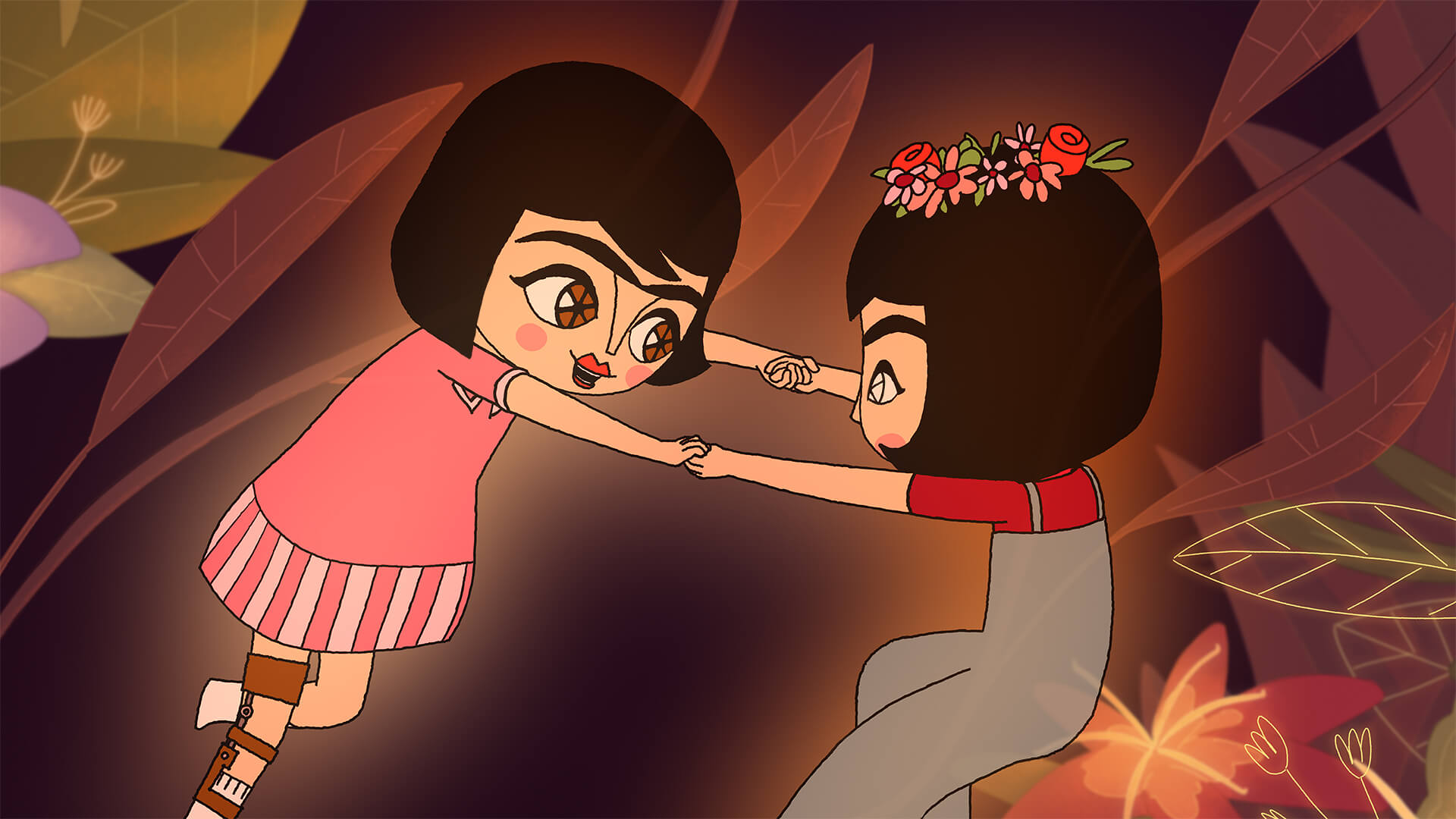
Frida Kahlo is one of the greatest artists of the modern age, and her life story is ripe for cinema. Salma Hayek got an Oscar nomination for the 2002 dramatization Frida, and the 2024 documentary of the same name was shortlisted by the Academy. I didn’t care all that much for the doc – it was fine but kind of boring for such a vibrant person – but I’ve really enjoyed the recent surge in her popularity as her legend becomes more mainstream.
A co-production of several countries and presented in both French and English, the animated Hola Frida is a delightful look at Kahlo’s artistry through very simple, very relatable children’s plotting. Mostly set in Kahlo’s early years and focusing on her family life and learning her love of painting, the film teaches solid lessons about inclusion and empathy while exposing the kids in the audience to some really fantastic designs and color schemes.
The story begins when Frida is about six or seven years old. She lives in Mexico City with her little sister Cristina, mother Matilde, and father Guillermo, the latter of whom works as a photographer. Frida is precocious and adventurous, and loves drawing pictures to show her class, highlighted by her best friend Tonito and rival Rafael, who’s bitter and moody after the death of his father, lashing out at Frida in bullying fashion because he doesn’t know how to process his emotions. We follow her through her day-to-day life, including her ambition to become a doctor in hopes of curing Guillermo’s epilepsy. She also plays with a local stray dog called Chiquita that the whole neighborhood adores.
The major turning point is Frida’s childhood diagnosis of polio, which very nearly kills her. In nightmares, she encounters “La Muerte,” an embodiment of death with a “Day of the Dead” styled skull head. La Muerte is sympathetic, but determined to collect the girl’s soul and cross over. As a defense, Frida imagines a healthy, protective version of herself (the film opens with a pull quote from Kahlo about creating her imaginary twin at age six) that fights on her behalf and convinces La Muerte to spare her for the time being.
The art style here is gorgeous, like some beautiful middle ground between Kahlo’s art, Dora the Explorer, and a Richard Scarry book. It’s a near-perfect environment to explore Frida’s life (and her trademark unibrow) while also conveying very strong themes to the young audience. It holds the kiddies’ hands a bit, but it never condescends to them on the heavier elements, including disease and death. We obviously don’t delve into Kahlo’s passion and sexuality, because that’s not appropriate for the target audience, but this definitely serves as an excellent primer for those who might grow up to admire her work.
If there’s one true flaw, it’s that the plot jumps unnecessarily in the final act, and tries to draw false tension. After an hour of Frida’s childhood, we use her notebook to montage all the way to the year 1925, when she’s in college and suffers another brush with mortality via a bus crash that left her in a body cast for months, having barely survived (ironically, this event is what begins the documentary). For the purposes of drama, this means another encounter with La Muerte, and Frida can no longer rely on her imaginary self. The problem is that this scene takes place in 1925, and the quote that opened the movie is timestamped to 1950. We know she’s going to live for at least another 25 years because of that, so the suspense is lost. I’m guessing the filmmakers were relying on kids not noticing that, and that’s fine, but they could have just as easily not dated the quote at all.
Still, for what it is, this is a great way to introduce kids to one of the greatest painters of all time. I remember seeing a little girl, no more than five, watching the film with her mom. She loved every second of it, and left the theatre at the end asking if she can learn more about Frida. That’s exactly what needs to happen for millions of other kids in this country. There’s hope for this world, yet.
Grade: B+
Boys Go to Jupiter
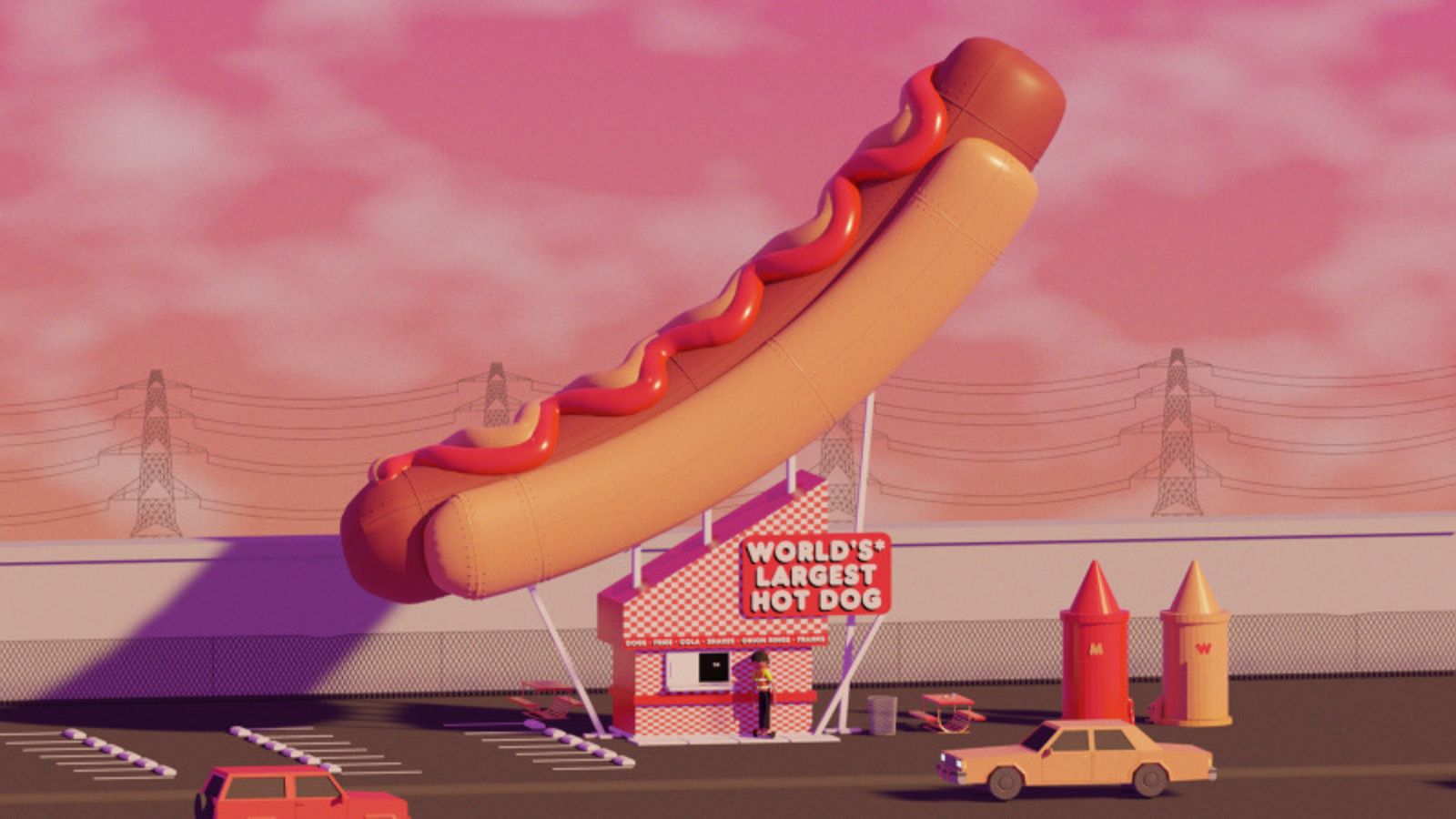
This is the debut feature for Julian Glander, who’s had a solid career as an animator on short films and TV shows, as well as designing indie video games, and this movie has gotten a pretty decent critical response since it premiered at Tribeca earlier this summer. A surreal, minimalist coming-of-age story, the flick has shades of Slacker, Clerks, and other tales of disaffected youth and arrested development, only with the Gen-Z backdrop. It’s very funny in parts, but there’s a crucial shortfall that prevents this from being truly great. Still, as a first film, this shows a lot of potential.
Named for the schoolyard rhyme (but also set in Jupiter, FL), the film goes to pretty decent lengths to show the various ways in which our protagonists “get more stupider.” The main character is Billy (voiced by Jack Corbett), who’s full name/online username is “Billy 5000.” Already we’re well into the realm of the absurd. He’s a 16-year-old high school dropout who uses his noteworthy math skills in an attempt to hustle his way into a payday equal to his last name so that he can put a deposit down on his own apartment (he ran away from his negligent mother and lives in the garage of his sister Gail, voiced by Eva Victor). He spends most of his days and nights on a motorized wheel platform (I refuse to use the buzzword name ripped from Back to the Future Part II because it literally does not hover) making food deliveries for a legally safe parody of GrubHub, using a glitch in the app’s currency conversion engine to give himself 10 times the amount of tips he actually gets from customers, all of which successively ask him to perform increasingly degrading exercises in order to get paid. The rest of the time is spent with his adolescent peers: the perpetually shirtless wannabe rapper Freckles (Grace Kuhlenschmidt), balaclava-clad Beatbox (Elsie Fisher), and the juvenile T-bone (Julio Torres), all of them spending their winter break bumming around town in an attempt to get “snags,” which from context I assume means anything they can steal or swindle. Billy simultaneously partakes in the shenanigans while pretending he’s above it all, repeating a mantra from some “HODL Gang” influencer who promises the necessary lifehacks to make his audience rich.
In the midst of all this is some straight up madness involving aliens and oranges. In the very first scene we meet a shiny slug monster thing called Glarba (Tavi Gevinson), who spends most of the film just wandering in and out of random shots like the snail in Adventure Time until her role becomes far more prominent. There’s also a round cryptid that follows Billy around like a wild animal that’s imprinted on him. Billy comes to call it “Donut,” and both creatures speak in modulated gibberish. No one’s really sure what their purpose is, but there are rewards out to catch them (Freckles in particular gets fixated on capturing one for half a minute). These efforts are led by a nosy religious neighbor (Sarah Sherman), as well as the head of the local orange juice conglomerate, Dr. Dolphin (Janeane Garofalo). Billy gets roped into her schemes when he delivers to Dolphin’s poseur rebel daughter Rosario (Miya Folick), who insists on being called “Rozebud” with a “z.” She becomes an instant love interest for Billy, though he does notice her shallowness, not to mention the privilege of being anti-capitalist when she grew up in a wealthy family and is poised to inherit the company with no effort.
All of this insanity is set in a pastel world of bulbous, minimal designs. Like, imagine if the “Money for Nothing” music video from the 80s had rounded forms instead of angular polygonal ones. Better yet, imagine a movie made entirely out of Playmobil characters… only if the actual Playmobil: The Movie didn’t exist and suck ass. It allows for an ease of messaging, in that the art style is intentionally as simple as the underlying commentary. Glander cut his teeth at Adult Swim, and most of the cast comes from internet comedy shows and other forms of digital content creation, so it fits in nicely with the motif.
There are many salient points to be had about the indignities of the gig economy and the pure exploitation that is influencer culture, as Billy’s predicament gets more and more bonkers. This also results in several laugh out loud moments and instances of delightful weirdness. My problem is that the film refuses to acknowledge the fact that Billy’s problems are 100% of his own making. He’s the one who decided to drop out of high school because he thought he was smart enough to outwit the system (spoiler alert, he is not). He’s the one who thinks that a measly $5,000 will be enough seed money to eventually make him a multibillionaire (spoiler alert, he is wrong). He’s the one who busts his ass into exhaustion while also acting as a living lemming to an obvious online huckster who makes his real money not through financial expertise, but through sponsorships from the very company that keeps Billy locked in the wage slave cycle because he thinks it’ll all pay off in the end (spoiler alert, it won’t). Not to be the old man yelling at a cloud, but if the kid would just put his fucking phone down and go back to school, he’d have infinitely higher odds of a successful, stable life. Sadly, the film seems to have no interest in exploring this rather obvious solution, instead leaning into the comic escalation. It works fine as it is, but it kind of beggars belief for Billy to be established as being so smart, smarter than everyone else in the film, but be blind to this naked manipulation and usury.
In the end, I think of Boys Go to Jupiter the same way I thought about Away, the first film from Gints Zilbalodis. That 2019 debut was spectacularly animated, but the story left a lot to be desired. However, even then, I could see the extreme talent that was on display, and I truly believed that if he could get a good story, he’d create a masterpiece. That ended up being Flow, and now Zilbalodis has an Oscar. Glander looks to be on the same trajectory here. This is much more a proof of concept and artistic ability than a fully realized narrative. Once Glander gets his hands on one of those, he can create something truly unique and memorable. As such, he gets the same score that Zilbalodis got for his opening salvo.
Grade: B-
The Bad Guys 2
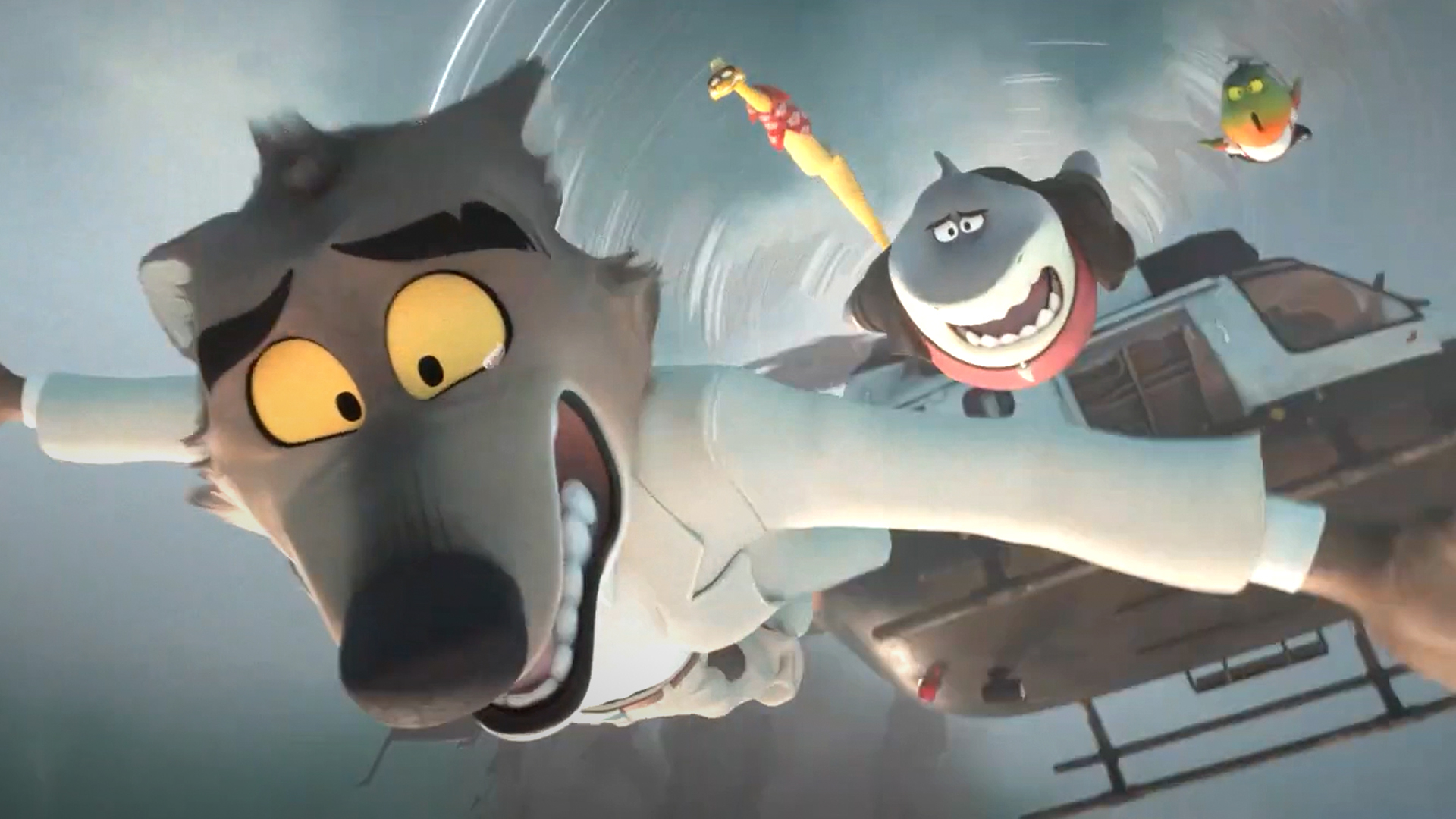
Strap in folks, it’s all downhill from here. I fully admit that I’ve been wrong before when I’ve included a trailer in the monthly TFINYW column, but in this case, I consider my misgivings 100% justified. The only part that didn’t pan out was the forced faux feminism of having the new group of thieves be called the “Bad GIRLS.” That was apparently just for the trailer, as they never use the name in the actual movie, but all that means is that the preview was also bullshit.
The core problems with the first Bad Guys were the litany of heist movie clichés, clear cribbing of the comic style Spider-Verse animation, nonsensical plotting, and cheap toilet humor/running gags that didn’t work in the first place. Sadly, because the movie still made a shitload of money, Dreamworks decided to double, triple, and quadruple down on those horrible elements this time around. This makes for a final product that got about the same reactions as last time, mostly because we as a society never learn our lessons, meaning it was a success by most measures, but for me it was basically excruciating.
The movie begins (after the studios cheekily call this a “caper” rather than a “film,” because even they know they’re robbing you of your time and money for what is essentially nothing) with one of the gang’s jobs in Egypt some five years prior, which also just happened to be the first action for Tarantula (Misspelled Bottled Water) as the team’s hacker, where Wolf (Sam Rockwell) stole his car from the previous film from a douchebag billionaire (Omid Djalili), a car he either lost in that movie (I honestly don’t remember nor care enough to revisit it) or had some other way of writing out of the proceedings, because he doesn’t have it in this movie, instead a subcompact that literally falls apart throughout the first act.
This is a completely pointless introduction, for several reasons, the biggest of which is that it ultimately has no bearing on anything else that happens in the rest of the story. Tarantula doesn’t have any larger or more important of a role in this movie than she did the last time. She basically has the same share of plot utility and screen time as before, which also holds true for Shark (Craig Robinson), Piranha (Anthony Ramos), and Snake (Marc Maron). Nothing she does, no skill she displays, is referenced or called back to in any other moment of the film. There are only two flimsy connections to the main narrative. The first is that Wolf says stealing the car – and heists in general – are about power moves rather than the actual loot, a refrain repeated a few more times later on. This might be interesting, except that none of the deeds done in this flick actually contain power moves, because at no point is there leverage for a long-term benefit. It’s all just in the moment or in reaction to it. There’s no power dynamic or paradigm established or subverted, so it’s just meaningless dialogue. The second is the billionaire himself, Mr. Solomon, who pops up again to provide a temporary obstacle, because there’s a chance he’ll recognize Wolf. The problem with that concept, however, is that the success of these Gordian Knot heists hinges on the fact that NO ONE recognizes the Bad Guys despite obvious and half-assed disguises, but sure, here’s the one time where that might be an issue.
Otherwise this is just a bunch of visual noise with no logic or reason to exist. The group gets caught in a high-speed chase throughout Cairo, one that gives the middle finger to physics well beyond the cartoon allowance, and despite the fact that Solomon says the car has never been driven before, Wolf is basically James Bond behind its wheel. The whole thing is scored to a mumble rap track with lyrics no one can understand, because what would be the fun in being able to follow… anything? Essentially, this means this whole vignette is only here for two possible purposes. One is to firmly state that there are no rules to anything we’re about to witness, which begs the question of why we’re even bothering, and two, to just introduce the characters as air quotes “bad asses,” but that makes even less sense because this is the sequel. Literally every single person in that theatre either saw the first film or is aware of this universe. It’s almost mathematically impossible that anyone went into this blind, so why do we need the refresher, especially since the “Bad Guys” are now the “Good Guys”?
Anyway, once we’re back in the universe’s present day, we get the one thread that really should have been the focus of the entire affair. Despite surrendering themselves and serving their time so as to come clean and go legit, none of the crew can get an actual job, as we see everyone (sans Snake) bombing in degrading interviews where their felonious past is used against them. This is a real problem in actual society, as federal law states that no ex-con is entitled to ever be employed again, and several states even force candidates to disclose criminal history on their applications so they can be eliminated. They either tell the truth and get turned down, or they lie, possibly get hired, get found out, and then they’re either fired or arrested again for knowingly falsifying the documents. It’s a discriminatory – yet fully legal – practice that allows society to continue punishing convicts even after they’ve paid their debt, and studies have shown that a lack of stable employment is a key factor that leads to recidivism. Had the movie focused on that, this could have been amazing, and it would have given us a good reason to have Governor Diane Foxington (Zazie Beetz) as an active player, rather than as part of a tired “friend zone” will they/won’t they dynamic with Wolf where she has to keep her distance for the sake of optics until she’s able to deus ex machina the climax.
There’s been a string of robberies lately that use tactics similar to the Bad Guys, so now-Commissioner Misty Luggins (Alex Borstein) gives the group a chance to help track down the copycats. At first they believe that Snake might have backslid into crime because he’s not around as much, and all of his “new age” activities coincide with the timelines of the thefts. However, this is actually because he’s dating a raven named Susan (Natasha Lyonne), who just happens to be one of the members of the new gang that’s actually pulling off these jobs. Accompanied by a boar named Pigtail Petrova (Maria Bakalova) and led by a leopard named Kitty Kat (Danielle Brooks), this whole crime string has been a tactic to lure the Bad Guys in, kidnap them, and force them into their grand scheme concocted by the villain from the last film, Marmalade (Richard Ayoade), who has become super buff in prison, and who is reintroduced to the film via an extended Silence of the Lambs reference. You know, FOR KIDS! Anyway, they’ve stolen a bunch of objects containing a rare mineral called MacGuffinite (the one genuinely clever joke in this thing), which has the power to magnetize gold. Kitty’s gang blackmails Wolf and the others for help, lest they release video footage that exposes Diane as the “Crimson Paw” master thief.
This is all just meaningless garbage, an extension of the opening 10 minutes of superfluous visual distractions, as if this were the cinematic equivalent of getting a cat to chase a laser pointer. Some of the animation and action set pieces look good, particularly the way the group tries to use MacGuffinite magnets to literally swing into action and save Diane’s secret. But the rest is just painfully not entertaining, especially the runners about Shark “panicking” into disaster and Piranha farting when he gets nervous, culminating with him inflating a space suit (oh yeah, they go into space for reasons) with his gas, torturing Snake who has the misfortune of sharing said suit. Speaking of Snake, there’s a bit of comedy to be had in how Susan’s continued betrayals actually make him more attracted to her, but we don’t even really get to enjoy it, because of the genuinely off-putting way he “makes out” with her. Far be it for me to kink shame, but if this is what you’re into, your love is wrong and an affront to God.
I intentionally skipped this when it came out two weeks ago, and it was the last of the four films I decided to watch once I saw how the showtimes lined up. I figured it had already made whatever money it’s going to make, and because it’s a Universal film, there’s a chance it would be shoved onto Peacock rather than Netflix after it leaves theatres, and that’s the one streamer that neither I nor my roommates have. I watched it purely for coverage’s sake, and that’s about the value that I got out of it. I have no idea why it’s gotten good reviews, but I had the same consternation last time. It’s just an increasingly dopey string of heist movie tropes aimed at little kids who aren’t evolved enough to realize that they suck yet. Once you realize that, this whole series becomes yet another exercise in sound and fury signifying nothing.
Grade: D+
Fixed
You know, it really does say something that despite my undying love for the artform, my personal bottom five films for the year so far have all been animation. Part of that is because I just haven’t watched as many movies this year as I have in other cycles (32 so far this year, whereas I was at 41 by this same point in 2024), part of it is that I’ve purposely avoided the projects that look shittier than normal thanks to my dwindling funds, and an unfortunate fact of the matter is that there has just been some truly terrible animated fare relative to the rest of the cinematic calendar.
We can safely add Netflix’s Fixed to that dubious club. This is some of the most puerile humor I’ve ever seen, coupled with wholesale ripoff animation, which is especially galling since this was directed by Genndy Tartakovsky. Yeah, as in Dexter’s Laboratory, Samurai Jack, Clone Wars, Primal, and Hotel Transylvania Genndy Tartakovsky. What in the actual retail fuck? I’m all for gross-out comedy when it’s done properly, but this is just lazy on every level.
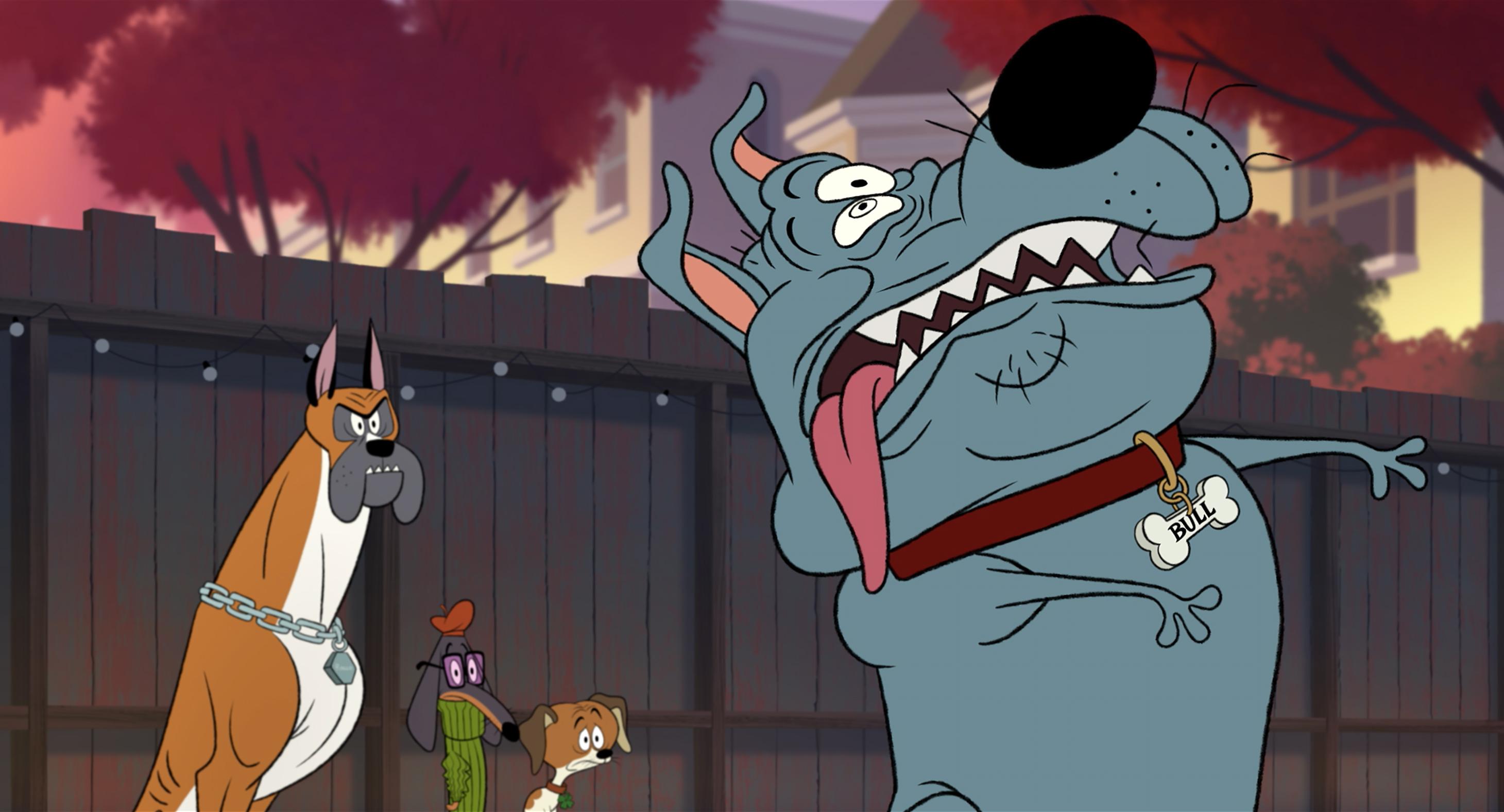
Adam DeVine stars as Bull, an amorphous pit bull-style dog who humps everything that moves, as well as several things that don’t. His favorite target is the leg of his family’s grandmother (Grey DeLisle), so much so that every neighborhood canine, be they friend or foe, teases him about his obsession with “Nana.” In spite of this, he’s madly in love with Honey (Kathryn Hahn), a Borzoi show dog who lives next door, the two having known each other since puppy-hood. Honey is clearly into him as well, dropping more than her share of signals and innuendo about how much she wants him to bone her, but Bull is so overcome with insecurities that he just can’t believe she’d ever be attracted to him.
Bull hangs around with three other neighborhood dogs: Boxer Rocco (Idris Elba), Dachshund Fetch (Fred Armisen), whose owner dresses him up in “human” outfits for an Instagram account, and Lucky (Bobby Moynihan), a nervous and sexually repressed Jack Russell terrier. One day, while at the local dog park, they learn that a friend of theirs, Luther (Aaron LaPlante), has recently been neutered. As the only one in the group that still has his testicles, Bull is worried that he might be next, especially given his proclivities for Nana, lamps, couch cushions, and random containers of frozen yogurt, and his fears are confirmed when the family becomes super affectionate with him and even gives him the same luxuries and treats that Luther got before he took a trip to Nuts Landing.
Feeling desperate and betrayed, Bull runs away, soon joined by his “pack.” As they were all neutered as pups in the shelter, they never really experienced what it was like to have balls, so they decide to take Bull for a night on the town and give his twig and berries an experience they’ll never forget.
It’s at this moment that I started screaming “SIMPSONS DID IT!” at the screen, because literally there was an episode of The Simpsons where Santa’s Little Helper got loose and sired a litter with Dr. Hibbert’s purebred dog, Rosa Barks, and Homer opts to give the dog a similar night of excess (including a doggie hooker) before taking him to get the snip (where do you think I came up with “Nuts Landing”?), which we later find he couldn’t go through with. Anyway, the problem isn’t that this one particular plotline is derivative, but the entire film is. Just as I yelled about The Simpsons, there are several other moments where I would shout, “SOUTH PARK DID IT!” or “FAMILY GUY DID IT!” Hell, the animation is a straight ripoff of Ren & Stimpy (or if you really want a deep cut of awful, maybe Movie 43, as Bull’s design reminded me of the cartoon cat Beezel in James Gunn’s mid-credits sketch), and the pithy observations the dogs have about human behavior might as well be rejected Seinfeld jokes. Why do they pick up our shit? It’s supposed to fertilize the ground! WHO ARE THESE PEOPLE?!?!?!?!?!?!
This entire escapade, where Bull alternately tries to get laid and chase after Honey at a dog show (she’s meant to win and be forcibly bred to an elitist shit heel champion called Sterling, voiced by Beck Bennett), is so horribly unfunny that it borders on pure anticomedy. Throughout this 90-minute “Try Not to Laugh” video disguised as a movie, nothing of merit is said or shown, and every supposed gag is just some tossed off combination of bodily fluids, outdated sexual stereotyping, and literal urine and feces substituting for story. It’s like Sausage Party without the subtlety, or Paradise P.D. without the sense of decency, political correctness, and integrity. Sometimes this can be really hilarious, but it’s all entry-level with no escalation, just continuation. Unless you’re that rare person who thinks dogs humping is the pinnacle of the artform of comedy, you will find this practically intolerable. There were exactly two moments that elicited a slight chuckle out of me, and 24 hours later, I don’t even remember what the second one was. The first was a literal dogpile at the park when everyone went for a ball that someone tossed onto the ground. Once the dust settled, one small dog yells up above him something to the effect of “Get off of me, fat ass!” The camera then pans up to the dog on top, who retorts, “I’m not fat, I’m husky,” and it’s actually a husky. Okay, you get a point, one point.
The one ounce of credit I will give to this heap of hot trash is that it pretty much fully commits to the bit. It’s a completely shit bit, filled to the brim with stolen jokes and shock value in place of actual laughs, but the film does go for broke on it. The only way it holds back is in the, for lack of better term, “design” of the canine anatomy. Bull’s, uh, bulls, are basically attached to his rear end, as if he’s a dog body hauling around a set of rubber truck nuts. They’re not connected to his penis, nor do we ever see it, save for a blurred incident with Nana early on. Similarly, neither Honey nor any of the other bitches have vaginas. Why do I bring this up at all? Well, because one, the testes are for all intents and purposes the MacGuffin of this story, and two, every dog’s anus is prominently displayed, and at times physically manipulated. In a very strange and sickening way, it’s honestly curious why they decided to release a full butthole cut, but not show any of the actual reproductive organs in a film where reproduction is the name of the game. Apart from that, though, yeah for better and much, much worse, the animation does go all in on the ins and outs, even when it logically doesn’t make sense.
When I saw the trailer, I thought this would be a bit of cheeky fun that would have something to say about the morality of “fixing” your animals. I know that controlling pet populations is important, particularly when it comes to strays, but Bob Barker be damned, to me the idea of mutilating a dog through castration is one of the most inhumane acts possible. It always boggles my mind that groups like PETA promote this practice, because I’m sorry, in what universe is cutting off an innocent creature’s balls considered more “ethical” than killing or eating them? I can tell you, sure as I’m sitting here, that I’d rather be dead than dead down there. That said, I would sooner take pruning shears to the scrota of everyone involved with this film than watch it again.
Grade: D-
***
That’s all for this edition. My only real disappointment is that this cycle sadly peaked with the first entry, but I still had an enjoyable experience. It was nice to get a full day back where I’m most at peace after everything I’ve been through for the last several months. Tomorrow begins the next lap around our star, and hopefully, things will finally start looking up.
Join the conversation in the comments below! Have you seen these films? Where do you see animation heading for the rest of the year? How much would someone have to pay you to deliver them hot dogs and also pre-chew them? Let me know! And remember, you can follow me on Twitter (fuck “X”) as well as Bluesky, subscribe to my YouTube channel for even more content, and check out the entire BTRP Media Network at btrpmedia.com!

 I Actually Paid To See This
4 thoughts on “Back Row Thoughts – Wheel of Four Toons”