
I have to be honest with you guys. I came dangerously close to including Chloé Zhao’s new film, Hamnet, in the November edition of TFINYW (and before you say anything, I will resume the series; I just had to take a hiatus for December and January due to all the hectic bullshit I was dealing with). I mean, a movie about a romance of William Shakespeare that inspired one of his greatest plays? You are aware that Shakespeare in Love exists, right? And that it winning Best Picture over Saving Private Ryan is one of the most egregious errors in Oscars history? Why are we doing this again?
Thankfully, this is not a rehash of the film that foisted Gwyneth Paltrow and her GOOP on us for all eternity, mostly because Zhao is far more talented, creative, and just plain smart than that (for the sake of this argument, and our collective sanity, we’ll pretend Eternals doesn’t exist). Adapting Maggie O’Farrell’s 2020 novel (and co-writing the screenplay with O’Farrell), Zhao focuses the brunt of Hamnet on the emotional toll that loss and grief take, not just from the Bard, but from his wife Anne Hathaway (here called Agnes). While entirely fictitious, like its presumed forebear, this is much more about how art can help mend a broken heart rather than just being a better-than-average rom-com. This makes for a shameless tearjerker that is nonetheless beautiful and at times quite cathartic.
Jessie Buckley stars as Agnes, imagined here as something akin to a druid, living on a farm outside of Stratford and spending most of her free time in the forest, where she communes with nature and keeps a hawk as a companion. Local gossip even says that she’s the daughter of a woodland witch. It is there that she meets William Shakespeare (Paul Mescal), working as a Latin tutor for a wealthier family to pay off his father’s debts. Pointedly, Shakespeare’s name is not uttered until the final sequence of the film, and only then a couple of times. This tells you two things fairly clearly. One, Zhao gives the audience enough credit to know who Shakespeare is without an exposition dump. Two, she’s demonstrating who, in her eyes, is the more important character, as Agnes is named in nearly every scene. This is further reflected in Awards Season campaigning, where Buckley is competing for Lead Actress while Mescal is mostly going for Supporting Actor. Despite the name that emblazons the title font, we know who this story is really about.
The bulk of the first two acts concerns Will and Agnes’ courtship, the eventual consummation of their relationship, and the resulting marriage and birth of eldest daughter Susanna (Bodhi Rae Breathnach). It’s largely a story of love conquering all, including the misgivings of Agnes’ brother Bartholomew (Joe Alwyn) and the outright objection and later acquiescence of Shakespeare’s mother Mary (Emily Watson). Agnes’ more pastoral habits are explored (she’s treated like the Elizabethan equivalent of a hippie), along with some old mystic practices, including visions of the future based on dreams and palm readings. Meanwhile, Will becomes more assertive as the responsibilities of parenthood sink in. He finally tells off his abusive father (David Wilmot), and spends significant time in London pursuing his theatre interests, gaining fame and renown.
Within a few years, Agnes is pregnant again, giving birth to twins, a girl named Judith (Olivia Lynes, a finalist on series 16 of Britain’s Got Talent) and a boy, the titular Hamnet (Jacobi Jupe, whose only previous film credit was as Michael Darling in the Disney remake Peter Pan & Wendy). From the moment they’re born Agnes is cautious and fearful. In her visions, there are two beside her on her deathbed, assuming it to be her two children. With the arrival of twins, the total comes to three, and because Mary won’t let her give birth in the woods as her tradition would dictate, she sees it as an omen that her children will die. It doesn’t help that Judith is initially believed to be stillborn, and after she’s revived, she’s somewhat weak and sickly.
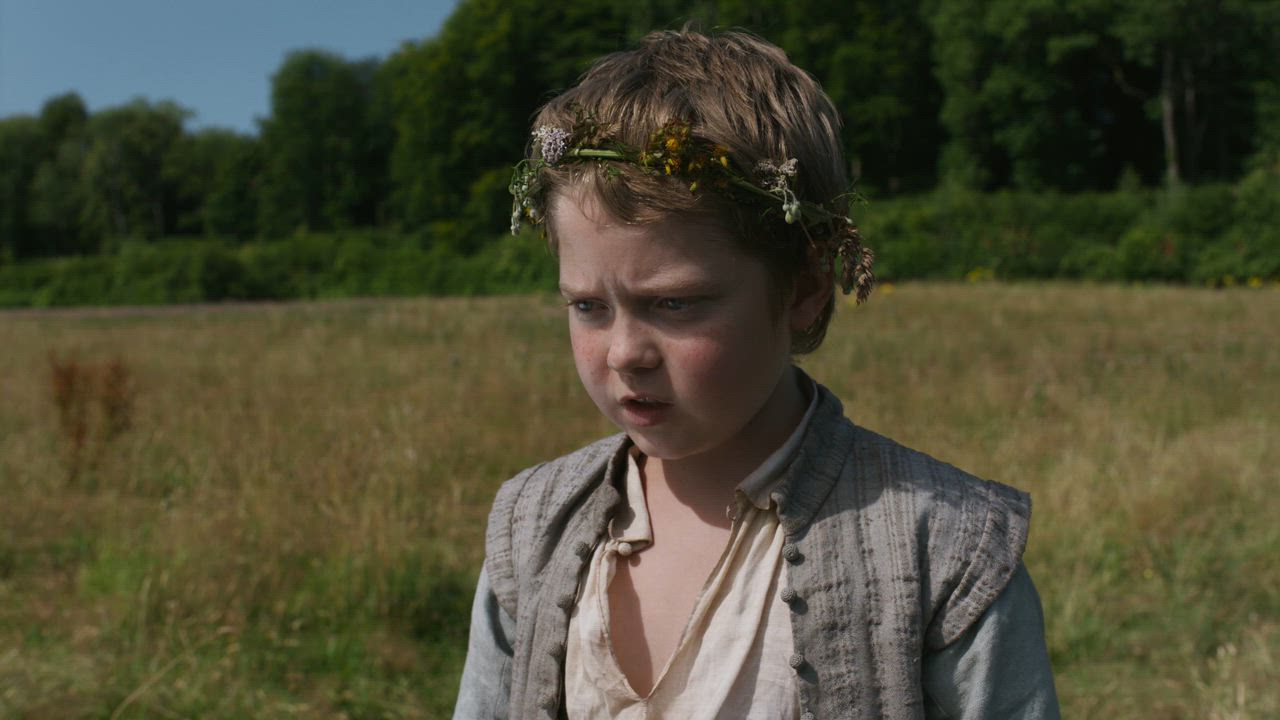
The pair grow up as an inseparable duo, with the two constantly playing games with one another, and Will teaching Hamnet how to be brave and defend his sisters. Ten years later, while Will is away in London, a rash of bubonic plague sweeps through Stratford, claiming Hamnet’s life. This is not a spoiler in any way, as it’s revealed in the trailer, and it serves as the inciting event for the remainder of the story. The circumstances surrounding Hamnet’s death I won’t reveal, because it’s honestly an expert display of maudlin emotionalism, enhanced by Jupe’s performance, which is far more complex than his age would indicate. The final act is focused on how Will and Agnes cope with the loss of their only son. As the narrative suggests, Agnes sinks into a deep despair, while Will processes his grief by writing what is arguably his greatest work, Hamlet.

Again, all of that is public knowledge from press releases and the trailers. I’ve given nothing away that you couldn’t already find with ease before you see the flick. But you do need to see it, because of how Zhao executes this vision. The cinematography is absolutely gorgeous, using bright colors and vibrant natural lighting to contrast the dark themes of the story. There’s a juxtaposition of space between the open outdoors where Agnes feels most at home and the claustrophobic, almost stage-like small areas of the homestead interiors. There’s something borderline magical and psychedelic about how those worlds blend in and out of reality, the limitless possibilities of the world clashing with the cold, narrow harshness of life.
Buckley and Mescal give solid performances, with the former emerging as a frontrunner for Best Actress. As I said previously, my vote goes to Renate Reinsve right now, but I wouldn’t be the least bit upset if Buckley took home the honors after her insane, top-level output over just the last five years. I mentioned that Jacobi Jupe definitely outperforms his young age, but there’s another bit of inspired acting in this piece. The actor who plays Hamlet in the first performance of the play is Noah Jupe, Jacobi’s older brother, likely best known for his roles in Honey Boy and the Quiet Place films. There’s a huge thematic reason for this, and an incredible reaction in the film’s denouement that I won’t spoil, but suffice to say, it’s a brilliant choice. The Oscars are debuting a new category in Casting this year, and this movie is on the shortlist. I don’t know what the criteria will be for the Casting Directors Branch to nominate, but from where I sit, this is the kind of move that makes a project like this stand out when it comes time to vote.
If there’s one major drawback for me, it’s in the presentation of the script. This is the one area where you could argue that this is in line with Shakespeare in Love, and it’s to this film’s detriment. Just like that 1998 movie, this story is completely fictional and imagined. Little is known about Anne Hathaway’s life outside of her marriage to Shakespeare, and even Hamnet’s death – and its connection to Hamlet – is the subject of academic dispute. This is largely due to the lack of proper record keeping, because, you know, it was the 1600s.
And yet, this story is sold as if it’s actual history, and not just in the whole “based on a true story” trope. The opening shot of the film is a bit of text saying that the names “Hamnet” and “Hamlet” were basically interchangeable during the 17th Century, implying that the reference to Shakespeare’s lost son is thinly veiled at best. Really it’s just a question of dialects and accents in Stratford at the time. Essentially, much more is being made about this than can be reasonably confirmed, and it’s up to you as a viewer to understand that this is just a dramatization of what O’Farrell fantasized when she wrote her novel. But nothing in what we see (or what is marketed around the film) gets that across. Just like John Madden’s piece from the late 90s, it’s all contextualized within historical events to give the impression that any of this actually happened, even though everything aside from the basic factual bullet points of births and deaths is entirely made up.
This will make for an interesting discussion should this get nominated for Adapted Screenplay. By all accounts, this is a very faithful translation of O’Farrell’s book, which is kind of taken as understood as the author co-wrote the screenplay with Zhao. Obviously there was enough creative input to make sure her vision wasn’t betrayed (though that’s never really a concern when it comes to Chloé Zhao’s work – even that horrible Marvel monstrosity was completely in line with what the studio wanted). But it is most definitely not an accurate portrayal of actual history, and the film makes no distinction between the two. Mind you, it doesn’t have to, but as I said, it will make the debate intriguing should the script get nominated.
Be forewarned, this will tug at your heartstrings, and with no qualms or apologies. There’s absolutely nothing wrong with that, even if the melodrama is laid on a bit thick at certain points. That said, you can tell that was the clear intent, and the movie certainly accomplishes its goal. It faithfully mimics the mood of a Shakespearean tragedy, framing the entire project as a meta experience and example of how art reflects life and vice versa. Thanks to immaculate camera work and acting, this definitely succeeds. But just like 1998’s alleged Best Picture, don’t be fooled into thinking this is anything but a play within a play. Once you do that, you’ll enjoy a good cry.
Grade: A-
Join the conversation in the comments below! What film should I review next? What’s your favorite Shakespeare play? What do you think is worthy of an Oscar for Casting? Let me know! And remember, you can follow me on Twitter (fuck “X”) as well as Bluesky, subscribe to my YouTube channel for even more content, and check out the entire BTRP Media Network at btrpmedia.com!

 I Actually Paid To See This
Appreciating your passionate voice here; Good one🎭
LikeLike
Thank you so much!
LikeLike