
The Live Action Short category has come a long way since I first started watching the curated screenings in 2014. In that first interaction with any of the Short contests, the entries were prefaced by interstitial interviews with several A-list directors and producers who cut their teeth in short films. The most memorable sound bites came from Steve McQueen, fresh off his Best Picture nomination (and eventual win) for 12 Years a Slave. It was a wonderful statement that these works of art can be the launching point to superstardom in this industry. That year’s winner, Helium, a tragic tale of a life cut short filled with imaginative steampunk designs and visual effects that you’d see in a big budget feature, seemed to be proof of that concept.
In the 12 years since then, we’ve seen a lot more Hollywood heft behind the medium. Actors like Sally Hawkins, Jim Broadbent, Oscar Isaac, and Benedict Cumberbatch have starred in winning and nominated projects. Major media corporations like the BBC, Netflix, and Apple have put their marketing and production dollars behind them. Riz Ahmed and Wes Anderson have excelled behind the camera. We’ve even seen profound works like Two Distant Strangers wade into the national political discourse. A dozen years on from McQueen’s kind words, we’re seeing this category – as well as Documentary and Animated Short – take on a much more active role and assert their importance in the Oscars discussion.
Personally, I’m just happy that comedies get the respect they deserve in this field. On the whole, the Academy is not exactly friendly to the genre. We have had a couple win Best Picture over the last decade (Birdman, Parasite, and Everything Everywhere All at Once), ending a drought that reached back to 1977 and Annie Hall, but you could argue they had to win over voters by adding in additional subgenres (dark comedy, satire, and bonkers science fiction, respectively). Even this year, with One Battle After Another as co-frontrunner, you can tell that it wouldn’t have gotten nearly the amount of love from the prestige bodies were it not for the solid satire, political commentary, and action suspense baked in along with the laughs.
No such bias when it comes to the Shorts, however. The last three winners (I’m Not a Robot, The Wonderful Story of Henry Sugar, and An Irish Goodbye) have all been comedies, and there have been a fair few nominees as well, including Hold Please, The Letter Room, The Eleven O’Clock, Ave Maria, and Do I Have to Take Care of Everything? At least in this category, the message is clear that making the audience laugh is just as important as making them cry or making them think. Hell, maybe the fact that Taika Waititi, an incredibly accomplished comedy director, is now the title sponsor of the screenings is a subtle hint that the least serious entries should be taken more seriously.
This year’s nominees for Live Action Short are…
Butcher’s Stain – Meyer Levinson-Blount and Oron Caspi
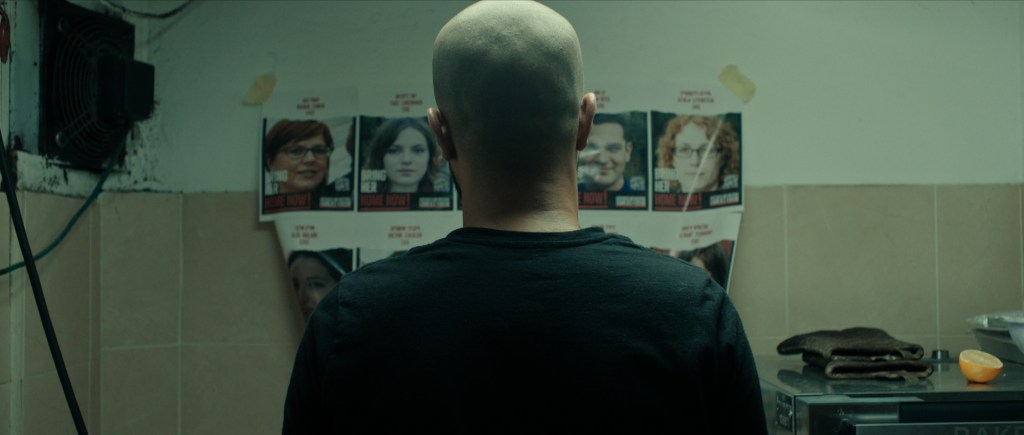
There are a lot of intriguing and nuanced stories that can – and do – come out of the tragedy that is Israel’s ongoing war in Gaza. Butcher’s Stain is, sadly, not one of them. I get the idea behind the project, and I’m sure the filmmakers mean well, but they’re not really adding anything new to the conversation.
At a grocery store in Tel Aviv, Samir (Omar Sameer) is regarded as one of the best butchers in the area, even though he works for minimum wage because as an Arab, he can’t get anything that pays better. He’s always the first to arrive at work each day and the last to leave, partly to prove his dedication, but also because he’s beholden to public transport to get to and from. His uncertain schedule leads to some consternation over visitation rights with his son, as his ex-wife and her new husband are often rigid and condescending about violating their custody agreements.
At the store, there are two major concerns. The first is that the air conditioner is on the fritz, going off at random intervals and not adhering to the thermostat. This makes Samir’s job a bit more difficult, as he has to constantly monitor the cooling and storage of the meats. The second is that his supervisor Michal (Rona Toledano) has accused him of taking a poster of Israeli hostages off the break room wall, leaving it on the floor. As the only Muslim in the store, Michal only suspects Samir, casually saying that someone claims to have seen him do it.
The problem here is obvious, and so is the actual truth of the situation. However, the film spends far too much time on Samir trying to track down his naysayers and other potential perpetrators. The bigotry on display is completely surface level, with one co-worker equating Samir posting pictures of the atrocities in Gaza on his Instagram as “supporting terrorism,” and Michal acting as if Samir is already guilty, promising not to discipline him if he admits that he’s the culprit, even though he has no motive other than “not Jewish.” Also, the side tangents about custody arguments have no bearing on the plot, other than to establish that Samir’s getting flack from all sides.
My biggest issue is the impracticality of the inciting incident. Why would you post pictures of the hostages in the break room? This is where people get coffee and have their lunch. Who would want to stare at photos of kidnapping victims in the one spot in the workplace where they’re meant to decompress and not be reminded of outside stresses? If they were posting the pictures throughout the shop, maybe for customers who might have information leading to rescue, that would make sense. But in the break room? It’s just an artifice to drive the drama, which pales in comparison to other recent shorts about the disparity between the rights of Israelis and Palestinians. If you want a much better representation of this modern apartheid, watch the 2020 nominated short, The Present. This just doesn’t measure up.
A Friend of Dorothy – Lee Knight and James Dean
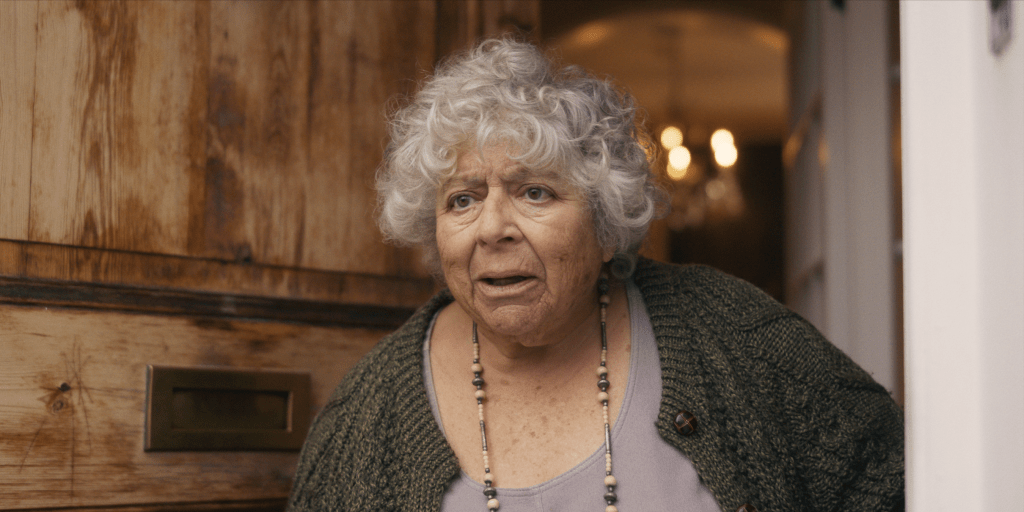
As I stated earlier, a lot of well-known performers wind up in these films, which definitely helps to elevate their profiles. Thankfully, in the case of A Friend of Dorothy, the final product would be endearing even without the celebrity participation.
That said, the setup doesn’t inspire much confidence. At an office, a lawyer (Stephen Fry) is preparing to read the will of a woman named Dorothy (Miriam Margolyes) to the two main beneficiaries: a dickwad entitled rich boy prick named Dickie who also happens to be Dorothy’s grandson (Oscar Lloyd), and a black teenager named JJ (relative newcomer Alistair Nwachukwu) who has no idea why he’s there. Dickie is pissed that part of his inheritance might be “stolen” from him by this minority interloper in a whiny bitch-fest that lays on the racism in an almost cartoonish manner. We then flash back to the recent past to learn what JJ did to inspire Dorothy to change her will so close to her passing.
This is where the film gets good. The two meet when JJ accidentally kicks his football into her garden, and he knocks on her door in hopes of retrieving it. Dorothy invites him in and chats with him for a bit, even gushing a tad when he’s able to open a tin of prunes for her. JJ reveals that he doesn’t particularly like football, but he’s training because that’s what his family wants, and because his brother is a successful footballer. He much more enjoys acting, so Dorothy has him read a monologue from a play she has on her bookshelf, as she and her late husband were dedicated theatre patrons and performing arts educators. They develop a rapport over their love of theatre, and Dorothy, sensing that JJ is closeted, informs him of what the phrase “a friend of Dorothy” means, and how significant it was for the LGBTQ community in previous generations. This helps JJ to understand who he is and to pursue his ambitions.
None of this is exactly new as far as stories go. We’ve had plenty of films, short and feature, dealing with the relationships between young people and older ones, and how the knowledge passed down helps to inform new and exciting paths forward. That said, the performances of Margolyes and Nwachukwu are very strong. You believe in their friendship pretty instantly, and the payoff of what Dorothy has left JJ is so sweet that my diabetes just moved from Type 2 to Type 1. They have amazing chemistry together, and there’s enough whimsy in the film to overcome the more tired aspects. One of my favorite shots in the entire project sees JJ and Dorothy having fun in her kitchen, his football visible in a tree outside, completely forgotten thanks to this new friendship. Is it all familiar? Of course, but that doesn’t stop it from putting a huge smile on your face.
Jane Austen’s Period Drama – Julia Aks and Steve Pinder
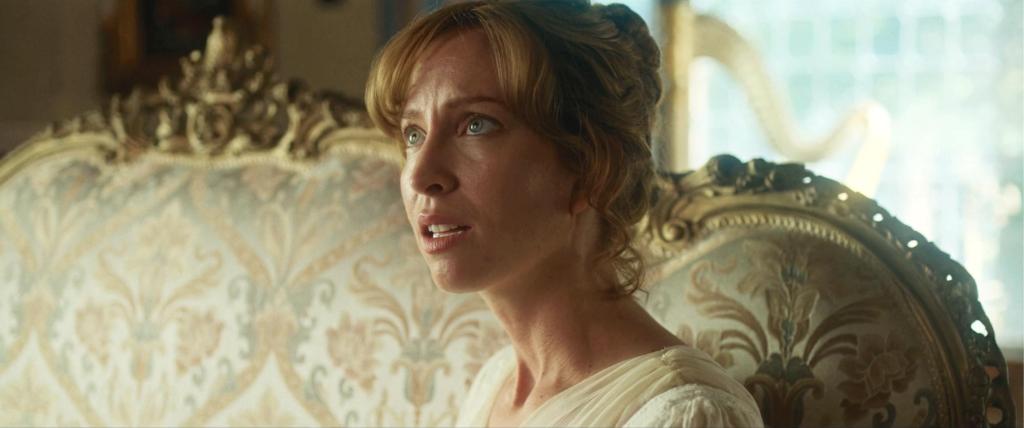
We may be looking at four straight years of comedies taking home the trophy, because Jane Austen’s Period Drama is a laugh riot. Taking some well-worn tropes and just having bonkers fun with them, this is the short that had the entire audience at my screening applauding when it was all said and done.
Aks stars as Miss Talbot, the heroine of a Jane Austen-esque romance. After several entanglements and travails completely off screen, Talbot hears the love confession of her childhood friend, Mr. Dickley (Ta’imua), who has broken off his arranged engagement after his fiancée ran off with another man. It’s all appropriately melodramatic and in keeping with Austen’s style. Mr. Dickley is about to propose to Miss Talbot when, all of a sudden, he notices blood seeping through her dress, particularly around the nethers. Already an awkward moment, Dickley makes things even more embarrassing by mistaking the flow for an actual injury, and spirits Talbot home to her family.
What follows is an insane, Monty Python-level farce about menstruation, the social stigmas surrounding it, and the complete lack of proper sex education that can ultimately make Austen’s work feel anti-feminist at times despite its assertive leading characters. To say more would be to spoil its surprises (if you couldn’t make a screening, it is on YouTube), but suffice to say, the comedic timing and escalation of the jokes are just so good, and the cast leaning into the absurdity made it hard for me to breathe I was laughing so hard.
This is just expert writing, something akin to what Tina Fey would come up with when she was in charge of the Saturday Night Live staff (I got several flashbacks to her famous “Col. Angus” sketch while watching). It’s not just a matter of taking the silly premise of “what if a Jane Austen heroine got her period” and letting that just be the entire joke. The filmmakers go all the way in creating the atmosphere of such a story, from a blue-blooded English countryside manor, to era-appropriate costuming, to the expected gender roles of the time. This could have been a one-note gag, but the commitment is there to see this thought experiment through to the end, no matter how batshit it is, because Austen’s work is still taught in literature classes to this day, but it’s like blindly throwing darts at a board to make sure that kids understand what’s happening to their bodies. It turns the idea of what is “proper” on its ear in much the same way Austen did in her novels, while also acknowledging that the curriculum needs to be updated, figuratively and literally.
The Singers – Sam A. Davis and Jack Piatt
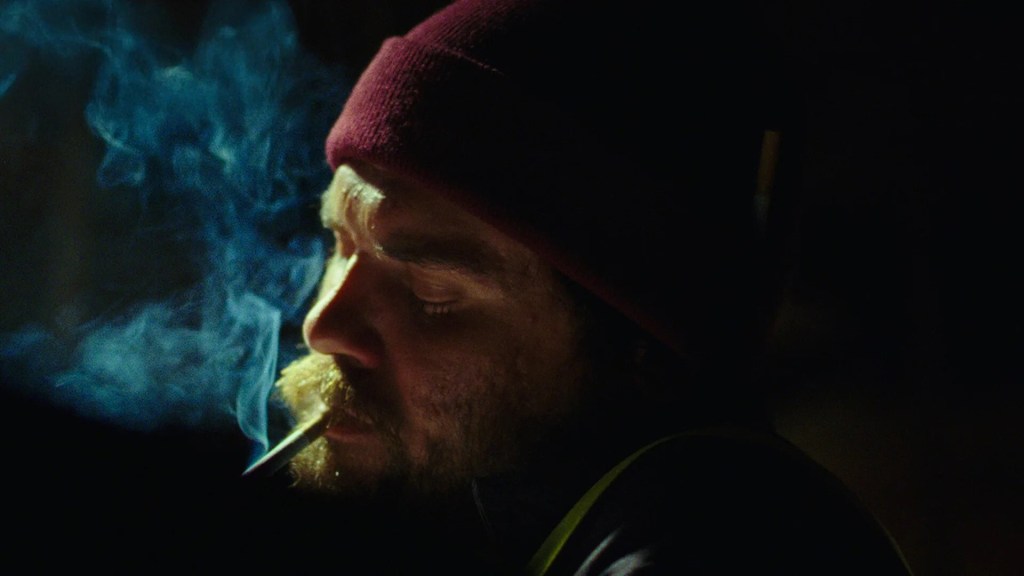
In the preamble, I mentioned that over the last decade-plus, major media companies have gotten behind short films, and The Singers is a prime example, but for all the wrong reasons. After it debuted at SXSW last year, it toured the festival circuit, eventually qualifying for the competition. After it was shortlisted, Netflix picked up the streaming rights and added it as a late supplement to its FYC campaign. So if it wins, the preeminent streamer gets to take the credit, even though they made no material contribution to its creation. In a way, this gives The Singers something of an unfair advantage, because recognizable brand backing can be seen as an artificial symbol of quality (all five nominees are available online in some form, so don’t let anyone just default to the Big Red N).
Based on a short story from 1852, the film takes place at a dingy bar on a cold night in the modern day. A blue-collar spot filled with construction workers and miners, the dimly-lit establishment doesn’t exactly see a high-end crowd. It’s there that a guy who lives in his van (implied to be a homeless drug addict) tries to mooch beers off the customers. The bartender tells him to stop lest he be thrown out, but then offers a challenge. If he can out-sing one of the bar’s older regulars, he’ll get $100 and free drinks for the night. The challenge is then extended to the entire bar. After a redneck butchers “Amazing Grace,” the older, more grizzled veteran has his go (the bartender admitting that the entire purpose of the bet was to coax him into singing for the first time in years). After everyone seems to agree that the contest is over, our moocher chimes in with some sultry blues vocals and piano, before the bartender himself breaks out in a tearful rendition of “The Unchained Melody.”
Unlike Jane Austen’s Period Drama, the escalation here doesn’t quite work. It’s something like three minutes from “Amazing Grace” to the old man’s turn (literally 1/6 of the film’s duration), and almost all of that time is spent with the yokel trash-talking everyone and cussing them out. We even have a diversion where a shy patron sings in the bathroom before quietly leaving the bar entirely. The smile on his face implies that he’s going to get other people to come in and enjoy this impromptu show, but no, he’s never seen again. Even the film’s coda feels a bit out of place, because it’s a comedic punchline to a story that wasn’t exactly framing itself as a joke fest.
In this way, the short ironically comes off a bit tone deaf. It’s not bad by any means, but we have a pretty direct way to compare narrative progression, and this isn’t nearly as good. The most admirable thing about it is the fact that the filmmakers were able to clear all the commercial music they used long before Netflix gave them any money. If you’re lucky, licensing a song for a short film can run as low as $500, but if you’re not, it could be $5,000 or more (and when we get to features the price tag can run into the millions). When you’re trying to put together a budget for an independent short, the idea of licensing any kind of copyrighted material seems insanely cost-prohibitive, yet they were able to pull it off here.
There is quality to the overall short, but not enough to warrant an Oscar. If nothing else, it suffers from the same issue as Marty Supreme, in that the scenes aren’t lit properly to see what’s going on half the time. I know we want to give the bar a grimy look, but when the audience is squinting to see who’s talking/singing for the bulk of the 18-minute runtime, maybe scale back the moody lamp-shading. Also, just as Butcher’s Stain has already been bested by a previous, thematically similar nominee, so too can The Singers be set aside in favor of another mournful story about cover songs in a bar, 2021’s On My Mind.
Two People Exchanging Saliva – Alexandre Singh and Natalie Musteata
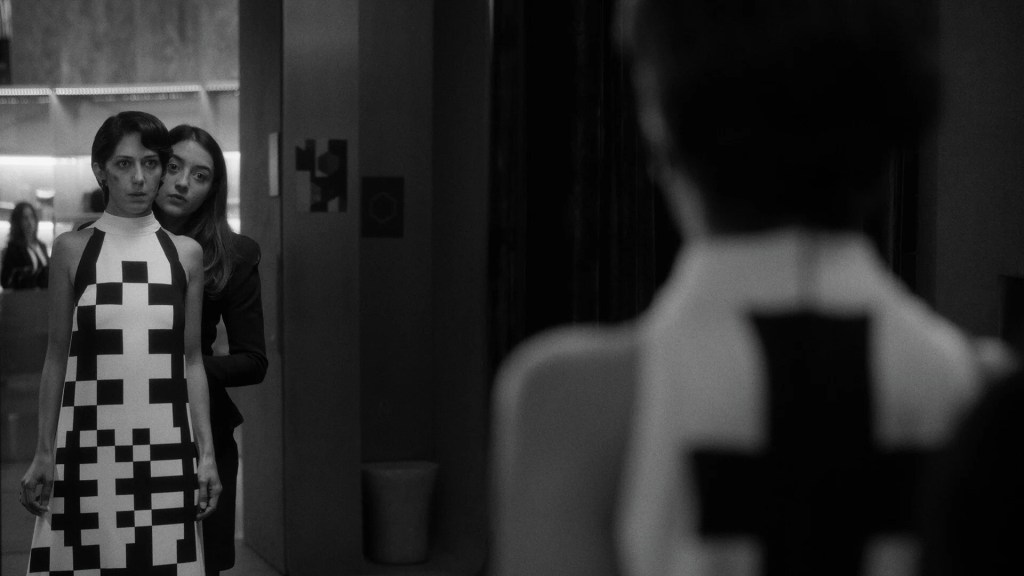
One of the highlights of the Short competitions is the intriguing and often downright weird titles that some of these pieces get. They often inflame the imagination, making you wonder what exactly is going on here, and that in itself can be a draw. In the case of Two People Exchanging Saliva, however, it’s the only draw there is, because this genuinely sucks.
In some dystopian French future, apparently romance is illegal, with the mere act of showing affection being punishable by death, but only for women based on what we see. In this world lives Malaise (Luàna Bajrami from Portrait of a Lady on Fire), who works at a high-end boutique store as a hostess and sales consultant. One day, she meets an important client named Angine (Zar Amir Ebrahimi from Holy Spider), and decides to play a game with her, pretending to be a friend who’s known Angine for years. Somehow this leads to a big sale, where instead of exchanging currency, the customer is slapped in the face a number of times. Somehow, some way, this leads to the two kinda sorta falling in love, but they’re unable to express it to each other, lest their lives become endangered.
I… I have no clue what’s going on here, and neither does the movie. This is exactly what I was talking about in regards to Jane Austen’s Period Drama about just having the “what if” idea be the entire film rather than taking it in any number of directions. I mean, this picture doesn’t even know what it’s satirizing. Okay, so public affection is illegal, kiss in the view of others and you’re dead. Fine. But how does that extend to basic oral hygiene? It’s one thing to say not to “exchange saliva,” but it’s another thing entirely to have toothpaste be a black market item and to force Malaise and all the other boutique workers to chew garlic gum and go through a security check where they spray their foul breath in the faces of guards. The two concepts are completely incongruous, apart from the basic thought that you wouldn’t want to kiss someone with bad breath (I’m sure there are people out there for whom this is their exact kink). You know you can be chaste and not have your teeth and gums rotting, right movie?
Also, how does that relate to the slapping commerce? If there was something to the commentary, it might be interesting, but it’s just “the more expensive something is, the more you get slapped.” That doesn’t make any sense. How are there even rich people in this world? Is being able to take a punch the same as accumulating wealth? If so, why is someone as dainty as Angine so “well off”? Is she a masochist? We never learn anything about this, yet we’re supposed to accept that money has been subbed out for violence. Even then, what’s the scale? Malaise goes to the supermarket and gets slapped twice for her groceries, yet Angine gets 31 for a haute couture dress. I’m pretty sure after slap number five your face is basically numb, so how do we even determine worth in this universe? How does international trade work? Do heads of state and captains of industry just slap each other silly thousands of times in lieu of tariffs? DO SOMETHING WITH YOUR PREMISE!
Then, of course, we have the obvious, on-the-nose character names that are just meant to sound clever rather than having any actual meaning. We have Malaise (sadness and ennui), Angine (a reference to angina, literal chest pains or “heartache”), and a jealous saleswoman called, I’m not kidding, Pétulante, because she’s a brat, you see! By contrast, with Jane Austen, we’re in on the joke. The names are silly and mildly ribald, but they’re also stylized in a way that’s consistent with the overly formal style of Austen’s work. It’s wordplay there, but here it’s just a blunt declaration of mood, as if the names are smacking us upside the head along with the store clerks.
So you ripped off Nineteen Eighty-Four and coated it in French pretension without actually saying anything, or knowing what you’re saying in the first place (and that’s before we get to Vicky Krieps’s overly affected narration). Good for you, now get the fuck out! There’s no message, no actual issue that’s being satirized, no cause for the dystopian societal change, no character motivation outside the nebulous desire for love, which itself is ill-defined (Angine is married, so clearly some ceremonial form of coupling exists, and children are born in this world, so fucking still happens). The only thing approaching thought is the fact that we see what happens to those who express romance, but the deadly consequences only befall women, and the morbid means of removal for said are created by Angine’s husband. We can observe that there might be something to that idea, but again, nothing is done with it. It’s just a thing that happens to be in the periphery of this nonsense. Sitting through this, I often wondered if the real joke was on the part of The New Yorker, which bought and distributed the picture, as if recognizing its own critics by releasing something so fart-sniffingly smug and meaningless, and then daring its own audience to lap it up purely through brand recognition.
***
So, as I said two weeks ago, this was a fairly weak crop for all facets of the Short Film program. In Documentary, we had a whole lot of depressing content and three donkeys walking up a mountain road. In Animation, the supplemental shortlisted film included in the theatrical screening was better than the five actual nominees. Now, with Live Action, we have the strongest class of the bunch, and even then we have one surefire great entry, one that’s pleasant in spite of it going back to a familiar well, one meh candidate that is ultimately forgettable, one well-meaning misfire, and one massively snooty bit of bullshit. This is a very rare situation where all three categories kind of dropped the ball at the same time, and I have confidence that next year’s field will be a lot stronger. Still though, it’s sad when the best I can say is that each contest has two viable options out of five.
My Rankings:
1) Jane Austen’s Period Drama
2) A Friend of Dorothy
3) The Singers
4) Butcher’s Stain
5) Two People Exchanging Saliva
Who do you think should win? Vote now in the poll below!
Up next, we’re down to the final two categories, and the penultimate breakdown was a matter of necessity, because it contained the one nominee I had a legitimate shot to miss, so I gave myself as much lead time as possible. It’s Documentary Feature!
Join the conversation in the comments below! Have you been able to see any of the Short Film nominees this year? How has the art form progressed for you over the last few years? In what universe would anyone make garlic-flavored chewing gum? Let me know! And remember, you can follow me on Twitter (fuck “X”) as well as Bluesky, subscribe to my YouTube channel for even more content, and check out the entire BTRP Media Network at btrpmedia.com!

 I Actually Paid To See This
2 thoughts on “Oscar Blitz 2026 – Live Action Short”