
Earlier this week, the Academy of Motion Picture Arts and Sciences released their eligibility lists for the specialty feature categories: Animated, Documentary, and International. For the latter of the three, we have a record-breaking number of entries this year, with a total of 104 films making the final list. A big chunk of that is the fact that 100 different national boards submitted this year (New Zealand’s Mārama would have been the 101st, but it was disallowed), a new high mark in and of itself, including three debutantes in the forms of Cyprus (Hold Onto Me), El Salvador (Vertices), and Rwanda (Ben’Imana). In addition, the Academy changed the rules for this year, allowing the winners of various film festivals (Berlin, Busan, Cannes, Sundance, Toronto, and Venice) to qualify, so long as they met the language and production requirements. Of course, a country could also submit these winning films if they so desired.
Such was the case with Fjord, which won the Palme d’Or at Cannes back in May, and was then later put forward as the official entry for Romania, the home country of writer-director Cristian Mungiu. There was briefly a question of whether or not the flick would be eligible, as the mix of languages in the script (Romanian, Norwegian, and English) came dangerously close to being majority English. In-depth analysis of the line deliveries did establish that the other two tongues combined to just barely eke out a little more than 50%, ending that potential controversy. Now the only question is if the film warrants serious consideration, given the odd way it appears to take sides with its political messaging.
To be clear, this is very well-made film. The performances are strong, the camera work is superb, and there are a few subtle moments that are genuinely thought-provoking. That said, the Cannes juries of late tend to go gaga over projects that present themselves as tackling poignant issues, even if it’s only surface level. Remember that Triangle of Sadness, Anatomy of a Fall, and Titane are all recent Palme d’Or winners despite having nothing meaningful to say, and they gave a joint Best Actress prize to the entire cast of Emilia Pérez because it was a movie about a trans woman, even though the trans woman playing the lead was a bigoted piece of shit. Sometimes the appearance of shock value seems to matter more than the substance of what’s doing the shocking. Does Fjord fall into the same trap? To a degree, yes. But surprisingly enough, I think the film reveals a larger truth that may have been completely accidental.
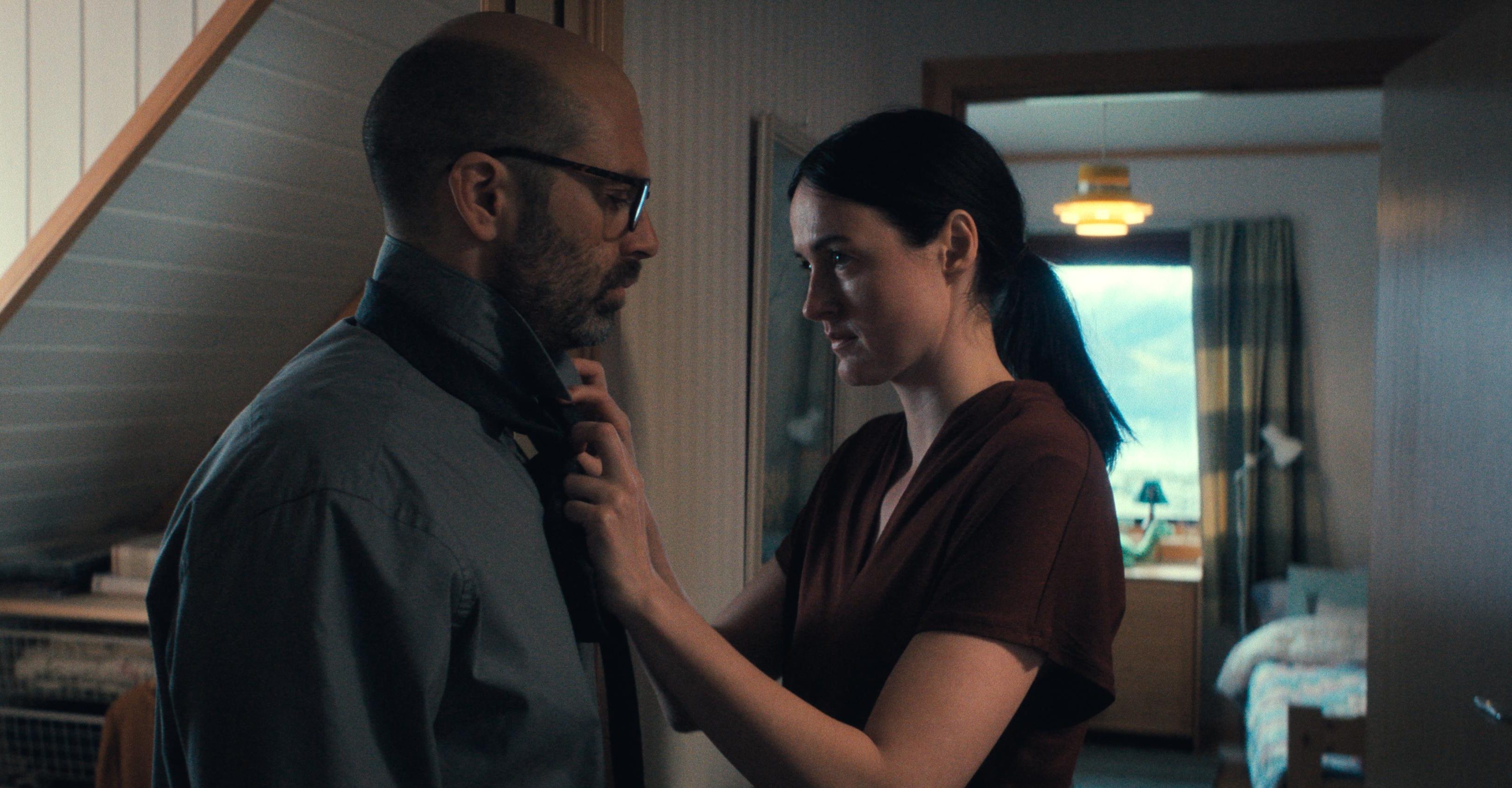
The story focuses on the Gheorgiu family, particularly patriarch Mihai (Sebastian Stan) and his wife Lisbet (Renate Reinsve), along with their five children. There’s a baby and two grade-schoolers, but the only kids who get any real attention are teenagers Elia (Vanessa Ceban) and Emmanuel (Jonathan Ciprian Breazu). After living in Romania for years, the clan has relocated to a small village in Norway, near one of the country’s many titular inlets, to be closer to Lisbet’s extended relations. Their next-door neighbors are Mats (Markus Tønseth), the school headmaster, his wife Mia (Lisa Carlehed), and their own teenage daughter Noora (Henrikke Lund-Olsen), who’s going through her rebellious phase. Noora quickly befriends Elia and Emmanuel, goading them into some playful mischief and convincing them to let go of some of the paranoia associated with their home life.
What paranoia, you may ask? Well, Mihai and Lisbet are incredibly strict evangelical Christians, going so far as to mandate bible study around school hours and handing out punishments for not praying multiple times daily. The film itself opens with Lisbet ordering Elia to apologize to Mihai for some sin she might have committed, and Mihai awkwardly embraces her, telling her it’s important for her to admit when she’s wrong. Clearly they take the “honor thy father and mother” part VERY seriously. One day, while Lisbet (who also works as a hospice nurse in addition to her self-imposed domestic duties) is cooking on the stove, Elia and Emmanuel get into a fight, roughhousing near the kitchen, causing Lisbet to shove them away lest they (or the baby in her arms) get scalded by the boiling pot. The next day, they show up to school with Elia having a bruise on her shoulder and Emmanuel offhandedly telling Noora that they were beaten as punishment for their actions. This statement, overheard by the bus driver, leads to the school administrators interviewing the kids, and when they admit that they are occasionally spanked if they get out of line, Child Welfare Services launches an immediate investigation, taking all five kids to live in foster care until the matter is settled.
What follows from here is the process of Mihai and Lisbet fighting to get their children back, with all the suspicion, innuendo, and uncertainty that comes with it. Mungiu is careful not to show any explicit action that would exonerate the parents or confirm the worst assumptions, leaving things intentionally ambiguous because every parent has a different definition of what it means to discipline their children. No better is this exemplified than when Mihai is taken to the police station to give a statement, and he concedes that sometimes he gives his offspring a swat on the bum, but to him that’s perfectly normal, and does not equate to “beating” or “abuse.” However, in order to even have a chance to reclaim the kids, he has to sign the declaration, which is later used against him in court.
There are a lot of grey areas along the way, which is to Mungiu’s credit as a storyteller. The kids clearly and unanimously want to go home, regardless of the severity of their physical penances. No one’s faith is ever shaken by the tribulations that take place. And despite the protocols and evidence before them, all of the administrators are uneasy about involving the government over what may just be a misunderstanding. At the same time, there are certainly a few scenes where Mihai asserts what he believes is his fatherly authority, including shooing Noora away (albeit politely) when he senses her getting too close to Elia, and scolding Lisbet when she enlists Mia (a former lawyer) as their legal aid in the case, claiming, “Now we do it my way!”
It does make you take stock of your upbringing and how you might apply things to your family life. I don’t have kids of my own, but I’m pretty sure I wouldn’t ever hit them, not even a light “love tap” to scoot them down the hallway. At the same time, I was spanked quite often as a child, and like so many others, I turned out all right. There have been plenty of traumatic moments in my life, but none of them can be traced back to getting a hand on my backside when I misbehaved. My own grandmother used to say that God invented the buttocks so you could be a disciplinarian without leaving a mark or hitting any vital organs. Now, I don’t subscribe to any of that, but I also can’t pretend that corporal punishment is a universal instrument in warping a child’s development. I think if your heart’s in the right place and you’re trying your best to do right by your kids, you’ll figure out the proper path, fully aware that there are lines that simply cannot be crossed. Am I equivocating too much? Probably, but the fact that any viewer can have this internal debate while watching this film, and still keep up with the plot, is definitely a point in the picture’s favor.
Sadly, where the movie starts to falter is in those moments where Mungiu stops presenting good faith arguments and instead just picks a side, and it’s decidedly with the family. While the affair starts off with an even-handed examination of all angles, it quickly turns into an indictment of the so-called “nanny state,” with Norway standing in for all progressive governments who may act hastily, but it’s always in what they feel is the best interest of the child, and has an emphasis on taking the word of the young more at face value than that of the defensive parents. From the moment CWS gets involved, it becomes almost a farcical parade of increasingly aggressive attempts to not only keep the family apart, but to then make this into a criminal matter and an attack on conservative religious rights. Of the many ways this manifests itself are two key sequences, one where an offscreen piece of evidence involves the youngest daughter telling another student who identifies as lesbian that she’s going to Hell for defying God, and a scene in court where an offer is made to Mihai and Lisbet to get their children back if they agree to plead guilty to the criminal charge and admit they beat their kids. They’d serve no jail time and face no fine, but it would be on record that they’re abusive parents.
To me, this is beyond the pale, and it smacks of Mungiu just having an axe to grind against liberal bureaucracy. Is it silly to use a child expressing their religious beliefs as evidence of abuse? Of course, which is why it doesn’t actually happen. At worst, in the real world, the kid gets a talking to with the teacher to let them know that they can believe what they want, but to condemn a classmate is a form of bullying, which isn’t tolerated, so keep it to yourself. More to the point, what kid truly understands their sexual orientation at age seven (the age of the alleged parties)? I’m not saying it’s impossible, but it’s highly unlikely that any child that young can confidently say that they’re a lesbian, or bi, or straight, or anything. Puppy love crushes are one thing, but most kids haven’t developed the hormones for pure sexual attraction by that point, at least as far as I’m aware. Again, not saying it can’t happen, but to make this a lynchpin of the case comes off as extremely disingenuous.
However, this strawman nonsense, in a roundabout way, ends up suggesting a much more sinister revelation, and that’s the persecution complex of the modern right-wing evangelical movement. The instant that the kids are taken, the prevailing opinion of Mihai, Lisbet, and their entire congregation, is that they’re being targeted for being Christian, which is just bollocks, but it’s all too often the default interpretation. We see it all the time, not just in far-right pockets of Europe, but right here in the U.S. Whenever anyone suggests that a religious tenet might come into question, or asks that worship be kept personal and/or private, you’ve got Billy Graham’s Bible Blasters out in force acting like they’ve been wronged because they only have most of the power instead of all of it. This odd lesbian reference is a perfect example. The child who identifies herself as gay (again, we never see it, it’s only spoken of by the adults) does not then turn around and say, “I’m a lesbian, and anyone who doesn’t like it is a doody-head who deserves to get beaten up.” If that were the case, one, it would be noted in dialogue, and two, appropriate action would be taken similar to what I described above, only in reverse. You can’t force your beliefs onto other people, whether we might agree with them or not. However, the victimhood that these extremists place onto themselves is the idea that telling a kid not to damn their classmate to perdition, to simply be polite in polite society, is tant amount to denying their ability to express their faith, and that is 100%, Grade A, certified BULLSHIT!
I’ve said it before, and I’ll say it a thousand more times before I die, I will never quibble with someone’s right to their faith, so long as they’re not doing active harm to someone else, and so long as they don’t expect me to live by their dogma. You want to believe that a carpenter from two millennia ago is the Messiah? Fine. You want to believe that we have brainwashed alien souls trapped in our bodies? I’ll make fun of it, because it’s risible almost by design, but you do you. However, when you apply that to things like murder, genocide, bombing abortion clinics, human trafficking, and making us continually question whether or not a lady named Shelly is still alive, then we got problems.
There is not a single moment in Fjord where the Gheorghius are prevented from practicing their faith. The closest we come for Mihai is a brief scene in the school where he comes across a keyboard and starts playing “Amazing Grace.” His coworkers are impressed that he can play, but they do ask for “a more chipper” number next time. Not a secular song, mind you, just not something as slow and solemn as that particular hymn. For Lisbet, when she first starts working in the nursing home, she is cautioned by her superiors that many of the residents are not religious, so she should refrain from giving them any paraphernalia or praying with them unless they ask. This is not an attack on religious freedom. It’s just a reasonable request to be considerate of others and not be a dick.
It honestly might be the secret genius of this movie. Mungiu clearly sets out to riff on an overprotective and overly reactionary sector of the government, but in his haste to paint with such broad strokes, he may have unintentionally proven why people might see Mihai and Lisbet as unfit guardians. This is ironically aided by Reinsve and Stan’s incredible performances. The pair proved how well they work off each other in A Different Man a couple years ago, and as far as screen chemistry and commitment to the bit go, it’s like they never spent a day apart. Stan, who was born in Romania and speaks the language fluently, plays Mihai with a brooding determination, quietly masking a potential dark streak, but always fully convinced of his correctness in all matters. Reinsve, rather than playing Lisbet as a subservient domestic, has her own full agency, and outside of a couple moments treats her situation with Mihai as a case of equals. She even has her own rather inspiring B-plot where she forms a bond with Mia’s father Åke (Øyvind Venstad Kjeksrud), whom Mia believes is catatonic after a stroke, but really he just didn’t want to interact with his family, as he finds them boring, but sees a zest for life in Lisbet. The way Reinsve and Stan play these characters, you can alternately sympathize, empathize, or denounce them in equal measure, especially when their argument does oftentimes boil down to, “If you don’t let me hit my kids, then you’re denying me my rights as a Christian.”
Really, all the performances are top notch, especially the young actors playing the teens. They deal with some really heavy material, and they acquit themselves admirably, particularly Lund-Olsen. She gets a lot of great moments despite being, maybe, fifth or sixth on the bill. Just like when Reinsve herself broke through with The Worst Person in the World, I’ll be curious to see where Lund-Olsen goes next.
This is a stellar film from a pure production and acting standpoint, but honestly, I’m shocked at the lack of empathy from Mungiu when it comes to the very thorny issue of child welfare, especially when you consider the film that essentially launched his career. When 4 Months, 3 Weeks, and 2 Days came out, it was celebrated the world over for its tender, yet honest look at the issue of abortion, especially when it’s illegal and forced into the shadows. With Fjord, the filmmaking skill and the stalwart deliveries of its leads is what saves it from being an artsy version of a guy complaining about the DMV. There’s a bit of foreshadowing when Mats notes how the walls of the school are fortified to handle the onslaught of an avalanche without injuring the students or damaging the property, arguing that the building can weather the worst of what Mother Nature throws at them. It then becomes dispiriting when Mungiu then leans into, and appears to endorse, people with skin so thin they couldn’t withstand a butterfly landing on their arm.
Grade: B
Join the conversation in the comments below! What film should I review next? Who do you think are the favorites for this year’s International Feature competition? Do you think there’s an acceptable level of corporal punishment with children? Let me know! And remember, you can follow me on Twitter (fuck “X”) as well as Bluesky, and subscribe to my YouTube channel for even more content, and check out the entire BTRP Media Network at btrpmedia.com!


