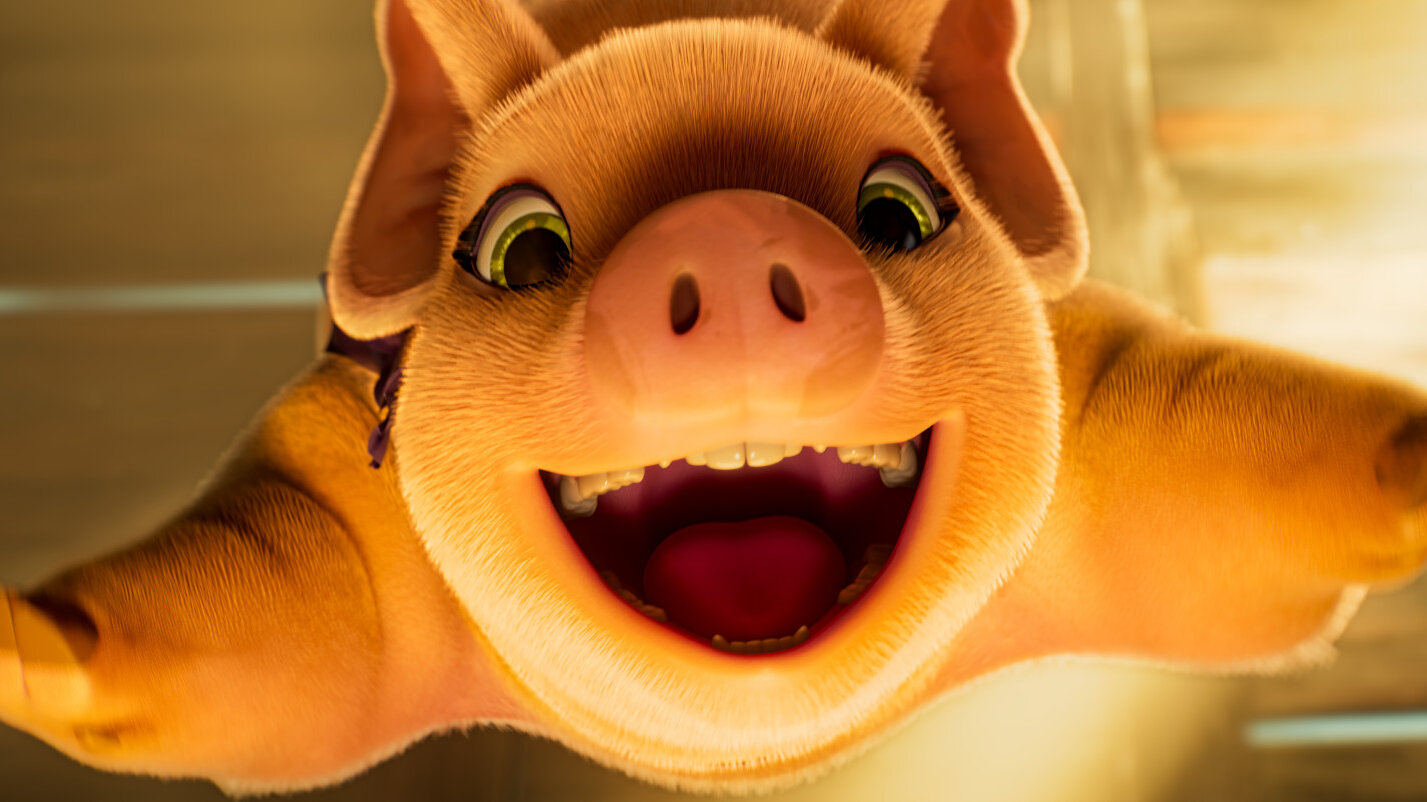

There’s a common phrase in the entertainment industry that you may or may not have heard before. I’ve used it a couple of times in this space, though I’ve never really done a deep dive on the concept or anything. It’s called “Development Hell.” It’s when a project is passed through so many creative hands over the course of several years, to the point that when the final product is at last made public, it in no way resembles the original intent or vision. Oftentimes, one wonders why it was eventually made and released at all, given the overabundance of cooks in the kitchen diluting the idea.
Such was the case with Andy Serkis’s Animal Farm. Debuting at Annecy last year and finally getting a public release this weekend, this flick has been through the wringer. Serkis, along with Rupert Wyatt, secured the rights to George Orwell’s allegorical satire of Stalinism back in 2011, and were in the process of writing the script around their work on the Planet of the Apes reboot trilogy. The plan was to make a motion-capture centric 3D CGI film, similar in vain to the Apes and Avatar films, and by 2018, they had a deal with Netflix for distribution. However, several rounds of studio notes and rewrites later, the Big Red N dropped out, and the film itself was retooled into a mainstream animated picture. After Annecy, the critical response was so negative that Serkis couldn’t get a buyer, until eventually, Angel Studios of all people picked it up. Yeah, the Christian propaganda studio.
With this information alone, I knew I had to see what all the fuss was about. I mean, how terrible could this actually be? How desperate could the producers – which now included Matt Reeves and Woody Harrelson – be to try to make some money off this that they’d get in bed with the psychopaths who gave us Sound of Freedom? What could have happened to make this ambitious project fall so far so fast?
Well, I’ll tell you. It’s a kiddie flick.
No, I’m not kidding. I made a point not to watch any trailers beforehand, because I wanted my eyes to be as fresh as possible when I went to the theatre, but even I couldn’t have imagined that was what happened. We’re talking about one of the most important works of 20th Century literature, one that deftly navigated the recent history of authoritarian communism in Soviet Russia to make it as relatable as possible, and they turned it into a rejected Disney straight-to-video feature. I figured maybe Serkis or credited screenwriter Nicholas Stoller (Forgetting Sarah Marshall) had just wildly missed the point of the story or something, or that maybe the animation itself was shoddy. Those things are also true here, but the fact that the final product was completely reworked to be a pandering nothingburger that insults everyone’s intelligence is something out of a Hollywood nightmare, like the ending of The Player come to life. Like a book report written by ChatGPT, this film fails on nearly every conceivable layer, rendering it ironically as its own cautionary tale.
Basically, I can only give this movie two points in its favor, and even then, they’re in a meta sense. The first is that, as described above, you can tell what Serkis wanted this movie to be, and that was a modern take on the story, but with late-stage capitalism and oligarchy being the enemy rather than militant dictatorial socialism. You can see hints of that original thought peppered here and there, but you also see how quickly and easily it’s bastardized to the point of being self-parody. The second is that the film’s A-list cast (not since Movie 43 have I been this shocked at the number of celebrities in such an objectively terrible film – though at least back then that was the point) includes the likes of Jim Parsons and Laverne Cox, which means that Angel Studios – the people who fight for repression under the guise of Christianity – willingly paid money and put their name on a project that has openly gay and trans actors in a project for kids.
Aside from that, this is a garbage fire of epic proportions, and the jaw drops start early. The film opens with our audience cipher character, Lucky the piglet (Gaten Matarazzo), created specifically for the film, going about his day while the horse Boxer (Harrelson doing what sounds like a bad Owen Wilson impression) narrates, immediately telling us that Napoleon (Seth Rogen… I wish I was joking) is the bad guy, because Heaven forbid the young viewers figure it out through the pig’s actions. Anyway, all the animals at Manor Farm are being loaded into a truck, thinking they’re going “on vacation.” Lucky even endorses the move after he sees that the truck is labeled “LAUGHTERHOUSE,” because the “S” is obscured by the trailer doors. Once Snowball (Cox) realizes the truth, the animals quickly rebel and escape, driving out the drunken Farmer Jones and the rapacious banker trying to seize the land, Mr. Whymper (Steve Buscemi, for reasons known but to God Himself). As this revolution plays out over a whole 30 seconds (complete with cast roll call), the soundtrack kicks in with a rap that goes, and I shit you not, “Old McDonald had a farm, had a farm, ha-ha-had a farm!” Never mind that the farmer’s name is fucking JONES, that is creative bankruptcy and laziness on par with a latter-day Tim Allen sitcom.
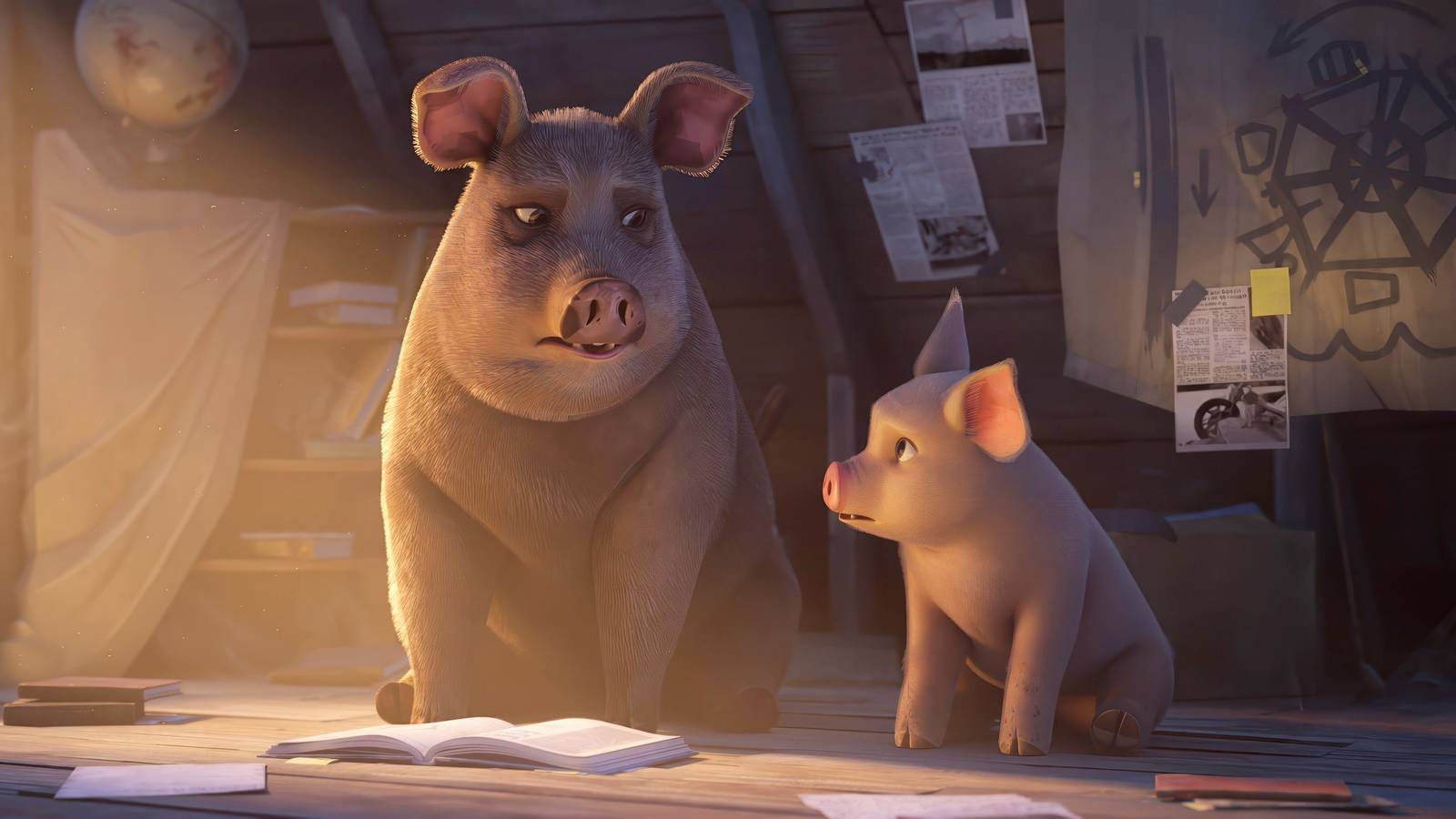
For a while, the plot follows the basic beats of the novella, but you can see where the corners are cut. For example, when Snowball creates the rules of the farm, she repeats the first law that “Whatever goes upon two legs is an enemy,” and loops in “Whatever goes upon four legs is a friend,” making one blanket rule that’s painted on the grain silo, “Four legs good, two legs bad.” If you’ve read the story, or even have a basic awareness, you already see the problem. There are BIRDS on this farm. Ducks, hens, chicks, and Serkis himself voicing a rooster called Randolph (another invention for the film). The actual law is “Whatever goes upon four legs, OR HAS WINGS, is a friend.” This is a crucial omission that will instantly confuse the kids this picture is trying to reach. Any three-year-old can point out, “But the chicken has two legs. Does that mean he has to leave?”
You get the hint of some interesting ideas, but they’re never properly fleshed out or explained. Parsons, for example, plays all the sheep, but in particular one named Carl. He sees what’s going on at the farm when it comes to the growing corruption, but somehow only because a wacky accident sheers him in such a way that his eyes are uncovered. All the other sheep just chant whatever “party line” they’re fed by the pigs. It makes no sense. For whatever reason, in addition to Lucky, we have twin “show piglets” in the forms of Tammy and Puff (both voiced by Ms. Marvel‘s Iman Vellani), the latter of whom is also Lucky’s love interest, for some reason. Napoleon’s villainy starts mainly from sloth before turning into pure, unadulterated greed and delusions of grandeur, making him something of a stand-in for Donald Trump (which makes Snowball, by extension, Kamala Harris in this analogy), which has been done enough already, but could have worked with a bit of nuance. Kieran Culkin plays Squealer not as a skilled orator but as a mindless sycophant, which would also track, but nothing’s done with it. And through it all, the real threat is Pilkington, a rival farmer in the book turned into a lady Jeff Bezos here, inexplicably voiced by Glenn Close.
What starts as basically competent spirals into a carnival of nonsense that defies even the elementary logic necessary to form sentences. Narration shifts between Boxer and Lucky. Napoleon and the pigs get bought off with sports cars and buttered pretzels. The cynical donkey Benjamin (Kathleen Turner… why?) becomes the only relatable character because “he” is the only one who speaks to the sheer inanity of it all and echoes the audience yearning for the sweet release of death. Sometimes the animals can speak English to humans and sometimes they can’t. The animals hold a farmer’s market to attract hipsters. What the fuck is going on?
There’s a disingenuous nihilism to all of it, and it hurts all the more because you can see where it might have worked if Serkis had stood up for his ideas. There are some who are pissed off that capitalism is the enemy in this film instead of communism, and honestly when I heard that Angel Studios had picked up the rights that maybe that meant the production had gone super jingoistic with that misinformation, as they do with many of their other properties. But again, they just bought distribution, they didn’t actually produce it. So there was at least some freedom for Serkis to explore this idea that in the 21st Century, the new form of oppression and fascism comes from the wealthy capitalists rather than opportunistic people appropriating and warping Marx’s vision, especially since the movie was released on May Day. The political ideology was never the threat, but the dangerous people who take it to extremes for personal benefit. Back then it was the Red Scare. Today it’s Trump, Putin, Netanyahu, and all of their ilk. If you squint, you can see the eraser marks where these potentially profound theories were excised in favor of a tween piglet taking selfies, and the fact that all of it was so callously tossed aside is more heartbreaking than Boxer’s quixotic naivete that hard work leads to positive results for everyone.
And honestly, the cruelest joke of all comes at the very end. I’ve harped on this before, but in addition to your ticket money, Angel Studios likes to try to manipulate its largely devout audience by soliciting for studio/church donations during the credits, often by trotting out porcelain white children with QR codes. Since they didn’t make this film, rather than just leaving well enough alone, they decided to be more sneaky and meta with their scam. As they often do, they put a countdown on the screen as the credits started to roll. However, instead of one countdown clock in one corner, they blinked it in and out and eventually placed it in all four corners of the screen at different points, with each one advertising a “Mandatory Farm Meeting” or a “Pig Announcement.” When the countdown concluded, the audience was presented with TWO QR codes to scan. The screen literally asked, “How’s our farming,” with the codes representing the possible answers. If you picked, “Wow, I loved it,” you were taken to a page where you’d be asked to donate money to buy free tickets for other potential viewers/church groups. If you chose “Never do this again,” you were informed that your answer was wrong, and that you need to donate so that Napoleon will forgive you for misremembering how much you enjoyed the film.
Yup, you read that right. The final “gag” is literally gaslighting the audience for money by pretending we didn’t just witness the crass exercise in corporate chicanery that just transpired. I’d say that all but solidifies the Trump analog, except Trump isn’t nearly that clever in his evil. This is what we’ve come to. This is what happens when vision is compromised. I can’t act like I would have loved whatever Serkis’s original premise was, but it certainly would have been more honest and thoughtful than this dreck. It’s one thing to make some creative compromises to get a project across the finish line, but sometimes it’s not worth the aggravation, and this proves the thesis better than anything I could have ever dreaded into existence. We took Animal Farm, a fairly easy to grasp Cold War satire, and turned it into a fourth-rate Illumination knockoff with pointless new characters, Seth Rogen cackling for a pig in a track suit, religious kleptocracy, a Nickelodeon-style 90s rap about a farmer with the wrong name, and a story that changes the target of its commentary while simultaneously missing the point of all of it.
To quote a much better property with Andy Serkis in it, “CAST IT INTO THE FIRE!”
Grade: D-
Join the conversation in the comments below! What film should I review next? What movies have shocked you by how badly they missed the mark? Is casting Kathleen Turner as male characters supposed to be a joke about how she’s not hot anymore? Let me know! And remember, you can follow me on Twitter (fuck “X”) as well as Bluesky, subscribe to my YouTube channel for even more content, and check out the entire BTRP Media Network at btrpmedia.com!


2 thoughts on “Slop – Animal Farm”