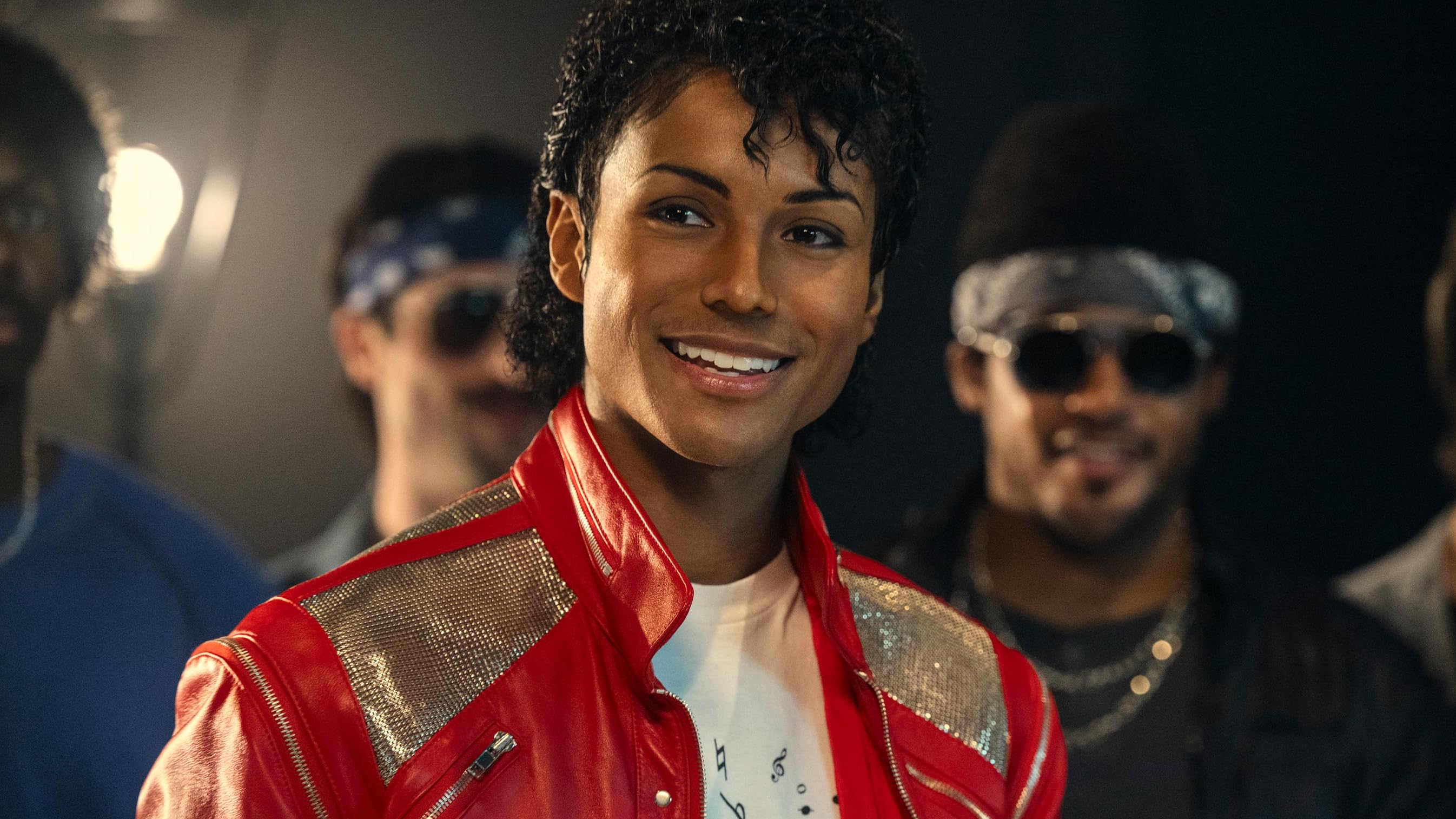

Thirty years ago, the movie Michael was released. It was a shmaltzy bit of 90s tripe where John Travolta played a chainsmoking archangel who somehow taught a struggling country singer and a tabloid journalist how to love. Also, there was some bullshit with Bob Hoskins and a dog. It was pure, distilled 90s that was the right kind of cheesy in the moment, but quickly aged like, well, milk.
I’d rather watch that film on a 24-hour loop than watch the 2026 Michael again.
A revisionist and controversial biopic about the late King of Pop Michael Jackson, Michael is already breaking box office records, which in today’s economy will be seen as justifying everything involved in its production, but once the nostalgia and novelty wear off, I’m guessing it will be seen for what it really is, a textbook example of why we as a society should leave well enough alone. After a troubled development cycle where fine print in legal agreements made it so that any reference to Jackson’s latter-day scandals were completely excised, along with any mention of Randy, Rebbie, or Janet even existing, the project was, from an artistic standpoint, rendered meaningless. Directed by Antoine Fuqua and produced by Graham King (who already knows about sanitized musical biopics after making Bohemian Rhapsody), the picture does heavily involve some remnants of Jackson’s family, but not in a way that’s satisfying, or indeed, honest. However, rather than just cutting their losses and admitting that there can’t be a true portrayal of Jackson without acknowledging the more salacious aspects of his life (to say nothing of the insult to his alleged victims), Fuqua et al pushed ahead with a pure fantasy depiction of the singer, in the end more whitewashed and artificial than Michael’s actual face before the end.
The main problem is in how saintly and daintily Jackson is shown. Beginning as a child (Juliano Valdi) with the Jackson 5 and later progressing into his adult solo career (Michael’s nephew Jaafar Jackson), our lead is never presented as anything other than a god among men. Everyone lauds his talents, convincing him that he’ll be the greatest who ever lived. He gets a Dr. King-esque speech where he somehow solves inner city violence by casting gang members for the “Beat It” video (only to quickly relegate them all to the background without input). Every choice he makes is for the betterment of others, right down to an awkward moment where he buys a Twister board game so that he and his brothers can play like they did as kids. When it comes to actual children – a subject that should have been treated VERY delicately – his only interactions are altruistic. Child Michael sings “I’ll Be There” to a girl in a wheelchair. He signs autographs at a toy store. There are three separate scenes where he spends time with juvenile cancer patients at the hospital. There’s not even a whiff of his potentially pedophilic predilections. Even his musings about “Neverland” are just moments of whimsy as he stares at an illustrated Peter Pan book. It’s almost appropriate that so much time is spent on him and his mother (Nia Long) watching old movies like Pinocchio, because in many ways this version of Michael is tant amount to a lost Disney Princess. The closest thing to a “flaw” in his character is his inability to stand up and be assertive to his father Joseph (a tragically wasted Colman Domingo), a domineering and calculated figure here rendered as little more than a cartoonish, slack-jawed monster of greed. Half the time he looks like Dave Chappelle’s impression of Rick James.
It’s not that there aren’t good things in this film. The makeup job done on Jaafar showing the progression of Michael’s facial transformations (up to the 1988 Bad tour, where the film conveniently ends) is pretty decent. The sound editing, which often isolates Michael’s vocal tracks from his biggest hits so you can tell just how great a singer he was, is a nice touch. To his credit, Jaafar clearly put in the hours to properly recreate his uncle’s dance moves. You can tell there was effort put into this.
But that doesn’t make this good, other than the fact that the film often drifts into “so bad it’s good” territory. The first time Jaafar speaks as Michael, the voice is so affected and fay that I couldn’t help but laugh. It sounded like every lame comedian’s impersonation of Michael, like the voice didn’t even match his face or body, and I’m not talking about lip sync and ADR. You eventually get used to it, but seeing him grin like an idiot while reading his lines is unintentional comedy on par with The Room. Similarly, there are moments that are just downright unsettling out of context. For example, there’s a scene where Michael reads fan mail with his sister LaToya (Jessica Sula), saying his fans are his family (the word “family” rivals your average Fast and the Furious movie for degree of repetition), all while stroking the head of a boa constrictor on their couch. When he’s called away, Michael teases LaToya to be careful, because the snake is “very hungry.” There’s a cut of this film where Michael is a serial killer.
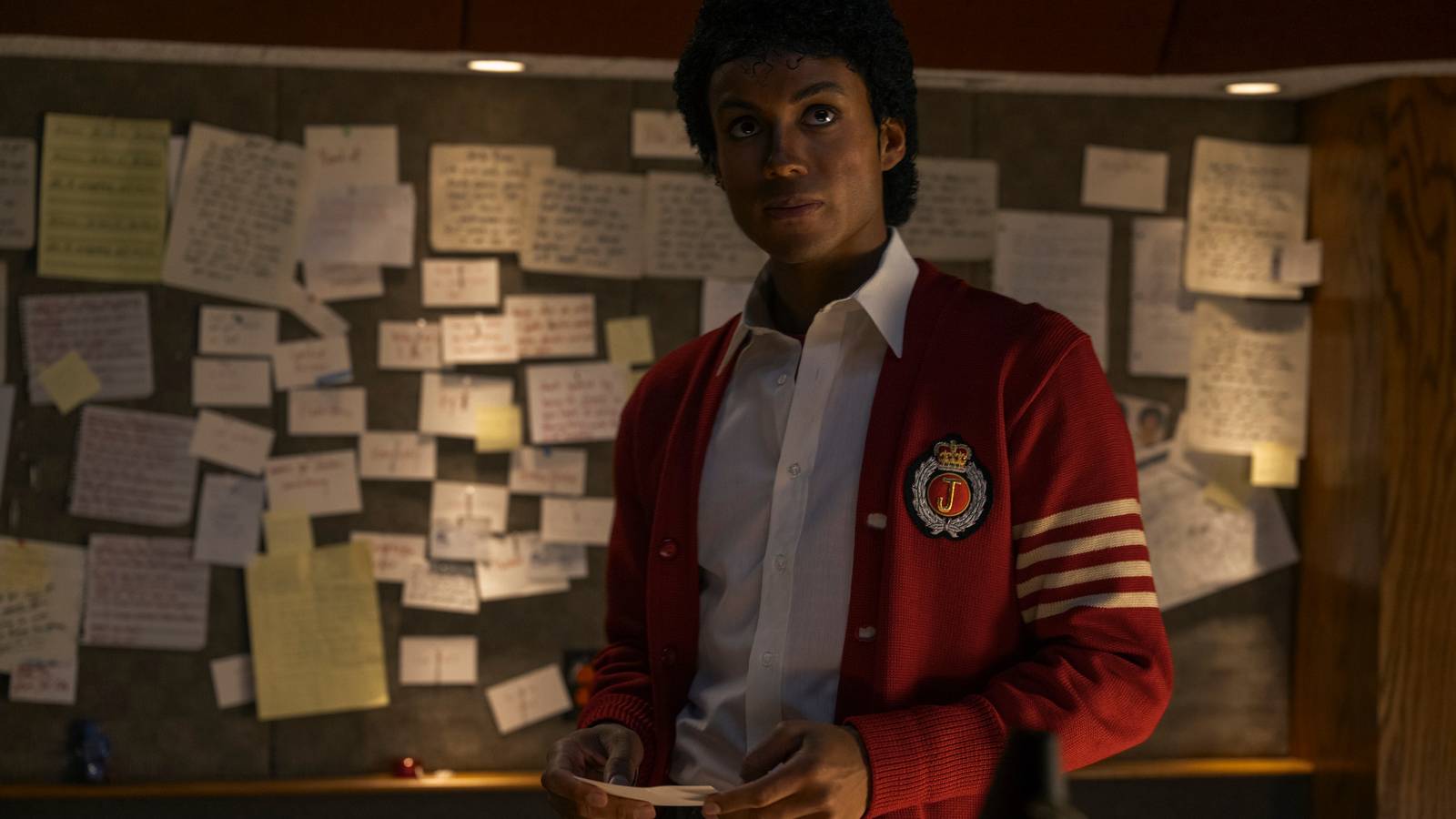
From a technical standpoint, the flick comes up massively short. The camera work is all over the place, and in ways that are unnecessarily glaring. The biggest instance of this is during the filming of the “Thriller” video. Michael calls a cut in the action, asking his bodyguard Bill Bray (KeiLyn Durrel Jones) to relay a request to the unseen John Landis to do a take where the camera pulls out all the way so that you can see his feet during the zombie dance. Never mind that there’s no playback monitor that Michael can see to know his feet aren’t in frame, when he’s obliged, the scene is just a shot-for-shot replication of the music video, as if several cameras are shooting from 20 different angles in real time. So what was the point of that, other than to have another example of Michael being a meek genius who’s quiet but smarter than everyone else in the room?
There are a few moments, particularly during concert performances, where the editing is sharp and tight, vacillating between Michael’s dance moves and the manic adoration of the crowd. But the rest of the time, the editing is cheap and slapdash, often cutting in the middle of a line of dialogue to an angle where the character speaking is still speaking, just from a different view that’s awkwardly matched up. Apart from that, the CGI on some establishing shots looks like it was AI-generated, the scene for “Beat It” takes place seemingly before the song is even recorded, the animation on Bubbles the Chimp (who gets WAY too much screen time) and the rest of Michael’s menagerie is shamefully bad, Miles Teller plays Jackson’s manager John Branca (who also got a producer credit along with much of the Jackson clan) like an 80s version of John Cusack that got stuck in a microwave, and in the oddest parallel to Bohemian Rhapsody imaginable, Mike Myers cameos yet again as a record executive. At least this time he plays a real person, CBS Records president Walter Yetnikoff.
But really, all of this is largely irrelevant because the film never addresses the elephant (llama, giraffe, whatever) in the room. I’m not saying we had to show Michael as a predatory beast abusing children, but to pretend there was nothing going on in his head, other than the nebulous princess idea of “wanting more,” and that he was this innocent child in a man’s body, is just disingenuous. In a way, it’s slander via lies of omission. It’s okay to separate the art from the artist. Tons of celebrities have dark sides and have done wrong. John Lennon hit Yoko. Arnold Schwarzenegger knocked up the housekeeper. Joan Crawford abused her daughter to the point where that trauma itself turned into a film. But there’s a difference between accepting someone warts and all and simply living in denial. This is the latter. Literally nothing that happens to Michael is his fault. Even his eventual addiction to painkillers – what ultimately ended his life – is only hinted at in the film, and even then it’s presented as being indirectly a sin on Joe’s part for “pressuring” Michael into the Victory Tour and Pepsi commercial that ignited his hair.
In this way, the film is even more damaging than it would have been if it had just ignored Michael’s demons. This flick openly absolves him of any responsibility for any negative thing that happened in his life. He just wanted to be a normal kid and have friends. Instead, he was forced to work against his will, so his only companions end up being his pets and his mother, and he dreams of escaping to Neverland. Are we really trying to say that he’s off the hook for molesting kids because his dad whipped him with a belt? Because guess what? A lot of us got whipped as kids, myself included. I still have yet to diddle a child. Maybe I’m a special one.
Look, I loved Michael’s music. I grew up trying to dance like him (never could figure out the Moonwalk, but I was able to do a reasonable imitation of the “Thriller” dance at one point), and I spent hours singing his songs, both from his Jackson 5 days and his solo career. When I first went to Disney as a kid, my sister and I made a beeline for Captain EO. I know the impact his work has had.
But that doesn’t mean that I can just act like the other stuff isn’t real. I don’t know all the facts. Few people do. But there’s enough evidence and testimony to suggest that something profoundly wrong happened with him, and that has to be understood and given proper attention. If you’re not willing to go there, then what’s the point?
Nostalgia baiting and profit, that’s what. If all you want is to turn off your brain and willingly succumb to cinematic gaslighting for the sake of reminiscing about songs you loved from the 60s-80s, fine, go with God. Unfortunately, though, we live in a world where objective reality is being denied and actively fought at nearly every turn, and a movie like Michael is just another symptom of the disease that goes undiagnosed for the sake of a quick buck. It’s one thing to take dramatic license, but even Bohemian Rhapsody balanced its fiction with the facts of Freddie Mercury’s private life and eventual illness and death. There’s a reason why half the living Jacksons wanted no part of this. There are still wounds to be healed, hard truths to reconcile, and it’s a disservice to Michael and those whose lives he changed for better and worse to ignore them, especially for money. If you really want to just close your eyes and listen to some hit songs in a movie theatre, you’ll enjoy this. If you’re looking for anything resembling honest insight into the life of a very complicated artist, this will be among the worst films you see this year.
Grade: D
Join the conversation in the comments below! What film should I review next? Are you okay with bending facts for entertainment in music biopics? Anyone else find it ironic that “Pretty Young Thing” isn’t in the soundtrack? Let me know! And remember, you can follow me on Twitter (fuck “X”) as well as Bluesky, subscribe to my YouTube channel for even more content, and check out the entire BTRP Media Network at btrpmedia.com!


2 thoughts on “Sham On! – Michael”