
Steven Spielberg is inarguably one of the greatest filmmakers in history. He’s given us some of the most inspiring, dazzling, and poignant movies ever made, from E.T. to Schindler’s List. He is the very definition of an auteur, and even in his weakest entries, he’s earned a degree of deference and a lifetime of mulligans.
That said, he’s also definitely fallen victim to his own ego and foibles over the years. He’s had a strange preoccupation with making movies featuring aliens, even when it’s not warranted based on the story structure. He’s addicted to “cool” shots, even when they don’t make sense within the context of a scene. He’s far too prone to settling for “popcorn” entertainment when the opportunity is clearly there to do something profound. He sometimes straight up believes he’s better than his contemporaries and forebears when it comes to telling certain stories, evidenced by the West Side Story remake. And as I and several others have mentioned over the years, he has a fetish for backlit spotlights and lens flares, which can come off as whimsical at times, but mostly it’s just distracting/blinding.
All this is to say that when Spielberg hits, he hits better than almost anyone out there. But when he misses, it feels like a cheap parody of his own greatness. His latest film, Disclosure Day, falls squarely in the latter category. Billed as a thrilling and cerebral companion piece to his previous otherworldly masterworks, the end result is frustrating, preachy, and often plays like a knockoff of Close Encounters of the Third Kind.
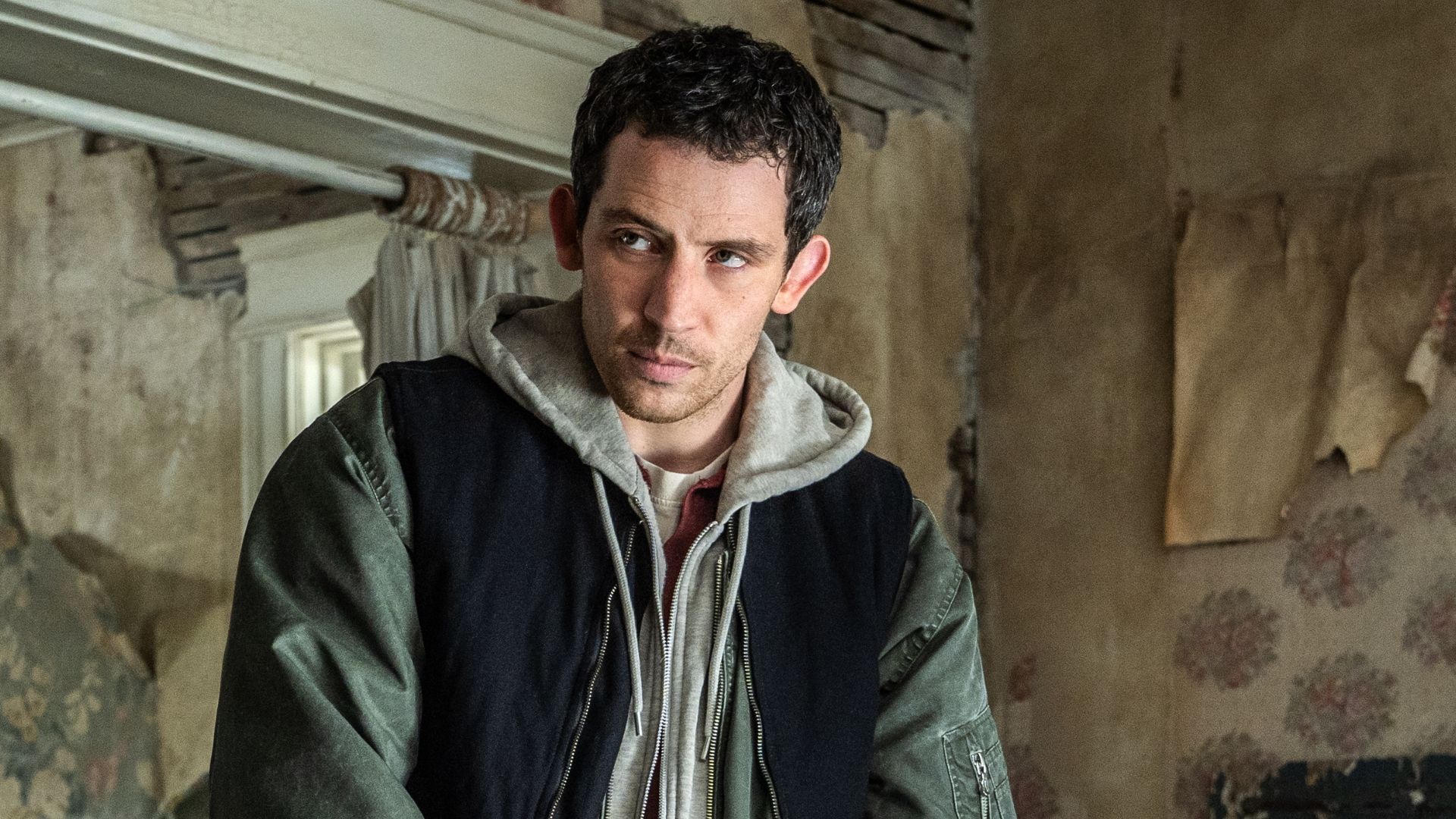
You know you’re on shaky ground when the film opens at a pro wrestling match, shot by cinematographer and frequent Spielberg collaborator Janusz Kamiński from a first-person perspective of the “losing” combatant, meaning our very first images are of abject scripted fakeness being screamed directly into your face. Not a good sign. This leads into the first major confrontation between one of the main protagonists, Daniel (Josh O’Connor) and his former boss, Noah, played by Colin Firth. Daniel was a tech specialist at the secretive security contractor Wardex (I dare you to not subliminally replace it with Windex) who, along with a dozen other staffers, stole sensitive videos and data that prove the existence of extra-terrestrials on Earth. He’s coordinating with another former supervisor called Hugo (Colman Domingo) to eventually release the information to the world, and Noah – along with his vaguely defined and most certainly illegal private militia – wants to stop him at any cost, including kidnapping Daniel’s girlfriend Jane (Eve Hewson, utterly wasted in a thankless role). The meeting at the wrestling match is to exchange the stolen assets for the girl. But of course, Daniel has the upper hand, as he also stole a “device,” one of a pair where Noah naturally has the other, that has nebulous and plot convenient abilities when gripped. The movie tries to make this thing into a scary weapon, but it looks like a travel version of the metallic xenon thingy that Rocky sends to Grace at the beginning of Project Hail Mary. Daniel and Jane escape, and the chase is on.
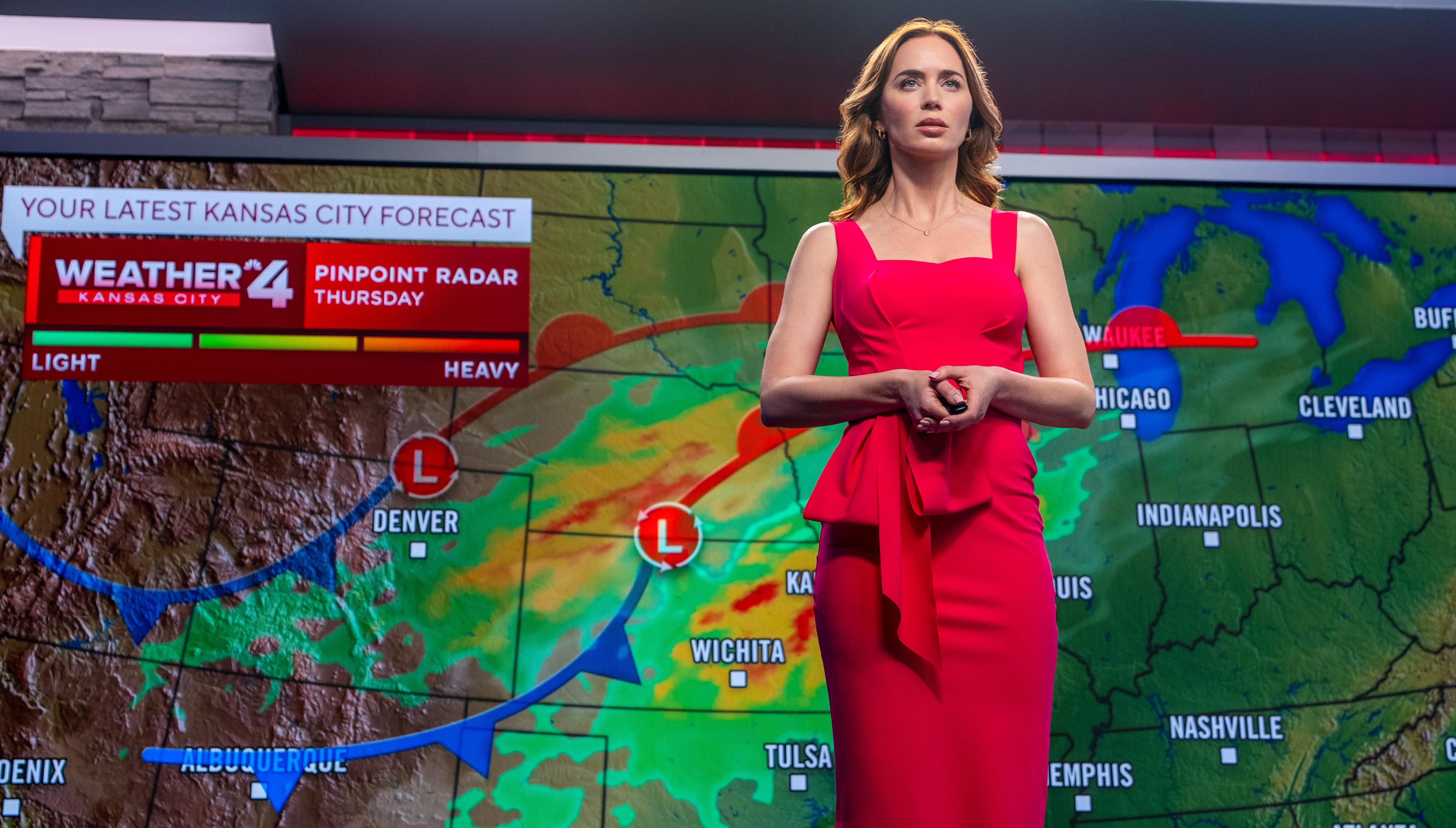
Meanwhile, in Kansas City, a weather reporter for a local news station named Margaret (Emily Blunt) is constantly searching for “something more,” like she’s a lost Disney princess. She and her boyfriend Jackson (Wyatt Russell) have moved to and from multiple cities as Margaret chases her career ambitions to elevate from weather girl to the anchor, but Jackson likes the life they’ve created for themselves. After an exceedingly fake-looking CGI cardinal flies into their loft apartment and stares at Margaret, she can suddenly speak fluent Russian, much to Jackson’s shock. Before anything can be processed, Margaret rushes to the television station to give her report, but she’s stopped by a police officer. She gets out of a ticket by instantly reading the cop’s mind, giving him some family advice, and driving away as he stands dumbfounded. When Margaret arrives, rather than giving her weather report normally, she instead starts talking in a series of clicks and groans, though she alone doesn’t notice anything amiss.
This dual opening illustrates the key issue with how the plot unfolds. We are told absolutely nothing about what’s going on, but we’re meant to accept it at face value. There’s a scene a few minutes later on where Jane tells Daniel, “There will come a moment when I ask you to tell me everything. And you will tell me everything.” When that moment comes, Daniel tells Jane nothing of consequence, instead showing her some of the alien proof footage on his computer, hiding most of it from our view, and that’s meant to suffice as an explanation. This is infuriating. I’m a strong proponent of the “show, don’t tell” philosophy, but you do still have to show us something that makes sense, or at minimum tell us enough to put what we see into proper context.
We get none of that here. It takes nearly 40 minutes for anything to be communicated that expressly says the MacGuffin is aliens. That could be suspenseful if done properly, but because movie marketing is what it is, every single person who sees this already knows it’s aliens thanks to the trailer. There is no surprise here, only frustration that they won’t just come out and say what’s going on. The introduction only exacerbates this, because that meta knowledge is used to hand-wave the exposition and give us scene after scene of batshit nonsense that we’re just meant to accept. If it’s so important to expose the existence of beings from another world to ours, why is there even a pursuit? Daniel and Hugo have the proof, why not just upload it immediately? Problem solved. Instead we have to have this meandering black-ops style festival of clichés rather than getting to the bloody point.
And in Margaret’s case, not only does no one take a minute to breathe and process what’s happening, anyone who attempts to make sense of it all – chiefly Jackson – is accused of gaslighting her and calling her crazy. Seriously, how hard is it to say, “Whoa, what was that? It sounds like you were just speaking Korean for the last 30 seconds. How did you do that?” and have Blunt take a step back and say, “What do you mean? To me it was perfect English. Wow, that’s weird. Let’s figure out what’s going on”? I mean, she literally reads a policeman’s mind and tells him stuff about his family that no one would know, and not even SHE questions how she can do that! That’s just lazy writing.
From an inside baseball standpoint, this extends to Margaret’s first moments through her work. From the time she leaves her apartment, it takes her a few minutes to drive to the station, get pulled over, and walk inside, where she’s briefly scolded by her producer for being late, but then literally does a walk-and-talk while getting her makeup done, puts on high heels, speaks fluently to a Korean diplomat in the studio (oh yeah, all of this is happening while a World War III-style military buildup with North Korea takes place completely in the background), and then she stands in front of the camera just in time to do her segment.
People, I work in television. I’ve been in this business for over 20 years. That is not even remotely how any of this works. On-air talent is due on set hours before they’re meant to go on, not five minutes. If Margaret was supposed to be on a morning show (evidenced by Jackson making breakfast when we first meet them), she should have been at the studio by 3am at the latest. Reports are written, edited, re-written, and approved multiple times before they’re put in the teleprompter, where the talent simply reads what’s on the monitor without improvisation. Makeup is done well in advance, because it can smear if applied too quickly, and on-air personalities wear microphones on their bodies. Margaret doesn’t even get mic-ed up! Spielberg probably thinks this sequence looks awesome because it’s largely done in just a few long takes with minimal cuts. But the reality is that Margaret would have likely been fired, or at least read the Riot Act before her producer brought in a substitute for the day, and any aspirations towards the anchor desk would instantly be kiboshed because she’s clearly a fuck-up. Add in the fact that, given that we’re in Missouri, Margaret is more likely to have been shot by the cop if she were anything but an attractive white woman for all her arguing against getting ticketed, and that the movie made up a call sign for the station (KCXE) while keeping NBC branding because the film is a Universal property (Kansas City’s actual NBC affiliate is KSHN if you’re curious), and the whole thing just screams that not an ounce of research or care was put into the script. Sadly, since this was penned by David Koepp, the most successful hack writer in Hollywood, it’s the only part of the screenplay that actually makes sense.
From then on, it’s just impossible to get engaged with the material because the plot has more holes than your average block of Swiss cheese. Wardex believes in retrieving the smuggled files as discreetly as possible, but employs a private army all traveling in a line of black SUVs. As Daniel and Jane hide in a remote country house, crop circles form around Daniel for no reason and are never addressed in future. Daniel tries to “sneak” towards the cars to make an escape, but he’s in an open field where anyone can see him, including the multiple agents looking in his direction, but because it’s a movie they simply don’t. And when he gets to the car at the back of the convoy, rather than quietly backing out and driving away, he pulls forward and rams into the other vehicles. Meanwhile, Noah is using the thingy to “possess” Jane in an attempt to mind control her to get her to kill Daniel, and he’s temporarily defeated because Jane cuts her hand with the giant crucifix necklace she wears (oh yeah, Jane used to be in training to become a nun, and initially hates the idea of revealing aliens because it somehow takes away God’s powers of creation or something), so literally NOAH is beaten by the POWER OF CHRIST COMPELLING HIM! ARE! YOU! HIGH?!?!?!?!?!
Compare this to something like Close Encounters, since it’s clear Spielberg et al really want you to get nostalgia triggered. That film was also about the buildup of discovering other life in the universe, but it was done incrementally, with the characters trying to make sense of it all as they went. Here, there’s no “This is important. This means something.” That confused yet curious sense of wonder is literally replaced with Daniel and Margaret facing down a firing squad while standing next to a car, with no one shooting because Margaret just gave them all mental images of their dead relatives, somehow stopping them in their tracks. Daniel speaks for us all when he gapes, “I don’t understand what’s happening,” to which Margaret responds, “Just get in.” That’s the difference here. Close Encounters invited you to imagine what could happen if aliens were real. Disclosure Day just states declaratively that it is all real, that you’re owed no explanation, and you just have to go with it. This is reinforced during the finale, where a news anchor played by Courtney Grace tearfully tells the viewers something along the lines of, “We’ve all been changed because of this” and “If you’re watching this, you’re not alone.” Well duh, there were more than two people in the auditorium. And way to stroke your own ego, Steven.
Once you realize that conceit, the whole movie falls apart. Why is Hugo building… something in a warehouse? Who cares? The payoff is idiotic anyway. Why is Jane having a crisis of faith? Who cares? It means nothing. Why were Margaret and Daniel picked to have these powers by the aliens? No reason. Why doesn’t anyone shoot the obvious dead person standing in front of them when confronted with their visage? Because logic would ruin the “fun.” Why is there a 40,000 watt beam of light coming from a west-facing window at 10 in the morning? Because fuck you, spotlights are awesome! What would happen if the world found out aliens were real? It’s far more important to show everything EXCEPT that.
Now, for what it’s worth, the film is not a total loss. While it’s clear that Spielberg cares far more about shots that look good rather than being appropriate (there are so many continuity errors that I genuinely wonder if he thought to shoot any coverage), some of them do look pretty great, particularly during the climax (invisible firetrucks ramming into things is classic Spielberg). It sucks that it took two hours to get there, but I’ll take whatever wins I can get at this point. While Margaret as a character is completely absurd and unreasonable, Blunt plays her to the hilt. Whoever the dialect coach on set was, they didn’t get paid nearly enough to convincingly train Blunt to not only speak several foreign languages, but to seamlessly work them into her normal dialogue. That’s pretty amazing. While the ending is incredibly naïve (and weirdly steals Blunt’s big moment in favor of Grace), there is a degree of hope in it that would hit much harder in a better film. The score by John Williams is a touch familiar, but still has that grandiose sweeping flair to it that we all know and love, the one instance of good nostalgia baiting.
The problem is that the flick is all style with no real substance, and even that style feels like Spielberg playing the hits in a half-assed manner. This isn’t E.T. This isn’t Close Encounters. But it certainly wants you to think that it is, even though it’s just a basic “conspiracy” movie with aliens as the backdrop and no interest in helping the viewer along if they don’t completely buy in to the underlying concept well in advance. And that’s just not how any of this is supposed to work. One of the most unintentionally hilarious moments comes during the climax, when a random control room technician asks if what they’re seeing is AI-generated, only to be instantly shot down by someone else telling him that the footage was totally screened by AI detectors in the microsecond they’ve been watching, and it’s all totally real, you guys (even though it looks completely fake to us in the theatre)! That’s where this ultimately fails. We’re ordered to believe everything we’re seeing despite no evidence, only the say-so of the so-called “good guys” who go to convoluted lengths to do what Edward Snowden did in 15 seconds. For a film called Disclosure Day, Spielberg and Koepp almost gleefully refuse to give us any useful information, with the picture insisting upon itself with nothing more than name recognition in place of credibility. It’s not as bad or illogical as War of the Worlds (seriously, how does a blood infection from eating humans cause the spaceships’ shields to drop so they can be blown up?), but that’s not a high bar to clear. Even the idealized version of Spielberg we saw in The Fabelmans would call this absolute trash.
Grade: C-
Join the conversation in the comments below! What film should I review next? What’s your favorite Spielberg picture? Why couldn’t the production be bothered to get actual raccoons and deer for the animal scenes instead of shoddy CGI? Let me know! And remember, you can follow me on Twitter (fuck “X”) as well as Bluesky, subscribe to my YouTube channel for even more content, and check out the entire BTRP Media Network at btrpmedia.com!


One thought on “Spielberg Tells Us Nothing – Disclosure Day”