
By now you all know my feelings about the Toy Story franchise. The original trilogy (the fact that I can use that phrase in multiple contexts is emblematic of the problems with modern Hollywood) are all-time classics, with Toy Story 3 ending things on the most perfect note imaginable. And then we did Toy Story 4 because MONEY! And then we did Lightyear because MONEY! Neither film was altogether bad, but they are textbook examples of “unnecessary,” and they did have glaring flaws, like overstuffing the already fit to bursting ensemble casts, retconning previously established canon, and the feeling that they only exist because Pixar is running out of ideas and/or creative freedom as part of the larger Disney machine.
So you can understand why I was a touch apprehensive about having a fifth installment. I mean, what else is there to do without just fully denigrating what made the series essential to Pixar’s identity (and the art of cinema writ large) in the first place? It also felt exceedingly rich and tone deaf for Disney of all companies to present a villain in the form of a tablet when the company itself tries to insert itself into our lives through every screen imaginable, and even flirted with generative AI in the form of the “Sora” deal that was mercifully aborted earlier this year. They’re pretty much the least qualified people to lecture us on the value of imagination and human contact over technology.
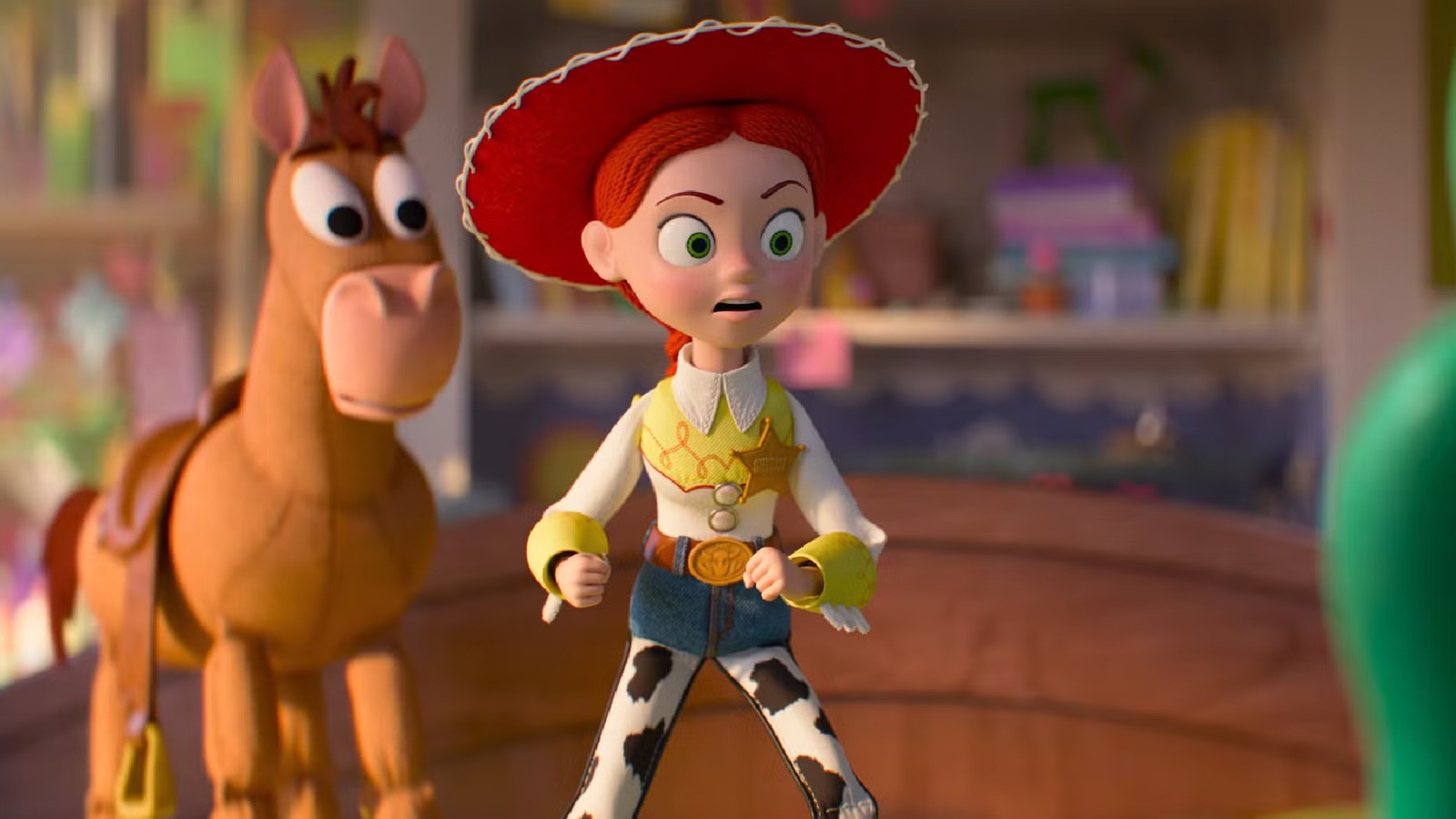
With all that in mind, what could Toy Story 5 possibly do to stand out and actually deliver some quality? Well, the answer lies in two creative decisions that largely work to great effect. The first is some character development for our main human protagonist, and the other is shifting the narrative away from Tom Hanks’s Woody and Tim Allen’s Buzz Lightyear and refocusing it on Joan Cusack’s Jessie.
There were hints in the last two films that Bonnie (now voiced by Scarlett Spears, who did more to make Glinda likeable in her single scene of Wicked: For Good than Ariana Grande did across two movies) was a bit different than most kids. She was overly shy and had problems socializing in kindergarten. You got the impression that there was territory to explore about her having development issues, perhaps being on the autism spectrum, or at least somewhat neurodivergent. This entry does indeed dive into the possibilities here, with Bonnie being at her happiest when she’s letting her imagination soar with her toys, beginning with a wedding between her own creations, Forky (Tony Hale) and Karen Beverly (Melissa Villaseñor), but also being petrified about inviting the neighbors to join her. The arrival of our antagonist, an AI-fueled, frog-shaped tablet called LilyPad (Leapster should sue), voiced by Greta Lee, comes out of Bonnie and her parents trying to find ways for her to make friends.
You can see the desire in Bonnie’s eyes to be accepted and have a social life while still being who she is at her core. When her classmates tease her for still playing with toys instead of just the device, her anxiety isn’t based in the old adage of “putting away childish things.” It’s an indictment of her own personality, or her development as a child and person. She’s only eight years old, but other eight-year-olds are basically mocking her for not behaving like a 16-year-old. The way the film tackles the issue is a bit clumsy, mostly because it’s framed in the context of Jessie’s battle with Lily rather than the child’s actual emotional needs, but it’s more character development than Andy ever got. As much as I love the original films, and as superior as they are to the more recent two in nearly every conceivable way, it can’t be ignored that Andy was basically a MacGuffin for Woody and Buzz, while Bonnie is treated like an actual kid. Again, the subject isn’t handled as delicately as it should be, but at least it’s something in the way of the film justifying its existence beyond P&L charts.
When it comes to Jessie, it does sort of feel overdue for her to get the spotlight. She’s been the solid #3 of the gang since Toy Story 2, but she’s never gotten the spotlight, even though one of the inciting incidents of the last flick was Bonnie choosing Jessie over Woody as the new “sheriff.” It’s good to see a shift to the only key player who hasn’t been a true lead, and for what it’s worth, her story isn’t a bad one. I just wish it was a bit more original.
Essentially, Jessie is afraid that she’s outlived her usefulness. She mentions her original owner, Emily (seen in flashbacks with an instrumental version of “When She Loved Me” in the background), as well as her time as Andy’s toy. With Bonnie growing up and Lily working aggressively to take the child away from the analog world and into the digital, Jessie fears being permanently rendered obsolete. This insecurity is amplified when she contacts Woody via walkie-talkie (you’ll recall that Woody left the group with Annie Potts’s Bo Peep to be a “lost toy” that any kid can play with) and learns that “tech” has invaded more and more homes, creating an overload of childless toys. After a disastrous sleepover where Lily manipulates Bonnie’s parents to box up all the toys, Jessie and Bullseye the horse get left on the side of the road, where an elderly couple picks them up, notices Emily’s old address written on the inside of Jessie’s chaps, and delivers them to that house, now occupied by a nine-year-old horse enthusiast named Blaze (Mykal-Michelle Harris from Mixed-ish). Jessie’s dual task is to get over her own worry to return home while also finding a way to get Bonnie and Blaze together as potential real-world friends.
There are some terrific moments in this plotline, especially the requisite “Pixar Feels” moment in the third act, and the genuinely creative fantasy sequences when Bonnie and Blaze play with the toys. Unfortunately, it does get bogged down by some logical inconsistencies (even within the context of talking toys) that have plagued the series since it was resurrected in 2019. We add still more side characters to this already way overcrowded franchise, in the forms of a digital camera called Snappy (Shelby Rabara), a hippo with a GPS named Atlas (Craig Robinson), and a toilet training device named Smarty Pants (Conan O’Brien). They too feel the sting of obsolescence, bridging the gap between toys and tech, but we’ve also established in this series that the toys are aware of their purpose and intended age usage. So yeah, it may be a shock that none of them has seen Blaze since she was three, but they should also know that they weren’t meant to if the movie is playing by the rules the series itself set.
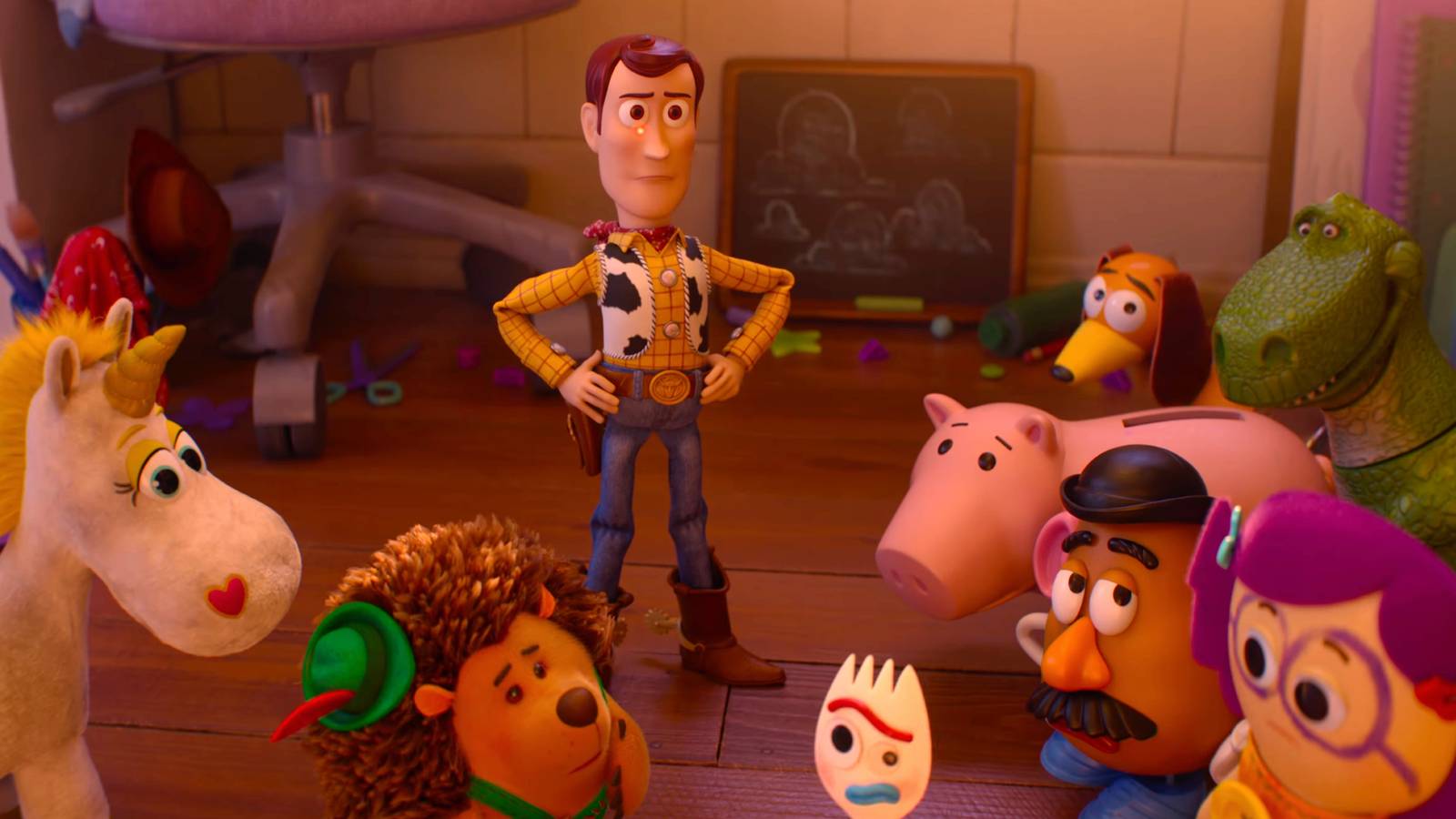
Similarly, the narrative device of having Emily’s address written on Jessie to get her back to her old home makes very little sense if you have any recall of the earlier movies. In Toy Story 2, we saw how Al hired a guy to paint over Andy’s name on Woody’s boot to make him appropriate for sale to the other collectors. You’re telling me he never noticed an address written on a freely moving piece of fabric on Jessie? Or that Andy himself never saw it while playing with her for over a decade? Really? This has never come up in any previous film to my knowledge, and yet it’s the lynchpin of the plot. You seriously couldn’t find another way to get Jessie to Blaze’s house without retconning and contradicting your own previous works? This even extends to the trademark emotional whammy later on, because it throws the events of Jessie’s original abandonment into question.
You may have noticed that I haven’t really mentioned Woody or Buzz in this review, and that’s because the film all but forgets they exist, with three notable exceptions, all of which just don’t work. When Jessie contacts Woody, he takes it upon himself to return to Bonnie’s house to help, mishearing through static that Jessie wants to deputize him. What she really said is that she had already tapped Buzz for that duty, but aren’t mishaps from 70s sitcoms just the funniest? So Woody shows up, and he and Buzz playfully argue about who should be the true deputy. It’s even lamer than it sounds. This is all an offshoot of the second trite side plot, Buzz attempting to propose to Jessie. We already went over this through mainline Disney via The Rescuers Down Under and Frozen II, and they worked back then to varying degrees because the antics were played up for comic effect (“Lost in the Woods” is now, unironically, one of my favorite Disney songs), but here it just falls flat because there are no stakes to it. We’ve seen the two essentially as a couple for two and half movies already (instant attraction at the end of Toy Story 2 until now), and there was never a lopsided dynamic where the guy would be reasonably nervous that he’s punching above his weight despite the clear affections in the relationship. Bernard was always awkward while Bianca was always the eye candy. Kristoff was a commoner wooing royalty in Anna. Buzz is an overly confident toy in love with another overly confident toy. There’s no imbalance of roles here, so there’s no reason for the nerves. Just like the “voices” in Buzz’s head with his buttons last time out, this entire thread is just to give the character something to do for the duration of the runtime. And given that the kids think up their own matrimonial scenarios, what “reality” does any of it have?
But oddest of all is the concurrent side arc to this whole process. The film opens with a shipping container washed up on a beach, where dozens of “High Tech” Buzz Lightyear dolls have fallen onto the shore. They all activate, using a WiFi hotspot in their chests to coordinate as something of a hive mind (you’d think batteries would be sold separately so that they couldn’t boot up any electronics on them, but logic is for idiots, you see), and they decide to follow a bright star in the sky in hopes of contacting “Star Command.” They then migrate from this desert island to the mainland like the Minions traversing continents – and somehow harnessing the power of fire and heavy cranes – to provide a mind-numbing deus ex machina for the climax. It’s truly one of the dumbest things Pixar has done outside of the Cars series, but at least it gives us the one good retcon of the story, undoing the previous retcon in Lightyear and reestablishing that Zurg is canonically Buzz’s father.
Everywhere else, the film is basically just okay. There are a lot of jokes about the age of the toys – complete with Woody having a bald spot and a beer gut for some reason – that are hit-and-miss, even though the real gag would have been commenting on the aging of the characters’ voices (as much as I love her, Joan Cusack very much sounds like a woman in her 60s at this point). Taylor Swift’s over-the-credits track, “I Knew It, I Knew You” is tolerable, even though it’s basically a clone, in both style and substance of, “I Thought I Lost You” from Bolt. There are some solid laughs to be had, but just like last time you can tell that Andrew Stanton and crew were struggling to give as many characters as much screen time as possible, even when it’s not warranted (Ducky and Bunny have a silent cameo so as not to pay Keegan-Michael Key and Jordan Peele, but they shelled out some cash for Keanu Reeves to say three lines as Duke Caboom, for example).
But when you come right down to it, the reason this only gets the mildest of recommendations – and will likely rank as the worst of the franchise to date – is because there was a golden opportunity to truly go in some exciting directions and breathe new life into characters that are figuratively and literally aging out. The biggest example of this is Lily herself. She’s not so much a villain as she is an annoying obstacle, a semi-sentient “Okay Boomer” dismissal in physical form until she’s suddenly a good guy. There was legitimate exploration and commentary to be had about the outsized role that tech plays in the lives of modern children, and for the most part it’s just ignored in favor of generic antagonism, which as previously mentioned just plays like the largest pot in the world calling every kettle black.
For example, my nephew has ADHD, and is likely on the low end of the spectrum. He’s very smart, but he does have socialization and boundary issues that his mother and the schools are working to put right, so that he can use his intelligence properly and become a high-functioning member of society someday. He doesn’t have many friends, and he spends an inordinate amount of time on screens, be they phone, TV, or video games. Hell, sometimes the only way he can be disciplined is to threaten taking them away.
At the same time, he is putting some of this tech to good use. He’s fascinated by music and chess, among other things, and he uses apps to expand his understanding of them. He learns game strategies and different techniques, to the point where he consistently beats my sister and gave me a run for my money the last time I played him. He uses music composition apps to learn chord progression and harmonization, toying around with remixing classical works while creating his own melodies. They’re still rudimentary, but there’s a surprising amount of potential with what he’s doing, especially given the fact that he’s only seven years old. And yet, he still loves playing with regular toys, be they stuffed animals, LEGO, jigsaw puzzles, or board games. He’s probably a touch neurodivergent, just like Bonnie, but his playtime and use of imagination aren’t black-and-white, either-or propositions. He has fun with all of it, thanks to the guidance of those who love him (I play the smallest of parts).
Had Toy Story 5 focused on that nuanced approach, that we all have a role to play, and that it’s okay to recognize when it’s time to adjust (seriously, how can a potty training toy not realize that once the kid is fully out of diapers, it’s fulfilled its purpose?), this might have been something truly special. And for what it’s worth, I can at least recognize the few areas where there’s a spark of a novel concept. Giving Jessie center stage and demonstrating through Bonnie that childhood development isn’t a monolithic straightforward path are excellent ideas, and had the picture fully committed to them, it could have been spectacular. But on the whole, the film relied too heavily on nostalgia and rehashing old themes that didn’t need to be revisited yet again, making this feel like just another franchise installment, no better or worse than the fifth round in any other long-running series. I guess I should be thankful that it’s actually good and not complete shit, but given the heights this property has achieved as Pixar’s flagship, “good enough” just isn’t good enough, especially when we all know that after winning two consecutive weekends during Summer Blockbuster Season, Toy Story 6 is already on the horizon.
Grade: B-
Join the conversation in the comments below! What film should I review next? Is it worth continuing the series even further? Aren’t you supposed to see a doctor if your Woody goes on for longer than four? Let me know! And remember, you can follow me on Twitter (fuck “X”) as well as Bluesky, subscribe to my YouTube channel for even more content, and check out the entire BTRP Media Network at btrpmedia.com!


One thought on “Jessie’s Girls – Toy Story 5”