
Here’s a fun little game. Try to guess the countries represented in the first International Feature submission I’ve seen each year since starting this blog back in 2018. It’s an interesting list. First was Shoplifters from Japan, followed in 2019 by Colombia’s Monos. In 2020 the first entry was the eventual winner, Another Round, from Denmark. After that it was Germany and I’m Your Man, Argentina, 1985 (no points for guessing where that one came from), Marry My Dead Body from Taiwan, and Kneecap from Ireland. Finally, last year the “honor” went to Ukraine and 2000 Meters to Andriivka, a film that, in a more just world, would never have needed to exist.
So who joins the club this year as the first foray into foreign films vying for fame? Drumroll please (I can hear you not doing it). It’s LITHUANIA! Sadly, this is about as lighthearted as this review will get, because while no country has ever repeated as the premiere passport stamp, the backdrop of How to Divorce During the War is identical to the 2025 opening salvo.
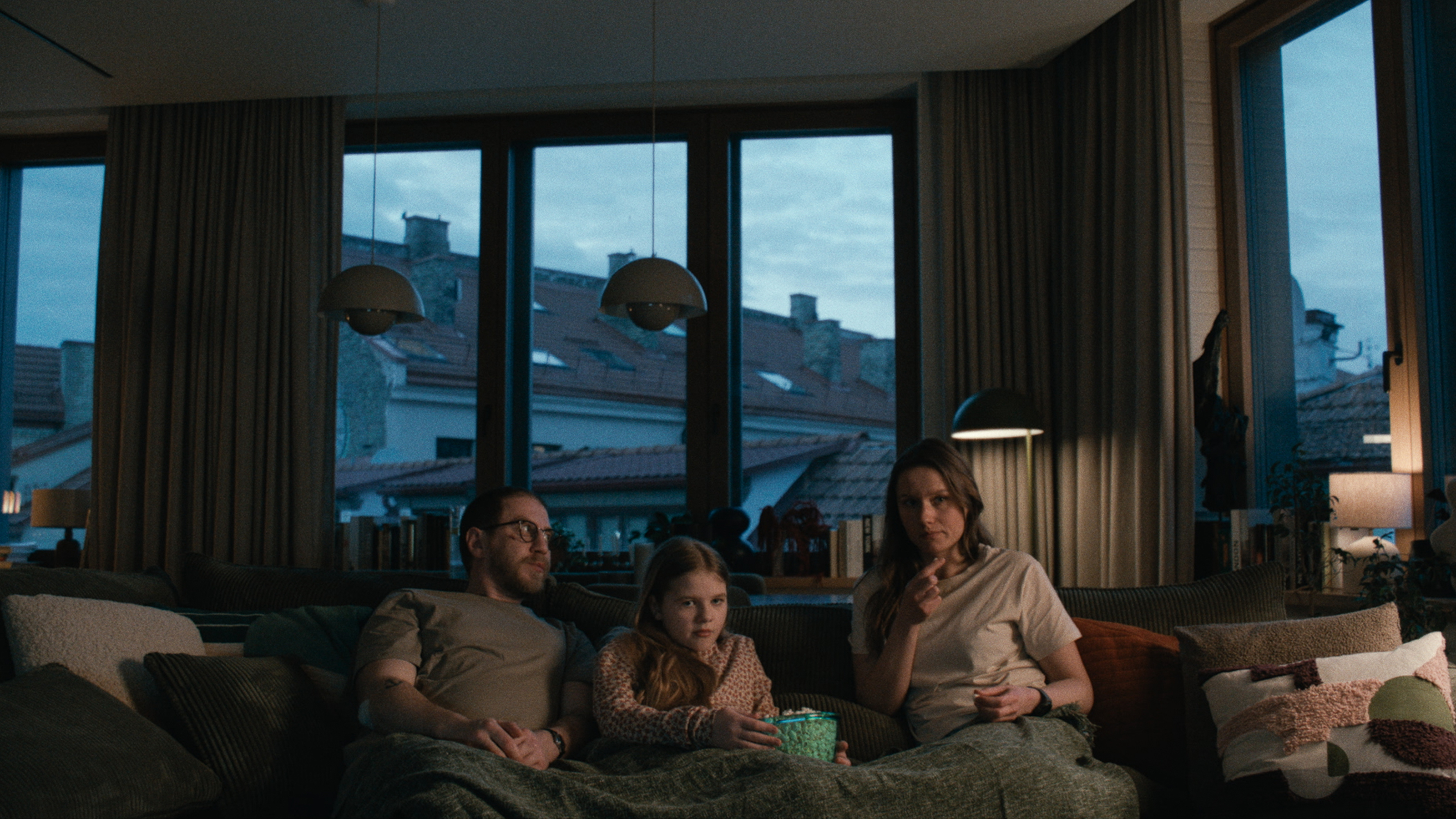
The title is pretty self-explanatory in terms of the plot. Marija (Žygimantė Elena Jakštaitė) is a successful media executive at a company that’s best described as the Eastern European equivalent of Buzzfeed, where she supervises the creation of shortform videos intended to draw millions of views. She’s married to Vytas (Marius Repšys), an arthouse filmmaker who’s hit something of a mental block while writing a screenplay, and who is content to have settled into the role of stay-at-home dad to the couple’s daughter, Dovile (Amelija Adomaityte). Marija is the breadwinner, while Vytas cooks, cleans, and shepherds Dovile to various activities.
It’s a neat little arrangement until Marija, having intimated to her coworkers that she’s unhappy, decides to pull the trigger and tell Vytas she wants to separate. As this major change in their lives goes down, Russia invades Ukraine, beginning an illegal and costly war that continues to this day. From there it’s a difficult balancing act as both Marija and Vytas try to navigate the divorce while also engaging in performative deeds of largesse and resistance to show support for their neighbors to the south (with Belarus separating them) and one-up each other as the “good guy” in this domestic dispute.
There are a lot of ways this premise could go, and thankfully, writer/director Andrius Blaževičius doesn’t opt for madcap comedy, though this could easily lend itself to pure farce. Instead, the film takes a somewhat measured approach that explores the consequences of everyone’s actions, many of them unforeseen, without succumbing to treacly melodrama.

This is accomplished through two major points in the film’s favor. The first is the camera work. There are a lot of very cleverly constructed scenes that grant the affair something of a voyeuristic charm, as we’re never shown anything more than what we absolutely need to in order to make the moment effective. This works on both sides of the dramatic spectrum. When Marija breaks the news to Vytas that she wants out of the marriage, the entire conversation plays out in a single take over the course of several minutes, with the camera pointed straight at them sitting in their car, only briefly moving for a pan to the left as Vytas momentarily gets out of the vehicle after losing his temper. The eventual break of the shot is just a smash cut to the exact same framing, only it’s dark outside, as the whole argument unfolded after dropping Dovile off at her music lessons, ending when she returns after she’s finished. On the flip side of things, part of Vytas’s rebellious streak in the wake of the invasion is to throw rocks through the windows of any car he sees with a Russian license plate. After getting away with it once, he later tests his luck again in the woods, only for the owners to magically materialize from behind some trees and beat the shit out of him in a comedic bout of instant karma. These scenes couldn’t be more different in terms of tone and plot relevance, but the cinematography fully commits to both of them.
The second, naturally, is the cast. There is so much childish behavior at play in this conflict, but again, the leads give it everything they’ve got to make sure it doesn’t come off as silliness. As secrets about them are revealed throughout the film (though pointedly never to each other), Marija and Vytas still have to come off as at least somewhat likeable and redeemable, otherwise the entire picture would be a maudlin slog akin to a Lifetime movie-of-the-week.
There’s also an odd sense of maturity and civility as things play out. Marija and Vytas aren’t together anymore, but they don’t hate each other, and they do their best to be proper co-parents to Dovile. So when one party does something positive, the other is willing to acknowledge that, and when good intentions pave the way to Hell, each former partner is there to offer support and understanding. The end result is an emphasis that these are good people, but far from great, and while they may each yearn for a shakeup in their lives, the bigger picture of world events shows them that the status quo might not be so bad. It’s one thing to make these gestures of goodwill, it’s quite another when you realize you can’t actually live up to your own ideals, especially when you’re just doing it to rub it in your ex’s face. The recognition of that flaw, and the willingness to course correct, are why the two leads are able to play so well off of one another.
Is this an instant contender for the Oscar? I’d say probably not. There are a few moments that drag on too long, points that are repeated unnecessarily, and honestly, while that scene in the car was expertly crafted, it is a bit cheesy and cliché for Marija to basically have no real reason for wanting the divorce, just the standard “I wish you were more exciting like when I met you” gripes that you’d see in a soap opera, far too banal for the callous urgency with which she springs this on Vytas. We do learn the true emotional core of her desire later on, thanks to her colleague Jurate (Indrė Patkauskaitė), which comes back to bite her in poetically just ways, but it doesn’t stop the actual case for divorce from seeming half-baked and lazily conveyed. Similarly, Vytas is painted as the “victim” of this arrangement for a good chunk of the movie, only to undercut that by revealing an affair with a prostitute (Yuliia Shynkarenko) that only really exists to set up another contrived bit of awkwardness down the line rather than fully explore his own ethical shortcomings. There are a lot of solid and believable human moments in this flick, so when we venture into the absurd, it feels a bit superfluous.
All told, though, this is a good opening for this year’s competition. I wouldn’t be the least bit angry to see this on the December shortlist, or even as a nominee come January. In the iconic final moments of Casablanca, Rick famously tells Ilsa that “the problems of three little people don’t amount to a hill of beans in this crazy world.” This film is that hill of beans within the context of a new battle for freedom nearly 85 years later. In a normal world, this sort of drama plays out every day. When millions are being displaced by a murderous dictator, a stable household might as well be paradise. How to Divorce in the War illustrates that distinction quite well.
Grade: B
Join the conversation in the comments below! What film should I review next? Have you seen any foreign entries yet this year? Who will get first dibs on my eyeballs next year? Let me know! And remember, you can follow me on Twitter (fuck “X”) as well as Bluesky, subscribe to my YouTube channel for even more content, and check out the entire BTRP Media Network at btrpmedia.com!


