
Spite can be a very powerful thing. We’re humans. We’re flawed. And when we get hurt, there is a natural impulse to take that pain out on others, especially those who harmed us in the first place. I’m certain that a lot of the initial hype around the release of Coyote vs. Acme was born from that exact sense of spite. As part of Warner Bros. CEO David Zaslav’s baffling obsession with killing potentially profitable projects for tax write-offs, the film was shelved, along with Batgirl and Scoob! Holiday Haunt, back in 2023. The main difference between this picture and the other two was that Coyote vs. Acme was already finished and in the can, and could easily have been released. Given the corporate ghoul’s flimsy defense that the others were of so poor quality as to not be viable, the implication was that this movie was also a pile of garbage, which in itself is rich because the studio still went ahead with Space Jam: A New Legacy.
Then a curious thing happened. Footage got leaked. Members of the cast and crew held “funeral” screenings amongst family and friends. Word of mouth grew that this was, in fact, not an immolated trash bin, and as people began to see bits and pieces of what was being denied to them, the public backlash intensified. It soon became clear that audiences were going to see this movie if it ever got released, if nothing else than as a giant middle finger to Zaslav and all the other Hollywood suits who’ve been conspiring openly for the last few years to consolidate ownership, drive out creatives in favor of AI, and shift entire productions overseas so they can profit to an obscene degree through cheap labor and pay little to no taxes, while thousands of dedicated workers watch their hopes and dreams disappear, and that’s before we get to the merger bullshit with Paramount that, if allowed to go forward, would essentially turn two legacy studios into right-wing propaganda factories.
So yeah, once the film was bought by Ketchup Entertainment (the same outfit that put out The Day the Earth Blew Up), those who protested the chicanery made good on their righteous rage and went to see it. The flick was expected to take in about $8-$10 million on its opening weekend, a modest goal given that the end of August is usually a dead period for cinemas (as the transition from Summer Blockbuster Season to Awards Season begins), and the fact that Brand New Day and The Odyssey were still going strong after several weeks. Instead, Coyote vs. Acme took in over $15 million, edging The Odyssey out for second place, and in the four days since, it’s gained another $10 million, putting it well on pace to make back its $70 million budget and then some.
I think we can safely say that spite worked. The people voted with their wallets, and the verdict is that Zaslav and everyone like him can go fuck themselves with a boulder and run straight into a mountainside with a painted on tunnel. But is the movie actually good? Well, if the 96% rating on Rotten Tomatoes or the headline of this review didn’t tip you off, then yes. Yes it is. In fact, it’s utterly brilliant. And this is not a sentiment colored by the natural inclination to inflate the grade as an extension of that well of anger. Taken purely on its own merits, this is a clever, hilarious, and surprisingly affecting romp, the best animation/live action hybrid film since Who Framed Roger Rabbit?, and easily one of the best movies of the year.
One of the key ways in which the film succeeds is that, like Roger Rabbit, the integration of animated characters with live humans is just taken as a given. It’s not a gimmick like in Space Jam and other movies of that ilk, which rely on some contrivance to bring the two groups together. Here, not only are cartoon characters just a part of society, they have their own carveouts and services that cater specifically to them while still being a full part of our world. This extends to the interactivity between humans and toons, where just like the 1988 classic, there are reference actors and puppeteers live on set, so that the main cast can actually look at, speak to, and touch their cel-shaded counterparts as if they’re really occupying the same space. In this particular case, with the silent Wile E. Coyote as the main lead, the rest of the ensemble can take their time in pacing out their blocking and reactions, with no need to wait for a scripted line they can’t hear before taking their next action.
Once that absurdity is firmly established as plausible within context, the story and characters are free to breathe and be as zany as they want to be. The film opens with a sinister hint of what’s to come, when an animated scientist version of Peter Lorre (a caricature that the WB trotted out quite often in its heyday) attempts to blow the whistle on some malfeasance at the Acme corporation, only to be caught and imprisoned in the most Looney Tunes way possible.
We fast forward 30 years to join the Coyote in his relentless and quixotic mission to catch and eat the Road Runner. Through a combination of archival footage and new gags that land every single time, we get to enjoy the abject silliness in new but familiar ways, as his schemes continually fail with painful slapstick consequences. This is some pristine writing, coming from a rather unlikely source in the form of screenwriter Samy Burch, who penned the Oscar-nominated script for May December a couple years back. Combine this with director Dave Green (Earth to Echo) expertly framing the scenes and pacing the edits, and you already know you’re in good hands when it comes to that oh so crucial element of comedy: timing. Because of that, the audience can instantly settle in and enjoy some gut-busting laughs and engage with the meat of the plot.
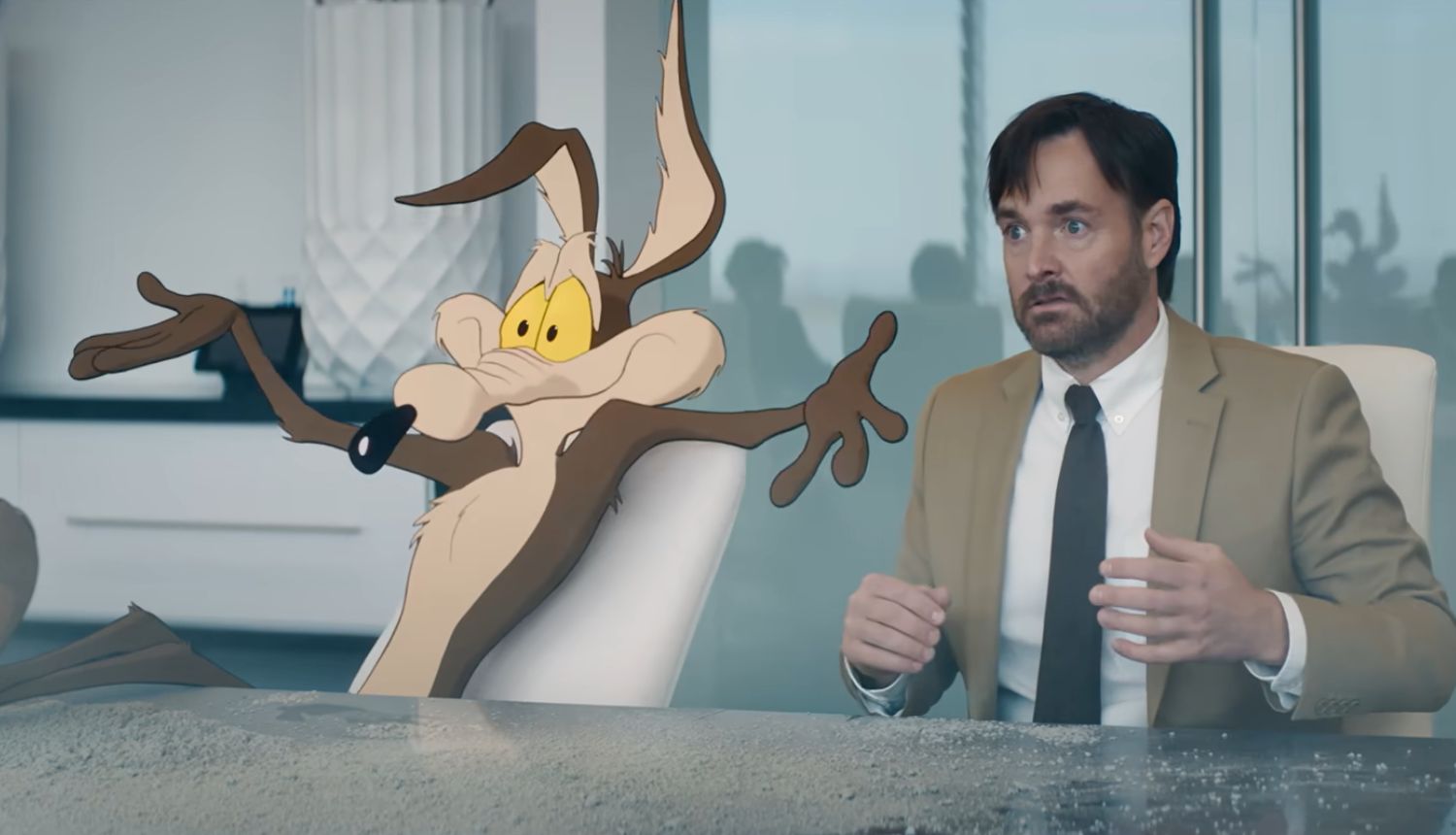
After a particularly fruitless pursuit of his beeping bird prey, Coyote sees a commercial for a local law firm that specializes in getting quick cash settlements for animated accidents. Taking an inventory of all his past defeats, he decides that Acme is to blame, and makes his way to Albuquerque (a natural choice for any Looney Tunes devotee). There he meets Kevin Avery (Will Forte) in another clever yet subtle nod to the franchise’s history, as the law firm of Avery, Jones, and Maltese is named for animators Tex Avery and Chuck Jones, as well as writer Michael Maltese, all of whom had a hand in creating the Coyote and Road Runner series. Seeing the defective rocket-powered roller skates that resulted in the Coyote’s most recent debacle, Kevin agrees to sue Acme for a small claim of a few hundred dollars, something he’s done dozens of times without resistance. However, the Coyote wants to aim higher, bringing along a slew of broken products with the intent of launching a huge suit that could garner national headlines. Kevin instantly refuses, as his firm is too small with too few resources to challenge a corporation as large as Acme, and he fears that rocking the boat even a little bit will ruin him. That doesn’t stop the Coyote from slyly cramming everything into a small box (I love cartoon physics!) and passing it along to Paige (Lana Condor, who as Ruby Gillman has some experience with taking shots at greedy studios), Kevin’s niece and intern, and she unwittingly files the massive grievance.
This draws the attention of Acme’s chief legal counsel, Buddy Crane, played by John Cena, who also happens to be Kevin’s rival from law school. Sensing an opportunity to crush his former classmate’s spirit once more, he assembles a large and intimidating team to stare Kevin and Coyote down as he offers a settlement far larger than Kevin has previously secured, but which would still be pocket change for Acme. Kevin is eager to sign, but Coyote tears it up, setting the stage for the titular courtroom showdown.
What makes all of this so compelling is that all the actors are fully committed to the bit. Cena and Forte are perfectly cast in their roles, not just because of the visual juxtaposition of their respective body types, but also because of the personas they project. Cena has always been imposing, while Forte has made his bones many a time thanks to his high-pitched voice that vacillates between timid and eager when the situation calls for it, while somehow not cracking. They know how to properly occupy the space, allowing for great physicality in their performances, to say nothing of their hysterical line deliveries. I absolutely love it when Cena gets to be funny, because despite his hulking figure, he really knows how to sell a punchline, as shown in films like Trainwreck and Blockers. And just as crucially, the supporting cast of Condor, Tone Bell, Martha Kelly, P.J. Byrne, and Luis Guzmán aren’t just the straight men to the antics of the two male leads. Each gets their own running gags and moments of euphoric nuttiness throughout this structural throwback to 90s legal dramas.
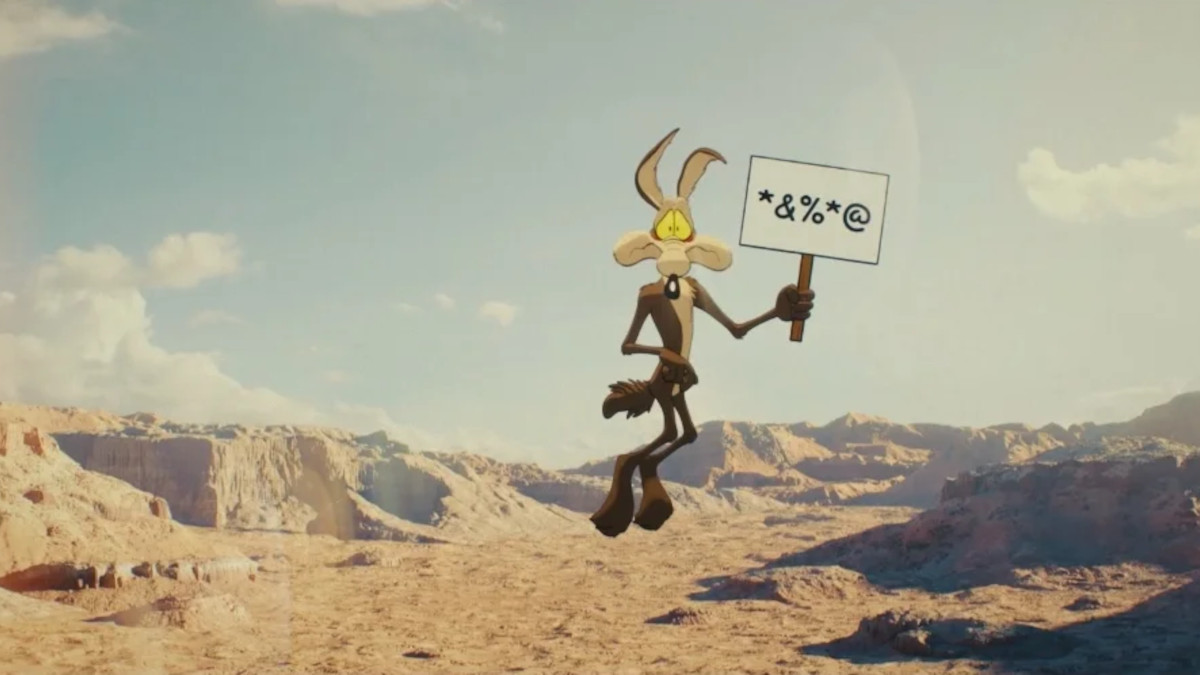
Then we have the Looney Tunes themselves. Voiced by Eric Bauza (all the males save one), Candi Milo (all the women), and Jim Cummings (the Tasmanian Devil), each of the beloved toons is used impeccably, be it in cameos or full-fledged roles. Bugs Bunny is an anonymous informant because he can physically stay underground. Daffy has been driven literally insane due to painful experiments. Tweety is forced to be an enforcer for Acme in order to keep Granny safe (his “tought I taw a puddy tat” exchange with Cena late on was so funny that I had to force myself to stifle my own laughter so that I didn’t miss any crucial plot details or catch a stitch in my side). Elmer Fudd is somehow a U.S. Senator (what state elected him, and how in God’s name did he get to be the chair of a committee), Miss Prissy serves as a juror, literally henpecking and brooding over Cena’s manly appearance. It’s pure gold, and the fact that they’re all topped by Foghorn Leghorn as the head of Acme is not only inspired, but a credit to the lasting legacy of all of these characters. Even our title lead acts wholly within his established parameters, including his outsized ego, ulterior motives, and his penchant for only communicating via comical signs. These aren’t just references and knowing nods to trigger nostalgia. These are fully realized ideas executed at the highest level, and the gags never once leave you rolling your eyes or checking the clock to see how much longer the film will last, because while the overall humor explores many different and new avenues, the wacky bits are still grounded in the established core of all these manic pop culture icons. All of this is aided by the stellar compositing of the animated characters (2D always works better than 3D in this equation) into the real-world environments, using practical effects, clever prop work, and expressive designs to make the cartoons’ presence in the scene feel natural. It’s a credit to the production that there are dozens of puppeteers and ink-and-paint animators featured in the credits before we get to the digital asset artists, because they’re the ones who make this come alive in the same way that Roger Rabbit did nearly 40 years ago.
The satire is, naturally, completely on point, so much so that it becomes quite obvious why Zaslav really tried to kill the picture for his own financial gain. The idea of “too big to fail” corporate America is on full display, with a heavy emphasis on skirting laws in favor of profit, accepting no responsibility for any collateral damage, and an overarching arrogance that the customer is just grist for the mill rather than the resource vital to the sustainability of the business model. One of the biggest problems of late-stage capitalism is that the paradigm has shifted in favor of oligarchy and monopolies, so that the consumer is more obligated to patronize entities that are actively exploiting them, rather than companies innovating and competing for our business. The little guy is meant to take the scraps on offer and behave, instead of being the catalyst for new ideas or accountability, driven home by the fact that Kevin’s biggest flaw is his lack of confidence because he’s always willing – and often eager – to “settle.” Once the power positions are firmly established, the game is then rigged to perpetuate the status quo, and Coyote’s continued comeuppance (the slapstick is just so delicious) serves as a pristine microcosm of this problem. Of course Zaslav would want to destroy anything that might suggest that what he’s doing is immoral or objectively wrong. Unlike Tim Burton’s toothless and performative parody of Disney in the god-awful Dumbo remake, this is the kind of critique that studio execs find genuinely threatening if the public is allowed to consider it.
All of this works to fantastic effect, but what really blindsides you is in the sneaky ways the film finds emotional resonance, particularly when it comes to the theme of our respective lots in life. There’s a surprising sense of reality in this picture, despite its utterly illogical framework. I mean, the whole premise of the series of cartoons requires us to conveniently forget that coyotes are actually faster than roadrunners. No, the real emotional resonance comes from the idea that none of us wants to be considered unimportant and left to fight our battles alone, a through line that’s been explored in other superlative works this year like Cookie Queens and Hoppers. In a classic episode of The Simpsons, Lisa puts it quite succinctly when Bart and the recently-fired Principal Skinner become unlikely friends: “Everybody needs a nemesis. Sherlock Holmes had his Dr. Moriarty. Mountain Dew has its Mello Yello. Even Maggie has that baby with one eyebrow.” Well, loathe though he might be to admit, Wile E. Coyote needs the Road Runner, and the way the film gets that across is one of the most shockingly profound moments I’ve seen in recent memory. The sold-out auditorium where I watched this audibly gasped when the shoe dropped. That’s not supposed to happen with a Looney Tunes property, but it did, and it made perfect sense, which might be the craziest thing of all.
Let this movie stand as notice that we can still find new ways to explore the familiar, that tried and true IPs can still have an impact beyond pure nostalgia, and that the movie-going public wants actual art and ideas in the cinema. The final line in the credits is a heartfelt thank-you from the producers to everyone who “posted, shared, held up signs,” and performed any number of acts of solidarity to get this film into theatres. Let’s make sure that this isn’t a one-off, and that the movement started by calling foul on studio shenanigans becomes a sustained effort. Demand more, stay vocal, and most of all, go see Coyote vs. Acme in an actual theatre and show the so-called money men that you mean business, in every sense of the word. If you do, we’ll only get more treasures like this film that was long overdue, and we’ll be watching movies for the love of the craft, not just to spite rapacious assholes.
Grade: A
Join the conversation in the comments below! What film should I review next? Who’s your favorite LT character? Do you ever think the ACME grocery stores got angry/nervous about the cartoon company? Let me know! And remember, you can follow me on Twitter (fuck “X”) as well as Bluesky, and subscribe to my YouTube channel for even more content, and check out the entire BTRP Media Network at btrpmedia.com!


