

Homer’s Odyssey is one of the most dense stories ever conceived, but also one of the most fascinating I’ve ever read. A giant tome broken up into lengthy tangents and songs, the epic poem meanders for hundreds of pages, but you never lose track of what really matters for the overarching narrative: the grand scale journey of Odysseus to get home from Troy, the minutiae of the treachery of the suitors trying to take over Ithaca, and the consequences of hubris, be they practical or divine. There have been many adaptations of the work over the years, both in film and television forms, but the best ones are those that maintain that trifold thematic underpinning. Just about everything else is not only open to interpretation, but open to manipulation, as embellished oral histories are what led to the creation of the adventure in written form.
As such, the story was perfect for Christopher Nolan to transform into the latest version of The Odyssey, one that captures the scope of the tale of the man of many trials, but is given a different sheen that is both over-the-top in a classic Hollywood style while also having its more subtle moments of modern relevance. It’s a film that assaults your senses, but makes the trip worth taking.
Much pearl-clutching was done online in the wake of the cast reveals, almost universally by puds on all sides of the culture war spectrum. On the one hand you had people whining, “Well why can’t all the actors be actually Greek and/or speak in British accents?” and on the other you had racists and bigots crying foul about Lupita Nyong’o playing Helen of Troy or Elliot Page being allowed to exist. To the former group, I say, get a life. To the latter, particularly the likes of Elon Musk, I beg of you, for the sake of humanity, die in the largest fire imaginable.
Because here’s the thing. Top to bottom, to a man (or woman), this cast is fantastic. I admit I had some concerns, particularly when it came to Matt Damon in the lead role as Odysseus. But in all honesty, save for a couple of hiccups here and there (usually in the smaller parts like Mia Goth as Melantho; she does fine but some of her line readings are a bit off), none of it really bothered me. Yeah it’s a tad odd for Telemachus (Tom Holland) to yell “Dad!” in one brief instance, but in a three-hour film, if you let that ruin your experience, I don’t know what to tell you.
Here’s a novel thought. Why not just pick the actors you think will give the best performances? This cast is massive, and everyone gives it their all, whether they’re a lead, a support role, a bit player, or one of the hundreds of background extras. Much will be made about some of the turns, including Damon, and Anne Hathaway as Penelope, but no one phones it in here. Hell, my MVP is John Leguizamo as Eumaeus, the half-blind but fiercely loyal pig keeper. He doesn’t need to command our attention, but he does anyway, and makes the most out of every moment without chewing the immaculately designed scenery. It’s like all the actors collectively decided, “Hey, this is an epic, so let’s MAKE IT EPIC!” and Nolan rightfully trusted them to do it. This is one of the many respects in which the film evokes classic Hollywood mega productions like Ben-Hur or Spartacus, but with a nuanced modern perspective.
If you’ve ever read the book, or seen any of the numerous renderings (I read it freshman year of high school, right before NBC turned it into a miniseries which I also watched), you know the basic story. Odysseus (Damon) is the king of the island of Ithaca, and is conscripted to fight in the Trojan War. After a 10-year stalemate, he conceives the Trojan Horse as a means to get inside and capture the walled city, thus ending the conflict. As he and his crew travel home, they are beset with multiple challenges and deadly encounters thanks to Odysseus’s prideful defiance of the gods. Meanwhile, his son Telemachus (Holland) has grown up without a father, watching his palace be besieged by dozens of suitors claiming Odysseus is dead and attempting to convince his wife Penelope (Hathaway) to marry them so they can take over the kingdom and kill Telemachus. They’re led by the villainous Antinous (Robert Pattinson just killing it yet again). The 20-year journey of Odysseus to reclaim his throne and his honor has been told over and over again for centuries.
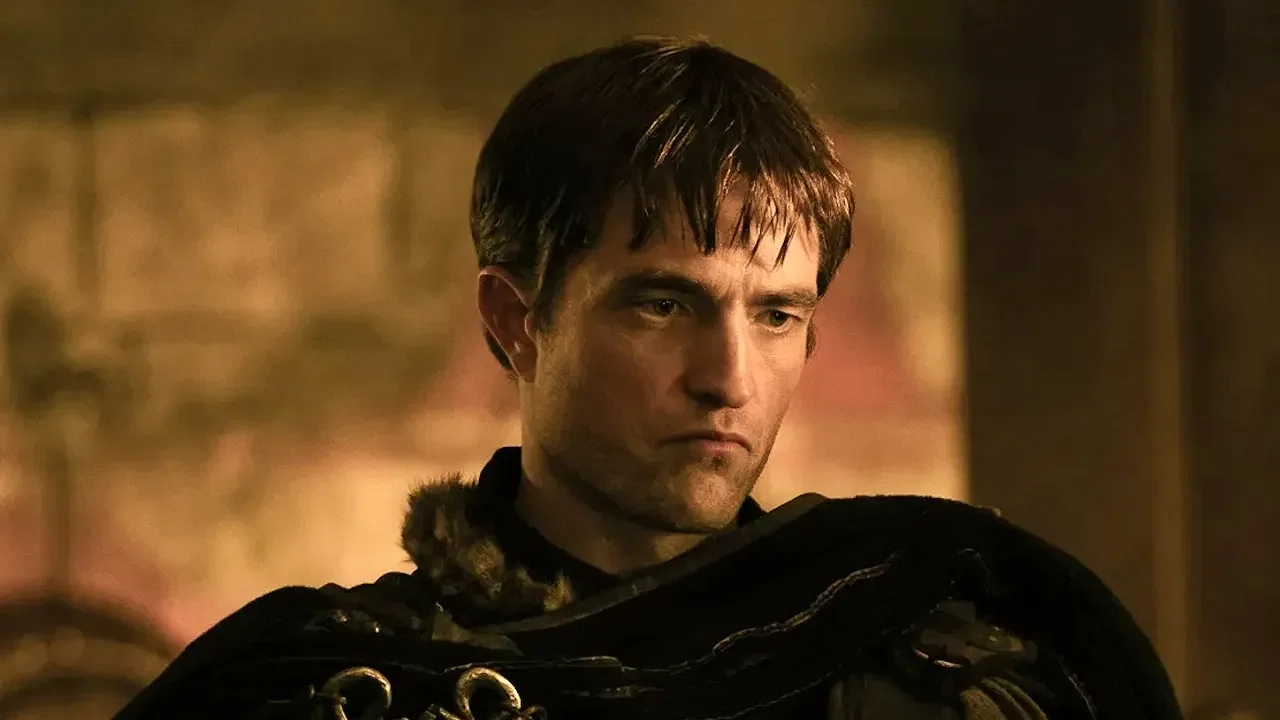
The key is in how the poem is performed and presented. This is where one of Nolan’s most notable cinematic tricks comes in, and it’s played to perfection. If you’re familiar with his work, you know he likes to fuck with time. Whether he’s telling a story in reverse order (Memento), criss-crossing timelines (Oppenheimer), dilating time it in space (Interstellar), setting separate timeframes on a collision course (Dunkirk), or literally sending characters simultaneously forwards and backwards in time (Tenet), the very notion of linearity appears to be his favorite toy.
Here, Nolan takes the most natural approach, and tells the story similarly to how it’s told in the poem itself, out of order, through recitation and memory. One of the opening scenes is a brief “song” of Odysseus from rapper Travis Scott (as the bard Demodocus) that relays an idealized version of the Trojan War. Eumaeus tells Telemachus stories of how Odysseus used his bow like a harp and adopted his hunting dog Argos. Odysseus himself slowly regains his memory after years shipwrecked on an island with the nymph Calypso (Charlize Theron). Telemachus sneaks his way to Sparta, where king Menelaus (Jon Bernthal) and wife Helen (Nyong’o) regale him with a hopeful history to suggest that Odysseus might still be alive. This is in keeping with the divergent nature of the epic, which begins in medias res and has several digressions and asides rather than giving the reader a straightforward narrative.
From there it’s just a matter of what parts are told, which are altered, and which are omitted for the sake of cohesion. This is also true to the poem’s origins, as it was compiled from years of lore and various interpretations. In ancient times, it was likely quite rare, if not impossible, to convey the entire plot in one sitting, and each performer probably added their own spin. So never mind the fact that you can’t tell the whole story in three hours anyway, artistic license is in itself key to the experience.
Now, I didn’t agree with all of the creative choices in Nolan’s screenplay. There were some scenes I would have loved to see on the big screen that didn’t make the cut, and this version is decidedly chaste compared to the original text (despite Odysseus’s drive to get home in the poem, he does take multiple side lovers in the forms of Calypso and the witch Circe, played to a terrifying hilt by Samantha Morton). But on the whole, I really enjoyed Nolan’s take on the source material, particularly two key decisions.
The first was to make this a decidedly human story. Being a Greek myth, there’s heavy involvement from the myriad Olympian deities in the epic, particularly Zeus, Poseidon, Hermes, and Athena. Here, however, the only one who appears is Athena, played by Zendaya, and rather than serving as a guide to Odysseus, she’s a reminder of what he has sacrificed. Apart from her, the gods are almost exclusively mentioned in reference and superstition. The cyclops Polyphemus calls out for Poseidon when he’s blinded. The crew is warned not to slaughter Apollo’s cattle when starving on a distant island. A child is sacrificed to Artemis. That’s about the extent of it.
In their place is an intimate exploration of human nature. In the poem, Odysseus’s hubris is on the surface, boasting about his accomplishments while refusing to acknowledge the divine intervention that helped him win the Trojan War, thus incurring their wrath, particularly from Poseidon. Here, while the gods are acknowledged, the king’s downfall centers more on a belief in his own skill and luck, an honorable desire to deliver his men safely home in defiance of prophecy, and an over-reliance on his own trusting nature, often approaching scenarios without considering the worst outcomes or the human cost. No better is this illustrated than in the form of Sinon (Page), a very minor character in antiquity, but who stands as a symbol for the casual nature with which the least among us are treated.
All of this extends into the second superb choice, one that makes the film borderline political. There’s a heavy emphasis on the so-called “Zeus’s Law,” or xenia. The basic idea is that every house is open and hospitable to strangers, and gifts are given and exchanged in the name of friendship. As part of his plot to take the throne of Ithaca, Antinous spreads lies about “men of the sea,” pirates and invaders who would seek to plunder an island kingdom without a king to defend it, and he treats any visitors – especially beggars – with the utmost disdain.
You can see where this is going. Quite literally, the moral of the story is to welcome the stranger with open arms. This is often bandied about in modern times as a Christian philosophy, and the religion certainly has adopted it as a core principle, but it far predates the Abrahamic faiths. The real enemy, as the film shows, is often from within, casting aspersions on outsiders while working to horde riches and destroy tranquility from the inside. I’m sure there will be some chode on Fox News in the near future who will notice this theme and accuse the movie of being “woke,” but as usual, they’ll be proven a hateful idiot.
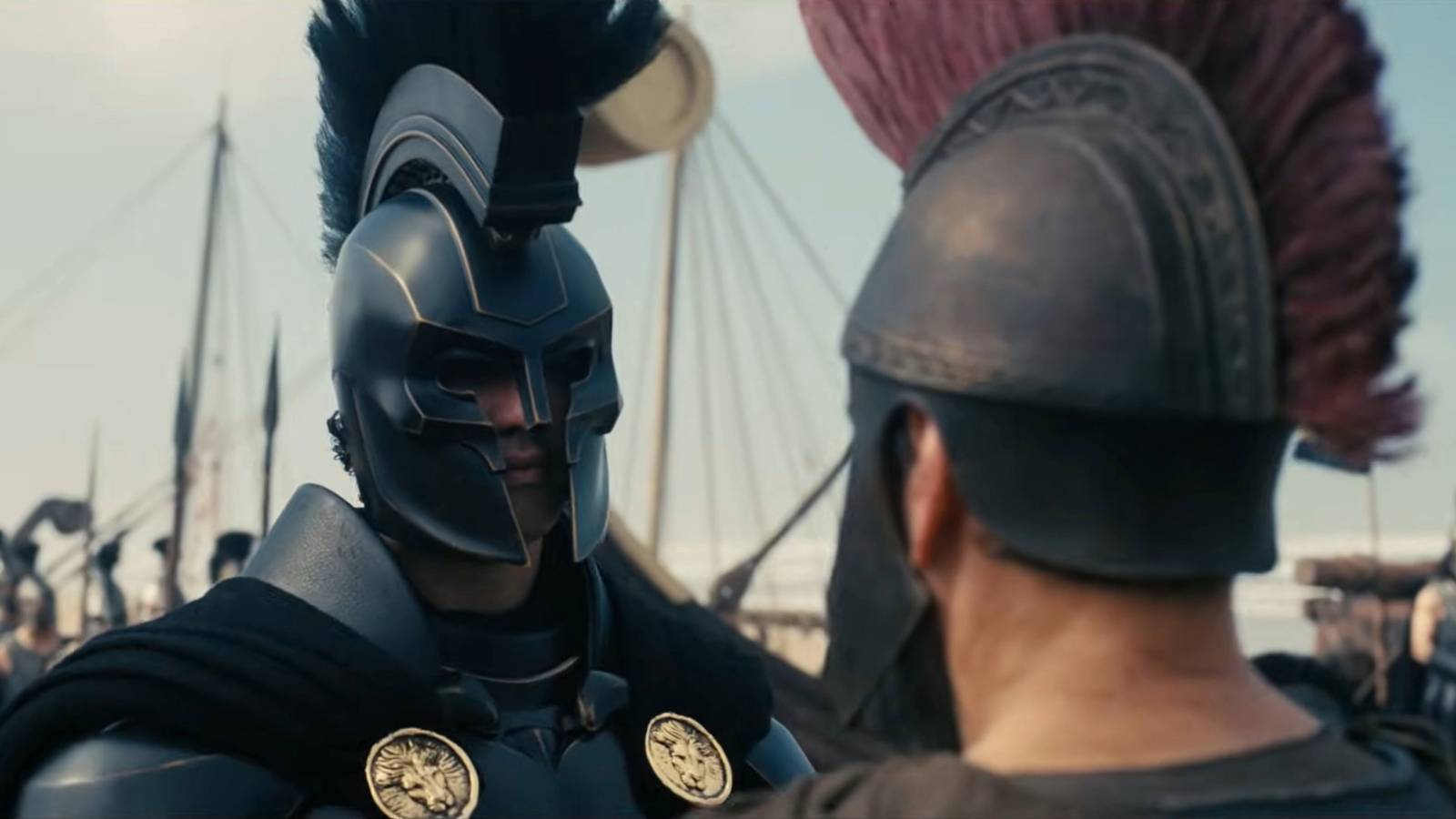
From a technical standpoint, the picture is stupendous. Cinematographer Hoyt van Hoytema shot the entire project with IMAX cameras, with minimal CGI added in post, so as not to sully the incredible vistas and massive sequences. Costume designer Ellen Mirojnick offers some incredible looks, particularly for Agamemnon (Benny Safdie), whose helmet features a train made out of a fucking spine (there’s been some pushback for a lack of historical accuracy, but this is a work of mythological fiction, so I see no need to die on this hill, especially when the wardrobe looks this cool). There are some incredibly disturbing makeup effects when it comes to Circe’s interactions with Odysseus’s crew. Ludwig Göransson turns in another nomination-worthy score, alternating between sweeping orchestral cues and electronic fusion themes that are intended to be off-putting.
My one and only complaint is with the sound design. To be clear, the overall audio profile is decent, but the sound effects and the mix come dangerously close to knocking the film out of the 2026 pantheon, mostly because it keeps trying to knock the viewer out of their chair. We experience it very early on, as the film opens with Sinon waiting by the Trojan Horse, and an incoming volley of arrows sounds like you’re being smacked upside the head with a steel beam.
Once it starts, it doesn’t really stop (save for one particular scene where things are intentionally muffled as demonstration of a crucial plot device). You are bombarded with sound. It’s oppressive, almost overwhelming at times. When a storm rages at sea, the roll of thunder and the crash of waves feels unceasing. Part of this is likely a creative decision, because Nolan wants an immersive experience, but there’s a limit, and we hit it several times. I’m sitting in the very back row of a standard theatre, and the sound is so overpowering that the seats vibrate and I feel literal tremors in my chest. I can’t imagine seeing this in the intended IMAX format, because it might genuinely have hurt me.
It detracts from the actual film as well, because the mix is often imbalanced. There are far too many instances where dialogue is completely drowned out by the SFX, and not for any good reason. It would make sense if the cacophony was bludgeoning Odysseus the same as it was the audience, so that the actual words being said are ultimately meaningless compared to the dizzying experience he might be facing. But sadly, that’s just not the case. There were moments where I feared I was missing an important plot detail simply because the editors decided to crank the clash of metal on metal well past 11 without justification. It was almost enough for me to dock the final grade.
Thankfully, just about everything else in The Odyssey is incredible. The visuals are stunning. The story is a faithful retelling where Nolan let his creativity shine. The entire cast does a tremendous job, especially Leguizamo and Pattinson. The thematic ideas that took priority were intriguing and very well executed. The overall film has all the bombast of a mid-20th Century studio spectacle while being surprisingly grounded and thoughtful for a 21st Century audience. It’s far too loud at points, but part of the appeal of Odysseus’s journey is his passionate screams into the proverbial void, and Christopher Nolan understood that in order to do the story justice, it had to signify something important with its sound and fury. He more than succeeded.
Grade: A
Join the conversation in the comments below! What film should I review next? What are your favorite parts of the epic story? Remember when the miniseries had Armand Asante in the lead role? Let me know! And remember, you can follow me on Twitter (fuck “X”) as well as Bluesky, subscribe to my YouTube channel for even more content, and check out the entire BTRP Media Network at btrpmedia.com!


One thought on “The Sound of Fury – The Odyssey”