
I’ve been maintaining this blog for over eight years now, and through it all, I’ve had several pervading mantras as I review various films. One of the biggest ones is the ethos that I’m far more forgiving towards an ambitious failure than I am a safe mediocrity. Basically, to put it in baseball terms, it’s far better to strike out while taking a big swing than to just watch the ball sail over the plate and do nothing.
The latest entry from Alejandro G. Iñárritu, Digger, stretches the bounds of that idea to the breaking point. After 10 months of intentionally vague and obfuscated marketing, the only thing we knew for certain was that this would be a major campaigner during Awards Season, and that star Tom Cruise would be getting into the makeup chair for the most aggressive prosthetic transformation he’s had since Tropic Thunder. By all accounts, this would be an attempt to finally achieve Oscar glory after basically abandoning prestige cinema after The Last Samurai (and after Top Gun: Maverick only won for Sound), and it would hopefully be Iñárritu’s return to form after the confounding misfire that was Bardo.
The problem is, once you’ve seen the film, you realize that this isn’t an ambitious swing for the fences. It’s a troll movie. Billing itself as satire despite clearly not understanding the basic concept, Digger is a movie that just beats you over the head with obvious messaging cloaked in a veneer of cleverness that it doesn’t earn, opting far more for style over substance. It’s not a total failure because there are redeeming production elements and the overall story isn’t as insulting or offensive as some other projects this year, but it is as in-your-face as possible, screaming its positions at breakneck speed. But instead of having something new to say, or really anything to say, it just repeats old points, clearly taking cues from other sources to do the thematic work, including some far superior entries in Iñárritu’s own catalog.
You know you’re in “strap yourself in” territory as soon as the film opens, with our lead, Digger Rockwell (Cruise), slowly waking up in his king-size bed inside his palatial mansion, turning off his alarm clock, declining calls from his sister Emma (Sandra Hüller failing quite often to affect an American accent), and lovingly greeting the female companion in bed with him… his 30-year-old cat. Attempting to feed her tuna with his pinky finger (and eating it himself when she refuses), you can already tell that Digger loves this feline more than anything else in this world, which isn’t creepy on its face – lots of people adore their pets more than people – but it’s abundantly clear that Digger has a complete disregard for everyone else, and it doesn’t help when you can see that “Maggie” is an animatronic prop, and it is the most disturbing fake cat seen in a movie since, well, you know.
For the next 15 minutes straight, we are beset by non-stop evidence that Digger is a rich asshole, the latest in a string of oligarchs both real and fictitious who profess to make the world better for their own profit, but who would only truly improve life on this planet if Madame Defarge introduced them to the guillotine. Servants flit in and out of the scene, he receives various notifications from his digital assistant, and he calls a veterinarian only to fire him when the doctor gives the cat a terminal prognosis. He goes on a lengthy diatribe about how his grandfather used a 10-cent shovel to dig until he struck oil (pointedly doing so while avoiding military service in World War I), leading to his family’s fortune, and wielding said shovel like a bat before dropping it on the floor for every underling to trip over. He gets an urgent call from one of his workers at an oil rig in Greenland (Danny Kirrane) who has been sending him warnings about methane gas leaks under the ice shelf that have caused dangerous cracks, warnings Digger has constantly ignored, and the tycoon berates the scientist, daring him to “shut down” the drilling, making it his fault if anyone is laid off as a result. Throughout all of this, Cruise as Digger never lets anyone finish a thought, continuously interrupting to spew nonsense in a Jerry Jones-style Texas shit-kicker accent, yelling nearly every single line at the top of his lungs (sadly almost every major character follows suit in this regard). Honestly, the most impressive parts of this introduction are a) how long it lasts (it would work as a five-minute sketch on Saturday Night Live, but beyond that it’s quite tiresome), and b) the fact that the makeup job makes him look like an actual man in his mid-60s. You know, one who hasn’t had all the brainwashed alien souls extracted from his body.
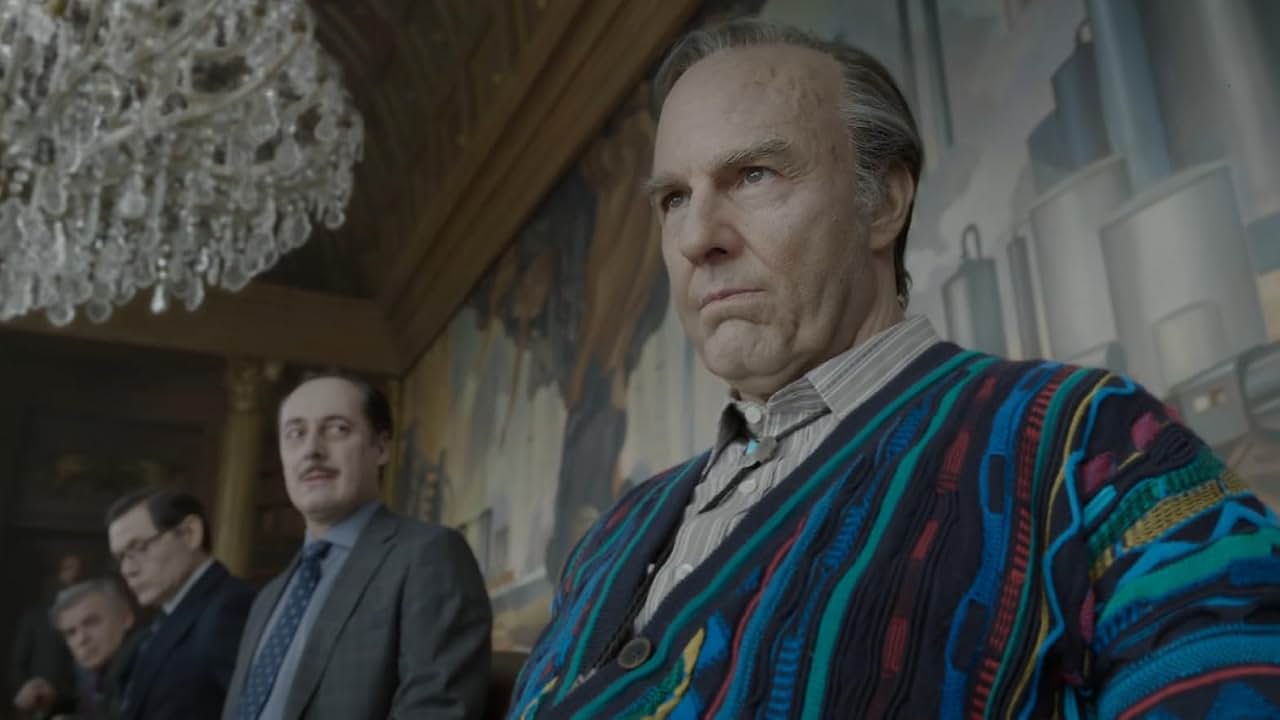
After this exercise in the swinging of his dick, Digger is met by three scientists, led by Dr. Ganesh (Riz Ahmed), to brief him on the situation at the rig. Initially dismissive because he’s already browbeaten the previous guy, he is shocked to learn that in the intervening two minutes, the methane has caused a major explosion, and the ice shelf has separated into an iceberg floating directly towards mainland Europe. Convening the President of the United States (John Goodman) and his entire cabinet at his house – because apparently billionaires can just do that – Digger sits back as Dr. Ganesh informs the group that the most likely scenario will be that the shelf will run aground near Scandinavia, causing catastrophic flood damage and loss of life, with only the slightest chance that wind and ocean currents will divert it south towards the more temperate areas of the Atlantic Ocean, where it would simply melt. The government’s response? Create a “media firewall” where they control the narrative and eliminate any words that might portend this disaster and simply pray for the miracle, which of course never comes. Meanwhile, President Compson intimates to Digger that he’s dying of colorectal cancer, because why not?
It’s at this point that the film takes a completely out of nowhere turn. I won’t go into too many details, because there is a legitimate surprise in it, and it recontextualizes the entire affair. It also happens to suck copious amounts of ass. When this hits, it becomes clear that Iñárritu and his team of five writers thought that they had the most brilliant idea for a twist, and no one was there to tell them that it was patently stupid. It’s what I like to call the Shyamalan Paradox. From there it’s just a back-and-forth between the main storyline and this side tangent, with each diluting the quality and credibility of the other in equal measure.
It amounts to what the movie insists is satire, but it completely misses the point, and often the definition of the word. Satire is meant to poke fun at society’s foibles, particularly by those at the top. It’s also supposed to be at something of a remove from the real world, in a way that the comedy seems plausible, but its own absurdity is designed to ensure it’s not taken seriously.

This falls flat because it utterly fails to understand that nuance, evidenced by the fact that every obvious bit of commentary is literally shouted at us. There is neither subtlety in premise nor presentation. It’s also far too close to the reality of our current world order. Yes, the consequences of unfettered capitalism and climate change are taken to extremes, but not in a way that feels fantastical. It’s merely a louder version of what we’re already seeing (spare a thought for the foley artists on this one, who were apparently ordered to exaggerate every possible noise and sound effect in post so that each creak of a chair or bite of food is excruciating to listen to). No better is this illustrated than in what is, ironically, the best technical scene in the picture, a speech Digger gives to the European Parliament, where he accepts full moral and ethical responsibility for everything that’s happened, but waves it off it as “the cost of doing business,” and protests that he’s actually a messianic figure in hopes of getting everyone to fight amongst themselves rather than even momentarily put up guardrails against his greed. People, Donald Trump literally gave a speech THIS WEEK where he presented the hypothetical nuclear bombing of Los Angeles and San Diego – and the millions of lives it would cost – as a “small price to pay” for him to win the illegal war he started with Iran. The timing is a coincidence, but the flaws in the thesis remain. This isn’t speaking truth to power. It’s just telling us what we can already see is happening.
This is when you truly realize that this flick has nothing of its own to say. As well done as that scene is – it’s a nearly 10-minute unbroken shot where Cruise chews the well-designed scenery like he’s on The Great British Bake Off – the argument is basically the same as another misplaced “satire,” Don’t Look Up. The cabinet meetings where Cruise, Goodman, and the rest puff out their chests to yell platitudes about American Exceptionalism are just pale imitations of the War Room scenes from Dr. Strangelove. Even the meta twist of the plot is basically just Birdman (Iñárritu’s former Best Picture winner) from a different angle.
It almost makes you wonder if all of this derivative nonsense is in itself part of a larger prank on the viewer. The intentionally nebulous marketing for the movie has since been reinforced as a backlash against criticism itself, as Iñárritu has taken the Megalopolis approach of inviting negative reviews simply so he can denounce them. Even the overall moral of the story, delivered by Jesse Plemons, is that everyone’s right, so long as the audience is entertained. Essentially, the solution to capitalism is more capitalism, just a form that’s more demand side than supply side, with a positive end result justifying all means to get there, rendering the underlying concept moot.
Aside from that, there are two big issues here. One, the movie isn’t all that entertaining. Cruise gives it his all, but in a lot places he’s far too manic, particularly in scenes where this supposed elderly man he’s playing is climbing up on set pieces like it’s Oprah’s couch all over again. Also, I’ll admit I laughed a few times at moments that were supposed to be funny. From a technical aspect, the film is quite sound, particularly the makeup on Cruise and the production design. If this is indeed an awards bait movie, the Academy will likely oblige it in those two areas at least. But apart from that, once the façade of the overarching conceit is taken away, what we’re left with is alternately boring and insulting to our intelligence, making one wonder how an audience is supposed to see this, and what audience this is even for. This is true in a contextual and meta sense.
The second is that this script, much like Triangle of Sadness, fundamentally misunderstands the purpose and meaning of satire itself. The whole point is to hold a surreal and often insane mirror up to the powers that be so that those being affected by their actions can see that the emperor indeed has no clothes. It’s intended to get a laugh, but it’s also meant to be a comfort and a call to arms. Because of this, by definition, you cannot punch down. By saying that it’s all okay if the audience likes it is patronizing to an unacceptable degree, and it minimalizes the suffering of the larger society you’re playing to by treating their pain as comedic fodder and excusing it by saying someone might find temporary catharsis in it. While I referenced The Simpsons in the headline of this review – itself one of the great American satires – it’s another property, Family Guy, that spotlighted this idea quite well. In the 2008 episode, “Back to the Woods,” James Woods steals Peter’s identity in order to ruin his life and exact revenge for a humiliation in a previous episode. Peter then turns the table by pretending to be Woods, appearing on late night TV to promote his new comedy, September 11, 200-Fun. When it’s pointed out how offensive that would be to most people, Peter doubles down and says that David Spade would be in the movie, which Woods finds to be an even larger threat to his career, not to mention a personal slight.
THAT is satire. The joke is that only an awful person would make such a horrible movie AND think it’s a good idea, that a person as narcissistic as this farcical version of Woods would be disgusted for all the wrong reasons, and that a normal, civilized, empathetic society would be rightfully appalled by it. Here, the idea is that if we just poke fun at those who callously toy with our survival, those who do survive will not only be okay with it, but actively buy into it, which misses the point so thoroughly that it might as well be called Pearl Harbor. More importantly, it’s a slap in the face to our collective intellect to create a situation where all parties, even those diametrically opposed to one another, can still be considered “correct.” I’m sorry, but no, that’s now how words work. This isn’t a reverse of Buffalo Springfield singing “Nobody’s right if everybody’s wrong.” If everybody’s right, then no one is right, because there is no “right.” Right comes from an acknowledgement of objective fact, not subjective posturing. This film, sadly, doesn’t know the difference.
All of this combined gives off the impression that the real suckers and losers are the ones who got duped into forking over their money to see this in the first place (though thankfully that doesn’t appear to be that many, as the picture hasn’t even made back 20% of its budget as it enters its second weekend). It’s why my default setting has been stress tested so much. You can tell that Iñárritu really thinks he’s onto something, so I can’t really be angry with a film like Digger. It’s just that he simply isn’t onto anything. Again, there are functional – and even a few genuinely interesting – elements to the overall affair, and it does fully commit to what it’s doing. It’s just not doing anything we haven’t already seen, and seen done far better over the years. It pretends to be ambitious and bombastic, but in the end it’s just a bunch of people trying to talk over one another without anything meaningful to say, with our leading man only really separating himself by doing it in a rubber mask and a fat suit. So many ideas were ingested and spit back out in a strange amalgam of references and ripoffs to show us an absurd vision of a dystopian future. When it’s all said and done, though, the only real red flag is the almost AI-generated vision the film executes.
Grade: D
Join the conversation in the comments below! What film should I review next? Will Tom Cruise ever get another Oscar nomination? Is satire a dying art, given all the real-world craziness we face? Let me know! And remember, you can follow me on Twitter (fuck “X”) as well as Bluesky, and subscribe to my YouTube channel for even more content, and check out the entire BTRP Media Network at btrpmedia.com!


