
One of my favorite moments of the 1993 film Jurassic Park is actually one of the quieter scenes. In the midst of the chaos, while Dr. Grant and the kids are trying to make their way to safety, and Mr. Arnold is meeting his end trying to restore power to the park, there’s a very poignant exchange between Laura Dern’s Ellie Sattler and Richard Attenborough’s John Hammond. Over melted ice cream, Hammond laments the failure of his ambitious design, relating an anecdote about being a child and convincing himself that he could see actual fleas operating a toy flea circus. Sattler scolds him about his almost Ahab-esque desire for control, telling him that the idea that he could have any control over nature at all is the biggest illusion of all.
That scene played in my head on repeat as I watched You Can See Everything, the incredible new documentary from Nathan Fielder (Nathan For You) and Lance Oppenheim (Primetime). A truly unique form of active, almost gonzo, filmmaking that inserts the creator into the process to the point where the Observer Effect is obliterated (sort of like a less overt and confrontational Michael Moore), Fielder and Oppenheim – along with a stunning bit of aid from a Hollywood A-lister (seriously, is there a way to get a Supporting Actress nomination in a documentary?) – immaculately piece together and then shatter one of the grandest illusions of our tech-centric modern societal paradigm. Some things are left to interpretation, but one thing is made perfectly clear. Someone is being manipulated, it’s just a question of who, and to what extent.
We begin in a rented beach house in southern California, 34 days out from Elizabeth Holmes reporting to prison to begin an 11-year sentence for fraud and malfeasance after the collapse of her company, Theranos. If the name is familiar to you, it’s because her case has been widely hashed out in the public sphere, particularly through various news cycles and a drama series called The Dropout. There was also a previous documentary about her, directed by Alex Gibney, who oddly enough debuted his new film about Elon Musk the same weekend this came out.
If you’re blissfully unaware, here’s the CliffsNotes version of events. In her youth, Holmes dropped out of college and began development and marketing for Theranos, a company that was meant to disrupt and revolutionize medical screenings by inventing a machine that could test for every known malady from a single drop of blood. Her quirky personality and affinity for black turtlenecks (a nod to her idol Steve Jobs) were enough to garner national media attention, and before long she was declared the country’s youngest self-made billionaire. The problem is, like John Hammond’s prehistoric flea circus, the tech didn’t actually work, and through multiple investigations into corporate chicanery, she was eventually arrested and convicted of fraud on a massive scale, along with her then-boyfriend and co-leader of the company, Ramesh “Sunny” Balwani. She has always maintained her innocence, but very few believe it. Most see her as a doe-eyed con artist, and one of the few rapacious tech executives to actually see consequences for the harm they’ve done.
As we start this film, we see Holmes and her new partner, Billy Evans, preparing for her incarceration while raising two young children. The first thing we can easily see is that Liz is trying to rehabilitate her image, while Billy attempts to steer the conversations and topics of discussion. At times it looks like he’s being overprotective, at others it looks like he’s trying to insert himself into the project as if he’s one of the producers. Either way, while he’s tolerant of having Nathan Fielder and the crew in the house, he’s not exactly comfortable with them, and with not getting to control the narrative.
Fielder, for his part, vacillates between being an active participant and an omniscient voyeur, particularly when it comes to Billy, who likes to make displays of alpha dominance. Part of Fielder’s insecurity comes from the fact that he was even allowed this level of access to the couple in the first place, given his main work as a comedian and satirist. Hell, the appeal of Nathan For You was that his “advice” to struggling businesses was always surrealist and tongue-in-cheek. The idea that these people are willing to open up to him, knowing how he’s made his bones in entertainment, is odd to say the least, if not outright suspect, and Fielder carries that cautious skepticism the entire way through, even as he gets closer to Holmes.
What he’s able to uncover over the ensuing five weeks is nothing short of amazing, particularly when it comes to Liz not being able to understand how her actions were wrong, and in how Billy – who already comes from money – attempts to leverage the situation for profit. It’s equal parts mysterious, humorous, and haunting – aided spectacularly by Ari Balouzian’s score – but no matter what, you can’t look away.
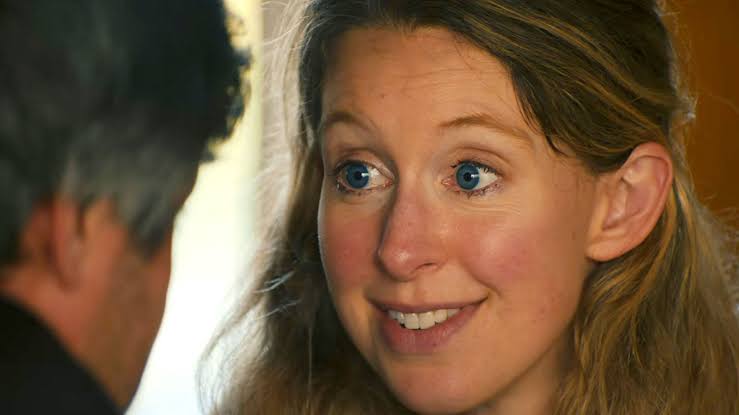
This comes to a head in two key sequences. One is right before Liz goes to prison, where she has an intimate conversation with Nathan, assuring him that she has nothing to gain by being dishonest with him. This is the scene highlighted in the film’s teasers and previews, where it looks like Holmes hasn’t blinked in years, her face contorted into this twisted approximation of serenity. The second comes a few days prior, where, after a conversation about her public statements about the Theranos machinery and business model, Nathan confronts her and Billy with one of the most ingenious methods to illustrate the disconnect between Liz’s ambitions and the practical reality of her actions. He shows them Abbott and Costello’s classic “Who’s On First?” routine, demonstrating the circular logic of their talking points and how easy it is to misinterpret an unclear message. This failure to properly communicate was, for the sake of this argument, one of many mistakes that led to Liz’s downfall, and there’s a perhaps quixotic hope in Fielder’s eyes that she can internalize the lesson and do better in future.
Here’s the thing, though. All this brilliance is just the first half of this nearly three-hour dive, and once Holmes goes inside, it only gets stranger and more dangerous. To go into further detail would be to rob the viewer of the experience of the genuine shocks along the way, but suffice to say, it’s almost impossible to tear yourself away from the screen, and the more we see how intricate and potentially malicious the truth may be, the harder it is to imagine that any good can come of it. This is especially true when Amanda Seyfried, who played Holmes in The Dropout, enters the picture.
On the one hand, you can see Elizabeth Holmes as a sort of Frankenstein’s Monster of the Silicon Valley culture of avarice and elitism. A forgiving interpretation of her crimes would be that she was a product of the system that is set up to exploit people, and she was an unintended casualty who fell while other opportunists rose by doing much worse. On the other hand, this could all just be one more performance, one more deception. It’s impossible to tell. I think we can safely say that she’s a tragic figure. Not guiltless, mind you, but tragic. It’s very easy to see her as a well-meaning Othello corrupted by her Iago in the form of Billy, who may love his family but acts in ways that many of us would find deplorable (and those who don’t are just as bad, if not worse). In a way, the disquieting dynamic all three (and eventually four) of our principals share mirrors the fatal flaw of Theranos itself, in that Holmes allegedly designed the device to be a one-stop shop to simplify medical care, but the truth and reality are far too complex to be so neatly contained.
Back in 1994, one of the most important documentaries of all time, Hoop Dreams, debuted to massive critical acclaim, with many prominent voices – including Roger Ebert – ranking it as the best film of the year, and decrying the Academy when it wasn’t even nominated for the Documentary Feature Oscar. Here may be another case study in how non-fiction filmmaking can transcend the traditions of Awards Season voting. This movie has already grossed over $60 million, and there’s talk that it could be the first documentary ever to be seriously considered for Best Picture. It took me a while to finally take it in (we’re in its third weekend as of this writing), but put me firmly in that camp. I had no idea what to expect when I watched You Can See Everything, but I would have never imagined what I witnessed, and the finesse with which Fielder and Oppenheim delivered this story is nothing short of miraculous. Like so many great works, this is one that could stand alone as a one-off achievement, or it could help rewrite the rules for how we think about documentary filmmaking as a whole. Whatever its eventual legacy, in the here and now, this is a much-needed look at our own societal sickness, and however you come to judge Holmes, Evans, or Fielder, this movie shows that something, anything, needs to change.
Grade: A
Join the conversation in the comments below! What film should I review next? What documentaries have had the biggest impact on your lives? Will Elizabeth’s unblinking eyes devour my soul? Let me know! And remember, you can follow me on Twitter (fuck “X”) as well as Bluesky, and subscribe to my YouTube channel for even more content, and check out the entire BTRP Media Network at btrpmedia.com!


